
Overview

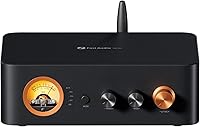
The Fosi Audio MC351 is a compact 2.1 channel integrated amplifier that bundles a DAC, Bluetooth receiver, and stereo power amp into one tidy, desk-friendly box. It sits in a crowded mid-range bracket alongside units from Topping and SMSL, but it carves out its own identity with a retro aluminum chassis and an analog VU meter whose needle bobs visibly with the music. Launched in early 2024, it has gathered around 118 ratings averaging 4.2 stars — a respectable start, though still a relatively small sample to draw firm conclusions from.

Features & Benefits

At the heart of this integrated amp sit two Texas Instruments TPA3255 Class-D chips, capable of pushing serious headroom through a pair of 4-ohm speakers alongside a dedicated subwoofer channel. Five input sources — Bluetooth 5.3, RCA, USB, Optical, and Coaxial — are all accessible via one-touch switching, which keeps daily use straightforward. Bass and treble knobs include center detents so you can snap back to a flat, uncolored signal whenever you want. The all-aluminum CNC chassis feels noticeably solid for the price tier, with no visible screws and a clean sandblasted finish. An auto-standby function kicks in after two minutes of silence, which is a small but welcome touch.

Best For

This Fosi Audio receiver makes the most sense for someone building a first serious home stereo or upgrading from a entry-level shelf system. Turntable owners will appreciate the retro aesthetic — the VU meter alone makes it a natural visual match for vinyl setups. It also suits anyone who streams music via Bluetooth daily but still wants reliable wired digital inputs from a TV or computer. The 2.1 output configuration is a genuine advantage for beginners who want to add a subwoofer without buying a separate crossover or receiver. If aesthetics matter as much as specs to you, that's exactly the kind of buyer this amp was designed for.

User Feedback

Buyers tend to highlight build quality and sound clarity as the strongest positives, with several noting the unit punches above its weight on well-matched bookshelf speakers. The VU meter draws consistent praise for adding character without feeling gimmicky. On the critical side, some users have flagged that Bluetooth range can be inconsistent in larger rooms, and a handful found the subwoofer output level harder to balance than expected. A few reviewers also wished the manual were clearer about the 2.1 wiring process. With roughly 118 reviews at the time of writing, the 4.2-star average looks genuine but should be revisited as the review pool grows over the coming months.

Pros

  • All-in-one design eliminates the need for a separate DAC, Bluetooth receiver, or preamp.
  • The aluminum CNC chassis feels and looks substantially more premium than the price implies.
  • Five input sources with one-touch switching cover virtually every common audio source in one box.
  • Built-in 2.1 subwoofer output lets beginners add a powered sub without extra hardware or crossovers.
  • Tone controls with center detents make it easy to return to a flat, uncolored signal by feel.
  • The analog VU meter adds genuine visual character without feeling like a cheap gimmick.
  • Auto-standby kicks in reliably and keeps idle power draw low without any manual effort.
  • Sound clarity at everyday listening volumes earns consistent praise, especially with bookshelf speakers.
  • The MC351 offers meaningful headroom for typical 4 to 8-ohm speakers in small and medium rooms.

Cons

  • Bluetooth range drops noticeably through walls, limiting its usefulness beyond one room.
  • The fixed subwoofer crossover point cannot be adjusted, frustrating users with specific sub configurations.
  • Setup documentation for the 2.1 wiring is thin and leaves many first-time buyers guessing.
  • No physical power switch means you need a wall outlet or smart plug to cut power fully.
  • The VU meter illumination is always on and cannot be dimmed, which bothers some users at night.
  • RCA input sensitivity is on the lower side, potentially requiring a preamp for weak sources.
  • Volume knob has reported lateral play in some units, inconsistent with the otherwise solid build.
  • Running 8-ohm speakers reduces real-world output noticeably compared to the rated 4-ohm figures.
  • Review volume is still relatively modest, so long-term reliability data remains limited.

Ratings

Our scores for the Fosi Audio MC351 are generated by AI after systematically analyzing verified buyer reviews from multiple global markets, with spam, incentivized, and bot-flagged submissions actively filtered out. The result is a transparent snapshot of where this integrated amp genuinely impresses and where real-world ownership reveals friction. Both strengths and recurring pain points are reflected honestly in every category below.

Sound Quality
83%
Most buyers describe the output as clean and well-defined at moderate listening volumes, with good separation between instruments on bookshelf speakers. The dual TPA3255 chips handle dynamic passages without audible strain, and the noise floor is low enough that hiss is rarely an issue even at higher gain settings.
At the absolute top end of its power envelope, some users notice a slight hardness in the high frequencies. Listeners coming from analog class-A or class-AB amps may find the Class-D character a touch clinical on certain recordings.
Build Quality
91%
The all-aluminum CNC chassis is one of the most consistently praised aspects across reviews — buyers frequently note it feels more expensive than the price suggests. The sandblasted finish resists fingerprints well, and the absence of visible screws gives it a genuinely polished, one-piece appearance.
A small number of users reported that the volume knob has slight play when pressed laterally, which feels inconsistent with the otherwise solid construction. The rear port labeling is also quite small and can be hard to read in low-light setups.
VU Meter
88%
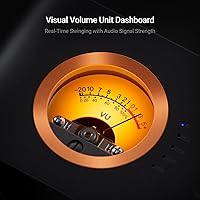
The analog needle meter is a genuine point of delight for buyers who place it on a desk or turntable shelf — it responds fluidly to musical dynamics rather than just sitting pegged at one position. Several reviewers specifically mentioned it as the reason they chose this amp over a visually plain competitor.
The meter illumination is fixed and cannot be dimmed, which a handful of users found distracting in darkened listening rooms at night. It also does not reflect subwoofer output independently, so it only tells part of the full signal story in a 2.1 setup.
Connectivity & Inputs
86%
Having five discrete input sources — including both optical and coaxial digital alongside USB — makes this receiver genuinely versatile for mixed-source setups like a TV, turntable, and PC sharing the same amp. One-touch input switching is fast and reliable according to the majority of buyers.
A few users wished for an HDMI ARC input to simplify TV integration further. The RCA input sensitivity is also on the lower side, meaning sources with weak output levels may not drive the amp to satisfying volumes without a preamp stage in between.
Bluetooth Performance
71%
29%
Bluetooth 5.3 pairs quickly and holds a stable connection at typical desktop or small-room distances. Streaming quality from a phone or tablet positioned within about 20 to 25 feet is consistently described as solid, with no stuttering under normal conditions.
Range drops noticeably through walls or when the source device is more than one room away, which limits its usefulness as a whole-home wireless receiver. A handful of buyers also reported occasional reconnection hiccups after the unit exits standby mode.
2.1 Subwoofer Integration
74%
26%
The dedicated subwoofer output with its own level control is a practical feature that lets buyers add a powered sub without any external crossover hardware. For beginners building a first 2.1 system, having everything routed through a single box simplifies the setup considerably.
The sub-out crossover point is fixed and cannot be adjusted, which frustrated users with subs that have their own low-pass filters already built in. Several reviewers also noted the manual offers minimal guidance on balancing the sub level relative to the main speakers.
Power Output
79%
21%
For bookshelf speakers in small to medium-sized rooms, the headroom on tap is more than sufficient — buyers report the amp never feels like it is working hard at conversational listening volumes. The separate subwoofer channel adds meaningful bass extension without taxing the main amplifier stage.
Rated figures assume 4-ohm loads, so buyers running 8-ohm speakers will see noticeably lower real-world output. A few users with larger floor-standing speakers felt the amp ran out of authority at higher volumes in rooms bigger than about 200 square feet.
Tone Controls
82%
18%
The bass and treble knobs with center detents are more useful than they might seem — the detent makes it easy to return to a flat response by feel alone, without looking at the unit. Buyers who listen to a mix of music and podcasts appreciated being able to quickly add warmth or cut muddiness.
The control range is fairly broad, which means even small rotations off center produce noticeable changes — fine-tuning is harder than expected. There are no midrange controls, so users dealing with specific frequency problems in their room have limited adjustment options.
DAC Performance
77%
23%
For USB and optical sources, the onboard DAC handles standard high-resolution files without distortion, and buyers using it as a desktop amp with a PC report clean, quiet playback. It removes the need for a separate DAC unit in most casual listening scenarios.
Dedicated standalone DAC units at a similar price point will outperform it in fine detail retrieval. Users who are particularly sensitive to digital presentation may notice the onboard DAC sounds slightly flat compared to more resolving external options.
Setup & Ease of Use
73%
27%
For a 2.0 stereo setup, getting started is straightforward — plug in speakers, connect a source, and it works. The input switching button and tone knobs are logically placed, and the auto-standby removes any need to remember to power it down manually.
The 2.1 wiring configuration trips up a meaningful number of buyers who are new to subwoofer integration, largely because the included documentation is thin. Online resources help, but the out-of-box experience for beginners setting up a full 2.1 system could be considerably better.
Value for Money
84%
Bundling a DAC, Bluetooth receiver, and a generously powered stereo amp with 2.1 capability into one unit at this price is a strong proposition. Buyers upgrading from a basic Bluetooth speaker or entry-level receiver consistently describe it as a meaningful step up in both performance and build.
The value calculation changes if you already own a quality DAC or a dedicated Bluetooth receiver, since those built-in features then represent money spent on redundancy. Competitors from Topping and SMSL offer similar chip specs, sometimes with more tuning flexibility at comparable prices.
Standby & Power Efficiency
81%
19%
The two-minute auto-standby feature works reliably and draws very little power at idle, which buyers who leave their system on continuously found genuinely useful. Wake-up from standby is fast enough that it does not interrupt a listening session noticeably.
There is no physical power switch on the unit itself, so if you want to cut power entirely you need to switch off at the wall or use a smart plug. Some users also noted the standby timeout cannot be adjusted, which caused it to kick in during quiet passages of music.
Aesthetics & Design
89%
The retro-industrial look — matte aluminum body, round VU meter, minimal control layout — is one of the most visually distinctive options in this price bracket. It photographs well and consistently draws positive comments from buyers who display it prominently on a desk or shelf.
The design is polarizing for buyers who prefer a modern, minimalist black box aesthetic. The retro style also means the unit is slightly larger than purely functional competitors, which can be a constraint on crowded desks or compact shelving setups.
Thermal Management
78%
22%
The large 100-fin heatsink keeps operating temperatures in a comfortable range during extended sessions, and buyers report the unit never becomes uncomfortably hot to the touch even after hours of continuous use at moderate volumes.
At higher sustained output levels, the heatsink becomes noticeably warm, and the unit needs clear airspace above and on both sides to dissipate heat properly. Placing it inside an enclosed cabinet or stacking other components on top of it is not advisable.

Suitable for:

The Fosi Audio MC351 is a strong fit for anyone building or upgrading a small to medium home stereo system who wants everything — DAC, Bluetooth, and amplification — handled by a single box without needing a rack of separate components. Turntable enthusiasts will find it a natural match both sonically and aesthetically, since the retro aluminum body and VU meter look right at home next to a record player. It also works well for desktop listeners who stream music from a phone or laptop throughout the day but still want the option to run a wired digital source like a TV or gaming console through the same amp. Buyers who are newer to passive speaker setups and want to add a subwoofer without buying extra hardware will appreciate that the 2.1 output is built right in. If you care about how your audio gear looks on a shelf as much as how it performs, this integrated amp occupies a rare niche where the industrial design actually justifies the attention.

Not suitable for:

The MC351 is not the right call if your listening room is large, your speakers are power-hungry, or you expect the amp to fill a space much bigger than a standard living room or bedroom comfortably. Buyers who already own a quality standalone DAC or a dedicated Bluetooth streamer will be paying for redundant features they will never use. If you need precise subwoofer crossover control — for example, if your sub lacks its own low-pass filter — the fixed crossover point on the sub output will frustrate you. Audiophiles accustomed to class-A or class-AB amplification may find the Class-D character a bit lean or analytical on revealing speaker systems. This Fosi Audio receiver also lacks a physical power switch and HDMI ARC input, which rules it out for buyers who want simplified TV integration or want to cut standby power entirely without reaching for the wall socket.

Specifications

  • Channels: The amplifier operates in a 2.1 channel configuration, supporting two full-range speaker outputs plus a dedicated subwoofer channel simultaneously.
  • Amplifier Chips: Two Texas Instruments TPA3255 Class-D chips are used, one per stereo channel, providing high efficiency and low distortion at sustained output levels.
  • Max Power Output: Rated peak power reaches 165W per channel into 4-ohm loads for the stereo outputs, with up to 350W available on the subwoofer channel under the same conditions.
  • Impedance: The amplifier is designed to work with passive speakers rated between 4 and 8 ohms, covering the vast majority of bookshelf and floor-standing speaker models on the market.
  • THD: Total harmonic distortion is rated at 0.03% or below, indicating a clean signal with very low audible coloration under normal listening conditions.
  • SNR: The signal-to-noise ratio is specified at 100dB or greater, meaning background hiss and noise floor are kept well below audible thresholds in typical use.
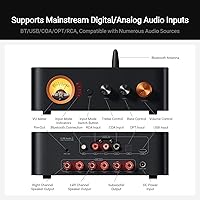
  • Inputs: Five input sources are supported: Bluetooth 5.3, analog RCA stereo, USB audio, optical (TOSLINK), and coaxial digital, all selectable via a single front-panel button.
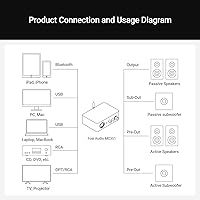
  • Outputs: Output connections include binding posts for two stereo speakers, a dedicated RCA subwoofer output, and a 3.5mm pre-out jack for headphones or additional powered monitors.
  • Tone Controls: Independent bass and treble rotary controls are fitted with center detents, allowing the user to return to a flat frequency response by feel without looking at the unit.
  • Standby Mode: The unit enters low-power standby automatically after two minutes of continuous silence on the active input, and wakes immediately when a signal is detected.
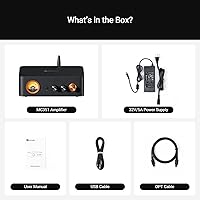
  • Power Supply: A 32V/5A external DC power adapter is included in the box, and the unit accepts a DC input voltage range of 24V to 48V for compatibility with third-party supplies.
  • Chassis Material: The enclosure is machined from a single piece of aluminum alloy using CNC processes, then finished with a fine sandblast texture that resists smudges and minor scratching.
  • VU Meter: A round analog needle-style level meter is mounted on the front panel, displaying stereo output level in real time with a response that tracks musical dynamics visibly.
  • Dimensions: The unit measures approximately 13.86 inches wide by 9.17 inches deep by 5.47 inches tall, making it compact enough for a desk shelf or small audio rack.
  • Weight: The amplifier weighs 2.2 pounds without the power adapter, reflecting its aluminum construction and internal component density.
  • Bluetooth Version: Bluetooth 5.3 is implemented, offering improved connection stability and slightly lower latency compared to earlier Bluetooth 4.x audio receivers.
  • Release Date: The product was first made available for purchase in March 2024, making it a relatively recent addition to Fosi Audio's amplifier lineup.
  • Manufacturer: The MC351 is designed and sold by Fosi Audio, a Chinese audio brand specializing in compact Class-D amplifiers and DAC units for the consumer HiFi market.

Related Reviews
Fosi Audio TDA7498E
Fosi Audio TDA7498E
83%
88%
Sound Quality
93%
Value for Money
71%
Build Quality
74%
Power Output & Headroom
66%
Noise Floor & Background Hiss
More
Fosi Audio BT10A
Fosi Audio BT10A
81%
93%
Value for Money
82%
Sound Quality
91%
Noise Floor
84%
Bluetooth Performance
67%
Power Output
More
Fosi Audio BT30D
Fosi Audio BT30D
78%
83%
Sound Quality
88%
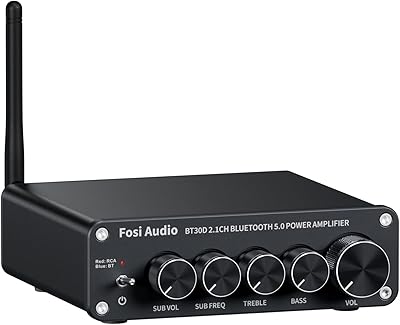
Subwoofer Performance
81%
Bluetooth Connectivity
91%
Value for Money
62%
Build Quality
More
Fosi Audio ZP3 Balanced Preamp
88%
94%
Sound Quality
88%
Ease of Use
90%
Build Quality
87%
Customization Options
75%
Memory Function
More
Fosi Audio M03
Fosi Audio M03
81%
91%
Audio Clarity & Distortion
74%
Power Output & Headroom
88%
Versatility & Operating Modes
93%
Value for Money
72%
Build Quality & Enclosure
More
Fosi Audio P4
Fosi Audio P4
81%
88%
Build Quality
84%
Sound Quality
91%
Motorized Volume Control
79%
Remote Control
86%
Input Flexibility
More
Fosi Audio M04 Subwoofer Amplifier
89%
94%
Bass Performance
91%
Sound Clarity
88%
Build Quality
90%
Ease of Setup
87%
Thermal Management
More
Fosi Audio V3 Stereo Amplifier
81%
93%
Value for Money
91%
Audio Clarity & Noise Floor
67%
Real-World Power Output
74%
Build Quality & Finish
88%
Thermal Management
More
Fosi Audio HT4S
Fosi Audio HT4S
80%
88%
Build Quality
84%
Value for Money
76%
Sound Quality
82%
Multi-Channel Versatility
63%
Bluetooth Performance
More
Fosi Audio SK01 Headphone Amplifier
83%
88%
Sound Quality
72%
Battery Life
91%
Build Quality
85%
Tone Control Flexibility
80%
Portability
More

FAQ

You can connect a turntable, but only if it has a built-in phono preamp or if you use a separate phono stage between the turntable and the RCA input. The MC351 does not have a built-in phono preamp, so a standard moving-magnet cartridge turntable without its own preamp will sound very quiet or thin without that extra stage in the chain.

The subwoofer output is a single RCA jack on the rear panel, so you just run a standard RCA cable from that output to the LFE or line-level input on your powered subwoofer. The crossover point is fixed inside the amp, so your sub will receive a low-pass filtered signal automatically. If your subwoofer has its own crossover control, set it to its highest point and let the amp handle the filtering.

A few users have reported that the Bluetooth connection occasionally needs to be re-paired or re-selected after the unit wakes from standby. It is not a universal problem, but if you use Bluetooth as your primary source it is worth being aware of — keeping your phone or source device close by makes reconnection faster if it does drop.

It depends on the speakers. For efficient floor-standers in a medium-sized room it can work well, but if your speakers are 8-ohm and on the less sensitive side, you may find the amp running out of headroom at higher volumes before the room is fully filled. This integrated amp is better matched to bookshelf or moderately efficient floor-standing speakers in rooms up to roughly 200 to 250 square feet.

Yes, the 3.5mm pre-out carries a line-level signal and works well for connecting a pair of powered monitors or a headphone amp. Keep in mind it is not a fully discrete headphone output, so for critical headphone listening a dedicated headphone amp would give better results, but for speakers it works reliably.

There is no dedicated on/off switch on the Fosi Audio MC351 itself. To cut power completely you will need to switch off at the wall outlet or plug it into a power strip with a switch. The auto-standby mode reduces idle draw significantly, but if cutting power entirely matters to you, factor that into your setup planning.

In an open room with a clear line of sight, Bluetooth 5.3 holds a stable connection at normal room distances — roughly 20 to 30 feet. Through a single interior wall the connection generally stays intact but can become less stable, and multiple walls or floors between your source and the amp will likely cause dropouts. It works well as a desktop or single-room Bluetooth receiver, but it is not designed as a whole-home wireless solution.

They are fairly effective — even small rotations off the center detent produce audible changes, so they are more powerful than on some budget amps. The center detent is the most useful part, because it lets you confidently snap back to a flat response without having to guess whether the knob is truly centered. If you want narrow parametric EQ control over specific frequencies, these tone controls will not satisfy that need.

The heatsink gets noticeably warm during long listening sessions at moderate to high volumes, but it should not become uncomfortably hot to the touch under normal use. The important thing is to leave clear space around the unit — do not stack anything on top of it and avoid enclosing it in a tight cabinet. Class-D amplifiers are generally efficient, but the heatsink still needs airflow to do its job properly.

The main differentiators this Fosi Audio receiver offers over most competing units at a similar price are the built-in Bluetooth, the onboard DAC across multiple digital inputs, the dedicated 2.1 subwoofer output, and the retro VU meter aesthetic. Competing units from Topping and SMSL often focus on pure stereo amplification with cleaner specs on paper, but they require separate DAC and Bluetooth components to match the all-in-one functionality here. If you already own those components, a dedicated stereo amp might offer slightly better measured performance; if you want everything in one box, the value calculation shifts in favor of this unit.