
Overview

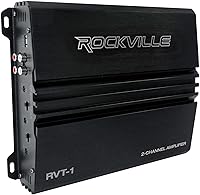
The Rockville RVT-1 2-Channel Car Amplifier is Rockville's answer to the demand for capable amplification without a premium price tag. Rockville has built a reputation for accessible audio gear, and this 2-channel amplifier fits that mold well. Its Class-AB design strikes a practical balance between power efficiency and audio fidelity — not audiophile-grade, but genuinely solid for everyday listening. The chassis measures 11″ x 8.5″ x 2.24″, compact enough to tuck under a seat or wedge into a trunk corner. It's also bridgeable, meaning it can moonlight as a mono subwoofer amp when the situation calls for it. For a first-time buyer on a budget, that kind of flexibility is hard to argue with.

Features & Benefits

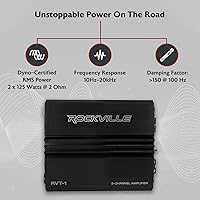
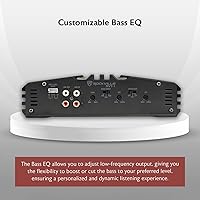
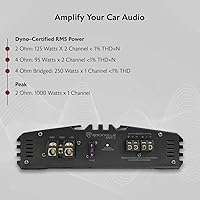
What the RVT-1 actually delivers comes down to 250W RMS of continuous power — that's the number that matters, not the splashy 1000W peak figure you'll see advertised. The amp runs 125W per channel at 2 ohms, drops to 95W per channel at 4 ohms, or can be bridged to push 250W into a single 4-ohm subwoofer. On-board controls include a 12dB bass equalizer and selectable low-pass and high-pass crossover filters, covering 50Hz to 200Hz and 50Hz to 1.2kHz respectively. A MOSFET power supply keeps things stable, and the IC-controlled protection circuitry handles short-circuit and thermal events automatically. The extruded aluminum heatsink does its job quietly — no cooling fan rattling anywhere in the background.

Best For

This Rockville amp makes the most sense for someone replacing a factory head unit system and wanting more output without overspending. It fits naturally under a seat in compact vehicles, and the bridgeable output makes it a solid subwoofer option for a 10-inch or 12-inch driver in a sealed box. Drivers who want basic tone shaping without buying a separate equalizer will appreciate the built-in controls. It also works well as a secondary amplifier in a more elaborate setup — handling rear fill while a dedicated mono amp manages the sub. Practical tip: when bridging, connect your subwoofer to the positive terminal of channel one and the negative terminal of channel two.

User Feedback

Owners of this 2-channel amplifier tend to agree on a few things. The wiring process is straightforward, and most buyers had it running without much head-scratching — which matters on a first install. The value-for-money sentiment is generally positive, especially among those using it bridged for a single sub. That said, a handful of users flag the knob labeling as small and difficult to read in dim trunk lighting, and a few wish the gain control offered finer adjustment. Long-term reliability appears mixed; some owners report years of trouble-free use, while others mention heat-related shutdowns at sustained high volume. The included documentation is basic, so true beginners will want to supplement it with an online wiring guide.

Pros

  • Bridgeable output lets you run a single subwoofer without buying a separate mono amp.
  • Built-in bass EQ and crossover filters remove the need for an external signal processor.
  • Compact dimensions make under-seat installs genuinely feasible in most vehicles.
  • Class-AB design delivers cleaner audio than pure Class-D budget amps at similar price points.
  • MOSFET power supply keeps voltage stable across the 9V–16V operating range.
  • IC-controlled protection circuitry handles shorts and overloads automatically, reducing install risk.
  • Passive aluminum heatsink means zero fan noise interfering with your audio.
  • Flexible impedance support — 2-ohm stable — gives you more speaker pairing options.
  • Straightforward wiring layout makes this a realistic DIY project for first-time installers.
  • Solid value for the price, especially when used bridged for a budget subwoofer build.

Cons

  • Peak power marketing overstates real-world output; actual usable power is 250W RMS.
  • Knob labeling is small and difficult to read in dim or enclosed install locations.
  • Gain adjustment range feels coarse, making precise tuning harder than it should be.
  • Thermal shutdowns have been reported during sustained high-volume use in poorly ventilated spots.
  • Included documentation is minimal and may leave true beginners without enough guidance.
  • Long-term reliability is inconsistent based on owner reports, with some units failing within a year.
  • No remote bass control output, limiting convenient low-end adjustment from the driver seat.
  • Build quality reflects the price point — plastics and finish feel noticeably entry-level on close inspection.

Ratings

The Rockville RVT-1 2-Channel Car Amplifier has been scored by our AI system after processing verified buyer reviews from multiple global markets, with spam, bot-generated, and incentivized submissions actively filtered out before analysis. Scores reflect a realistic composite of real installation experiences, daily driving use, and long-term ownership — strengths and frustrations weighted equally. Where the numbers dip, the reasons are explained plainly so you can decide whether those trade-offs matter for your specific setup.

Value for Money
83%
For buyers on a tight budget, this 2-channel amplifier punches meaningfully above what the price tag suggests. The combination of bridgeable output, built-in crossover filters, and a bass EQ in a single unit saves money that would otherwise go toward additional gear, and most owners acknowledge that frankly.
A handful of buyers felt shortchanged once they understood that the headline 1000W figure is a peak rating, not sustained output. When expectations are anchored to that number, the real-world 250W RMS can feel like a letdown, even if it is technically appropriate for the price tier.
Power Output
67%
33%
The 250W RMS rating is honest and usable for driving a compact subwoofer or a pair of aftermarket speakers in a smaller vehicle. Bridged into a 4-ohm sub, the RVT-1 delivers enough kick for most casual listeners who just want noticeably more bass than their factory system provided.
Power-hungry speaker setups and larger subwoofer enclosures will expose the amp's ceiling quickly. Users who pushed the gain high on longer drives reported the amp running out of headroom, and a few noted audible compression at sustained high volumes that more capable amps in the next price bracket avoid.
Build Quality
58%
42%
The extruded aluminum heatsink feels solid and does its thermal job quietly under normal conditions. For an entry-level unit, the terminal layout is tidy and the chassis holds together acceptably during the physical stress of install and mounting.
The overall plastic construction and lightweight feel of the enclosure make it obvious this is a budget product. Several long-term owners noted that the finish on control knobs wore down within a year, and a few reported that the RCA input sockets felt loose after repeated cable swaps — quality control appears inconsistent across production batches.
Thermal Management
61%
39%
In well-ventilated installs with adequate airflow around the heatsink, the passive cooling system manages heat effectively during normal commutes and moderate listening sessions. No fan noise is a genuine benefit — especially appreciated in quieter cabin environments where cooling fan hum would be annoying.
Thermal shutdowns are a documented pattern among owners who mounted the amp in confined spaces or drove at high volume in warm weather. The passive heatsink has clear limits, and without active cooling, sustained high-output operation in poorly ventilated trunk installs can trip the protection circuit more often than buyers expect.
Audio Clarity
72%
28%
At moderate listening levels, the Class-AB design produces a noticeably cleaner sound than budget Class-D alternatives at a similar price point. Vocals and midrange content come through without obvious coloration, and the amp handles the transition between low and high frequencies reasonably well when the crossover is dialed in carefully.
At higher gain settings, some buyers reported a faint but perceptible noise floor, particularly noticeable during quiet passages or between tracks. The amp is not going to satisfy anyone accustomed to higher-end amplification, and clipping becomes apparent before the gain knob reaches its upper range.
Ease of Installation
78%
22%
The terminal layout is clearly organized and the connections are appropriately sized for standard 8-gauge wiring, which most budget installers will already be using. First-timers consistently reported getting the unit operational without professional help, which is a meaningful practical win for this buyer profile.
The included instruction sheet is thin — really just a basic connection diagram — which leaves newer installers guessing on gain staging and crossover setup. The knob labels are small and poorly lit, making fine-tuning adjustments in a dim trunk more difficult than they should be.
Crossover Performance
74%
26%
Having both a low-pass and high-pass filter built into the same unit saves real money compared to adding an external processor, and the frequency ranges covered — 50Hz to 200Hz for low-pass, 50Hz to 1.2kHz for high-pass — are broad enough to handle most typical install scenarios without compromise.
The crossover knobs lack detents or reference markings precise enough for accurate frequency setting, so dialing in a specific crossover point requires patience and a bit of trial and error. Buyers with more demanding setups found the filter slopes insufficient for completely eliminating bleed between speakers and subwoofer.
Bass EQ Control
71%
29%
The onboard 12dB bass equalizer is a genuinely useful feature for this price range, letting users add low-end presence without a separate equalizer unit in the chain. Casual listeners found it easy to dial in a warmer sound on daily commutes, and for subwoofer-only bridged setups it adds a welcome layer of control.
The EQ boost has a fairly broad Q, meaning it affects a wider frequency range than a parametric EQ would, which can make the bass response feel one-dimensional when pushed. A few more detail-oriented users noted that maxing out the bass boost introduced a muddiness that required rolling back the head unit's own bass control to compensate.
Compatibility
81%
19%
The amp's 2-ohm stereo stability opens up compatibility with a wider range of speaker pairings than 4-ohm-only units, and the variable input sensitivity adjustment accommodates both factory head unit outputs via a line output converter and aftermarket head unit preamp voltages without issue.
The absence of a high-level speaker input means factory radio owners must purchase a separate line output converter — an extra step and extra cost that some buyers only discover after the amp arrives. There is also no remote bass control output, which limits convenient real-time adjustments from the driver seat.
Noise Floor
63%
37%
In properly grounded installs with clean power wiring, the RVT-1 runs quietly enough at moderate volumes that background hiss is not a meaningful issue during normal driving. Buyers who took care with their ground connection and used quality RCA cables reported satisfying results.
Grounding problems or cheap RCA cables can surface an audible hiss or alternator whine that the amp does little to suppress on its own. This is a common issue at the budget amplifier tier, but it affects the RVT-1 more visibly than its modest shielding and input circuitry can handle without careful installation practices.
Long-Term Reliability
54%
46%
A portion of owners — particularly those who installed the amp in ventilated locations and set the gain conservatively — report trouble-free operation spanning one to two years of regular daily use. For a budget amp used as a secondary channel driver or a light-duty subwoofer amp, that lifespan is acceptable to most buyers.
Failure rates reported by longer-term owners are noticeably higher than comparable products from more established audio brands. Common failure points include protection circuit trips that become permanent and RCA input degradation after extended use, suggesting component quality tolerance is tighter than it should be for a product expected to survive a car's electrical and thermal environment.
Protection Circuitry
76%
24%
The IC-controlled protection system reliably catches short circuits and over-temperature events before damage escalates, which is reassuring for first-time installers who may not have a perfectly optimized wiring setup from day one. Several buyers credited the protection circuit with saving the amp after accidental wiring errors during install.
The protection circuit's thermal threshold appears calibrated conservatively, tripping even during moderate listening sessions in warmer climates or tight enclosures. While protective in intent, recurring shutdowns during normal use conditions point to the amp running closer to its thermal limits than the spec sheet implies.
Documentation & Support
47%
53%
Rockville maintains an accessible online presence and their basic product pages include some supplementary wiring guidance that goes a step beyond what is in the box. For buyers willing to search, community install guides and video walkthroughs specific to budget Rockville amps are reasonably easy to find.
The printed documentation included with the unit is widely criticized as too sparse for anyone without prior amplifier install experience. There is no gain-setting guidance, no recommended wiring gauge table, and no crossover setup examples — information that competing brands include as a matter of course, even at budget price points.

Suitable for:

The Rockville RVT-1 2-Channel Car Amplifier is a strong fit for budget-conscious buyers taking their first step beyond a factory stereo system. If you drive a compact or mid-size vehicle and want noticeably more output without dedicating serious trunk space to gear, the slim profile and lightweight build work in your favor. It's particularly well-suited to anyone looking to power a single subwoofer on the cheap — bridge it across the two channels and you have a workable mono setup for a 10-inch or 12-inch driver in a sealed enclosure. Drivers who want some control over their sound signature without purchasing a separate equalizer will also find the on-board bass EQ and crossover filters genuinely useful for day-to-day tuning. It also slides neatly into secondary roles, like driving rear-fill speakers in a larger system where a dedicated mono amp is already handling subwoofer duties.

Not suitable for:

The Rockville RVT-1 2-Channel Car Amplifier is not the right tool for listeners who demand consistent, high-output performance at extended volumes. The 250W RMS figure is the honest ceiling here, and buyers chasing the advertised 1000W peak number will be disappointed when real-world listening doesn't match that expectation. Enthusiasts running power-hungry component speaker sets or large subwoofers that need sustained headroom should look at purpose-built amplifiers in a higher output class. The passive cooling design, while quiet, can become a liability in poorly ventilated installs or hot climates — some users have reported thermal shutdowns during prolonged high-volume use, which is a real concern if you listen loud on long drives. Anyone who values premium build materials or fine-tuned gain controls will likely find this Rockville amp feels like what it is: a value-tier product with functional but basic hardware.

Specifications

  • Peak Power: The amplifier is rated at 1000W peak power, which represents a momentary maximum rather than a sustained output figure.
  • RMS Power: Continuous RMS output is 250W, which is the reliable, real-world power figure to use when matching speakers and subwoofers.
  • Channels: This is a 2-channel amplifier capable of operating in stereo mode or bridged to a single mono output.
  • Power at 2 Ohms: In stereo mode at 2-ohm loads, the amplifier delivers 125W per channel.
  • Power at 4 Ohms: In stereo mode at 4-ohm loads, output drops to 95W per channel, suitable for most standard aftermarket speakers.
  • Bridged Output: When bridged into a single 4-ohm load, the amplifier produces 250W, making it viable as a mono subwoofer amp.
  • Amp Class: Class-AB topology is used, balancing power efficiency and audio fidelity better than pure Class-D designs at this price tier.
  • Power Supply: A MOSFET-based power supply ensures stable voltage handling across the full 9V–16V operating range.
  • Bass EQ: A fully adjustable 12dB bass equalizer is built in, allowing low-frequency tuning without an external processor.
  • Low-Pass Filter: The low-pass crossover filter is adjustable from 50Hz to 200Hz, useful for directing signal cleanly to a subwoofer.
  • High-Pass Filter: The high-pass crossover filter spans 50Hz to 1.2kHz, allowing full-range speakers to be protected from damaging low-frequency content.
  • Dimensions: The chassis measures 11″ x 8.5″ x 2.24″, a compact footprint well-suited to under-seat or trunk installs.
  • Weight: The amplifier weighs 5.44 pounds, light enough to mount securely without reinforced bracketing in most vehicles.
  • Heatsink: An extruded aluminum heatsink manages thermal dissipation passively, with no cooling fan required under normal operating conditions.
  • Protection: Full IC-controlled protection circuitry guards against short circuits, thermal overload, and voltage irregularities automatically.
  • Operating Voltage: The unit operates between 9V and 16V, covering standard 12V automotive electrical systems with typical voltage fluctuation.
  • Impedance Stability: The amplifier is 2-ohm stable in stereo mode, providing flexibility when pairing with lower-impedance speaker loads.
  • Input Sensitivity: Variable input sensitivity allows the amp to interface with both low-voltage head unit preamp outputs and higher-voltage aftermarket sources.

Related Reviews
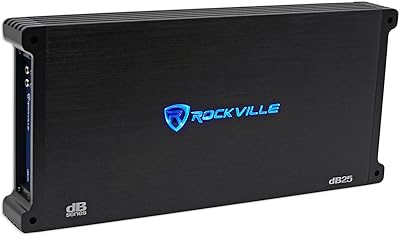
Rockville dB25 2800W 2-Channel Car Amplifier
86%
94%
Power Output
89%
Sound Quality
85%
Ease of Installation
91%
Bass Control
82%
Durability
More
Rockville RVF-2 4-Channel Car Amplifier
84%
88%
Audio Quality
91%
Power Output
85%
Build Quality
72%
Thermals (Heat Management)
80%
Installation Ease
More
Rockville RXA-T1 1500W 2-Channel Car Amplifier
85%
88%
Audio Performance
92%
Bass Response
85%
Build Quality
89%
Compactness/Size
80%
Ease of Installation
More
Rockville RXD-T2 2-Channel Car Amplifier
79%
91%
Power Accuracy
83%
Build Quality
67%
Thermal Management
88%
Ease of Installation
84%
Crossover & EQ Controls
More
Planet Audio AC1200.2 2-Channel Car Amplifier
72%
84%
Value for Money
67%
Power Output
88%
Ease of Installation
71%
Sound Quality
58%
Thermal Performance
More
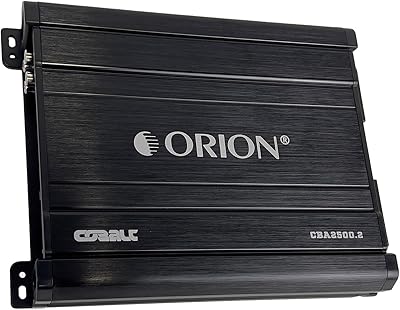
Orion Cobalt Series CBA2500.2 2-Channel Car Amplifier
88%
94%
Power Output
89%
Sound Quality
90%
Heat Management
85%
Ease of Installation
87%
Bass Boost Effectiveness
More
Taramp's MD 1200.1 1-Channel 1200W RMS Car Audio Amplifier
86%
93%
Power Output
89%
Sound Quality
91%
Installation Ease
85%
Build Quality
65%
Thermal Performance
More
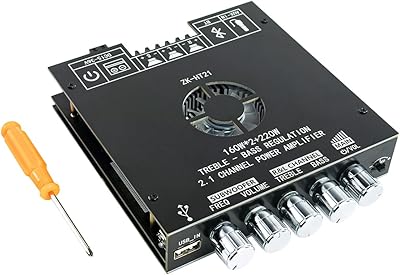
Hosyond TDA7498E 2.1 Channel Bluetooth Amplifier Board 160W×2+220W
73%
88%
Value for Money
76%
Power Output & Headroom
83%
Bluetooth Connectivity
79%
Build & Component Quality
62%
Thermal Management
More
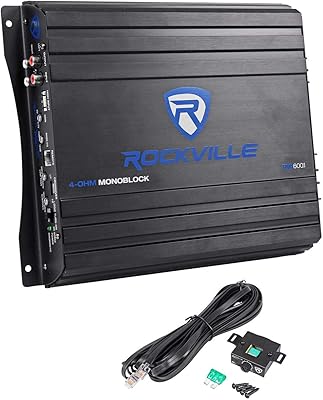
Rockville RVA600.1 Mono Car Amplifier
74%
83%
Value for Money
74%
Sound Quality
88%
Ease of Installation
52%
Power Accuracy
67%
Build Quality
More
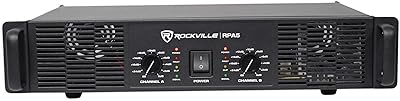
Rockville RPA5 2-Channel Power Amplifier
78%
88%
Value for Money
76%
Power Output & Headroom
67%
Build Quality & Construction
79%
Cooling & Thermal Management
91%
Connectivity & I/O Flexibility
More

FAQ

Not quite. The 1000W figure is a peak rating, which reflects a brief, theoretical maximum under ideal conditions. The number you should build around is 250W RMS — that is the continuous power the amp can sustain during normal listening. When shopping for speakers or a subwoofer to pair with this unit, always match based on RMS, not peak.

Yes, and this is actually one of the more practical uses for the RVT-1. Bridge the two channels together and you get 250W into a single 4-ohm subwoofer — enough to drive a 10-inch or 12-inch driver in a sealed or ported enclosure without needing a dedicated mono amp. Just make sure your subwoofer is rated for 4 ohms when bridging, since the amp is not rated for 2-ohm bridged operation.

Bridging is straightforward once you know the trick. Connect the positive speaker wire to the positive terminal on channel one, and the negative speaker wire to the negative terminal on channel two. Set the amp to bridged mode using the onboard switch, then engage the low-pass filter and dial in the bass EQ to taste. Your head unit or receiver does not need any special setting — the bridging is all handled at the amp itself.

It likely will in most compact and mid-size vehicles. The chassis measures 11″ x 8.5″ x 2.24″, which is on the slimmer side for a 2-channel amp. Measure the clearance under your seat before ordering, paying attention to floor-to-seat height and any seat rail brackets that might obstruct the footprint.

No, and that is part of what makes it practical for a first install. The onboard low-pass and high-pass crossover filters handle basic signal routing, and the 12dB bass equalizer covers low-end tuning. For a budget setup driving a subwoofer and a set of rear speakers, you can get a clean signal chain without adding any external processing gear.

For an amp in this power range, 8-gauge power and ground wire is typically sufficient and is the standard recommendation for RMS outputs up to around 300W. Use a matching 8-gauge ground wire run to bare chassis metal — not a painted surface — and keep the ground cable as short as possible, ideally under 18 inches, to minimize resistance.

Under normal conditions and with adequate ventilation, the aluminum heatsink handles heat well enough. The problem shows up when the amp is mounted in a sealed space with no airflow — like wedged tightly against carpet inside a sealed enclosure — and driven at high volume for extended periods. If you are doing long highway drives at high volume, make sure there is at least a few inches of clearance around the heatsink sides.

Yes, as long as you use a line output converter (LOC) to step the speaker-level signal down to a preamp-level signal the amp can accept. A basic LOC costs very little and is a standard workaround for factory radio installs. Some installers also use an amp with speaker-level inputs directly, but the RVT-1's input sensitivity adjustment can usually accommodate a wide enough range to work with an LOC output cleanly.

Owner reports are mixed. Many users have had this 2-channel amplifier running without issues for a year or two of regular use. Others report failures, most commonly heat-related shutdowns or unit failures after roughly 12 to 18 months of heavy use. Longevity seems closely tied to how well-ventilated the install is and whether the gain is set conservatively. Overdriving a budget amp is one of the fastest ways to shorten its life.

Generally yes, though the included instructions are minimal. The terminal layout is labeled and logically arranged, and the gain, filter, and EQ knobs are straightforward once you understand what they do. That said, first-time installers will benefit from watching a few YouTube install guides specific to this amp or comparable units before starting. The knob labels are small, so a flashlight and reading glasses if needed will save frustration during the tuning phase.

Where to Buy