Overview

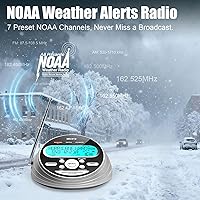
The Rychi TMUS-MD319 NOAA Weather Alert Radio sits in that practical middle ground between bare-bones emergency radios and expensive professional units — a home-focused device that genuinely earns its place on a nightstand or kitchen counter. What separates it from cheaper alternatives is S.A.M.E. localized programming, which lets you tune alerts to your specific county rather than waking up to warnings from three states over. It also doubles as an everyday alarm clock, so it stays useful on calm days too. Rychi backs it with an 18-month replacement warranty, which is a reassuring commitment at this tier. Solid, practical, and purposeful — just don't expect professional-grade build quality throughout.
Features & Benefits

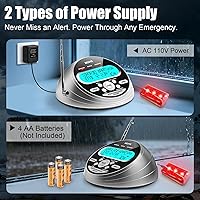
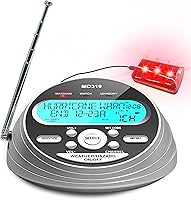
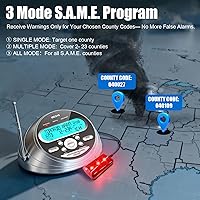
The standout feature is the S.A.M.E. county filtering, which lets you monitor up to 23 counties at once while silencing alerts that have nothing to do with your area — a real difference if you live near a county border. You can configure the radio to broadcast a full voice announcement, blast a siren, or simply flash a warning light depending on your situation. That third option, the external warning light, is more useful than it sounds at 2 a.m. The external antenna interface is a thoughtful addition for rural households where NOAA signals can be weak. Battery backup via four AA cells keeps things running during outages, and the built-in alarm clock means the radio earns its counter space every single day.

Best For

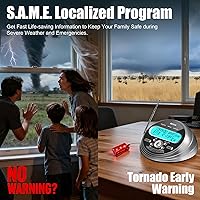
This emergency radio was practically designed for households in storm-prone regions — tornado corridors, Gulf Coast communities, flood-prone river valleys. If a major alert goes off at night and sleeping family members might not hear it, the flashing external light changes the equation considerably. Preppers and emergency-kit builders will appreciate having a dedicated, always-on alert station that does not rely on a smartphone app or internet connection. Rural homes where NOAA reception is spotty will get particular mileage from the external antenna option. It also suits families who want one countertop device covering both daily alarm functions and emergency monitoring without managing two separate gadgets. Less suited for users expecting zero-effort plug-and-play setup.

User Feedback

Among buyers who have left reviews, this weather alert radio holds a 4.3-star average across more than 330 ratings — a respectable score reflecting genuine satisfaction. The most consistent praise centers on reliable alert triggering and how manageable the S.A.M.E. county setup turns out to be once you commit to reading through it carefully. The external warning light draws specific appreciation from households where someone sleeps deeply or has hearing difficulties. On the downside, a notable share of reviewers found the printed instruction manual confusing, particularly around initial programming. Battery life during prolonged outages drew mixed reports. Customer service responsiveness, tied to the 18-month warranty, was frequently highlighted positively in follow-up reviews when issues arose.

Pros

  • S.A.M.E. county filtering covers up to 23 counties simultaneously, cutting out irrelevant regional alerts entirely.
  • The external warning light is a genuine safety asset for households where audio alarms alone are unreliable at night.
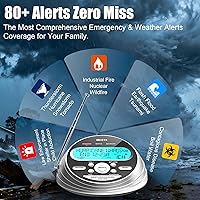
  • Over 80 selectable alert types give real flexibility in tailoring exactly what events trigger a response.
  • Battery backup via four AA cells keeps this emergency radio functional when the power grid goes down.
  • The external antenna port is a practical solution for rural homes with weak NOAA broadcast reception.
  • An 18-month replacement warranty is longer than most competitors offer at this market tier.
  • The built-in clock with alarm and snooze means the device earns its counter space on ordinary days too.
  • Alert memory logs up to 20 past warnings, letting you review what fired while you were away or asleep.
  • Rychi customer service has drawn consistently positive feedback when warranty replacements were actually needed.
  • Scanning all seven NOAA weather channels is quick, and the radio locks onto the strongest local signal automatically.

Cons

  • The printed instruction manual is widely criticized as confusing, especially during initial S.A.M.E. programming.
  • Battery runtime during prolonged multi-day outages falls short for users in severe, extended storm scenarios.
  • No rechargeable or USB-C backup option is available, limiting power flexibility during emergencies.
  • Display readability suffers noticeably in brightly lit rooms or near windows with direct sunlight.
  • Speaker volume at maximum introduces audible distortion on certain broadcast frequencies.
  • The plastic housing flexes slightly under firm handling, raising questions about long-term durability.
  • Alert log navigation is clunky, and stored events lack detailed timestamps for post-storm review.
  • An external antenna is often necessary in rural areas but is sold separately, adding unplanned cost.
  • Menu navigation for customizing individual alert types is slow and unintuitive without clearer guidance.
  • The alarm feature is functional but basic, with a fixed snooze interval and limited independent alarm slots.

Ratings

The Rychi TMUS-MD319 NOAA Weather Alert Radio has been scored by our AI system after analyzing verified buyer reviews worldwide, with spam, bot-driven, and incentivized feedback actively filtered out. Across hundreds of real-world accounts, this emergency radio shows consistent strengths in alert reliability and localized programming, while a handful of recurring friction points keep it from a clean sweep. Both the wins and the frustrations are reflected honestly in the scores below.
Alert Reliability
86%
Buyers in storm-prone areas repeatedly report the alert system triggering correctly and promptly during actual severe weather events. There is strong confidence in the radio waking households up during nighttime warnings, which is ultimately the most important job it has.
A smaller subset of users noted occasional missed alerts in areas with weaker NOAA broadcast signals, especially without an external antenna attached. Reception quality varies meaningfully depending on geographic location and local tower proximity.
S.A.M.E. Programming Ease
71%
29%
Once users invest time in the setup process, the county-level filtering works exactly as advertised, eliminating nuisance alerts from neighboring regions. Households near multi-county borders find this feature particularly valuable for reducing false alarm fatigue.
The initial programming process trips up a significant number of buyers. The included manual uses dense, unclear language, and several reviewers specifically mention needing to rely on online tutorials or YouTube walkthroughs to complete the S.A.M.E. configuration correctly.
External Warning Light
89%
This feature receives some of the most enthusiastic feedback in the entire review pool. Families with elderly relatives or household members who sleep through audio alarms describe the flashing light as a genuine safety upgrade, especially during overnight severe weather events.
The light is only as useful as its placement — reviewers in larger rooms note that the flash intensity is adequate but not powerful enough to illuminate an entire open-plan space. It works best when the radio is positioned in a central, visible location.
Battery Backup Performance
63%
37%
Four AA batteries provide a functional fallback when AC power is cut, which is precisely the scenario this radio is designed for. Short to medium outages lasting a few hours are handled without issue according to the majority of buyer reports.
Extended outages reveal the limits of the AA battery setup. Users who experienced multi-day power loss during hurricanes or ice storms report the battery runtime falling short of expectations, and there is no rechargeable or USB-C backup option available.
Build Quality
67%
33%
The radio feels solid and appropriately weighted for a countertop device at 1.21 pounds. The button layout is tactile and responsive, and the silver grey housing does not look cheap sitting on a kitchen counter or nightstand.
The plastic casing shows fingerprints easily and flexes slightly under firm pressure, which gives some users pause about long-term durability. A few reviewers mention that the display feels less premium up close than product photos suggest.
Audio Clarity
74%
26%
Voice broadcasts from NOAA channels come through clearly enough to understand emergency instructions without straining. Most users report the speaker volume is adequate for average-sized rooms, and the siren alert mode is genuinely loud when needed.
At maximum volume, the speaker introduces slight distortion on certain broadcast frequencies. Users in noisy households or with larger rooms occasionally find the maximum output level insufficient for reliable audibility from an adjacent room.
Setup & First-Use Experience
62%
38%
The physical setup — plugging in the adapter, inserting batteries, placing the antenna — is straightforward and takes just a few minutes. Users with prior experience using similar emergency radios generally get up and running without significant friction.
The software side of setup is a different story. Programming alert modes, entering S.A.M.E. codes, and navigating the menu system without clear guidance frustrates a notable share of first-time users. A better quick-start guide would meaningfully improve this score.
Value for Money
81%
19%
Considering the range of features packed into this price tier — multi-county S.A.M.E. filtering, three alert modes, external antenna support, and an everyday alarm clock — most buyers feel they are getting strong utility relative to cost. The 18-month warranty adds perceived value.
Buyers who compare it side by side with slightly pricier dedicated emergency radios occasionally feel the build and manual quality do not fully justify the mid-range positioning. It competes well on features but less so on tactile finish.
Signal Reception
72%
28%
In suburban and semi-rural areas with reasonable NOAA tower coverage, the built-in antenna performs reliably without any additional accessories. Scanning all seven WX channels is quick, and the radio locks onto the strongest local signal automatically.
Users in rural or mountainous regions frequently note that the built-in antenna alone is insufficient for stable reception. While the external antenna port is a helpful solution, the accessory itself is sold separately, which adds unplanned cost for those who need it most.
Display Readability
69%
31%
The display is legible in normal indoor lighting and shows clock time, alert status, and programming information without excessive clutter. Daytime readability in a typical home environment is generally considered acceptable by the majority of buyers.
In bright rooms or near windows, the screen can wash out noticeably. Night brightness is adequate but not adjustable, which some users find mildly intrusive when the radio is used as a bedside alarm clock in a dark bedroom.
Alert Customization Depth
83%
The ability to select from over 80 alert types and configure the radio to respond to ALL, a single event type, or a custom combination gives this device a flexibility that cheaper weather radios simply cannot match. Power users appreciate having that level of control.
Navigating the full alert menu to customize individual event types is time-consuming and not intuitive. Users who want a simple plug-and-alert experience may find the depth of options overwhelming rather than empowering, especially without a clearer manual.
Clock & Alarm Functionality
77%
23%
The built-in alarm clock with snooze works reliably and adds genuine daily utility, making the radio a practical countertop fixture rather than something that gets buried in a drawer between storms. Time display accuracy over weeks of use is consistently reported as dependable.
The alarm feature is functional but basic — there is no gradual wake option, multiple independent alarm slots are limited, and the snooze interval is fixed. Users expecting a feature-rich alarm clock experience will find this aspect modest compared to dedicated clock radios.
Alert Memory & Missed Event Log
78%
22%
Storing up to 20 past alert messages is a thoughtful inclusion that lets users review what warnings fired while they were away or asleep. This is particularly useful for households tracking weather patterns during active storm seasons.
The log interface is not the most intuitive to navigate after the fact, and there is no timestamp detail beyond basic alert type for some stored events. A clearer replay system would make this feature considerably more practical during post-storm reviews.
Warranty & Customer Support
82%
18%
The 18-month replacement warranty is longer than what most competitors offer at this price point, and buyer reports of actual warranty claims suggest Rychi customer service responds promptly. Several reviewers specifically note replacement units were shipped without prolonged back-and-forth.
A minority of buyers report difficulty getting timely responses during peak periods, such as immediately following major storm seasons when demand for replacements spikes. The 24/7 support claim appears to hold up in normal conditions but shows strain under high volume.

Suitable for:

The Rychi TMUS-MD319 NOAA Weather Alert Radio was built with a specific type of household in mind, and it genuinely delivers for that audience. Families living in tornado corridors, Gulf Coast communities, or flood-prone river valleys will find the S.A.M.E. county filtering system particularly practical — it means alerts are relevant to your actual location, not a region two counties over. Households with elderly parents or members who have hearing difficulties benefit meaningfully from the external flashing warning light, which adds a visual layer to nighttime emergencies that audio alone cannot cover. Rural residents who struggle with weak NOAA broadcast signals will appreciate the external antenna interface, which can make a real difference in signal stability. It also suits preppers and emergency-kit builders who want a dedicated, internet-independent alert station that pulls from official NOAA channels around the clock. The built-in alarm clock makes it a practical everyday countertop device, not just something that sits unused between storm seasons.
Not suitable for:

Buyers expecting a plug-and-play experience out of the box may find the Rychi TMUS-MD319 NOAA Weather Alert Radio more demanding than anticipated, particularly during the initial S.A.M.E. programming phase, which requires patience and a willingness to work through an unclear instruction manual. Anyone who needs a radio to carry through extended multi-day power outages — such as those caused by major hurricanes or prolonged winter storms — should weigh the four-AA battery backup against their realistic power needs, as runtime under sustained use is limited. Users who prioritize a premium tactile feel or a polished display will likely feel the build quality reflects its price tier rather than exceeding it. Those who want a feature-rich alarm clock as the primary function, with gradual wake, multiple independent alarms, or adjustable snooze intervals, will find this emergency radio falls short of dedicated clock radio alternatives. If you live in an area with consistently strong NOAA coverage and simply want a basic, single-county alert radio with zero configuration, the depth of options here may feel like unnecessary complexity rather than added value.

Specifications

  • Brand: Manufactured by Rychi under parent manufacturer TM, model designation TMUS-MD319.
  • Dimensions: The unit measures 6.02″ long by 5.59″ wide by 2.95″ tall, making it compact enough for a countertop or nightstand.
  • Weight: The radio weighs 1.21 pounds, light enough to reposition easily but substantial enough to sit stably on a flat surface.
  • Color: Available in Silver Grey with a neutral finish suited to most home interiors.
  • Power Source: Primary power is supplied via an included AC adapter; four AA batteries serve as a backup power source during outages.
  • Radio Bands: Receives all seven standard WX NOAA weather band channels used by the National Weather Service across the United States.
  • S.A.M.E. Coverage: Supports Specific Area Message Encoding for up to 23 counties simultaneously, allowing precise geographic alert filtering.
  • Alert Types: Over 80 individual emergency alert categories are selectable, covering severe weather events, civil emergencies, and public safety notices.
  • Warning Modes: Three output modes are available: a full voice broadcast, an audible siren alarm, and a silent visual display-only warning.
  • External Light: An integrated external flashing warning light activates during alerts, providing a visual signal useful in loud or sleeping environments.
  • Antenna Interface: A dedicated external antenna port allows connection of an aftermarket antenna to improve reception in rural or signal-weak locations.
  • Alert Memory: The radio stores up to 20 past alert messages, enabling review of warnings received while the user was absent or asleep.
  • Clock Function: A built-in digital clock includes a programmable alarm and snooze function for everyday timekeeping use independent of emergency alerts.
  • Programming Modes: Three programming modes — ALL, SINGLE, and MULTIPLE — let users control which alert types and geographic areas trigger the radio.
  • S.A.M.E. Memory: S.A.M.E. county codes are stored in permanent memory, so programmed settings are retained even after a power interruption.
  • Available Since: This model became available for purchase in February 2023.
  • Warranty: Rychi provides an 18-month replacement warranty backed by 24/7 customer support contact availability.
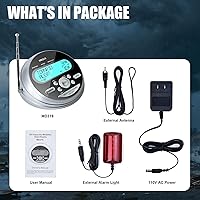
  • Included Items: Each unit ships with the radio, an AC power adapter, and a printed owner's manual.

Related Reviews

Leaton Emergency NOAA Weather Alert Radio
85%
88%
Battery Life & Charging Options
85%
Weather Alerts & Reception
90%
Build Quality & Durability
93%
Portability & Size
87%
Ease of Use
More
Sangean DT-800BK AM/FM/NOAA Weather Alert Pocket Radio
77%
88%
AM/FM Reception Quality
91%
NOAA Weather Alert Reliability
93%
Portability & Form Factor
67%
Build Quality & Durability
72%
Battery Life
More
TFTDOUP Emergency Weather Alert Radio
86%
88%
Overall Performance
85%
Battery Life
90%
Charging Options
80%
Ease of Use
87%
Build Quality
More
Raynic NOAA Weather Radio 12000mAh
86%
88%
Performance in Emergencies
91%
Charging Options
83%
Signal Reception
89%
Flashlight & Lamp Effectiveness
85%
Ease of Use
More
Audiocrazy AM FM NOAA Emergency Weather Radio
67%
83%
NOAA Reception
61%
Battery Life
58%
Build Quality
79%
Value for Money
62%
Bluetooth Performance
More
Reecom R-1630C Weather Alert Radio
79%
91%
SAME Filtering Accuracy
88%
Battery Backup Reliability
86%
Alert Volume & Siren
61%
Setup & Programming Experience
89%
Event Memory & Countdown Timer
More
Midland ER210 Emergency Weather Radio
75%
91%
NOAA Reception Quality
83%
Power Source Versatility
78%
Battery Life
89%
Ease of Use
67%
Flashlight Performance
More
FQBLXY H27 30000mAh Emergency Weather Radio
67%
83%
Value for Money
71%
Battery Capacity
44%
Solar Charging
41%
Hand Crank Efficiency
67%
Radio Reception
More
Sangean CL-100 Weather Alert Radio
79%
93%
Alert Reliability
88%
SAME Filtering Accuracy
61%
Ease of Setup
84%
Build Quality & Durability
58%
Audio Quality
More
Eoxsmile CR1009Pro Emergency Weather Radio
79%
88%
Value for Money
91%
NOAA Weather Alert
67%
Battery Life
83%
Charging Versatility
74%
Build Quality
More

FAQ

The Rychi TMUS-MD319 NOAA Weather Alert Radio works anywhere in the United States where NOAA Weather Radio All Hazards broadcasts are available, which covers the vast majority of the country. You simply program the S.A.M.E. code for your specific county or counties, and the radio locks onto the relevant local signal. If you live in a remote area with weak coverage, the external antenna port can help pull in a more stable signal.
Honestly, it takes a bit of patience. The concept is straightforward — you enter the six-digit S.A.M.E. code for your county, which you can look up for free on the NOAA website — but the menu navigation on the radio itself is not the most intuitive, and the printed manual could be much clearer. Most users get through it in 15 to 30 minutes, and searching for a YouTube walkthrough specific to this model can save you real frustration.

Yes, that is one of the more useful features on this radio. You can select from over 80 individual alert categories and configure the radio to respond only to the event types you care about most. If you want tornado warnings and flash flood emergencies but not every watch or advisory, you can set it up that way using the MULTIPLE or SINGLE programming modes.

Under normal standby conditions with the AC adapter disconnected, four AA batteries will keep the radio running for several hours, which covers most short-term outages. For extended outages lasting more than a day or two — common after major hurricanes or ice storms — you should plan to have spare batteries on hand, as the AA backup alone will not carry you through a multi-day event comfortably.

For most people sleeping in a standard bedroom with the radio on a nightstand, yes — the flashing light is noticeable enough to rouse light to moderate sleepers. It is particularly valued by households with elderly family members or people who do not easily wake to audio alarms alone. In very large or open-plan rooms, the light intensity may not reach far enough to be reliably visible from across the space.

Not at all — this emergency radio operates entirely independently of Wi-Fi, cellular networks, and smartphones. It receives broadcasts directly from NOAA Weather Radio transmitters via dedicated WX radio frequencies, which means it continues functioning during events where internet and cell service are disrupted. That independence from digital infrastructure is actually one of its core advantages as an emergency preparedness device.

Voice mode plays the actual NOAA broadcast audio, giving you a spoken description of the emergency for up to three minutes. Siren mode skips the voice and instead sounds a loud alarm for up to five minutes, which is more effective for grabbing attention quickly. Display mode is the quietest option — it only lights up the warning indicator on the screen, which is useful in situations where you want a silent visual alert, such as in a baby's room or a shared sleeping space.

Yes, the radio supports S.A.M.E. programming for up to 23 counties simultaneously. This is especially useful if you live near a county border, have a vacation property in a different area, or simply want broader regional coverage. You will only receive alerts when a threat is confirmed in one of your programmed counties, so it does not flood you with irrelevant warnings from regions you have no connection to.

The S.A.M.E. codes and programming settings are stored in permanent memory, so they are retained even if the radio loses both AC and battery power. The clock time will likely need to be reset after a power interruption, but your county codes and alert preferences should stay intact, which means you will not need to reprogram the entire unit after every outage.

Based on buyer feedback patterns, the 18-month replacement warranty appears to be one of the more genuinely responsive in this product category. Multiple reviewers report that contacting Rychi customer support resulted in replacement units being sent without excessive back-and-forth. Response times appear solid during normal periods, though some buyers noted slower replies immediately following major storm seasons when support volume likely spikes. Overall, it is a more reassuring warranty than what most competing radios at this tier offer.