Overview

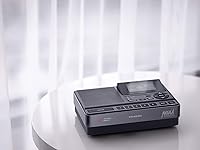
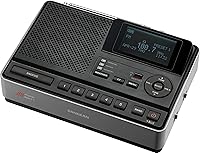
The Sangean CL-100 Weather Alert Radio has been a fixture in home preparedness setups since 2004, a run that speaks to a design that simply works. It carries NOAA and Public Alert certifications, meeting real government standards for emergency broadcasting rather than just marketing claims. Think of it as two devices in one: a workaday AM/FM clock radio for everyday use, and a certified alert system that can wake you at 3 a.m. when a tornado warning is issued for your county. Purpose-built utility is the right framing — if you want rich, room-filling sound, look elsewhere. If you want dependable, night-after-night reliability, this earns its spot on the nightstand.
Features & Benefits

What sets this weather alert radio apart from a basic NOAA receiver is S.A.M.E. technology. Rather than blaring alerts for an entire state or region, you can program up to 25 specific FIPS location codes, so you're only woken up for conditions that actually affect your area — a real advantage if you live in a large county where severe weather might be 80 miles away. It also stores up to 20 alert messages, letting you review warnings you slept through. Dual daily alarms let you choose radio or buzzer wake-up, with sleep and snooze timers included. An EEPROM backup keeps your 10 station presets intact even after a power outage.

Best For

This tabletop alert unit is a natural fit for anyone living in tornado alley, hurricane-prone coastal areas, or any region where weather turns dangerous fast. It's especially valuable for hearing-impaired users — the external alert port lets you connect a separate horn or flashing light, providing a physical warning that a speaker alone can't deliver. If you want one bedside device that handles your morning alarm and stands ready for overnight emergencies, this covers both. Rural households also benefit here, where NOAA radio coverage is often the most dependable emergency source. And if you prioritize certified hardware over relying on a cell signal, this fits that mindset well.

User Feedback

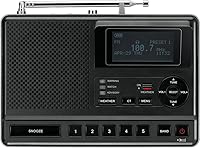
Long-term owners tend to be the most enthusiastic voices, frequently pointing to years of reliable use as the main reason they'd buy it again. Reception on all seven NOAA channels is consistently described as solid, and the EEPROM preset backup earns genuine appreciation from anyone who's lived through a power outage. That said, not all feedback is uniformly glowing. Programming FIPS codes can be fiddly for first-time users — the button layout isn't immediately intuitive, and the manual earns its keep. Audio quality is also a recurring caveat: the speaker is adequate for alerts and background radio, but if you're hoping for rich sound quality, you'll be disappointed.

Pros

  • NOAA and Public Alert certified — this isn't a marketing claim, it meets actual government standards.
  • S.A.M.E. filtering lets you program up to 25 local FIPS codes, so only relevant alerts wake you up.
  • Stores up to 20 past alert messages, so you can review warnings that triggered while you were asleep.
  • EEPROM backup keeps all your station presets intact after a power outage — no reprogramming needed.
  • The external horn and light alert port is a genuine lifeline for users with hearing impairments.
  • Dual daily alarms with both radio wake and buzzer options give real flexibility for everyday use.
  • Battery backup via 4 AA cells means the radio keeps working even when the power goes out.
  • Decades-long production run reflects a product that has held up under real-world conditions.
  • Covers all 7 NOAA weather channels with consistently reported solid reception.
  • Compact and lightweight at just over a pound — easy to position anywhere on a nightstand or shelf.

Cons

  • Programming FIPS location codes is not intuitive and will require reading the manual carefully.
  • Speaker audio quality is adequate but noticeably thin — not enjoyable for extended music listening.
  • The button layout feels dated and can be confusing until you've spent time with the unit.
  • No wireless connectivity — there is no Bluetooth, Wi-Fi, or app integration of any kind.
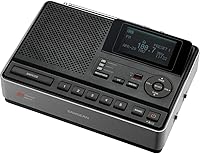
  • The LCD display, while functional, lacks the clarity and brightness of more modern screen designs.
  • Batteries are not included, which is a minor but notable omission for an emergency-preparedness device.
  • Alert tones can be jarring at full volume — there is limited control over alarm intensity levels.
  • The overall industrial aesthetic won't suit buyers who care about how a device looks in their bedroom.

Ratings

The scores below for the Sangean CL-100 Weather Alert Radio were generated by our AI system after analyzing verified purchase reviews from buyers worldwide, with spam, bot submissions, and incentivized feedback actively filtered out. Each category reflects the honest spread of real user experiences — strengths are acknowledged where earned, and genuine frustrations are not glossed over.
Alert Reliability
93%
Owners in storm-prone states consistently report that this tabletop alert unit triggers promptly and accurately when NOAA issues a warning for their programmed area. Many describe waking up to alerts during overnight severe weather events as proof the system does exactly what it promises.
A small number of users in areas with weak NOAA transmitter coverage note occasional missed or delayed alerts, though this is typically a signal strength issue rather than a hardware fault.
SAME Filtering Accuracy
88%
The ability to lock in up to 25 specific FIPS county codes is one of the most appreciated features among buyers who live in large geographic counties. Rather than being woken up by a warning issued for a region 100 miles away, users get alerts that are genuinely relevant to where they live.
The filtering only works as well as the codes you program in, and a handful of users report accidentally entering incorrect FIPS codes during setup — resulting in missed local alerts until the error was caught.
Ease of Setup
61%
39%
Basic AM/FM radio and clock functions are straightforward to configure, and most buyers are up and running with everyday radio use within minutes of unboxing the unit.
FIPS code programming is a recurring pain point — the button sequences are not intuitive, and multiple users describe spending 30 minutes or more with the manual just to get location filtering working correctly. First-time weather radio owners in particular find this hurdle frustrating.
Build Quality & Durability
84%
Long-term owners are among the most vocal advocates for this weather alert radio, with many reporting five or more years of daily use without hardware failures. The chassis feels solid for its weight class, and the controls hold up well over repeated use.
The plastic casing shows scuffs and surface wear more readily than the build quality might suggest, and a few buyers note that the tuning knob develops slight wobble after extended use.
Audio Quality
58%
42%
For spoken-word content — weather broadcasts, news radio, and talk programming — the built-in speaker delivers clear, intelligible audio at a volume level that fills a typical bedroom without distortion.
Music listening reveals the speaker's limitations fairly quickly; bass is thin and the overall sound lacks warmth at any treble or bass adjustment setting. Users who want a satisfying FM radio experience for music will likely be disappointed by what this unit offers.
Alert Message Logging
82%
18%
The ability to store and review up to 20 past alert messages is genuinely useful for households where someone might sleep through an overnight warning. Several users describe checking the log in the morning to understand what had triggered an alert during the night.
The message log interface is not the most navigable, and a few users find it difficult to quickly scan through stored alerts without inadvertently clearing them — a minor but real usability annoyance.
Power Backup Performance
87%
The AC-plus-battery hybrid power setup earns consistent praise from buyers in regions with frequent storm-related outages. The transition to battery power is seamless, and owners report the unit continuing to function and alert reliably during multi-hour outages.
Battery life under continuous operation is moderate rather than exceptional, and the fact that batteries are not included in the box is a small but noted frustration for buyers expecting a fully ready-to-use package.
EEPROM Preset Retention
91%
Buyers who have experienced power outages — a common scenario for the households most likely to own this radio — genuinely appreciate not having to reprogram their AM/FM presets afterward. It is a quiet feature that earns outsized loyalty from long-term users.
This feature works exactly as intended and draws very little negative feedback; the only minor gripe is that 10 total presets feels slightly limiting for users who regularly listen to a wider variety of stations.
Hearing Accessibility
86%
The external horn and light alert port is a standout feature that buyers purchasing for elderly relatives or hearing-impaired family members specifically seek out. Being able to connect a visual strobe or a louder external alarm transforms this into a genuinely accessible emergency device.
The external alert accessories themselves are not included and must be sourced separately, which adds cost and setup effort that some buyers are not aware of at the time of purchase.
Display Readability
72%
28%
The LCD dimmer and contrast controls are a thoughtful touch — users who keep the radio on a nightstand appreciate being able to reduce glare in a dark bedroom without switching off the display entirely.
The display itself is functional rather than modern; several buyers note the font size and overall contrast feel dated compared to newer devices, and it can be hard to read from across a room in bright daylight.
Value for Money
78%
22%
For buyers who specifically need NOAA certification, S.A.M.E. filtering, and a reliable alert system with battery backup, the Sangean CL-100 delivers a feature set that is difficult to match at a comparable price point from a certified manufacturer.
Buyers who are primarily looking for a quality clock radio and treating weather alerts as a secondary bonus may feel the price is harder to justify given the audio limitations — the value proposition is strongest when emergency preparedness is the primary use case.
Interface & Usability
63%
37%
Once the initial setup is complete and users have familiarized themselves with the button layout, day-to-day operation — changing stations, adjusting alarms, setting the clock — becomes fairly routine and manageable.
The learning curve is steeper than it should be for a device aimed partly at older adults and less tech-savvy buyers. Button labels are small, menu logic is not always intuitive, and the manual is dense rather than beginner-friendly.
Reception Quality
83%
On all seven NOAA weather channels, reception is consistently reported as clear and stable, even in rural areas with generally weaker broadcast infrastructure. The external antenna input options also provide a meaningful upgrade path for users with significant signal challenges.
AM reception in urban environments can pick up electrical interference, which is not unique to this radio but is a limitation some buyers note — particularly those using it near older household appliances.
Physical Footprint & Portability
74%
26%
At just over a pound and with a compact tabletop profile, this alert unit fits neatly on a nightstand or kitchen counter without dominating the space. The lightweight build also makes it easy to move between rooms.
The form factor is strictly tabletop — it is not designed for travel, camping, or outdoor use. Buyers hoping for a single device that covers both home and portable emergency scenarios will need to look at a separate handheld unit.

Suitable for:

The Sangean CL-100 Weather Alert Radio is purpose-built for anyone who takes emergency preparedness seriously and wants a dependable, always-on device rather than relying on a smartphone app that could lose signal or battery at the worst possible moment. It's a strong choice for families living in tornado-prone, hurricane-prone, or flood-risk areas where a certified NOAA alert can mean the difference between acting in time and being caught off guard. The S.A.M.E. location filtering makes it particularly practical for households in large counties, where a single statewide broadcast might cover weather events happening far from home. Older adults and people with hearing impairments will find real value in the external alert port, which supports connecting a separate flashing light or loud horn — a feature most competitors simply don't offer at this tier. Rural residents also benefit, since NOAA radio signals often reach areas where cell coverage is spotty or unreliable during severe storms.
Not suitable for:

The Sangean CL-100 Weather Alert Radio is not the right pick for buyers shopping primarily for a quality bedside audio experience. The built-in speaker delivers functional, intelligible sound — adequate for alerts and casual background listening — but it won't satisfy anyone expecting warm, room-filling audio from their clock radio. If your household is entirely urban, already well-covered by multiple cell emergency alert systems, and you have no specific preparedness concerns, the specialized feature set here may simply go underused. The FIPS programming process also requires patience and a willingness to consult the manual; buyers who want a fully intuitive out-of-the-box experience may find the initial setup frustrating. And if you need a portable, handheld option for camping or travel emergencies, this tabletop unit's footprint and form factor are not a match for that use case.
Specifications

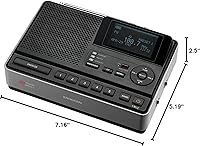
  • Dimensions: The unit measures 7.16″ long by 5.19″ wide by 2.5″ tall, making it compact enough for a nightstand or countertop without occupying excessive space.
  • Weight: At 1.1 pounds, the radio is lightweight and easy to reposition around the home as needed.
  • Power Source: Operates via the included AC adapter for continuous use, or 4 AA batteries (not included) for backup power during outages.
  • NOAA Channels: Receives all 7 designated NOAA Weather Radio channels, covering the full range of official U.S. weather broadcast frequencies.
  • SAME Technology: Supports S.A.M.E. (Specific Area Message Encoding) with up to 25 programmable FIPS location codes for county-level alert filtering.
  • Alert Types: Delivers three categories of S.A.M.E. alerts: Warning, Watch, and Advisory, each triggering the appropriate notification level.
  • Message Storage: Logs up to 20 received alert messages in memory, allowing users to review past warnings after the fact.
  • Station Presets: Stores 10 total station presets — 5 AM and 5 FM — with EEPROM backup that retains all presets after a power interruption.
  • Alarm System: Features dual independent daily alarms, each configurable to wake the user with AM/FM radio or a buzzer, plus sleep and snooze timer functions.
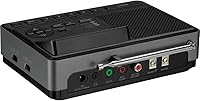
  • Audio Outputs: Includes a stereo headphone output jack and an auxiliary input for connecting an external audio source.
  • Antenna Inputs: Provides three dedicated external antenna connection terminals — one each for AM, FM, and Weather reception — for improved signal in weak-coverage areas.
  • Alert Port: Equipped with an external horn or light alert connection, allowing users to link a visual strobe or loud external alarm for enhanced notification.
  • Display: An LCD screen with adjustable dimmer and contrast controls allows comfortable viewing in both bright daylight and dark bedroom environments.
  • Audio Controls: Includes independent bass and treble adjustment controls for basic tonal customization of the speaker output.
  • Certifications: Officially certified by NOAA, the Public Alert program, and compliant with S.A.M.E. broadcast standards for emergency weather alerting.
  • Radio Bands: Tunes across AM and FM broadcast bands in addition to all NOAA Weather Radio frequencies, functioning as a full-featured everyday radio.
  • Tuner Technology: Uses a digital AM/FM-RBDS tuner, which can display station name and program information on supported FM broadcasts.
  • Ground Terminal: Includes a ground terminal connection, useful for reducing interference and improving reception in electrically noisy environments.
  • Manufacturer: Designed and produced by Sangean, a Taiwanese electronics manufacturer with a long-standing specialization in radio and audio products.
  • Availability: First introduced in July 2004 and currently listed as not discontinued, indicating active production and ongoing manufacturer support.

Related Reviews

Sangean H205TQ Portable AM/FM/Weather Alert Radio
85%
88%
Build Quality & Durability
81%
Sound Quality
90%
Ease of Use
72%
FM Reception
85%
Battery Life
More
Sangean DT-800BK AM/FM/NOAA Weather Alert Pocket Radio
77%
88%
AM/FM Reception Quality
91%
NOAA Weather Alert Reliability
93%
Portability & Form Factor
67%
Build Quality & Durability
72%
Battery Life
More
Sangean LB-100 Rugged AM/FM Radio
77%
93%
Build Quality
88%
Reception Quality
86%
Speaker Performance
91%
Durability Over Time
84%
Ease of Use
More
TFTDOUP Emergency Weather Alert Radio
86%
88%
Overall Performance
85%
Battery Life
90%
Charging Options
80%
Ease of Use
87%
Build Quality
More
Sangean TB-100 Toughbox Rugged AM/FM Radio
78%
93%
Build Quality
91%
Durability in Harsh Conditions
86%
Audio Performance
72%
AM/FM Reception
88%
Power Flexibility
More
Leaton Emergency NOAA Weather Alert Radio
85%
88%
Battery Life & Charging Options
85%
Weather Alerts & Reception
90%
Build Quality & Durability
93%
Portability & Size
87%
Ease of Use
More
Reecom R-1630C Weather Alert Radio
79%
91%
SAME Filtering Accuracy
88%
Battery Backup Reliability
86%
Alert Volume & Siren
61%
Setup & Programming Experience
89%
Event Memory & Countdown Timer
More
Sangean H201 Shower Radio
87%
91%
Waterproof Performance
87%
Sound Quality
89%
Portability & Design
92%
Ease of Use
67%
Battery Life
More
LIJIANI SH01 Portable NOAA Weather Radio
75%
83%
Reception Quality
81%
NOAA Weather Alert Performance
91%
Portability & Size
67%
Battery Life
88%
Ease of Use
More
Sangean U3 Jobsite Radio
87%
96%
Build Quality
94%
Water Resistance
88%
Audio Clarity
85%
Speaker Power
91%
Battery Flexibility
More

FAQ

The radio will receive all NOAA weather broadcasts automatically once it is powered on and set to a weather channel. However, to get the most out of it, you should take the time to program your specific county FIPS codes using the S.A.M.E. feature. Without that step, you will receive alerts for a much broader region than your immediate area, which can mean unnecessary interruptions.

Honest answer: it takes a little patience the first time. The button sequence is not immediately obvious, and most users find the manual essential for this step. Once it is set up, though, you rarely need to revisit it. Look up your county FIPS code on the NOAA website before you start, and the process will go much more smoothly.

Yes, that is one of the most practical aspects of this tabletop alert unit. Load four AA batteries and keep the radio plugged in normally — if AC power drops, it seamlessly switches to battery operation. Just remember the batteries are not included in the box, so pick some up when you buy the radio.

More than most radios at this price level, yes. The Sangean CL-100 Weather Alert Radio includes an external alert port specifically designed to connect a visual strobe light or a louder external horn. This means a hearing-impaired user does not have to depend solely on the built-in speaker — a genuinely useful design choice that is easy to overlook in the spec sheet.
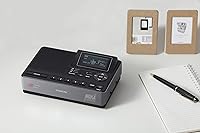
Functional, but not impressive. The speaker is clear enough for news, talk radio, and casual background listening. If you are expecting the warmth or volume of a dedicated bookshelf radio, you will likely be underwhelmed. The bass and treble controls help a little, but they cannot overcome the limitations of the small built-in driver.

Nothing — your presets are protected by EEPROM memory, which retains data without needing power. This is one of the features that long-term owners consistently appreciate, especially in areas with frequent outages.

Yes, the radio has dedicated external antenna jacks for AM, FM, and the Weather band separately, plus a ground terminal. If you are in a rural area or a building with poor signal penetration, running an external antenna can make a noticeable difference in reception quality.

It depends on your priorities. If you simply want reliable weather alerts and already receive Wireless Emergency Alerts on your phone without issue, the specialized feature set here may be more than you need. Where this radio earns its place is in situations where cell networks are overloaded or offline during a major storm — which happens more often than people expect.

The built-in speaker is reasonably loud for its size, and most users report it is sufficient to wake them from sleep. That said, if you are a particularly deep sleeper or have any hearing difficulty, connecting an external alert device through the horn port is a worthwhile precaution rather than relying on the internal speaker alone.

As of the most recent listings, the radio is not discontinued and Sangean continues to support it. Sangean has a reputation for standing behind their products, and the longevity of this particular model — in production since 2004 — suggests parts and service remain accessible. Checking Sangean's official website for warranty terms and regional support contacts is always the safest first step.

Where to Buy