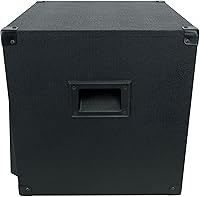
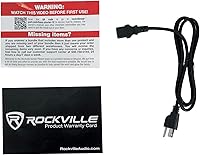
Overview

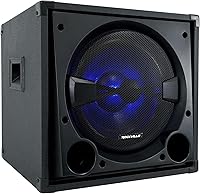
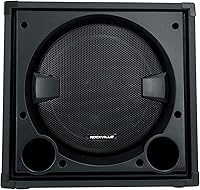
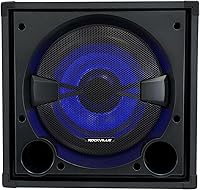
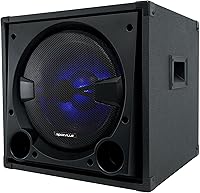
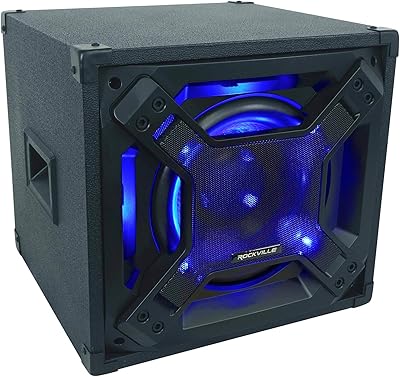
The Rockville Bass Blaster 12 Powered Subwoofer sits comfortably in the mid-range category — a 12-inch, self-amplified sub built for home theater fans and music listeners who want real bass impact without crossing into high-end pricing territory. It runs a 12-inch woofer paired with an onboard amplifier pushing 800W peak (400W RMS), all housed in an MDF enclosure wrapped in a vinyl leather finish. That cabinet construction is not just cosmetic — it signals a meaningful step above thin-walled budget boxes. This is a sub designed for small to medium listening rooms where punchy, consistent low-end matters more than audiophile-grade precision.

Features & Benefits

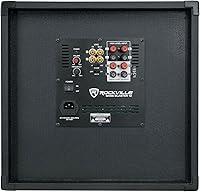
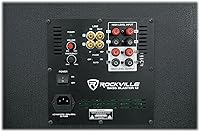
The Bass Blaster 12 puts its 800W peak amplifier to work through a 12-inch Y30 magnet woofer, and the combination produces a full, weighty low end that holds up well for movies and bass-heavy music. The adjustable crossover and 0/180-degree phase switch are genuinely useful — being able to flip phase or dial in the crossover point makes integrating this sub with mismatched speakers far less frustrating. Connectivity covers both RCA and speaker-level inputs and outputs, opening it up to AV receivers and basic stereo setups alike. There is also a sound-activated LED ring that pulses with audio — fun for gaming setups, easily switched off when it is not your thing. Voltage support spanning 110–240V is a quiet but practical bonus.

Best For

This Rockville sub hits a sweet spot for buyers setting up a home theater in a typical living room or apartment — not a dedicated acoustically treated space, but a real-world room where movies need some weight behind them. Gamers will appreciate the tactile punch it adds to explosions and low-frequency effects. If you listen to hip-hop, EDM, or pop and like your bass front and center, the Bass Blaster 12 delivers without requiring a complicated setup. It is also a smart pick for anyone running a basic stereo system that lacks a subwoofer output, since the speaker-level inputs remove that barrier entirely. Do not expect a flat audiophile response — this sub is tuned to impress.

User Feedback

Buyers consistently point to the bass impact as the standout strength, with many noting it fills a room more convincingly than they anticipated at this price tier. Setup tends to go smoothly, and the dual input options remove most of the guesswork for first-timers. On the critical side, some users flag a low-level hum during quiet passages, and a few find the crossover range limiting when blending with brighter satellite speakers. The LED lighting earns a mixed reception — welcome in gaming rooms, mostly ignored by home theater purists who just switch it off. At nearly 45 pounds, placement is a commitment; once positioned, most buyers leave it there. Long-term durability data remains thin, as most reviews reflect early impressions.

Pros

  • Delivers genuine, room-filling bass impact that punches above expectations for a mid-range subwoofer.
  • Both RCA and speaker-level inputs make hookup straightforward regardless of your existing receiver or amplifier.
  • The adjustable crossover and phase switch give you practical tuning options without requiring an external processor.
  • MDF cabinet construction feels solid and does a reasonable job keeping resonance in check during high-volume playback.
  • Sound-activated LED lighting is a fun bonus for gaming setups, and the on/off switch means it never overstays its welcome.
  • Wide voltage support across 110–240V means it works internationally without any additional hardware.
  • Setup is beginner-friendly — most users report getting audio out of it within minutes of unboxing.
  • At its price tier, the value-to-performance ratio is difficult to argue with for casual home theater use.
  • The 12-inch woofer size gives it low-frequency authority that smaller 8-inch or 10-inch budget subs cannot match.

Cons

  • A low-level hum has been reported by multiple users during quiet passages, which is noticeable in silent rooms.
  • At nearly 45 pounds, moving or repositioning this sub is a real physical effort — pick your spot carefully.
  • The crossover adjustment range may feel restrictive when trying to blend smoothly with brighter or more sensitive satellite speakers.
  • Long-term durability data is thin; most buyer reviews reflect impressions from the first few months of ownership.
  • The 85dB signal-to-noise ratio is adequate but not impressive — background noise can creep in on sensitive systems.
  • Bass tuning skews toward emphasis and punch rather than flat, accurate reproduction, which limits its appeal for critical listening.
  • The cabinet size is substantial relative to its output — compact living spaces may struggle to accommodate it comfortably.
  • The limited warranty offers less coverage assurance than competing units in the same price bracket from more established audio brands.

Ratings

The scores below reflect an AI-driven analysis of verified global buyer reviews for the Rockville Bass Blaster 12 Powered Subwoofer, with spam, bot-submitted, and incentivized feedback actively filtered out before scoring. Each category is rated based on patterns found in real purchase-verified opinions, capturing both what users consistently praised and the friction points that came up repeatedly. The results give an honest, unvarnished picture of where this powered subwoofer over-delivers and where it falls short.

Bass Output
83%
For a mid-range subwoofer at this price point, the low-end punch consistently impresses new owners. Movie explosions feel physical, and bass-heavy music genres like EDM and hip-hop have real weight to them in small to medium rooms. Most buyers describe the output as noticeably stronger than what they expected going in.
In larger or open-plan spaces, the Bass Blaster 12 starts to run out of authority — the room absorbs more than it can push. A handful of users also note the bass character leans toward boom rather than tight control, which can make complex low-end passages in music sound slightly muddled.
Value for Money
88%
The combination of a 12-inch woofer, onboard amplification, adjustable crossover, and dual input types at this price tier is genuinely hard to match. Buyers consistently point out that comparable output from a better-known brand would cost meaningfully more. For budget-to-mid-range buyers, the return on spend feels strong.
The value equation softens a little when you account for the sparse long-term reliability data. A subwoofer that needs replacing after two years is not the bargain it appeared to be up front. Buyers who prioritize verified durability may find the gap between this and pricier alternatives narrower than the sticker price suggests.
Setup & Connectivity
86%
The inclusion of both RCA and speaker-level inputs removes a major barrier for first-time subwoofer buyers who may not have a dedicated sub output on their receiver or amplifier. Most users report getting audio within minutes of unboxing, with no complicated configuration required to get a workable sound.
While setup is generally smooth, a subset of users encounters a low-level hum after connection that takes additional troubleshooting — usually a ground loop issue — to resolve. Instructions in the box are minimal, and buyers without prior experience diagnosing hum or interference may find the process frustrating.
Build Quality
71%
29%
The MDF cabinet with vinyl leather finish feels noticeably more solid than thin-walled plastic alternatives in the same price range. The detachable foam grille and poly cotton interior fill reflect a construction approach that goes beyond bare-minimum assembly, and the cabinet shows minimal flex even under heavy bass output.
Up close, the vinyl finish shows its limitations — seam alignment and corner finishing are inconsistent on some units, and it does not approach the look of premium wrapped cabinets. A few buyers have reported minor build issues like loose grille clips or visible cabinet imperfections out of the box.
Sound Tuning Controls
74%
26%
Having an adjustable crossover and a 0/180-degree phase toggle on a subwoofer at this price is genuinely useful — not just a checkbox feature. Buyers who take time to tune these controls report a noticeably better blend between the sub and their main speakers, especially when placement options are limited by their room layout.
The crossover's adjustment range is narrower than what more advanced users expect, and the controls themselves lack the fine-grained resolution of a parametric EQ. Users trying to integrate this sub with brighter or more demanding satellite speakers often find they cannot dial in a fully smooth transition.
Signal-to-Noise Ratio
63%
37%
At normal to high playback volumes in typical living room environments, the background noise floor is not intrusive. For movie watching and gaming sessions where ambient noise is present, the 85dB SNR is functional and most buyers will not actively notice it during content.
In quiet rooms during soft passages — late-night listening, ambient music, or dialogue-heavy scenes — a low-level hiss or hum can surface, and 85dB SNR is the underlying reason. Buyers with sensitive systems or those who listen at low volumes in very quiet spaces will likely find this noticeable.
LED Lighting
77%
23%
The sound-activated LED ring is a genuinely fun feature for gaming rooms and media dens — it reacts to bass pulses in a way that feels purposeful rather than purely decorative. The on/off switch means it is never forced on users who do not want it, which is the right call.
The LEDs are not customizable in color or pattern, which limits their appeal compared to RGB-capable competitors. A small number of buyers describe the glow as underwhelming in brighter rooms, noting it only has real visual impact in dimmer environments.
Room Suitability
79%
21%
In rooms up to roughly 300 to 350 square feet, this Rockville sub performs consistently well, delivering bass that fills the space without feeling strained. It handles typical home theater seating distances comfortably and works particularly well when placed near a corner or along a wall, which naturally reinforces output.
Push it into larger open-plan spaces or high-ceilinged rooms and the limitations become audible. Output that felt authoritative in a medium room begins to feel thin when it has to cover significantly more cubic footage, and there is no wireless or app-based volume compensation to compensate.
Weight & Portability
52%
48%
The 44.7-pound weight is partly a function of the MDF cabinet, which is heavier than alternatives but also more resonance-resistant. For buyers who place the sub once and leave it, the weight is essentially irrelevant to the day-to-day experience.
For anyone who rearranges their room, moves frequently, or is setting up in a space where they need to experiment with placement, nearly 45 pounds is a real inconvenience. Several buyers specifically flag that repositioning the sub for placement testing was physically awkward without a second person helping.
Low-Frequency Extension
68%
32%
The 12-inch woofer reaches deep enough to add satisfying weight to most mainstream content — action films, gaming soundtracks, and bass-forward music all benefit noticeably. For the typical home theater use case this sub targets, the extension is more than adequate.
The 200Hz upper frequency limit and the sub's tuning mean it does not extend cleanly into the deepest sub-bass registers the way larger or more expensive ported designs can. Listeners who specifically want to feel the lowest octave of cinematic content — around 20 to 30Hz — may find it falls slightly short.
Integration Flexibility
81%
19%
The pass-through outputs on both RCA and speaker-level connections mean this sub slots into existing systems without disrupting the signal chain. That flexibility is rare at this price and makes it genuinely compatible with a wide range of setups from basic two-channel stereo to multi-component home theater configurations.
There is no wireless connectivity or auto-on/off sensing based on signal detection, which some competing units at similar prices now offer. Buyers who want a more modern, low-friction integration will have to manually manage the power state or leave the sub running continuously.
Long-Term Reliability
58%
42%
Early ownership feedback is broadly positive — units typically arrive working correctly and hold up through the first months of regular use without obvious issues. Rockville's brand familiarity in the budget-to-mid audio space gives some buyers confidence in its continued support.
The pool of reviews covering extended ownership beyond six to twelve months is thin, making it difficult to assess how the amplifier plate and driver hold up over years of use. The limited warranty provides less reassurance than the longer-term coverage offered by some competing brands, and that uncertainty is reflected in the score.
Volume Control & Gain
72%
28%
The onboard gain control is straightforward and responsive — turning it up or down produces predictable results across the listening range. Buyers generally find it easy to match the sub's output level to their main speakers without going through repeated trial-and-error adjustments.
At high gain settings, some users report a compression effect where the sub's output starts to plateau rather than scale linearly, which limits headroom during very dynamic content. There is no remote volume control, so any adjustments require physically reaching the unit.

Suitable for:

The Rockville Bass Blaster 12 Powered Subwoofer is a strong match for anyone building or upgrading a home theater setup in a small to medium-sized room where cinematic bass impact matters but budget is a real consideration. Gamers will find it particularly rewarding — the 12-inch woofer adds physical weight to in-game explosions and low-frequency effects that smaller subs simply cannot reproduce convincingly. Casual music listeners who favor bass-forward genres like hip-hop, EDM, or pop will get satisfying output without having to spend significantly more. The dual input options — RCA and speaker-level — make this powered subwoofer genuinely accessible to people running basic stereo setups without a dedicated subwoofer output, removing a barrier that trips up many first-time sub buyers. If you want something that looks the part in a gaming room or media den and delivers real low-end presence, this Rockville sub covers that ground well.

Not suitable for:

The Rockville Bass Blaster 12 Powered Subwoofer is not the right tool for listeners who prioritize accuracy, tonal neutrality, or a flat frequency response — its tuning leans toward impact over precision, which audiophiles will find unsatisfying. The 85dB signal-to-noise ratio is acceptable for casual listening, but in a quiet room during soft passages, some users have reported detecting a low-level hum that more discerning ears will notice. At nearly 45 pounds and with dimensions exceeding 16 inches on each side, this is not a sub you reposition casually — buyers in tight spaces or those who rearrange their rooms frequently should factor that in. Anyone expecting the phase and crossover controls to offer the fine-grained precision of a higher-end unit may find the adjustment range limiting when integrating with more demanding speaker setups. Long-term reliability data is also sparse, so buyers seeking a well-documented track record for durability may want to look at more established alternatives.

Specifications

  • Peak Power: The amplifier delivers 800W peak output, providing strong headroom for dynamic bass-heavy content like action films and bass-forward music.
  • RMS Power: Continuous RMS power is rated at 400W, which reflects the sustained, real-world output during normal listening conditions.
  • Woofer Size: The 12-inch dynamic driver is paired with a Y30 magnet for efficient low-frequency reproduction across a range of content types.
  • Frequency Response: The subwoofer is rated up to 200Hz, meaning it handles deep bass frequencies and hands off cleanly to your main speakers at the crossover point.
  • Signal-to-Noise Ratio: An 85dB SNR is adequate for casual home theater and music use, though faint background noise may be perceptible on very sensitive systems in quiet rooms.
  • Impedance: The driver operates at 4 ohm impedance, which is a standard load compatible with the onboard amplifier and typical home audio configurations.
  • Inputs: Both RCA line-level and speaker-level inputs are provided, allowing connection to AV receivers, stereo amplifiers, and systems without a dedicated subwoofer output.
  • Outputs: Matching RCA and speaker-level outputs allow the signal to pass through to additional components, supporting more flexible system configurations.
  • Crossover: An onboard adjustable crossover lets you set the frequency cutoff point to blend the subwoofer smoothly with your existing speakers.
  • Phase Switch: A 0/180-degree phase toggle helps align the subwoofer's output with your main speakers to avoid bass cancellation caused by room placement.
  • Enclosure: The cabinet is constructed from MDF with a vinyl leather exterior finish, providing a more resonance-resistant build than thin-walled plastic or particle board alternatives.
  • Cabinet Fill: Fire-resistant poly cotton fill inside the enclosure helps dampen internal reflections and reduce audible distortion at higher volume levels.
  • LED Lighting: A built-in sound-activated LED ring pulses in response to audio playback and can be disabled via a dedicated on/off switch.
  • Voltage: The unit supports 110–240V input, making it compatible with both North American and international power standards without requiring a separate converter.
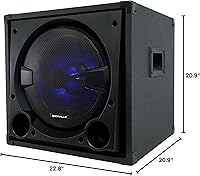
  • Dimensions: Physical dimensions are 15.9″ deep by 16.7″ wide by 20.9″ tall, requiring a dedicated floor or shelf space of at least 17 by 16 inches.
  • Weight: The subwoofer weighs 44.7 pounds, which should be factored into placement decisions and will typically require two people for safe repositioning.
  • Mounting Type: The unit is designed for tabletop or floor placement and does not include hardware for wall or in-wall installation.
  • Warranty: Rockville provides a limited warranty with this subwoofer; buyers should confirm the specific duration and coverage terms directly with the manufacturer.

Related Reviews
Rockville Bass Blaster 10
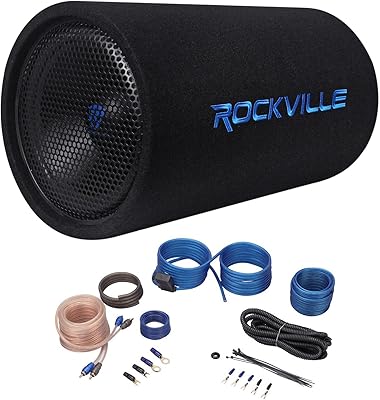
77%
78%
Bass Performance
83%
Build Quality
76%
Amplifier & Power Delivery
81%
Tuning & Customization
87%
Connectivity & Compatibility
More
Rockville RTB12A 12-Inch Powered Car Subwoofer
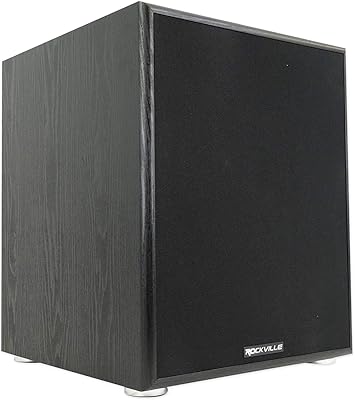
72%
78%
Bass Impact
86%
Ease of Installation
81%
Value for Money
61%
Build Quality
63%
Sound Quality
More
Rockville RWS12CA 12-inch Powered Car Subwoofer
78%
91%
Ease of Installation
78%
Bass Quality
83%
Value for Money
74%
Build Quality
58%
Thermal Management
More
Rockville Rock Shaker 12 Powered Subwoofer
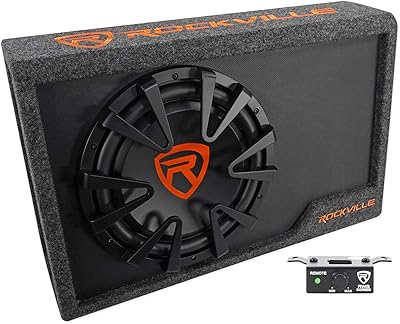
78%
88%
Bass Output
91%
Value for Money
83%
Build Quality
79%
Ease of Setup
86%
Crossover Flexibility
More
Rockville Wheel of Bass 8″ Powered Subwoofer
74%
89%
Ease of Installation
67%
Fit & Clearance Compatibility
72%
Bass Output & Impact
84%
Sound Tuning Flexibility
76%
Remote Bass Knob Usability
More
Acoustic Audio PSW500-12 12-Inch Powered Subwoofer
73%
83%
Bass Output for Price
88%
Ease of Setup
86%
Value for Money
67%
Build Quality
71%
Sound Quality
More
JBL SUBBP12AM 12-inch Powered Subwoofer
75%
86%
Bass Output Quality
81%
Ease of Installation
78%
Amplifier Performance
67%
Long-Term Durability
73%
Value for Money
More
Rockville MS12LW 12-inch Marine Subwoofer
71%
74%
Bass Performance
67%
Build Quality
52%
Water Resistance
88%
Installation Ease
81%
Value for Money
More
Rockville RTB10A 10-inch Powered Subwoofer
74%
83%
Value for Money
88%
Ease of Installation
74%
Bass Performance
47%
Power Accuracy
84%
Form Factor
More
Rockville Destroyer 12D1 12″ Car Subwoofer
81%
93%
Bass Output & SPL Performance
88%
Build Quality & Materials
91%
Voice Coil Durability
89%
Magnet Structure & Motor Strength
82%
Enclosure Compatibility & Flexibility
More

FAQ

It depends on what outputs your TV has. If your TV includes RCA audio outputs or a 3.5mm audio-out port (with an adapter), you can connect this Rockville sub directly. Most modern TVs route audio through an optical or HDMI ARC connection, which would require an AV receiver or a DAC with RCA outputs in between. Check your TV's rear panel before assuming a direct connection will work.

The RCA input is for line-level signals, which is what an AV receiver's subwoofer output or a stereo receiver's preamp output produces. The speaker-level input takes the amplified signal coming out of your receiver's regular speaker terminals, which is useful if your receiver has no dedicated subwoofer or RCA preamp output. Both options get audio to the sub — the speaker-level path just handles a different type of signal.

Honestly, it performs best in small to medium-sized rooms. In a large open-plan space, the 400W RMS output may feel underwhelming because bass dissipates quickly across open square footage. For a room under roughly 300 to 400 square feet, it should fill the space comfortably at moderate to high volume levels.

A low-level hum is often caused by a ground loop in the audio chain rather than a defect in the subwoofer itself. Try plugging all your audio components into the same power strip or surge protector, and make sure your cable connections are secure and fully inserted. A ground loop isolator (an inexpensive inline adapter) placed on the RCA cable often resolves the issue if the problem persists.

Yes, that is exactly what the speaker-level inputs are designed for. You connect speaker wire from your amplifier's speaker output terminals directly into the Bass Blaster 12's speaker-level inputs, and the subwoofer's internal circuitry filters out the bass frequencies it needs. You can then use the pass-through outputs to continue feeding your main speakers from the same signal.

A good starting point is to set the crossover frequency roughly 10Hz above the lowest frequency your main speakers can reliably reproduce. For example, if your bookshelf speakers are rated down to 80Hz, start the crossover around 90Hz and adjust by ear until the bass sounds integrated rather than localized or boomy. Small adjustments and listening tests are more reliable than fixed rules.

There is a dedicated on/off switch for the LED, so you have full control. When enabled, the lights pulse in response to audio — they react to the bass signal rather than staying static. If you find it distracting or just prefer a clean look, switching it off has no effect on audio performance.

For a sealed or ported MDF cabinet at this size, mid-40-pound weight is fairly normal. That said, most people place this kind of sub on the floor rather than a shelf — both for safety and because floor placement near a corner or wall tends to reinforce bass output. If you do shelf-mount it, make sure the shelf is rated for at least 60 pounds to give yourself a safe margin.

Yes, it can make a meaningful difference depending on where the subwoofer sits relative to your main speakers. When the sub and speakers are on opposite sides of a room boundary, their bass waves can partially cancel each other, making the low end sound thin. Switching to 180 degrees reverses the sub's waveform, which can restore bass fullness. Listen to a bass-heavy track, flip the switch, and go with whichever position sounds fuller and more cohesive.

It is tuned to emphasize impact, which works well for movies and gaming where you want to feel the low end. For music, it depends heavily on your taste — hip-hop, EDM, and pop benefit from that kind of emphasis, while acoustic, jazz, or classical listeners may find the bass coloring a bit heavy-handed. It is not a neutral, reference-style sub, but for bass-forward listening it holds up well at this price point.