Overview

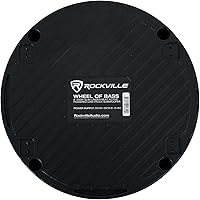
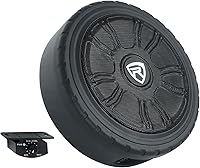
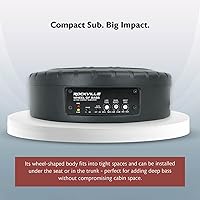
The Rockville Wheel of Bass 8″ Powered Subwoofer is Rockville's answer to a very real problem: you want more bass, but you have nowhere to put a full enclosure. At just over three inches tall, this under-seat sub slides beneath most car or truck seats without eating into your cargo space or passenger room. The built-in amplifier is a genuine convenience — no separate amp to mount, no extra wiring runs to plan. It sits at a mid-range price that makes it a realistic first step up from a factory audio system, and since its 2022 launch it has built a respectable following in the competitive car subwoofer category.
Features & Benefits

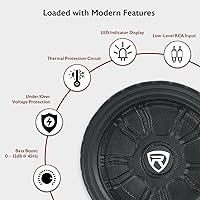
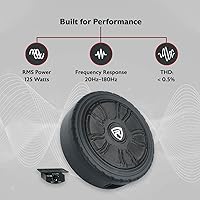
Power figures in car audio can be misleading, and the Wheel of Bass is no exception — the 500W peak number is a marketing ceiling, not a sustained rating. The 125W RMS figure is the one that actually matters, and for an 8-inch driver in a compact enclosure, it delivers a noticeable low-end kick rather than earth-shaking volume. What really stands out is the tuning flexibility: the adjustable bass boost, a variable low-pass filter across a wide frequency range, and a phase switch let you dial things in without touching the unit itself. The remote knob handles the rest from your seat. The cast aluminum shell also manages heat better than typical plastic boxes, which matters during long drives.

Best For

This compact powered subwoofer makes the most sense for truck and SUV owners who refuse to give up trunk or bed space for a full box setup. It also suits the daily commuter crowd — people who want noticeably better audio but aren't ready to commit to a full car audio build. If you're new to aftermarket audio and the idea of matching a separate amp and subwoofer sounds daunting, the single-unit install here removes most of that friction. It's also a decent fit for compact car owners with shallow trunk depth, provided your seat sits high enough off the floor to accommodate the enclosure. Bass-heavy listeners who like to fine-tune their sound rather than accept a fixed output will appreciate the onboard controls.

User Feedback

With a 4.1-star average across over 130 ratings, the Wheel of Bass earns its marks — but the picture is mixed. Buyers consistently praise the straightforward install, with many noting they had it running within an hour without professional help. The compact fit under a full-size truck seat is a recurring highlight. On the flip side, some owners with lower-profile car seats find the enclosure tighter than expected, so checking your clearance before ordering is worth the effort. A handful of reviews also raise questions about long-term reliability, and a few buyers note that the remote knob cable could be longer for certain dashboard placements. Taken together, it's a solid result for the price, with expectations properly set.

Pros

  • No separate amplifier needed — the all-in-one design dramatically simplifies installation for beginners.
  • Slides under most truck and SUV seats without sacrificing passenger or cargo space.
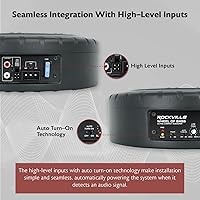
  • Compatible with factory head units via high-level inputs, so no head unit swap is required.
  • The remote bass knob lets you adjust output from the driver seat without touching the unit.
  • Auto turn-on signal detection means no additional wiring for a remote turn-on lead.
  • Adjustable low-pass filter and phase switch allow real integration with existing door speakers.
  • Cast aluminum enclosure resists vibration and handles heat better than typical plastic-shell competitors.
  • A noticeable step up from stock audio for commuters who mostly stream music throughout the day.
  • Subsonic filtering protects the driver from over-excursion on frequencies it cannot cleanly reproduce.

Cons

  • The remote knob cable is short enough to cause routing headaches in some vehicle layouts.
  • Fitment in low-profile sedans or sport cars with bolstered seats is far from guaranteed — measure first.
  • Pushing volume levels hard in smaller car cabins reveals compression and occasional distortion.
  • Installation documentation is thin, leaving first-timers to rely on online tutorials for gain setup.
  • The internal amp has a limited reliability track record beyond the 12-to-18-month mark based on early owner reports.
  • Auto turn-on can be finicky with factory amplified systems that output low speaker voltages.
  • Bass boost above moderate levels produces a one-note quality that muddies the overall sound.
  • Limited warranty coverage offers little protection if amp-related issues surface after the coverage window closes.

Ratings

The Rockville Wheel of Bass 8″ Powered Subwoofer has been scored across 12 performance categories by our AI rating engine, which processed verified global buyer reviews while actively filtering out incentivized, bot-generated, and duplicate feedback. The scores below reflect an honest, balanced picture — genuine strengths are recognized, but recurring frustrations from real owners are given equal weight and transparency.
Ease of Installation
89%
A large share of buyers — including those with zero prior car audio experience — report getting this under-seat sub running within an hour using only basic tools. The auto turn-on feature and dual high/low-level inputs mean it connects directly to factory head units without hunting for a remote wire.
A handful of users note that the included wiring instructions could be clearer, particularly around gain setting. Those with more complex aftermarket systems sometimes find the auto turn-on sensitivity needs adjustment before it stops cutting in and out.
Fit & Clearance Compatibility
67%
33%
In full-size trucks and larger SUVs the just-over-three-inch enclosure height genuinely disappears beneath the seat, leaving passenger legroom and cargo space untouched. Owners of mid-size pickups and crossovers consistently report a clean, hidden install.
Low-riding sedans and sport-oriented cars with bolstered, low-profile seats present real fitment problems. Some buyers discover the enclosure does not slide fully under their seat only after purchase, making pre-buy seat measurement absolutely essential rather than optional.
Bass Output & Impact
72%
28%
For daily commuters upgrading from a factory system, the improvement is immediately noticeable on bass-heavy tracks — kick drums hit with more authority and low-end synth lines fill out in a way stock speakers simply cannot reproduce. Hip-hop and EDM listeners in particular respond positively.
Expectations anchored to the peak power figure will likely lead to disappointment. The sustained output is more modest, and in larger cab vehicles like crew-cab trucks, the sub can sound thin at higher volumes. It is a meaningful step up from factory audio, not a replacement for a dedicated box build.
Sound Tuning Flexibility
84%
The combination of an adjustable low-pass filter, a phase switch, and a bass boost that covers a useful range gives owners genuine control over how the sub integrates with their existing speakers. Switching between a tight, punchy rock setting and a deeper, slower roll-off for R&B takes only a minute at the remote knob.
The bass boost, if pushed too high, introduces a one-note quality that muddies the mid-bass. Users without prior experience tuning car audio can easily over-boost and mistake the resulting distortion for a hardware problem, especially on lower-quality source material.
Remote Bass Knob Usability
76%
24%
Having real-time bass control reachable from the driver seat without touching the unit itself is a practical convenience that owners appreciate, especially when switching between spoken-word content and music during a commute. The knob action is smooth and responsive.
The cable length connecting the remote knob to the unit is a recurring complaint — it falls short in some dashboard and center console configurations, forcing awkward routing or a less accessible mounting position. A longer default cable would resolve most of these complaints.
Build Quality
81%
19%
The cast aluminum enclosure genuinely feels more substantial than the pressed-wood or thin plastic shells common at this price tier. It handles road vibration without developing rattles, and the unit stays cool even after extended highway use, which gives owners confidence in daily-driver reliability.
Some buyers note that the external finish shows scuffs and minor marks relatively easily, which matters less when the unit is hidden under a seat but is noticeable during installation. A few long-term owners also question whether the internal amp components match the durability of the enclosure itself.
Value for Money
78%
22%
When you factor in that the amplifier is already built in, the all-in cost compares favorably to buying a bare subwoofer and a separate compact amp. For first-time buyers who want a tangible bass upgrade without a full system budget, the price-to-improvement ratio is difficult to argue with.
Buyers who have owned higher-end powered subs will notice the ceiling on output quality fairly quickly. At close to the same investment, a few competing units offer slightly more usable RMS power, which makes the value proposition dependent on how much you prioritize install simplicity over raw performance.
Compatibility with Factory Systems
86%
The high-level input option is the key feature here — it lets the sub tap directly into existing speaker wiring without needing an aftermarket head unit, which is the main barrier for buyers who want more bass but are not ready to replace their factory radio.
Auto turn-on sensitivity can be finicky with some factory amplified systems that use low-voltage speaker outputs, occasionally causing the sub to power cycle or not wake up reliably. Manual adjustment of the input sensitivity helps, but the process is not well-documented in the included materials.
Low-Frequency Extension
69%
31%
The subsonic filter keeps the driver from straining on truly sub-bass frequencies it cannot physically reproduce, which results in cleaner output in the audible range. Tracks with prominent mid-bass content — funk, classic rock, certain EDM subgenres — benefit noticeably from this protection.
True deep bass extension below around 40Hz is not a realistic expectation from this configuration. Listeners who want that chest-pressure, theater-style sub experience will not find it here; the physical constraints of an 8-inch under-seat unit simply do not allow for meaningful output at the lowest frequencies.
Noise & Distortion at Volume
63%
37%
At moderate listening levels the sub runs cleanly and integrates reasonably well with mid-range door speakers. Users who keep the bass boost conservative and the volume at two-thirds or less report no meaningful distortion during daily use.
Pushing the unit hard — particularly in smaller, more resonant car cabins — reveals compression and some breakup at upper volume settings. The enclosure also occasionally picks up sympathetic vibrations from nearby trim panels, which adds a buzzing artifact that is difficult to track down and eliminate.
Package Contents & Documentation
58%
42%
The inclusion of mounting hardware and a remote bass knob in the box means buyers do not need to source additional accessories before getting started, which keeps the out-of-the-box experience relatively complete for a budget-to-mid install.
The installation documentation is thin — diagrams are basic and gain-setting guidance is nearly absent. First-time installers frequently turn to third-party video tutorials rather than the included materials, which is a real gap at a price point where buyer experience levels vary widely.
Long-Term Durability
66%
34%
The aluminum shell holds up well to the physical demands of daily driving — road vibration, temperature swings, and the occasional bump during off-road use do not appear to compromise the enclosure's structural integrity based on owner reports spanning one to two years of use.
Longer-term reliability of the internal amplifier board is harder to assess given the product's relatively short market history. A subset of buyers report amp-related failures after 12 to 18 months, and the limited warranty coverage leaves those owners with limited recourse once that period expires.

Suitable for:

The Rockville Wheel of Bass 8″ Powered Subwoofer is built for people who want a meaningful bass upgrade without committing to a full car audio overhaul. Truck and SUV owners are the natural sweet spot — the slim enclosure slides cleanly beneath most bench or bucket seats in larger vehicles, leaving cargo space and rear legroom completely intact. Daily commuters who are tired of flat, bass-deficient factory audio will find the improvement noticeable from the first drive, especially on bass-heavy playlists. It also makes a strong case for first-time subwoofer buyers specifically because the built-in amplifier removes one of the biggest installation hurdles; you are not matching an external amp to a bare driver, you are simply running power and signal to a single unit. If you drive a compact car with a shallow trunk but decent under-seat clearance, this compact powered subwoofer offers an installation path that a traditional box setup simply cannot.
Not suitable for:

The Rockville Wheel of Bass 8″ Powered Subwoofer is not the right call for buyers chasing serious, high-output bass performance. The sustained power output is moderate — enough to improve on factory speakers, but nowhere near what a purpose-built enclosure with a dedicated external amplifier can produce. Serious audio enthusiasts who already own or plan to build a proper sub-and-amp setup will find this under-seat sub underwhelming by comparison. Buyers driving low-profile sedans or sport cars with heavily bolstered seats that sit close to the floor should measure their clearance carefully before ordering, as the enclosure height that works in a pickup truck may not fit at all in their vehicle. Anyone expecting the advertised peak power figure to reflect real-world output will also be disappointed — that number represents a momentary ceiling, not the sustained performance that defines how the unit actually sounds day to day. If long-term reliability and a comprehensive warranty are top priorities, the limited coverage here may give cautious buyers pause.

Specifications

  • Driver Size: The unit houses an 8-inch dynamic driver responsible for producing the low-frequency output.
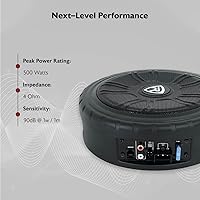
  • Peak Power: The amplifier is rated at 500W peak, representing the absolute maximum momentary power the unit can handle under ideal conditions.
  • RMS Power: Continuous (RMS) power output is 125W, which is the practically relevant figure for everyday listening performance.
  • Impedance: The driver is wound to a 4 Ohm impedance, which is the standard load for the built-in amplifier.
  • Enclosure Height: The enclosure stands just over 3.15 inches tall, allowing fitment beneath most truck and SUV seats.
  • Dimensions: Full product dimensions measure 12.9″ deep by 32″ wide by 24.9″ tall including mounting hardware context.
  • Weight: The complete unit weighs 9.85 pounds, which is manageable for a single-person install in most vehicle configurations.
  • Enclosure Material: The outer shell is constructed from cast aluminum, chosen for its vibration resistance and passive heat dissipation properties.
  • Input Types: Both high-level (speaker-level) and low-level (RCA) inputs are provided, covering factory head unit and aftermarket deck compatibility.
  • Turn-On Method: The unit activates automatically by detecting the incoming audio signal, eliminating the need to wire a dedicated remote turn-on lead.
  • Low-Pass Filter: An adjustable low-pass filter sweeps from 50Hz up to 180Hz, allowing the crossover point to be matched to the existing speakers.
  • Bass Boost: An onboard bass boost control adds up to 12dB of gain centered at 45Hz for enhanced low-end punch on music with heavy bass content.
  • Subsonic Filter: A fixed subsonic filter rolls off frequencies below 20Hz, protecting the driver from over-excursion on inaudible ultra-low content.
  • Phase Switch: A two-position phase switch toggles between 0 degrees and 180 degrees to align the subwoofer acoustically with the door speakers.
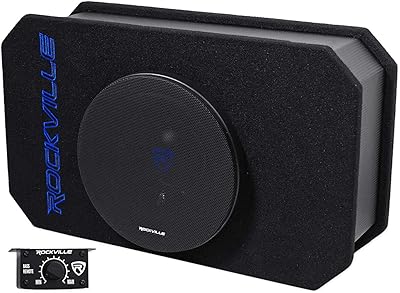
  • Remote Knob: A wired remote bass knob is included in the box, allowing real-time output adjustment from the driver seat without accessing the unit.
  • Audio Output Mode: The built-in amplifier operates in mono output mode, which is standard and appropriate for subwoofer-only bass reinforcement.
  • Power Source: The unit draws power directly from the vehicle's electrical system via a corded wired connection — no battery or wireless power option exists.
  • Mounting Type: The unit is designed specifically for under-seat mounting and includes the necessary hardware to secure it to the vehicle floor.
  • Compatible Vehicles: The manufacturer lists cars and trucks as the intended compatible vehicle types, with trucks and SUVs being the most practical fit given the enclosure height.
  • Warranty: Rockville provides a limited warranty with this unit; buyers should confirm the exact duration and claim process directly with the manufacturer before purchase.

Related Reviews
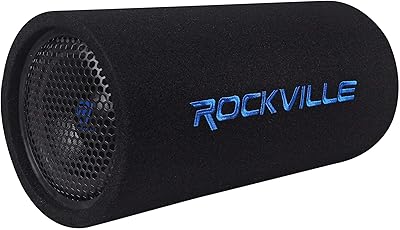
Rockville RTB80A 8″ Powered Car Subwoofer
69%
88%
Ease of Installation
71%
Bass Output
82%
Value for Money
67%
Build Quality
44%
Power Accuracy
More
Rockville Rock Shaker 8″ Powered Subwoofer
75%
83%
Bass Output for Size
88%
Value for Money
91%
Ease of Setup
74%
Build Quality
86%
Connectivity Flexibility
More
Rockville Bass Blaster 10
77%
78%
Bass Performance
83%
Build Quality
76%
Amplifier & Power Delivery
81%
Tuning & Customization
87%
Connectivity & Compatibility
More
Rockville RMW8A 8″ 800W Powered Truck Subwoofer
85%
90%
Bass Performance
88%
Ease of Installation
85%
Sound Clarity
89%
Build Quality
91%
Portability & Size
More
Rockville BASS Blaster 12 Subwoofer
84%
89%
Bass Performance
83%
Sound Customization
75%
LED Lighting Feature
90%
Build Quality
92%
Value for Money
More
Rockville RTB10A 10″ Powered Subwoofer
83%
91%
Sound Quality
88%
Bass Performance
75%
Ease of Installation
86%
Build Quality
82%
Durability
More
Kanto SUB8 8-inch Powered Subwoofer
80%
89%
Bass Accuracy
67%
Low-End Extension
91%
Speaker Integration
83%
Build Quality
86%
Setup & Ease of Use
More
Rockville RMW8P 8″ Shallow Car Subwoofer
75%
78%
Bass Output
91%
Space Efficiency
83%
Value for Money
81%
Ease of Installation
62%
Build Quality
More
Rockville RTB65A 6.5″ Powered Car Subwoofer
69%
83%
Ease of Installation
71%
Bass Performance
54%
Build Quality
67%
Value for Money
81%
Input Compatibility
More
Audioengine S8 Subwoofer
84%
93%
Bass Accuracy & Musicality
94%
Build Quality
91%
Integration & Setup Ease
86%
Crossover Flexibility
89%
Low-Frequency Extension
More

FAQ

It depends heavily on your specific vehicle. The enclosure is just over three inches tall, which clears comfortably under most full-size truck and SUV seats. However, if you drive a sport sedan or a car with heavily bolstered, low-profile seats, that clearance can disappear fast. Before ordering, take a tape measure and check the gap between your seat rail and the carpet — three and a half inches of clear space is the safe minimum to work with.

No — the amplifier is already built into the enclosure. That is the main selling point of the Rockville Wheel of Bass 8″ Powered Subwoofer: you just run a power wire, a ground wire, and your audio signal to the unit, and you are done. There is no separate amp to mount or match.

Yes, and this is one of the more practical features of this under-seat sub. It includes high-level inputs that tap directly into your existing speaker wiring, so you do not need an aftermarket head unit or an RCA output to make it work. Most buyers with factory radios use this method without any issues.

The unit monitors the incoming audio signal and powers itself on when it detects music playing, then shuts off when the signal stops. In most setups it works without any fuss. The main exception is certain factory-amplified systems that output a very low speaker voltage — in those cases the detection threshold can be borderline and the sub may not wake up consistently, which usually requires a small adjustment to the input sensitivity.

The 500W figure is a peak rating, meaning the absolute maximum the unit can handle for a fraction of a second under perfect conditions. The number that reflects real-world, sustained listening performance is the RMS rating, which is 125W. That is still enough for a noticeable bass improvement over factory speakers, but it is important to go in with calibrated expectations rather than picturing a competition-level setup.

Most first-timers report getting it done in under two hours with basic tools and a YouTube tutorial. The main runs are a power wire from the battery, a ground to nearby bare metal, and either a speaker wire tap or an RCA cable from the head unit. The auto turn-on means you skip the remote wire step entirely, which removes one of the trickier parts of a typical sub install.

The remote bass knob that comes in the box handles that. You mount the knob somewhere accessible — typically on the dash or center console — and it gives you real-time control over the bass level without touching the unit itself. The one complaint worth flagging is that the knob cable can be on the short side for some vehicle layouts, so plan your routing before committing to a mounting spot.

At moderate volume levels, most owners report no sympathetic rattling. If you push the bass boost hard or run the volume near its ceiling in a smaller cabin, loose trim panels can start to buzz — that is true of any sub at this output level, not a specific flaw in this unit. Starting with the bass boost conservatively set and working up gradually is the best way to find your vehicle's rattle threshold.

The phase switch flips the acoustic output of the subwoofer by 180 degrees. In practical terms, it helps align the bass from the sub with the bass coming from your door or dash speakers so they reinforce rather than partially cancel each other. To find the right setting, play a bass-heavy track at medium volume, flip the switch, and listen for whichever position sounds fuller and louder — that is the correct phase for your specific install geometry.

Aluminum does offer real advantages over thin plastic — it dissipates heat from the built-in amp more effectively, and it does not flex or resonate under vibration the way cheaper materials can. Compared to MDF (the wood composite used in quality traditional enclosures), aluminum is arguably a lateral move acoustically, but for an under-seat powered unit it is a sensible material choice. Owners who have had it for a year or more generally confirm the build holds up to daily driving without developing new rattles or structural issues.

Where to Buy