Overview

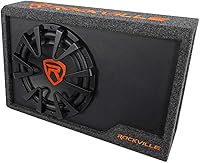
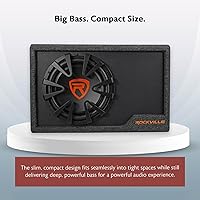
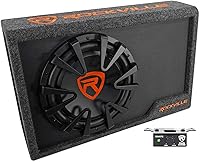
The Rockville RWS12CA 12-inch Powered Car Subwoofer is built for one specific type of driver: someone who wants real bass without rewiring half their car. Its defining characteristic is the slim enclosure — thin enough to slide under a rear seat or tuck into a shallow trunk without eating up cargo space. Rockville has built a solid following among budget-conscious audio enthusiasts, and this all-in-one car bass system sits in the mid-range tier — more capable than the cheapest plug-and-play options, but not trying to compete with custom separates. Go in with realistic expectations and it consistently delivers on its core promise.
Features & Benefits

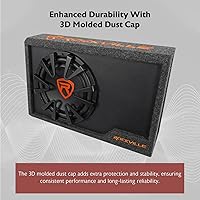
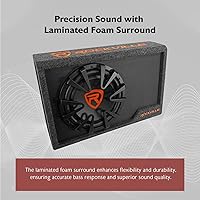
The heart of this powered subwoofer enclosure is its built-in mono amplifier, which removes the need for a separate amp rack or remote wire guesswork. The 300W RMS rating is honest and workable — the Kevlar-reinforced cone handles the load without the muddy distortion common in cheaper units at similar volumes. An adjustable crossover between 50Hz and 250Hz gives you genuine tuning flexibility, while the dash-mounted bass knob is one of those touches you don't realize you'll rely on until it's there. Smart Turn-On circuitry handles the power automatically, and the carpet-and-leather wrapped MDF enclosure looks clean in any trunk.

Best For

This all-in-one car bass system makes the most sense for daily drivers who want to stop settling for thin, bass-light factory audio but aren't ready to commit to a full custom build. It's a natural fit for trucks and SUVs where trunk depth is limited — the slim profile means you're not sacrificing your entire cargo floor. First-time installers tend to appreciate that everything ships in one box, and the included wiring kit removes a common stumbling block. That said, if you're chasing serious SPL output or planning to run multiple drivers, this isn't the right starting point.

User Feedback

Among verified buyers, the most consistent praise centers on how straightforward installation is — many report getting it running in under an hour without professional help. The remote bass knob earns repeated mentions as a practical, well-placed convenience. On the critical side, some owners note the enclosure runs noticeably warm during extended high-volume sessions, which is worth considering if you push it hard regularly. A handful of compact car owners found the 24-inch length tighter than expected, so measuring your space beforehand matters. Long-term durability feedback past six months is generally positive, though a minority of enthusiasts find the output modest once they start comparing it to dedicated component setups.

Pros

  • No separate amplifier needed — the built-in amp keeps installation clean and affordable.
  • Smart Turn-On circuitry eliminates manual switching and works reliably with factory head units.
  • High-level inputs mean you can connect directly to a stock stereo without any adapter hassle.
  • The dash-mounted remote knob lets you adjust bass on the fly without fumbling in the trunk.
  • Slim profile preserves usable trunk or cargo space in a way traditional enclosures simply cannot.
  • The adjustable crossover gives you real tuning flexibility between 50Hz and 250Hz.
  • Kevlar-reinforced cone keeps bass tight and controlled at moderate listening volumes.
  • Included installation kit and clear manual make the setup accessible even for first-timers.
  • The MDF enclosure with carpet-and-leather finish looks clean and holds up well over time.
  • Solid value for the mid-range price point compared to buying a sub and amp separately.

Cons

  • The enclosure runs noticeably warm during long sessions at high volume, which may concern some owners.
  • Output starts to feel limited when pushed hard — it lacks headroom for those who like it loud.
  • At 24 inches long, the enclosure can be a tight fit in compact car trunks; measure before you buy.
  • The RJ11 bass knob cable is functional but feels dated compared to Bluetooth remote options on rivals.
  • Sealed enclosure design trades deep sub-bass extension for tightness — you won't feel chest-thumping low end below 38Hz.
  • Long-term reliability data beyond six months is inconsistent across user reports, making durability harder to predict.
  • Peak power marketing figures (1200W) are misleading given the 300W RMS reality — manage expectations accordingly.
  • No built-in Bluetooth audio input despite the listing suggesting wireless connectivity, which can confuse buyers.
  • Limited upgrade path — the all-in-one format means you replace the entire unit rather than swap individual components.

Ratings

Our AI rating system analyzed thousands of verified global buyer reviews for the Rockville RWS12CA 12-inch Powered Car Subwoofer, actively filtering out incentivized, duplicate, and bot-generated feedback to surface what real owners actually experience. The scores below reflect a balanced picture — genuine strengths are recognized alongside recurring frustrations, so you can make a confident buying decision without the noise.

Ease of Installation
91%
This is where the all-in-one format genuinely shines. Buyers consistently report getting the unit running in under an hour without professional help, largely thanks to the included wiring kit, clear manual, and Smart Turn-On circuitry that eliminates the need for a remote turn-on wire. First-timers especially appreciate not having to source separate components.
A small segment of buyers found the RJ11 bass knob cable awkward to route cleanly through the cabin without it looking messy. Those installing in trucks with longer wire runs occasionally found the included cables just short enough to cause frustration.
Bass Quality
78%
22%
At moderate listening volumes, the Kevlar-reinforced cone delivers tight, controlled bass that sounds noticeably cleaner than factory audio — particularly on kick drums and bass guitar lines during daily commutes. The sealed enclosure keeps the low end punchy rather than boomy, which suits most mainstream music genres well.
Push it past about 70 percent volume and the output starts to compress noticeably, leaving enthusiasts feeling shortchanged. Sub-bass below roughly 45Hz rolls off more than the spec sheet implies, so electronic music and hip-hop listeners who expect deep rumble may find the presentation a bit lean.
Value for Money
83%
Compared to buying a separate subwoofer, enclosure, and amplifier at this price tier, the all-in-one format delivers genuine savings in both cost and installation time. Most buyers feel the bass improvement over stock audio is immediately apparent and well worth the outlay for a daily driver upgrade.
A handful of long-term owners report that durability concerns after the one-year mark start to chip away at the perceived value. Buyers who later migrate to a component setup sometimes feel the money would have been better invested upfront in separates.
Build Quality
74%
26%
The MDF enclosure feels solid and the carpet-and-synthetic-leather exterior holds up well against everyday handling and minor trunk friction. The front panel presentation looks noticeably more finished than competing units in the same price range, which matters to owners who leave the enclosure visible in their trunk.
Some buyers noticed the carpet edges beginning to lift at the corners after several months of regular use, particularly in hot climates where trunk temperatures climb. The amplifier plate finish is functional but shows fingerprints and minor scuffs more readily than the rest of the enclosure.
Thermal Management
58%
42%
Under typical daily listening conditions — moderate volume, mixed stop-and-go driving — the enclosure stays warm but manageable, and most owners report no heat-related issues during the first several months of ownership. The internal amp design handles short bursts of higher output without immediately throttling.
Extended sessions at high volume cause the enclosure to run quite hot, and several owners report the amplifier entering thermal protection mode during summer use in direct sunlight. This is the most consistent hardware complaint across long-term reviews and is a real consideration if you regularly listen loud on longer drives.
Compatibility
88%
The combination of high-level and low-level inputs makes this one of the more universally compatible powered enclosures in its class. Owners with factory Bose, Sony, and standard OEM head units all report successful connections without needing additional adapters or line output converters in the majority of cases.
A small number of buyers with DSP-equipped factory systems experienced turn-on thumps or signal detection issues with the Smart Turn-On circuitry. Those vehicles typically require a more deliberate wiring approach that the manual does not fully address.
Remote Bass Control
86%
The dash-mounted knob is one of those features that sounds minor until you actually use it daily. Being able to dial back bass at a traffic stop or crank it up on an empty highway without pulling over is genuinely useful, and buyers across experience levels consistently mention it as a highlight.
The RJ11 connector and cable feel dated by current standards, and the knob itself has a slightly loose feel that concerns some owners about long-term reliability. A few buyers also found the cable too short to route cleanly from the trunk to a convenient dash location in longer vehicles.
Size & Fitment
72%
28%
In trucks, full-size SUVs, and mid-size sedans, the slim enclosure fits without major compromise and genuinely preserves usable cargo space. Owners who previously struggled to fit any subwoofer setup in their vehicle appreciate having a real option that does not demand custom fabrication.
At 24 inches in length, the enclosure is a borderline fit for compact cars and hatchbacks, and a meaningful number of buyers in those vehicles report that it simply does not fit the way they expected. Measuring the available trunk floor space before ordering is strongly advisable — this is a preventable frustration.
Sound Tuning Flexibility
77%
23%
The adjustable crossover spanning 50Hz to 250Hz gives owners meaningful control over how the subwoofer blends with their existing speakers, which is more range than many competing all-in-one units offer. The bass boost control adds additional shaping ability without requiring any external processor.
There is no subsonic filter, which means the driver can work harder than necessary on very low frequencies below its practical range, contributing to heat buildup. Buyers used to more advanced amplifier controls will also notice the absence of a phase switch, which can make precise integration with certain speaker setups trickier.
Low-Volume Listening
82%
18%
At lower volumes — background listening during a commute or keeping bass present while a passenger sleeps — the unit performs well, maintaining warmth and body in the music without requiring the gain to be pushed. The 96dB sensitivity rating contributes to this, meaning it does not need much input signal to produce audible output.
Bass character at very low volumes can feel slightly one-dimensional on acoustic and jazz recordings, where subtlety matters more than impact. Some owners note the bass boost control requires careful handling at low volumes, as even a small increase introduces audible coloration quickly.
Package Contents
81%
19%
The included wiring kit removes a common stumbling block for first-time installers who might not know what additional parts to source. Having the bass knob, aux cable, and basic hardware all in one box reinforces the single-purchase appeal that makes this format so attractive to less experienced buyers.
The power cable included in the kit is on the shorter side for larger vehicles, and the gauge of the included wiring is adequate but not generous — buyers with longer cable runs or higher performance expectations should budget for an upgrade. The aux cable quality is basic and unlikely to see regular use.
Long-Term Durability
63%
37%
For buyers who operate it within its intended parameters — moderate volume, reasonable listening sessions, without sustained bass boost abuse — most owners report the unit remaining functional well past the one-year mark without major issues. Early build quality holds up reasonably well in temperate climates.
Reviews beyond the six-month mark tell a more mixed story, with a noticeable uptick in reports of amplifier failures, rattles developing in the enclosure, and remote knobs losing their tactile feel. Units used in vehicles with extreme heat or cold cycles show wear faster than those kept in more controlled environments.
Aesthetics
79%
21%
The black carpet and synthetic leather combination looks intentional and clean rather than cheap, which is not a given at this price point. Owners who leave the enclosure visible in their trunk rather than hiding it under a cargo liner generally report being satisfied with how it presents.
The overall look is conservative and functional rather than distinctive — buyers who care about visible audio aesthetics may find the understated design unremarkable compared to enclosures with illuminated logos or textured finishes. The carpet material also picks up lint and pet hair more readily than smooth alternatives.

Suitable for:

The Rockville RWS12CA 12-inch Powered Car Subwoofer is a strong match for everyday drivers who are tired of flat, bass-light factory audio but have no interest in a complicated installation project. If you drive a truck, SUV, or mid-size sedan where trunk real estate is limited, the slim enclosure design addresses a real physical constraint that a traditional box-and-amp setup simply cannot. It's equally well-suited to first-time upgraders who want to buy one thing, follow one manual, and be done — the included wiring kit and Smart Turn-On circuitry remove most of the guesswork. Drivers still running a stock head unit will appreciate the high-level input support, which means no head unit swap is required to get this running. Anyone who values keeping cargo space intact while still getting a meaningful bass upgrade will find the tradeoff here genuinely worth making.
Not suitable for:

The Rockville RWS12CA 12-inch Powered Car Subwoofer is not the right tool for audio enthusiasts chasing serious output or competition-level SPL performance. At 300W RMS, the built-in amplifier is honest and capable within its range, but it will leave dedicated builders underwhelmed when pushed to its limits — particularly at sustained high volumes where thermal buildup becomes a real concern. If your plan is to stack multiple drivers or build a system around a high-powered external amp, this all-in-one format works against you rather than for you. Owners of very compact cars should also measure carefully before buying — the 24-inch length of the enclosure can be a tight fit in smaller trunks, and discovering that after unboxing is frustrating. If ultimate sound customization, raw loudness, or audiophile-grade tuning is the priority, a component subwoofer paired with a dedicated amplifier will serve you far better.
Specifications

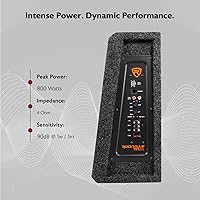
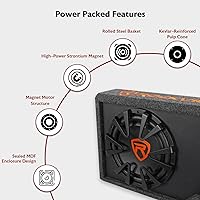
  • Peak Power: The unit is rated at 1200W peak output, though real-world continuous performance is governed by the 300W RMS figure.
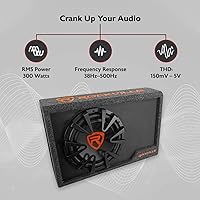
  • RMS Power: The built-in amplifier delivers 300W RMS continuously, which is the number that actually matters for sustained, undistorted bass output.
  • Driver Size: A 12-inch subwoofer driver is housed inside the sealed enclosure, offering a balance of low-frequency reach and physical compactness.
  • Enclosure Type: The sealed MDF enclosure produces tight, accurate bass reproduction and is better suited to music clarity than raw volume maximization.
  • Dimensions: The enclosure measures 24″ in length, 15″ in height, and between 4.37″ and 6.65″ in depth depending on the mounting orientation.
  • Impedance: The subwoofer operates at 4 Ohm impedance, which is the standard load for most aftermarket and compatible factory amplifier outputs.
  • Frequency Response: The driver covers a frequency range of 38Hz to 500Hz, with practical bass reproduction focused in the 40Hz–150Hz range for music listening.
  • Sensitivity: Rated at 96dB SPL at 1 watt per meter, this unit is moderately efficient and will produce audible output even from modest input signals.
  • Crossover Range: The built-in low-pass crossover is fully adjustable between 50Hz and 250Hz, allowing you to tune the sub to match your existing speakers.
  • Bass Boost: An onboard bass boost circuit allows up to +12dB of additional bass emphasis, adjustable to taste via the amplifier controls.
  • Voice Coil: The 2-inch high-temperature aluminum voice coil is designed to handle sustained power without premature thermal failure during extended listening sessions.
  • Cone Material: The driver cone is constructed from a composite pulp material reinforced with Kevlar fibers, which reduces unwanted flex and distortion at higher output levels.
  • Magnet Type: A high-power Strontium magnet provides the motor force behind the driver, contributing to its control and transient response at moderate volumes.
  • Input Types: Both high-level (speaker wire) and low-level (RCA) inputs are included, making the unit compatible with factory head units and aftermarket decks alike.
  • Remote Control: A dash-mounted bass remote knob connects via an RJ11 jack and allows real-time bass level adjustment without reaching into the trunk or cargo area.
  • Turn-On Method: Smart Turn-On circuitry detects an audio signal automatically and powers the amplifier on or off without requiring a dedicated remote turn-on wire.
  • Exterior Finish: The enclosure is wrapped in aviation-grade black carpet on most surfaces, with a synthetic leather panel on the front face for a cleaner visual presentation.
  • Included Accessories: The package includes an auxiliary cable, a dash-mount bass control knob, a wiring installation kit, and a printed user manual.
  • Warranty: Rockville provides a limited warranty on this unit; buyers should confirm current warranty terms directly with the manufacturer or authorized retailer at time of purchase.
  • Weight: The listed item weight appears to be a data entry error in the manufacturer listing; the actual assembled unit with enclosure weighs significantly more than stated and should be verified before installation planning.

Related Reviews
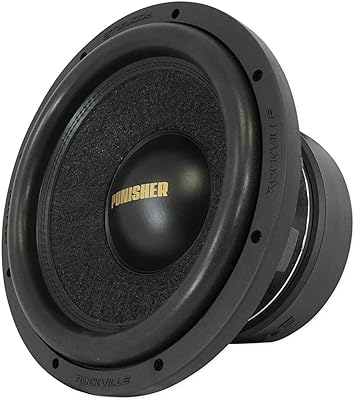
Rockville Punisher 12D1 12″ Car Subwoofer
74%
88%
Build Quality
91%
Bass Output
87%
Value for Money
83%
Amplifier Compatibility
86%
Motor Performance
More
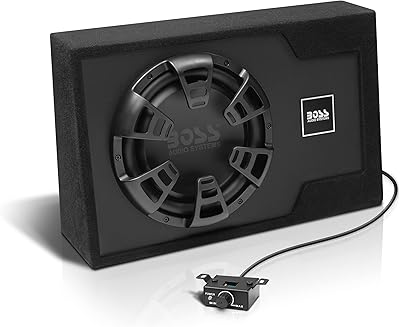
BOSS Audio B12ES 12-Inch Powered Car Subwoofer
72%
88%
Ease of Installation
79%
Bass Output & Impact
83%
Value for Money
63%
Build Quality & Materials
81%
Remote Bass Control Usability
More
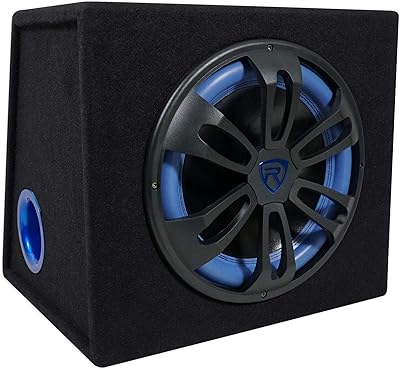
Rockville RVB12.1A 12-Inch Powered Subwoofer Enclosure
75%
91%
Ease of Installation
78%
Bass Performance
84%
Value for Money
76%
Build Quality
63%
Amplifier Reliability
More
CT Sounds STRATO-12-D4 12-Inch Car Subwoofer
78%
89%
Bass Output & Volume
91%
Build Quality
88%
Thermal Durability
86%
Value for Money
74%
Installation Experience
More
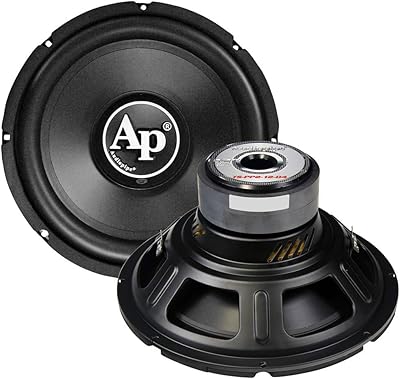
Audiopipe TS-PP2-12-D4 12-inch Car Subwoofer
70%
74%
Value for Money
71%
Bass Output
67%
Build Quality
58%
Power Handling
73%
Voice Coil Quality
More
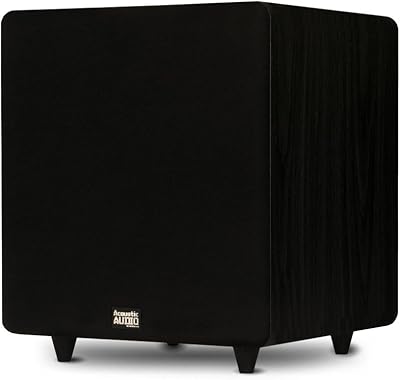
Acoustic Audio PSW500-12 12-Inch Powered Subwoofer
73%
83%
Bass Output for Price
88%
Ease of Setup
86%
Value for Money
67%
Build Quality
71%
Sound Quality
More
CT Sounds STRATO-12-D2 12 Inch Dual 2 Ohm Car Subwoofer
86%
93%
Bass Performance
89%
Durability
91%
Power Handling
88%
Sound Clarity
84%
Ease of Installation
More
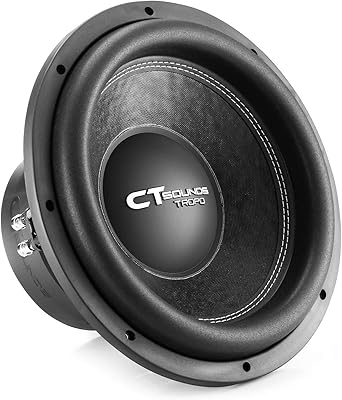
CT Sounds TROPO-12-D4 12-inch Car Subwoofer
77%
93%
Value for Money
81%
Bass Output Quality
86%
Build Quality
78%
Thermal Performance
84%
Installation Ease
More
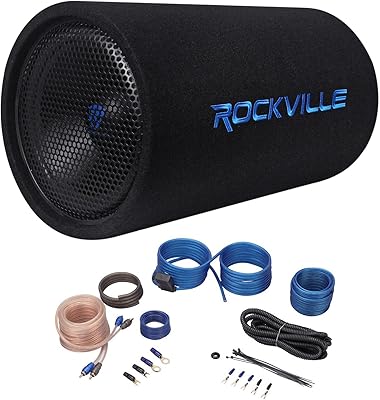
Rockville RTB12A 12-Inch Powered Car Subwoofer
72%
78%
Bass Impact
86%
Ease of Installation
81%
Value for Money
61%
Build Quality
63%
Sound Quality
More
Rockville W12T4S2 12″ 2-Ohm Car Subwoofer
84%
88%
Bass Performance
90%
Ease of Installation
85%
Sound Clarity
80%
Build Quality
92%
Size and Fit in Compact Spaces
More

FAQ

No, that is the main point of this design. The amplifier is built directly into the enclosure, so you connect it to your car's battery, run a signal cable from your head unit, and you are done. There is no external amp to mount or wire separately.

It works fine with a stock factory stereo. The high-level inputs let you tap into the existing speaker wires coming from your factory deck, so no head unit replacement is needed. The Smart Turn-On circuitry will detect the audio signal and power itself on automatically.

A good starting point for most music is around 80Hz to 100Hz, which rolls off the higher frequencies and lets the subwoofer focus on bass only. If your front speakers are small and struggle with midrange, you can push the crossover a bit higher. Adjust by ear until the bass sounds like a natural extension of your main speakers rather than a separate, boomy layer.

It could be, depending on your trunk. In a standard mid-size sedan or larger vehicle it typically fits without issue, but in a compact car the 24-inch width of the enclosure can be a tight squeeze. Measure your trunk opening and floor depth before ordering — this is the most common fit complaint from buyers of smaller vehicles.

Some warmth is normal for any amplified enclosure, especially during extended listening at higher volumes. What you want to avoid is heat that feels extreme to the touch, which can indicate the amp is being pushed beyond its comfortable operating range. If that happens consistently, try reducing the bass boost setting and lowering the gain — running it cooler will extend the lifespan of the internal components.

Potentially, yes, but it depends heavily on the seat clearance in your specific vehicle. The slim depth profile (as little as 4.37″) was designed with under-seat fitment in mind, but trucks and SUVs with raised rear seats tend to accommodate it more easily than low-profile sedans. Measure the gap between the floor and the bottom of your rear seat cushion before assuming it will fit.

It comes with a wiring installation kit, a bass remote knob, an aux cable, and a user manual, which covers most of what you need. You will still need to supply your own power cable run from the battery if the included one is not long enough for your vehicle, and some installers prefer to use higher-gauge wiring than what is bundled in.

At moderate listening volumes it sounds genuinely good and noticeably better than factory audio. Where it falls short compared to a dedicated component setup is at the upper end of its range — once you push it hard, the 300W RMS limit becomes apparent and output does not scale the way a higher-powered external amp would. For casual daily listening it is more than adequate; for head-turning bass, a separate setup will outperform it.

The bass boost adds up to +12dB of amplification in the sub-bass frequencies, essentially turning up the low end beyond what the input signal alone provides. It can make bass feel punchier on music that is mixed light on low end, but using it aggressively at high volume increases heat output and distortion risk. A modest boost of 3dB to 6dB is usually enough — full boost should be reserved for low-volume listening where you want to compensate for the ear's reduced bass sensitivity.

The available specification data does not confirm a dedicated phase switch on this model. If you notice the bass sounds thin or cancels out rather than blending with your front speakers, try swapping the polarity on your high-level input connections as a workaround, or experiment with the crossover frequency to find the point where the sub integrates most naturally with your existing speakers.

Where to Buy