Overview

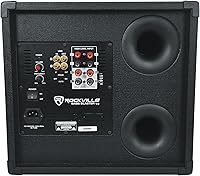
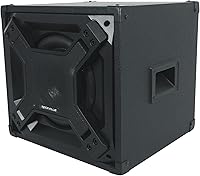
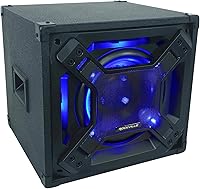
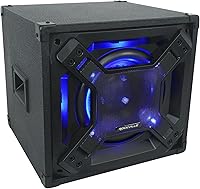
The Rockville Bass Blaster 10 is a mid-range powered subwoofer that positions itself squarely between budget noise-makers and the kind of serious home theater gear that costs several times more. Built around a 10-inch driver housed in an MDF cabinet with metal-reinforced corners, it feels noticeably more substantial than most competitors at this price point. The pulsating LED lighting is an unusual touch — not something you typically see on a subwoofer — and it sets this Rockville sub apart visually in a living room setup. With 164 ratings averaging 4.0 stars, the reception has been solid, though the pool is still relatively small to draw firm conclusions from.
Features & Benefits

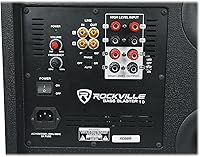
At the core of this powered subwoofer is a Class D amplifier, which runs efficiently and stays cool during long movie sessions — something cheaper designs with older amplifier topologies can struggle with. The real-world RMS output sits at 375W, not the peak 750W figure sometimes highlighted in specs, and that distinction matters when setting expectations. What stands out is the tuning flexibility: a variable crossover combined with a 0-to-180-degree phase switch gives you real tools to shape bass for your specific room. Connectivity covers both RCA and high-level inputs, so pairing it with budget receivers or older setups is rarely a problem.

Best For

This Rockville sub makes the most sense for someone furnishing a living room or media space in an apartment or average-sized home. A 10-inch driver has real physical limits — it will fill a mid-size room with authority, but don't expect it to pressurize a large open-plan space the way a 12-inch or 15-inch sub can. Buyers stepping up from a soundbar or bare TV speakers will likely be struck by the jump in low-end impact. Gamers who want some visual flair alongside decent bass punch will find the LED a practical bonus rather than an afterthought, especially with the toggle switch available.

User Feedback

Buyers consistently highlight two things: the bass output feels strong for what they paid, and setup was straightforward without much fuss. Build quality gets frequent praise too — the cabinet feels dense and the finish holds up. On the downside, a recurring complaint involves bass that sounds loose or one-dimensional when the crossover is left at factory defaults; a few minutes of tuning makes a real difference. A handful of users also found the LED distracting during films, though the on/off switch largely resolves that. With just over 160 ratings total, the overall picture is encouraging but not yet broad enough to be fully conclusive.

Pros

  • The MDF cabinet with metal corners feels noticeably solid and well-built for the price tier.
  • Both RCA and high-level inputs make this powered subwoofer compatible with a surprisingly wide range of receivers.
  • The Class D amplifier runs cool and clean during long movie or gaming sessions without throttling output.
  • Variable crossover and phase adjustment give real, usable room-tuning tools — not just cosmetic controls.
  • The reactive LED is fully togglable, so it adds atmosphere when you want it and disappears when you do not.
  • Setup is straightforward enough for first-time subwoofer owners to complete without professional help.
  • Bass output is strong and impactful in apartment-sized and mid-sized rooms, especially for movies and gaming.
  • Dual-voltage support makes it a practical option for international buyers or anyone who moves between regions.

Cons

  • The bass can sound boomy and one-dimensional if the crossover is left at factory default settings.
  • Real continuous output is 375W RMS — the 750W peak figure can set unrealistic expectations for buyers.
  • No wireless or Bluetooth connectivity, which feels like an omission at this price point in today's market.
  • Sub-bass extension below roughly 30-35Hz loses conviction, limiting performance with certain music genres.
  • The included documentation is too sparse to guide less experienced buyers through proper optimization.
  • Cabinet resonance at high volumes has been flagged by a small number of users, suggesting internal bracing limits.
  • The LED reacts to ambient sound rather than only dramatic audio cues, which can be distracting during quieter film scenes.
  • With just over 160 ratings, the review pool is not yet large enough to draw fully confident long-term reliability conclusions.

Ratings

The scores below for the Rockville Bass Blaster 10 were generated by our AI after analyzing verified buyer reviews from multiple global sources, with spam, bot activity, and incentivized feedback actively filtered out. The result is an honest, balanced snapshot that reflects both what this powered subwoofer does well and where real-world buyers have run into frustrations. Nothing has been polished over — the pain points carry just as much weight as the praise.
Bass Performance
78%
22%
For a 10-inch driver at this price tier, the low-end output genuinely surprised many buyers upgrading from soundbars or entry-level setups. Movie explosions and action sequences land with physical weight, and music with deep sub-bass content comes through with decent authority in rooms up to about 300 square feet.
In larger open-plan living spaces, the bass starts to feel thin and strained rather than room-filling. A recurring complaint is that the low end can sound boomy and indistinct at higher volume settings — particularly problematic for music listeners who want tight, articulate bass rather than just impact.
Build Quality
83%
The MDF cabinet with metal-reinforced corners gives this Rockville sub a noticeably solid feel out of the box — it does not flex or rattle when you knock on it, which is more than can be said for some plastic-heavy competitors. The vinyl finish holds up well to normal handling, and the overall assembly feels deliberate rather than cheap.
A small number of buyers reported minor cosmetic inconsistencies in the finish on arrival, and the grille attachment feels less refined than the cabinet itself. It is sturdy enough for home use, but the construction detail does not quite reach the level of purpose-built audiophile gear.
Amplifier & Power Delivery
76%
24%
The Class D amplifier runs cool even during extended listening sessions, which is a genuine practical benefit for a sub left on during long movie marathons or gaming nights. Clean output at moderate volumes is one area where buyers consistently noted satisfaction — no obvious clipping or distortion in typical home theater use.
It is worth keeping in mind that the 750W figure is a peak rating; the continuous RMS output is 375W, and the bass can feel compressed when pushed hard. Buyers expecting concert-level output from a sub at this price and size will likely be disappointed.
Tuning & Customization
81%
19%
The combination of a variable crossover and a 0-to-180-degree phase switch is genuinely useful — not just a spec on paper. Buyers who took the time to dial in the crossover frequency for their specific room and receiver reported a noticeably cleaner, more integrated sound compared to leaving it at default settings.
For buyers who are less experienced with audio setup, the tuning controls can feel intimidating, and the manual offers limited guidance. Several users who left the crossover at factory defaults were the same ones reporting boomy, one-dimensional bass — the controls help, but they require effort to use effectively.
Connectivity & Compatibility
87%
Having both RCA and high-level speaker inputs on the same unit makes this powered subwoofer unusually versatile for its price category. Buyers with older AV receivers lacking a dedicated subwoofer output appreciated being able to connect via speaker-level inputs without needing an adapter or additional hardware.
There is no wireless or Bluetooth connectivity, which is an increasingly expected feature even at this price point. Buyers building a modern, cable-minimalist home theater setup may find the wired-only approach a limiting factor when choosing placement.
LED Lighting
72%
28%
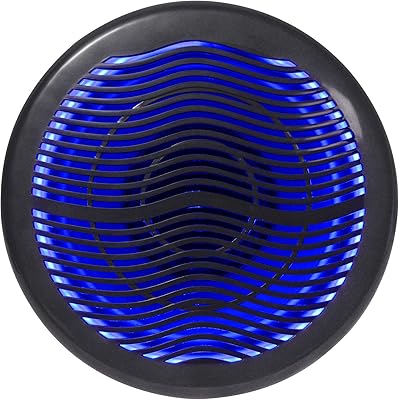
The reactive LED that pulses in sync with bass transients genuinely adds atmosphere for gaming sessions and action movie nights. For buyers who want their setup to have some visual personality, it delivers on that without feeling tacked on — and the on/off switch means it is completely optional.
Several buyers found the LED distracting or immersion-breaking during quieter film scenes, where the light reacts to ambient sound rather than dramatic moments. Audiophile-minded buyers in particular tend to dismiss the feature entirely, viewing it as a novelty that has no bearing on sound quality.
Setup & Installation
84%
Most buyers reported having this Rockville sub connected and producing sound within 15 to 20 minutes of unboxing, even without prior audio equipment experience. The labeled rear panel and straightforward control layout made the initial hookup process relatively painless for first-time subwoofer owners.
The included documentation is sparse — fine for getting the sub operational, but not particularly helpful for optimizing placement or dialing in the crossover settings. Buyers new to home theater audio may need to rely on online guides to get the most out of the tuning options.
Value for Money
79%
21%
Relative to what you get — an MDF cabinet, Class D amplifier, flexible connectivity, and a reactive LED — the pricing lands in a reasonable spot for casual home theater use. Buyers consistently framed it as a solid step up from budget-tier alternatives without requiring a major financial commitment.
In a competitive market segment, there are a few rival subs that offer tighter bass tuning or better raw output at a similar price. The Bass Blaster 10 earns its value through build quality and feature set rather than outright acoustic performance, which matters depending on your priorities.
Volume & Room Coverage
67%
33%
In apartment-sized rooms and dedicated media rooms up to roughly 250-300 square feet, the output level is more than adequate for creating a convincing cinematic low-end experience. Buyers in those contexts rarely felt the need to push it to its limits during normal use.
Larger living rooms, open-plan spaces, or rooms with high ceilings expose the 10-inch driver's physical limitations quickly. A number of buyers in bigger rooms noted that even at maximum volume, the sub felt underwhelming — a 12-inch or larger alternative would have been the more appropriate choice.
Noise & Distortion Control
73%
27%
At normal to moderately high listening levels, the 85 dB signal-to-noise ratio holds up well enough that background hiss is not a noticeable issue during typical use. The 4-layer voice coil construction contributes to keeping output relatively clean in the mid-to-high bass frequency range.
Push the sub toward its upper volume range and some buyers reported audible distortion creeping into the output, particularly on bass-heavy music tracks. Cabinet resonance at certain frequencies was also flagged by a small number of users, suggesting the internal bracing has limits under sustained high-output conditions.
Frequency Response & Extension
71%
29%
The 20Hz-200Hz frequency range on paper is broad, and in practice the sub handles mid-bass punch well — kick drums, explosions, and deep voice rumble all come through clearly in a well-matched system. The upper crossover range also gives good flexibility for blending with a variety of satellite speakers.
True sub-bass extension below around 30-35Hz is where this powered subwoofer starts to lose conviction, which can make certain electronic music genres and organ recordings feel incomplete. Buyers who specifically prioritize ultra-deep infrasonic response may want to look at units with larger driver excursion capabilities.
Aesthetics & Finish
75%
25%
The all-black vinyl finish with metal corners gives this Rockville sub a clean, understated look that fits naturally into most living room or gaming setup aesthetics. The LED adds an optional visual element for those who want it, and the overall dimensions are proportionate enough to avoid dominating a room.
The vinyl wrap finish, while decent, shows fingerprints and dust more readily than a matte painted surface would. A handful of buyers noted minor finish imperfections out of the box, and the grille design feels slightly dated compared to some competitor aesthetics at this price tier.
Phase & Integration with Speakers
77%
23%
The 0-to-180-degree phase adjustment is a feature that makes a genuine difference when blending this sub with bookshelf or floor-standing speakers, helping to avoid the muddy overlap that undermines cohesion in a lot of entry-level home theater builds. Buyers who used it reported noticeably tighter integration with their existing speaker systems.
Without a dedicated home theater receiver with auto-EQ features like Audyssey or MCACC, getting the phase dialed in by ear takes patience and multiple listening tests. Buyers relying on basic stereo receivers or older AV gear may find the manual tuning process hit-or-miss without guidance.

Suitable for:

The Rockville Bass Blaster 10 is a strong fit for anyone setting up a home theater or gaming space in an apartment or mid-sized room who wants a meaningful bass upgrade without spending serious money. First-time subwoofer buyers — particularly those stepping up from a soundbar or bare TV speakers — will notice an immediate and satisfying difference in how movies and games sound. The flexible connectivity, covering both RCA and high-level speaker inputs, also makes it a practical choice for people working with older AV receivers that lack a dedicated subwoofer output. Gamers who enjoy the aesthetic of a reactive LED setup will find the pulsating light a genuinely fun addition rather than a distraction. Anyone willing to spend 20 minutes dialing in the crossover and phase settings will be rewarded with noticeably tighter, better-integrated bass.
Not suitable for:

Buyers with large, open-plan living spaces should approach this Rockville sub with realistic expectations — a 10-inch driver simply does not have the physical output to pressurize a big room convincingly, and pushing it hard to compensate tends to introduce distortion. Dedicated audiophiles or critical listeners who prioritize tight, articulate bass over sheer impact will likely find the low-end performance underwhelming at higher volumes, particularly with demanding music genres. If your primary goal is ultra-deep sub-bass extension below 30Hz — organ recordings, certain electronic music, or reference-level home cinema — a larger driver with more excursion capability is a better investment. Those building a wireless, cable-minimalist setup will also hit a wall immediately, as this powered subwoofer offers no Bluetooth or wireless connectivity whatsoever. Buyers who want a plug-and-play experience with zero tuning required may also be frustrated if they leave the crossover at factory defaults and wonder why the bass sounds loose.

Specifications

  • Driver Size: Features a 10-inch dynamic driver designed to reproduce low frequencies from 20Hz up to 200Hz.
  • Peak Power: Rated at 750W peak power output, with a continuous RMS output of 375W under normal operating conditions.
  • Amplifier Class: Equipped with a Class D amplifier, which operates efficiently with minimal heat generation during extended use.
  • Frequency Response: Covers a frequency range of 20Hz to 200Hz, suitable for full sub-bass and upper bass reproduction.
  • Signal-to-Noise Ratio: Rated at 85 dB signal-to-noise ratio, providing reasonably clean output at moderate listening levels.
  • Impedance: The woofer operates at a 4 Ohm impedance, standard for powered subwoofer applications.
  • Voice Coil: Uses a 2-inch diameter, 4-layer wound voice coil paired with a Y30 magnet for controlled low-distortion bass output.
  • Cabinet Material: Constructed from MDF (medium-density fiberboard) with a vinyl outer finish and metal-reinforced corner protection.
  • Dimensions: Physical footprint measures 20″ deep by 18.9″ wide by 18.6″ tall, sized appropriately for mid-sized room placement.
  • Weight: Unit weighs 32 pounds, reflecting the dense MDF cabinet construction.
  • Connectivity: Provides both RCA stereo inputs and outputs, plus high-level speaker inputs for compatibility with a wide range of amplifiers and receivers.
  • Crossover: Includes an onboard variable crossover control, allowing adjustment to blend the sub with existing satellite or bookshelf speakers.
  • Phase Control: Offers a continuously variable phase switch adjustable from 0 to 180 degrees for precise integration with a main speaker system.
  • LED Lighting: Features a pulsating LED system that reacts to bass transients in real time, with a dedicated on/off toggle switch.
  • Input Voltage: Supports dual-voltage input of 110-240V AC, making it compatible with both North American and international power standards.
  • Audio Output Mode: Operates in mono output mode, as is standard for dedicated subwoofer channels in home theater configurations.
  • Surround Config: Designed to integrate into 5.1 or 7.1 surround sound channel configurations as the low-frequency effects channel.
  • Warranty: Covered under a limited manufacturer warranty; buyers should confirm current warranty terms directly with Rockville at time of purchase.

Related Reviews
Rockville BASS Blaster 12 Subwoofer
84%
89%
Bass Performance
83%
Sound Customization
75%
LED Lighting Feature
90%
Build Quality
92%
Value for Money
More
Rockville Punisher 10D1 10″ Subwoofer
88%
96%
Bass Performance
91%
Sound Clarity
88%
Build Quality
85%
Thermal Management
83%
Ease of Installation
More
Rockville RTB10A 10″ Powered Subwoofer
83%
91%
Sound Quality
88%
Bass Performance
75%
Ease of Installation
86%
Build Quality
82%
Durability
More
Rockville MS10LB 10″ Marine Subwoofer
86%
91%
Bass Quality
89%
Durability in Marine Environments
92%
Waterproof Performance
78%
Ease of Installation
85%
LED Lighting
More
Rockville VS10K54 10″ K5 Subwoofer
85%
92%
Bass Quality
88%
Durability and Build Quality
91%
Value for Money
84%
Power Output
85%
Ease of Installation
More
Rockville W10K6D2 V2 10″ Subwoofer
83%
91%
Bass Performance
88%
Build Quality
73%
Ease of Installation
85%
Sound Clarity
89%
Power Handling
More
Rockville APM10D 10″ Active Studio Subwoofer
83%
91%
Bass Performance
89%
Sound Clarity
84%
Build Quality
88%
Connectivity Options
82%
Ease of Setup
More
Rockville RWS10CA 10″ Amplified Car Subwoofer
85%
88%
Bass Performance
93%
Ease of Installation
84%
Build Quality
86%
Durability
87%
Sound Customization (Bass Control)
More
Rockville BASS Party 65 Bluetooth Speaker
85%
88%
Sound Quality
91%
Bass Performance
85%
Battery Life
62%
Portability
93%
Ease of Setup
More
Rockville Rock Shaker 10″
78%
86%
Bass Output
91%
Value for Money
83%
Amplifier Performance
88%
Connectivity Options
67%
Crossover & Controls
More

FAQ

No, you do not. The Bass Blaster 10 includes high-level speaker inputs in addition to the standard RCA connection, so you can wire it directly from your receiver's speaker terminals if there is no dedicated subwoofer output. This makes it compatible with a broader range of older or budget stereo receivers that lack an LFE or sub-out jack.

Realistically, this powered subwoofer performs best in small to medium-sized rooms — think bedrooms, apartments, or a dedicated media room up to roughly 250 to 300 square feet. In larger open-plan spaces, the 10-inch driver will start to feel underpowered, especially at higher volumes. If your room is significantly bigger, you would be better served by a 12-inch or larger unit.

Almost certainly not — this is a tuning issue rather than a defect. The factory crossover setting is a starting point, not an optimized one. Try lowering the crossover frequency to around 80Hz and adjusting the phase switch until the bass integrates cleanly with your main speakers. Most buyers who reported boomy bass had not touched the tuning controls at all.

Yes, there is a dedicated on/off switch for the LED. You do not have to live with it if you find it breaks immersion during films or if you simply prefer a cleaner look. The switch is on the rear panel, so once you set it, it stays put.

The 750W figure is the peak power rating, which represents the absolute maximum the amplifier can hit momentarily under ideal conditions. The more meaningful number for day-to-day performance is the 375W RMS rating, which reflects sustained continuous output. This is standard industry practice, but worth understanding so you set realistic expectations for output levels.

It depends on what outputs your TV or console has available. If your TV has RCA audio outputs, you can connect directly. Most modern smart TVs have moved away from RCA, so you may need an optical-to-RCA converter or to route audio through a receiver first. Gaming consoles typically send audio through a receiver or soundbar rather than directly to a subwoofer.

The basic connection is straightforward — most buyers report being up and running within 15 to 20 minutes. The challenge comes if you want to properly optimize the crossover and phase settings, which the included manual does not explain in much depth. There are plenty of free home theater setup guides online that will walk you through the process in under 30 minutes and make a noticeable difference in sound quality.

It supports dual-voltage input from 110 to 240V, which covers both North American and European or international power standards. You would still need the appropriate plug adapter for the physical outlet shape in your country, but the unit itself will not require a separate voltage converter.

At moderate listening levels the MDF construction is solid and rattle-free. A small number of buyers have noted some cabinet resonance when the sub is pushed toward its upper volume limits for extended periods. Placing it on a carpet or a isolation pad rather than a hard floor can help absorb some of that vibration and tighten up the overall sound.

It competes reasonably well in its price bracket, particularly on build quality and connectivity flexibility. Where some competitors edge it out is in bass tightness and low-frequency extension, especially for music listening. The LED feature is a differentiator that will appeal to some buyers and be completely irrelevant to others. If your primary use is movies and gaming in a mid-sized room, it holds its own; critical music listening may leave more demanding buyers wanting more.