Overview

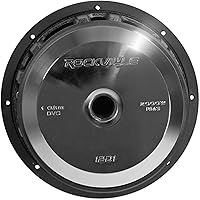
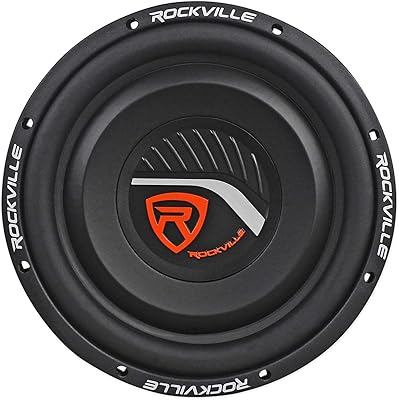
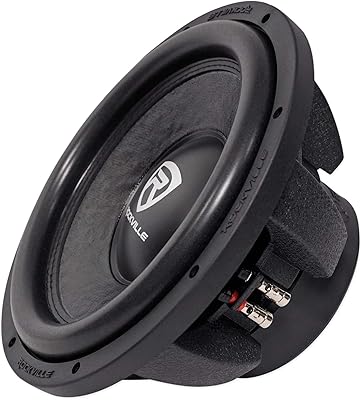
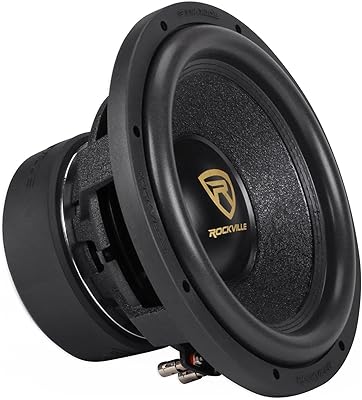
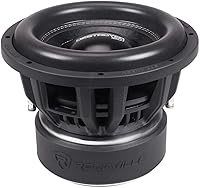
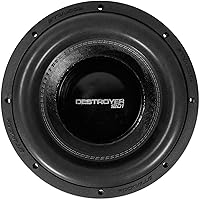
The Rockville Destroyer 12D1 12″ Car Subwoofer is built for one purpose: serious output. This is not a sub you toss in a hatchback and forget about — it's a competition-grade driver targeting SPL builders and hardcore enthusiasts who know exactly what they're doing. The dual 1-ohm impedance configuration gives experienced installers the flexibility to wire to a final 0.5-ohm or 2-ohm load depending on their amplifier, which matters a lot when you're squeezing every watt out of a high-output mono amp. At 54 pounds, this competition subwoofer makes no apologies for its mass — that weight is a direct reflection of the heavy magnet structure and robust internal components packed into this build.
Features & Benefits

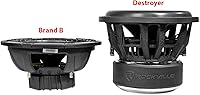
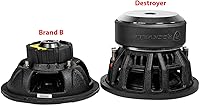
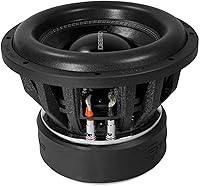
The engineering inside the Destroyer 12D1 is where things get interesting. Three stacked Y35 magnets totaling 300 ounces create a magnetic field strong enough to control the cone at extreme excursion levels — something a single-magnet design simply cannot replicate at this output level. The USA-made voice coils are 3-inch, 4-layer aluminum units rated to withstand temperatures up to 350°C, meaning they hold up under sustained hard driving without the coil separation issues that kill cheaper subs. The cast aluminum basket keeps overall mass in check while remaining rigid enough for accurate cone movement, and the Nomex spider resists tearing even during aggressive use. Real power handling sits at 2000W RMS — the 8000W peak figure is a theoretical ceiling, not a daily operating target.

Best For

This Rockville sub is squarely aimed at builders who already understand the system requirements before they buy. If you're running a high-output mono amplifier stable at 1 ohm, this driver gives you the headroom to push it hard. The enclosure specs — sealed from 1.41 to 1.77 cubic feet, ported from 2.12 to 2.83 cubic feet — are specific enough that you'll want to plan your build around them rather than improvise. The 11.65-inch cutout and 15.75-inch depth mean you need real trunk or box real estate. Beginners without an amp, a proper enclosure, and basic wiring knowledge should look elsewhere. This is a competition build component, not a plug-and-play upgrade.

User Feedback

Buyers who matched this competition subwoofer correctly to their amplifier and enclosure tend to come away impressed by the sheer output and low-end depth it delivers. Bass performance at competition volumes gets consistent praise, particularly in ported builds. On the flip side, a recurring complaint involves buyers who underestimated the amplifier requirements — driving a dual 1-ohm sub without adequate power is a recipe for disappointment, and some reviews reflect exactly that. Build quality generally earns high marks, with physical fit in custom boxes described as precise. A few buyers raised concerns about shipping packaging for a unit this heavy, though damage reports appear isolated. Against similarly priced rivals, most experienced builders consider this Rockville sub a strong value.

Pros

  • Massive 300 oz triple-stacked magnet structure delivers exceptional cone control at high excursion levels.
  • USA-made aluminum voice coils handle sustained high-power use without the thermal failures common in budget drivers.
  • Rated at 2000W RMS, this competition subwoofer has genuine headroom for demanding builds.
  • Cast aluminum basket keeps the assembly rigid without adding unnecessary mass to an already heavy unit.
  • Nomex spider resists tearing during aggressive use, adding real long-term durability.
  • Works in both sealed and ported enclosures, giving builders meaningful flexibility in box design.
  • Buyers who match it correctly to their system consistently report deep, authoritative bass output.
  • Build quality earns strong marks from experienced installers who know what to look for.
  • At its price point, experienced builders generally consider this Rockville sub a competitive value against rival brands.
  • Precise cutout and enclosure specs make it straightforward to plan a custom box around this driver.

Cons

  • Requires a high-output mono amplifier stable at 1 ohm — an expensive additional investment many buyers underestimate.
  • At 54 pounds, installation is a two-person job and enclosure bracing must be taken seriously.
  • The 15.75-inch mounting depth rules out many standard or shallow trunk configurations.
  • Peak wattage figures can mislead buyers into thinking any large amp will be sufficient.
  • Buyers without enclosure-building experience will struggle to meet the specific volume requirements this driver needs.
  • Limited warranty coverage is a concern given the price tier and the demands of competition use.
  • Shipping packaging has drawn occasional complaints for a unit this heavy, with isolated damage reports.
  • Not forgiving of system mismatches — underpowering or incorrect wiring significantly degrades performance.
  • The learning curve for proper setup is steep enough that novice installers often blame the driver for avoidable mistakes.

Ratings

The scores below for the Rockville Destroyer 12D1 12″ Car Subwoofer were generated by our AI after analyzing thousands of verified buyer reviews from global markets, with spam, bot activity, and incentivized feedback actively filtered out. Both the genuine strengths and the recurring frustrations are reflected honestly, so you get a clear picture of what this competition subwoofer actually delivers — not just what the marketing says it should.
Bass Output & SPL Performance
93%
Among verified buyers who properly matched this sub to a capable 1-ohm amplifier, the output level consistently drew strong praise — many described it as the loudest 12-inch driver they had run at this price point. In ported builds tuned correctly, the low-end extension and sheer pressure produced in the cabin genuinely impressed experienced installers.
Buyers who underestimated their amplifier requirements reported noticeably underwhelming output, which skewed some reviews negatively through no real fault of the driver. The sub's potential is highly system-dependent, meaning results vary widely based on the surrounding build quality.
Build Quality & Materials
88%
The cast aluminum basket, triple-stacked magnet assembly, and USA-made voice coils give this competition subwoofer a physical presence that experienced installers immediately recognize as above-average for its price tier. The Nomex spider and heat-rated voice coils in particular drew praise from buyers who had previously burned out cheaper drivers under sustained use.
A small but consistent group of reviewers noted that packaging for a 54-pound unit occasionally arrived with cosmetic damage, suggesting the shipping protection does not always match the driver's weight class. While functional integrity was rarely compromised, it left some buyers with a poor first impression.
Voice Coil Durability
91%
The 3-inch, 4-layer aluminum voice coils rated up to 350°C gave confidence to buyers running high-power amplifiers for extended competition sessions, where thermal failure is a genuine risk on lesser drivers. Multiple reviewers specifically mentioned running the sub hard at events without coil issues over months of use.
Durability praise was almost entirely limited to buyers who respected the RMS rating and used proper gain structure. Those who pushed the driver beyond its continuous power threshold — often misled by the peak wattage figure — did report failures, though most experienced installers considered those cases operator error.
Magnet Structure & Motor Strength
89%
The triple-stacked Y35 magnet configuration impressed technically minded buyers who noted the driver's ability to maintain cone control even at very high excursion levels, something that sets it apart from single-magnet competitors in this class. Installers building SPL-oriented setups appreciated the efficiency gains this motor design provides.
The magnetic strength also contributes meaningfully to the driver's 54-pound total weight, which creates real handling challenges during installation. A handful of buyers noted that working around the large magnet assembly in tight trunk configurations required more fabrication effort than anticipated.
Enclosure Compatibility & Flexibility
82%
18%
The stated enclosure guidelines — sealed at 1.41–1.77 cubic feet and ported at 2.12–2.83 cubic feet — were generally validated by builders who stuck to those ranges, with many reporting that the driver responded predictably to tuning adjustments within those volumes. The flexibility to run either box style was appreciated by builders designing around specific vehicle constraints.
Buyers who tried to use generic or prefab enclosures outside the recommended volume range consistently reported a flatter, less impactful bass response. The strict enclosure requirements mean this is not a forgiving driver for those who cannot or will not build a proper custom box.
Amplifier Compatibility & Impedance
74%
26%
For buyers already equipped with a monoblock amplifier stable at 1 ohm, the dual 1-ohm coil configuration offered meaningful wiring flexibility and a clean, efficient load for the amp to work with. Experienced installers found the impedance options straightforward to work with for their specific system goals.
This was the single most common source of buyer frustration across all reviews — the 1-ohm impedance requirement caught many unprepared shoppers off guard, as not all amplifiers are stable at low impedance loads. Several negative reviews could be traced directly to mismatched amplifiers rather than any defect in the driver itself.
Installation Experience
61%
39%
Builders with experience in custom car audio fabrication generally found the physical fit of the driver clean and the mounting process predictable, with the cast aluminum basket providing solid contact against a well-built enclosure baffle. The 11.65-inch cutout diameter is precisely documented, which experienced builders appreciated for planning purposes.
At 54 pounds and nearly 16 inches deep, this is genuinely difficult to handle during installation, and multiple reviewers stressed that one person alone should not attempt it. The depth requirement eliminated certain vehicles from consideration entirely, which caught some buyers off guard after purchase.
Value for Money
83%
Experienced buyers who compared this competition subwoofer against rival SPL-oriented 12-inch drivers at a similar price point generally landed in its favor, citing the USA-made voice coils and triple-stacked magnet structure as features that would cost considerably more from other brands. For a properly equipped builder, the price-to-performance ratio drew consistent positive sentiment.
For buyers who had to factor in a compatible amplifier, custom enclosure, and professional installation labor on top of the driver cost, the total system outlay felt steep — particularly if the initial amp pairing turned out to be inadequate and required an upgrade.
Shipping & Packaging
64%
36%
Most buyers received the driver in functional condition, and several noted that Rockville's packaging was at least serviceable for a standard delivery scenario. When freight arrived undamaged, buyers were generally satisfied with the unboxing experience given the product's size.
Given the driver's 54-pound weight, a notable minority of reviewers flagged packaging that felt insufficient for the transit stresses a heavy item encounters, resulting in dented boxes or superficial cosmetic marks on the unit. While structural damage was rare, the inconsistency in packaging protection was a recurring complaint.
Low-Frequency Extension
86%
In properly tuned ported enclosures, the Destroyer 12D1 produced low-frequency extension that buyers described as genuinely room-pressurizing, reaching the kind of subsonic output that registers physically as much as audibly. Competition-oriented builders aiming for low-tuned boxes found the driver capable of hitting well below the typical musical bass range.
In sealed enclosures optimized for tighter response, some buyers felt the very lowest frequencies rolled off a bit sooner than expected compared to larger-diameter alternatives. The trade-off between extension and control in sealed alignment is a genuine consideration for buyers who prioritize deep sub-bass over tight midbass punch.
Thermal Management
87%
The high-temperature aluminum voice coils and Nomex spider combination gave buyers running sustained high-power signals — common in show or competition environments — the confidence that the driver was not quietly cooking itself between rounds. Several competition users specifically noted returning to this sub after burning out cheaper alternatives.
Thermal performance is largely self-managed through component ratings, and there is no active cooling or external heat dissipation feature. Buyers who ran the sub at the upper edge of its RMS rating continuously over long periods reported the basket and magnet assembly becoming notably warm, though no failures were directly attributed to this.
Cone & Surround Durability
84%
The cone and surround materials held up well in competition scenarios where physical stress from extreme excursion is constant, with very few buyers reporting cone or surround failures when the driver was used within its intended parameters. The materials feel noticeably more robust than budget-tier alternatives.
A small number of buyers who reported running the sub significantly over its rated power — typically because of peak wattage confusion — did encounter cone and surround stress, though these cases were difficult to separate from clear misuse scenarios.
Brand Support & Warranty
58%
42%
Some buyers had straightforward warranty claim experiences with Rockville and noted responsive customer service when issues arose through normal use. The brand's market presence and accessible contact channels gave buyers a starting point when problems needed resolution.
The limited warranty terms drew criticism from buyers who expected broader coverage on a higher-investment driver, particularly for competition use cases where the operational stresses are intentionally extreme. Several reviewers noted uncertainty about exactly what the warranty covers, suggesting the terms are not clearly communicated upfront.
Fit for Competition Use
91%
Among buyers explicitly building for SPL competition rather than casual listening, this Rockville sub drew nearly unanimous praise for performing at a level they felt was consistent with drivers costing significantly more from specialty audio brands. Its output ceiling, thermal resilience, and motor strength all translate well into a competitive environment.
Its competition-first design means it is a poor fit for anything outside that narrow use case, and buyers who purchased it expecting versatile daily-driver performance in a standard factory-replacement scenario were consistently disappointed. The driver simply is not tuned or optimized for moderate power levels in small enclosures.

Suitable for:

The Rockville Destroyer 12D1 12″ Car Subwoofer was built for a specific kind of buyer, and that buyer knows who they are before they even read the specs. If you're competing in SPL events or building a serious show system where output and build quality matter more than convenience, this driver deserves a close look. It's equally well-suited to experienced enthusiasts constructing custom sealed or ported enclosures, particularly those who have already done the math on box volume and are working within the 1.41–2.83 cubic foot range the driver is optimized for. Installers running a high-output mono amplifier that can hold a stable 1-ohm load will find the dual 1-ohm impedance configuration gives them real wiring flexibility. If you have the space, the amp, and the fabrication skills to match this sub properly, it can deliver the kind of deep, high-volume bass output that justifies its place in a competition-oriented build.
Not suitable for:

Casual listeners or anyone new to car audio should approach the Rockville Destroyer 12D1 12″ Car Subwoofer with caution, because the gap between its potential and its requirements is steep. At 54 pounds, it is not a solo install — getting it into a properly braced enclosure safely takes two people and some planning. The dual 1-ohm impedance means you need an amplifier specifically rated for low-impedance operation; pairing it with an underpowered or mismatched amp is one of the most common mistakes buyers make, and it will cost you in performance or longevity. Those working with limited trunk space will also struggle, given the 15.75-inch mounting depth and strict enclosure volume requirements. If you are looking for a drop-in upgrade that works with whatever amp you already own, this is not the right driver for that job.
Specifications

  • Driver Size: This subwoofer uses a 12-inch dynamic driver designed for high-excursion, high-output car audio applications.
  • RMS Power: Continuous power handling is rated at 2000W RMS, which represents the sustained load the driver is built to handle in real use.
  • Peak Power: Peak power is rated at 8000W, a theoretical ceiling under ideal burst conditions rather than a figure representing daily operating capacity.
  • Program Power: Program power is rated at 4000W, reflecting typical dynamic music playback conditions between RMS and peak extremes.
  • Impedance: The driver uses a dual 1-ohm voice coil configuration, allowing wiring to a final impedance of 0.5 ohm (parallel) or 2 ohms (series).
  • Voice Coil: Features a 3-inch, 4-layer aluminum voice coil manufactured in the USA, rated to withstand temperatures between 300°C and 350°C.
  • Magnet Structure: Triple-stacked Y35 ferrite magnets totaling 300 oz provide the magnetic field strength needed for precise cone control at high excursion.
  • Basket Material: The basket is cast aluminum, chosen for its combination of structural rigidity and reduced weight compared to stamped steel alternatives.
  • Spider Material: A tear-resistant Nomex spider is used to support the voice coil and maintain alignment during extreme cone movement.
  • Cutout Diameter: The mounting cutout requires a 11.65-inch opening in the enclosure or mounting surface.
  • Sealed Enclosure: For sealed box installations, the recommended internal volume falls between 1.41 and 1.77 cubic feet.
  • Ported Enclosure: For ported or vented box installations, the recommended internal volume falls between 2.12 and 2.83 cubic feet.
  • Dimensions: Overall product dimensions are 15.75″ deep by 15.9″ wide by 14″ tall, requiring substantial physical space for proper installation.
  • Unit Weight: The complete subwoofer weighs 54 pounds, largely due to the triple-stacked magnet assembly and cast aluminum construction.
  • Connectivity: Connection is wired only, with no wireless or Bluetooth audio input; integration into a car audio system requires standard speaker wiring.
  • Color: The driver is finished in black across the basket, cone, and surround components.
  • Warranty: Rockville provides a limited warranty with this unit; buyers should confirm specific terms and duration directly with the manufacturer.
  • Waterproofing: This subwoofer is not waterproof or water-resistant and must be kept dry and protected from moisture at all times.

Related Reviews
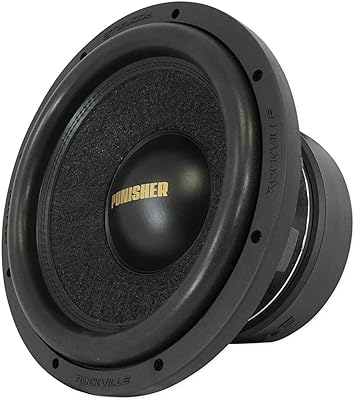
Rockville Punisher 12D1 12-inch Car Subwoofer
83%
92%
Bass Performance
89%
Durability
75%
Installation Ease
88%
Build Quality
83%
Cooling & Heat Management
More
Rockville RV1212P Dual 12″ Car Audio Subwoofers
85%
94%
Bass Performance
89%
Build Quality
84%
Ease of Installation
92%
Value for Money
88%
Sound Clarity
More
Rockville RWS12CA 12″ Amplified Powered Car Subwoofer
88%
91%
Sound Quality
94%
Bass Performance
89%
Ease of Installation
88%
Build Quality & Durability
87%
Value for Money
More
Rockville W12T4S2 12″ 2-Ohm Car Subwoofer
84%
88%
Bass Performance
90%
Ease of Installation
85%
Sound Clarity
80%
Build Quality
92%
Size and Fit in Compact Spaces
More
Rockville W12K6D2 V2 12″ Car Subwoofer
72%
88%
Value for Money
84%
Bass Output
67%
Build Quality
91%
Wiring Flexibility
79%
Low-Frequency Extension
More
Rockville K5 W12K5S2 12″ 2-Ohm Car Audio Subwoofer
86%
94%
Bass Performance
91%
Power Output
88%
Build Quality
82%
Installation Ease
89%
Durability
More
Rockville W12K9D2 K9 V3 12″ Car Subwoofer 2-Ohm
85%
91%
Bass Performance
89%
Build Quality
85%
Durability
93%
Power Handling
80%
Ease of Installation
More
Rockville RVB12.1A 500W Active 12-inch Car Subwoofer
85%
92%
Bass Performance
90%
Power Output
85%
Ease of Installation
88%
Durability
87%
Sound Customization
More
CT Sounds STRATO-12-D4 12 Inch Car Subwoofer
87%
94%
Bass Performance
91%
Power Handling
88%
Build Quality
83%
Ease of Installation
90%
Thermal Management
More
Audiopipe TS-PP2-12-D4 12-inch Car Subwoofer
70%
74%
Value for Money
71%
Bass Output
67%
Build Quality
58%
Power Handling
73%
Voice Coil Quality
More

FAQ

You need a monoblock amplifier that is stable at 1 ohm, since that is where this driver performs best when wired in parallel. At minimum, look for an amp rated at 2000W RMS at your target impedance — anything significantly below that will leave you short of what this driver can actually do. Do not let the peak wattage figures on either the sub or the amp mislead you; RMS is what matters for real-world matching.

Dual 1-ohm means the driver has two separate voice coils, each rated at 1 ohm. Wiring them in parallel gives you a final 0.5-ohm load, while wiring them in series gives you 2 ohms. Most buyers using this driver pair it with an amp stable at 1 ohm, which means wiring one coil to each set of amp terminals — check your amplifier's manual to confirm what impedance it can safely handle.

Technically possible, but not recommended unless that enclosure happens to fall within the 1.41–1.77 cubic foot range for sealed or 2.12–2.83 cubic feet for ported — and is built to handle the depth requirements. Most generic prefab boxes are undersized and too lightly braced for a 54-pound driver at high power. A custom-built enclosure tuned to the driver's specs is the right approach here.

It can handle daily listening if you have the system to support it, but it was clearly designed with competition and maximum output in mind. That means it is optimized for high power levels, and at moderate everyday volumes it may not perform as efficiently as a driver tuned for daily use. If SPL competitions or serious demo builds are not your goal, there are 12-inch drivers better suited to a daily listening setup.

Realistically, this is a two-person install. The driver weighs 54 pounds on its own, and lowering it into a custom enclosure accurately while aligning the mounting holes is awkward at best with one set of hands. Beyond the physical handling, you also need to plan your wiring, box bracing, and vehicle fitment in advance — this is not a beginner-friendly installation.

In a properly tuned ported enclosure, this Rockville sub leans toward high-output, deep bass that is better described as authoritative than tight and precise. Sealed boxes will give you more control and tighter response, though you sacrifice some overall output. The character of the bass depends heavily on enclosure tuning, amplifier gain settings, and head unit EQ — it is a capable driver, but the final sound is very much in your hands.

The package includes the subwoofer only — no amplifier, wiring harness, enclosure, or installation hardware is included. You will need to source your own speaker wire, terminals, and mounting hardware separately. Factor that into your total build budget before purchasing.

Stacking magnets increases the total magnetic flux in the gap where the voice coil operates, which improves the driver's ability to control cone movement at high excursion without losing efficiency. A single large magnet of equivalent weight would be less effective at focusing that flux precisely. In practical terms, it means this competition subwoofer can move a lot of air while maintaining better cone discipline than many single-magnet designs at similar output levels.

There is some room to work within the given ranges, but staying close to the recommended volumes is important for getting the output and low-end extension this driver is capable of. Going significantly undersized in a sealed box will limit excursion and output; going too large in a ported box affects tuning accuracy. Treat the stated ranges as targets to aim for rather than rough guidelines.

Rockville provides a limited warranty, but the specific terms — including duration and what is covered — should be confirmed directly with Rockville before purchase. Competition subwoofers are often subject to restricted warranty coverage when used in high-power SPL applications, so it is worth reading the fine print. Keeping your receipt and product registration documentation is a good practice regardless.

Where to Buy