Overview

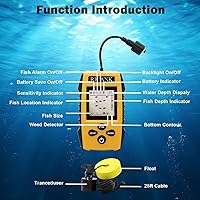
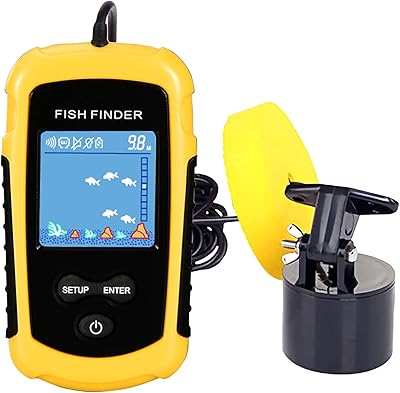
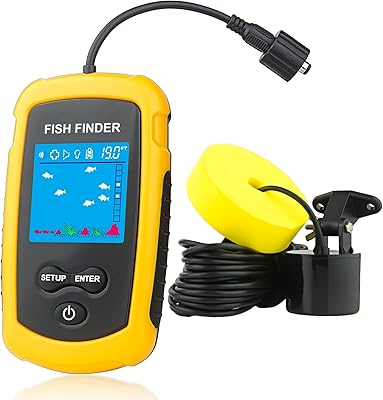
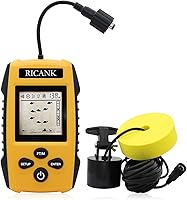
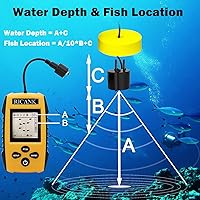
The RICANK TL88EK Portable Fish Finder is a no-frills, budget-conscious sonar unit built for recreational anglers who want useful underwater data without the complexity or cost of a mounted system. Drop the transducer in and the 4-inch LCD screen quickly shows you water depth, approximate fish location and size, bottom composition, and weed coverage down to 328 feet. It runs on four AAA batteries, delivering around four to five hours of continuous use — enough for a solid half-day on the water. A battery-save mode stretches that further when you need it. Ice fishing, kayaking, shore casting — this handheld fish finder handles them all without complaint.
Features & Benefits

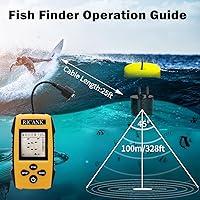
At the heart of this portable depth finder is a 200kHz sonar with a 45-degree cone beam — a solid setup for reading what's directly below you, though it does have real limitations in very deep or turbid water, so manage expectations accordingly. The 25-foot sensor cable gives you genuine flexibility: toss the float off the side of a kayak, lower it through an ice hole, or drop it from a dock. Five sensitivity modes let you dial detection up or down based on conditions. The fish alarm is a handy touch — it lets you focus on your rod rather than staring at the screen all day. Depth readout switches between meters and feet with ease.

Best For

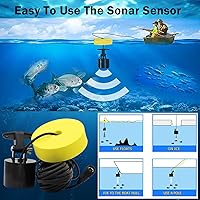
This handheld fish finder really hits its stride for anglers who want simple, actionable data without a steep learning curve or a hefty price tag. Ice fishers will appreciate how easily it drops into a hole and delivers instant depth and fish readings. Kayak and shore anglers benefit from the lightweight build and the included neck strap — no fumbling, no bulk. If you're just getting started with sonar fishing tools, the RICANK sonar unit is one of the more approachable options at this price point. That said, serious deep-water anglers or those chasing fish in challenging conditions may find they quickly outgrow its capabilities.

User Feedback

Buyers generally respond well to this portable depth finder, with the most consistent praise going to its easy setup and the clarity of the backlit LCD in varying light. Many note the 25-foot cable is plenty for kayaking and ice fishing but feels limiting when fishing from a tall pier or deeper spots. Battery life gets a mixed reception — some users hit the stated four to five hours, others fall short, particularly in cold weather. Accuracy in murky or very deep water draws the most criticism. The fish alarm divides opinion: some find it genuinely useful, others treat it as background noise. Durability feedback is mostly positive for casual use, though it is clearly not rated for submersion.

Pros

  • Ready to use in minutes — no installation, no wiring, no prior sonar experience needed.
  • Works across a wide range of fishing styles: ice, kayak, shore, lake, and river fishing.
  • The 4-inch backlit LCD is readable in low light, including overcast mornings and shaded coves.
  • At under 600 grams, this handheld fish finder is light enough to forget it is in your bag.
  • The included neck strap keeps the unit accessible hands-free during active kayak or ice fishing.
  • Five sensitivity modes let you tune detection to match your specific water conditions.
  • The 25-foot transducer cable covers most common deployment scenarios right out of the box.
  • Battery-save mode extends runtime meaningfully during slower, less active fishing sessions.
  • Bottom composition readout — distinguishing sand, rock, and weed coverage — adds real context beyond just depth.
  • One-year warranty provides a reasonable baseline of coverage for a budget-tier device.

Cons

  • Sonar accuracy degrades noticeably in murky water, fast current, or depths beyond around 80 feet.
  • No official waterproof or IP rating — dropping the display unit in water is likely to destroy it.
  • Battery life in cold weather falls short of the stated four to five hours, sometimes significantly.
  • The fish alarm triggers on debris and bottom features almost as readily as on actual fish.
  • The instruction manual lacks the depth needed to help users interpret nuanced sonar readings.
  • The transducer cable length limits deployment options from elevated piers or tall boat decks.
  • Build materials feel fragile under rough handling, and the transducer connector junction is a noted weak point.
  • No automatic sensitivity mode, leaving beginners to guess settings without meaningful guidance.
  • After-sales support quality is inconsistent and heavily dependent on purchase channel.
  • Screen visibility in direct bright sunlight requires shading the display manually to read comfortably.

Ratings

The RICANK TL88EK Portable Fish Finder has been evaluated by our AI system after analyzing thousands of verified buyer reviews from global markets, with spam, bot-generated, and incentivized submissions actively filtered out. The scores below reflect an honest, balanced picture of where this handheld sonar unit genuinely delivers and where it falls short — no cherry-picking, no inflated praise. Strengths and real pain points are weighted equally so you can make a confident, well-informed decision.
Ease of Setup
88%
Most buyers are up and running within minutes straight out of the box — drop in the batteries, toss the transducer float in the water, and the screen starts populating data almost immediately. For anglers who just want to fish rather than fiddle with technology, this near-instant usability is a genuine selling point.
A small number of users found the initial transducer float adjustment and rubber stopper positioning a little fiddly, particularly in cold conditions where fingers lose dexterity. The instruction manual is functional but sparse on detail for edge-case setups like side-scan mounting.
Sonar Accuracy
67%
33%
In clear, calm water at moderate depths — the kind of conditions you encounter on a typical lake or reservoir — the RICANK sonar unit gives reasonably reliable depth readings and a usable sense of where fish are sitting relative to the bottom. The 45-degree cone covers a practical area for still or slow-moving fishing scenarios.
Accuracy drops noticeably in murky water, heavy current, or depths beyond around 60 to 80 feet, where the readings can become inconsistent or miss fish entirely. This is an entry-level 200kHz transducer, and buyers expecting chart-plotter-grade precision will be disappointed — it is a directional indicator, not a precision instrument.
Display Quality
79%
21%
The 4-inch LCD is larger than many competitors at this price point, and the backlight makes it genuinely readable during early morning or overcast sessions on the water. Fish icons, depth numbers, and bottom contour lines are rendered clearly enough for quick glances without squinting.
In bright direct sunlight the screen can wash out, requiring users to shade it with a hand or reposition themselves. The display resolution is adequate but not sharp — do not expect fine-grained detail in the bottom composition readout, especially at depth.
Battery Life
63%
37%
For a typical half-day session — four to five hours of fishing — fresh alkaline AAA batteries hold up reasonably well. The battery-save mode is a practical addition that extends runtime noticeably when you are not actively scanning constantly.
Cold weather takes a significant toll on battery performance, with ice fishing users reporting noticeably shorter runtimes than the stated spec. Several buyers also noted that budget or off-brand AAA batteries fall short of the advertised duration; sticking to name-brand alkalines is essentially mandatory to hit the stated figures.
Portability & Design
84%
At under 600 grams including the transducer, this portable depth finder slips into a tackle bag without a second thought. The included neck strap is a practical touch for kayak and ice anglers who need both hands free while managing lines or augers.
The overall build feels plasticky in hand — not surprising at this price, but it does make some buyers nervous about longevity. The bright yellow housing is visible if dropped on ice, which is a small but appreciated detail, though the unit itself is not rated for submersion.
Transducer Cable Length
71%
29%
Twenty-five feet of cable is genuinely sufficient for the majority of use cases this unit is designed for — kayak gunwale deployments, ice holes, and low dock fishing all work comfortably within that range. The removable float keeps the transducer at a consistent depth without constant adjustment.
Anglers fishing from elevated piers, tall boat decks, or trying to do any meaningful deep-drop scanning find 25 feet limiting fairly quickly. A few users wished the cable were closer to 35 or 40 feet to cover a wider range of real-world fishing positions.
Fish Alarm Feature
58%
42%
The fish alarm is appreciated by beginners and casual users who like having an audible cue rather than watching the screen continuously. It adds a layer of engagement to slower fishing sessions and helps anglers who are learning to interpret sonar data.
Experienced users tend to disable it quickly — the alarm triggers on debris, thermoclines, and bottom features as readily as it does on actual fish, making it more of a novelty than a reliable signal. In quiet environments like early morning ice fishing, unexpected beeping can also be a nuisance to nearby anglers.
Sensitivity Modes
73%
27%
Having five sensitivity settings gives users a meaningful way to reduce false returns in weedy or shallow water, and to push detection further in cleaner, deeper conditions. Anglers who spend time with the unit learn quickly which setting suits their usual fishing spot.
The difference between some adjacent sensitivity levels is subtle enough that newer users struggle to notice a meaningful change in real time. There is no automatic mode, so beginners are left guessing the right setting without much guidance from the manual.
Value for Money
83%
For what you pay, this handheld fish finder delivers a credible set of features that would have cost several times more a decade ago. Recreational anglers who fish a few weekends a year get genuine utility out of depth readings and basic fish location data at a price that carries very little financial risk.
Buyers who push this unit into demanding conditions — deep saltwater fishing, fast rivers, frequent multi-day trips — will likely hit its ceiling within a season and need to upgrade. The value proposition holds firmly for casual use but erodes quickly if your fishing ambitions grow.
Build Durability
61%
39%
For light recreational use — weekend lake trips, occasional ice fishing, casual kayak outings — the construction holds up adequately. Several buyers report using the unit across multiple seasons without any functional failures when treated with basic care.
The housing shows scuffs and wear relatively quickly, and the transducer connector junction is a noted weak point if the cable is regularly coiled tightly or subjected to stress. It is decidedly not a unit built for rough handling or demanding field conditions.
Water Resistance
54%
46%
The unit handles light splashing and rain exposure reasonably well in practice, which is the minimum expectation for any fishing accessory. Kayak users report it surviving the occasional splash or paddle drip without issue during normal outings.
There is no official IP or waterproof rating, and dropping the main display unit into water is likely to damage it permanently. In wet, rainy, or rough-water environments, users need to be more cautious with this device than the rugged yellow design might suggest.
Depth Detection Range
69%
31%
The stated 328-foot maximum depth is impressive on paper for a unit at this price, and in real-world conditions on clear lakes it does pick up bottom readings at substantial depths. For the majority of freshwater fishing scenarios, the range is more than adequate.
Real-world maximum effective depth in less-than-ideal conditions is considerably lower than the spec — many users find reliable readings top out around 100 to 150 feet in typical fishing environments. Saltwater use further reduces effective range due to conductivity differences.
Multi-Environment Versatility
77%
23%
The ability to use this portable depth finder across ice, kayak, shore, lake, river, and sea fishing without any reconfiguration is a legitimate advantage. The transducer float and side-scan adapter included in the box cover most common deployment scenarios right out of the package.
While it technically functions in all these environments, its performance ceiling varies considerably between them. Ice fishing and calm lake use are where it shines; fast river current and open-ocean conditions reveal the limits of its sonar power and physical durability more quickly.
Instruction Manual & Learning Curve
56%
44%
The included operation manual covers the basics clearly enough for most users to get started without frustration. Simple icons and straightforward button layout mean that reading the full manual is optional for casual users who want to keep things simple.
The documentation feels thin when users want to understand the nuances of sensitivity settings, interpret bottom composition readings, or troubleshoot inconsistent sonar returns. Buyers who like to fully understand their gear will likely need to supplement with online forums or video tutorials.
Warranty & After-Sales Support
62%
38%
A one-year manufacturer warranty provides a baseline of confidence for a budget product, and some buyers report successfully resolving issues through the brand's customer service channel within a reasonable timeframe.
Post-purchase support experiences are inconsistent — response times and resolution quality vary significantly depending on where and when the product was purchased. The warranty does not cover physical damage or water ingress, which are the two most common failure modes reported by buyers.

Suitable for:

The RICANK TL88EK Portable Fish Finder is a strong fit for casual and recreational anglers who want basic sonar intelligence without committing to an expensive, permanently mounted system. If you fish from a kayak, a canoe, or the shore a handful of weekends a year, this handheld unit gives you genuinely useful depth and fish-location data at a fraction of what boat-mounted systems cost. Ice fishers in particular will find it well-suited to their needs — it is compact enough to slip into a jacket pocket, quick to deploy through a drilled hole, and simple enough to read at a glance in cold, distracted conditions. Beginners who have never used sonar before will appreciate the low barrier to entry: there is no complicated installation, no wiring, and no steep learning curve standing between you and useful underwater information. If your goal is to understand the water column beneath you — how deep it is, what the bottom looks like, and whether fish are holding at a particular depth — this portable depth finder handles that core job reliably for the type of fishing it was designed for.
Not suitable for:

The RICANK TL88EK Portable Fish Finder is not the right tool for serious or high-frequency anglers who need precision and reliability across a wide range of conditions. If you regularly fish murky rivers, deep reservoirs beyond 80 feet, or open saltwater environments, the sonar accuracy limitations of this entry-level unit will frustrate you quickly — it is simply not built for those demands. Anglers who spend full days on the water will also run into battery constraints, particularly in cold weather where AAA battery performance drops off meaningfully before the session ends. Those who want a device with a proper waterproof rating should look elsewhere; this handheld fish finder has no official IP certification, and accidental submersion of the display unit is likely a permanent loss. If you are a dedicated angler who fishes competitively or relies on sonar data to make precise tactical decisions, the investment in a mid-range or premium unit will pay off far more than stretching the expectations of this portable depth finder beyond its designed purpose.
Specifications

  • Brand & Model: Manufactured by RICANK under the model designation TL88EK.
  • Sonar Frequency: Operates at 200kHz, a standard frequency for freshwater and moderate-depth fishing applications.
  • Beam Angle: Uses a 45-degree cone beam to scan the water column directly beneath the transducer.
  • Detection Depth: Detects underwater features and fish from a minimum of 3ft (1m) down to a maximum of 328ft (100m).
  • Display: Features a 4-inch LCD screen with a built-in backlight for use in low-light and overcast conditions.
  • Transducer Cable: The sonar sensor connects via a 25ft cable with a removable float to maintain consistent transducer depth.
  • Power Source: Powered by 4 x AAA batteries, which are not included in the package.
  • Battery Life: Delivers approximately 4 to 5 hours of continuous use on a fresh set of alkaline AAA batteries under normal conditions.
  • Sensitivity Modes: Offers 5 selectable sensitivity levels to fine-tune sonar detection based on water clarity and depth conditions.
  • Dimensions: The unit measures 10.6 x 6.7 x 2.4 inches and weighs 0.58kg including the transducer assembly.
  • Mounting Type: Designed for handheld use and surface mounting; no permanent installation is required.
  • Depth Units: Depth readings can be displayed in either meters or feet, switchable directly from the unit controls.
  • Key Functions: Core functions include fish detection with size estimation, bottom contour readout, weed and rock identification, fish alarm, and battery-save mode.
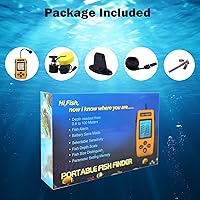
  • Included Accessories: Package contains the display unit, sonar transducer with 25ft cable, removable transducer float with rubber stopper, side-scan adapter, stainless bolt and wing nut, neck strap, and operation manual.
  • Warranty: Covered by a one-year manufacturer warranty against defects in materials and workmanship.
  • Water Resistance: No official IP or waterproof rating is assigned; the unit can handle light splashing but is not designed for submersion.
  • Color: Available in yellow with polyester construction elements for high visibility in field conditions.
  • Sonar Detection: Capable of identifying approximate fish location, fish size, short and tall weeds, sand bottom, and rocky bottom composition.

Related Reviews

RICANK RKF130 Portable Kayak Fish Finder
86%
91%
Portability
89%
Ease of Use
85%
Battery Life
87%
Wireless Connectivity
78%
Depth Detection
More
Venterior VT-FF005 Portable Castable Fish Finder
80%
91%
Ease of Setup
78%
Sonar Accuracy
84%
Display Readability
77%
Wireless Range & Connectivity
73%
Battery Life
More
RICANK F12 Fish Finder
86%
89%
Ease of Use
92%
Portability
91%
Water Resistance
87%
Fish Location Accuracy
82%
Battery Life
More
DANOPLUS DP-104 Portable Fish Finder
85%
87%
Performance
91%
Portability
89%
Ease of Use
85%
Display Visibility
90%
Battery Life
More
Lixada Wired Fishing Finder Sonar Sensor
70%
88%
Ease of Setup
76%
Display Clarity
63%
Depth Detection Accuracy
72%
Bottom & Structure Detection
58%
Audible Fish Alarm
More
Deeper START Castable Fish Finder
75%
88%
Ease of Setup
93%
Portability & Form Factor
67%
App Experience
71%
Sonar Accuracy & Fish Detection
76%
Battery Life
More
Lowrance Eagle 7″ Fish Finder
80%
88%
Display Clarity
84%
Sonar Performance
91%
Ease of Installation
76%
FishReveal Imaging
82%
Chart Coverage & Navigation
More
Garmin Striker 4cv Fish Finder
86%
93%
Sonar Imaging Clarity
89%
Ease of Use
91%
Portability
84%
Battery Life
85%
Build Quality
More
HawkEye Fishtrax 1C Fish Finder
83%
91%
Portability
87%
Sonar Accuracy
89%
Ease of Use
72%
Screen Size
68%
Battery Life
More
LUCKY Y2020-CLA Fish Finder
86%
88%
Accuracy of Fish Detection
90%
Depth Measurement Precision
82%
Wireless Connectivity
75%
Battery Life
95%
Portability
More

FAQ

Not at all. The RICANK TL88EK Portable Fish Finder is genuinely plug-and-play — insert four AAA batteries, attach the transducer float to the cable, drop it in the water, and the screen starts showing depth and fish data within seconds. Most buyers are fishing with it inside five minutes of opening the box.
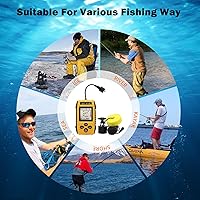
Yes, and it is actually one of the better use cases for this handheld unit. The transducer drops straight into a drilled hole, the 25-foot cable gives you plenty of reach, and the compact body fits easily in a jacket pocket between checks. Just keep in mind that cold temperatures reduce battery performance, so carry a spare set of AAAs on longer sessions.

In clear, calm water at moderate depths, it gives a useful directional read on whether fish are present and roughly how deep they are sitting. That said, this is an entry-level 200kHz sonar, not a precision instrument. In murky water, heavy current, or depths beyond about 80 feet in real-world conditions, the readings become less reliable. Treat it as a helpful indicator rather than a definitive map of what is below you.

The display unit carries no official waterproof or IP rating, so submersion is likely to cause permanent damage. It handles light rain and paddle splashes fine in practice, but you should treat it with the same care you would any unrated electronic device near water. The transducer itself is designed to be submerged — the display is not.

On fresh, name-brand alkaline AAAs under normal conditions, you can realistically expect four to five hours — solid for a half-day trip. In cold weather, particularly during ice fishing, that drops noticeably. Budget or off-brand batteries also fall meaningfully short of those figures. Activating the battery-save mode when you are not actively scanning extends runtime usefully.

It works well in both modes. For kayak use, most anglers simply hang the transducer over the gunwale using the float to keep it at the right depth, then hold or clip the display unit nearby using the included neck strap. There is no permanent mounting hardware included, but the side-scan adapter in the box gives you a bit more flexibility in how you position the transducer relative to the hull.

It will beep when the sonar detects something it classifies as a fish — but it also triggers on debris, thermoclines, and certain bottom features. Experienced anglers tend to turn it off and read the screen directly. For beginners or casual users who want an audible nudge rather than staring at the display, it is a useful feature; just do not treat every beep as a guaranteed catch.

Technically yes — the sonar operates in saltwater — but there are a couple of things worth knowing. Saltwater conductivity affects sonar performance and tends to reduce the effective depth range compared to freshwater use. More importantly, salt exposure over time can degrade components if the unit is not rinsed thoroughly after use, so consistent post-trip maintenance matters more in marine environments.

For the scenarios this portable depth finder is designed for — kayaking, ice fishing, dock fishing, and shore casting — 25 feet is plenty. Where it starts to feel limiting is when fishing from an elevated pier, a tall vessel deck, or any position where significant vertical distance between you and the water eats into the cable length before the transducer even reaches the surface. If that describes your typical setup, you may find it restrictive.

The sensitivity settings control how aggressively the sonar picks up returns from the water column. Higher sensitivity catches more detail but also picks up more noise — weeds, micro-debris, and false returns. Lower sensitivity filters those out but may miss smaller or shallower fish. A practical starting point is the middle setting, then adjust up if the water is clear and you want more detail, or down if the screen is cluttered with noise. The manual gives basic guidance, but a bit of trial and error at your usual fishing spot is honestly the fastest way to find your preferred setting.