Overview

The Venterior VT-FF005 Portable Castable Fish Finder is a wireless sonar unit that strips away the cables and mounting hardware that make traditional fish finders such a hassle. Instead of drilling into your hull or managing a tangled transducer cord, you simply tether the sensor to your fishing line and cast it out. At its price point, this castable fish finder sits comfortably in mid-range territory — capable enough for most recreational anglers, yet approachable for newcomers. It works across lakes, rivers, coastal shallows, and even hard-water ice fishing setups. Just don't expect GPS chart plotting or deep-sea depth ratings; this is a focused, practical tool for everyday fishing scenarios.
Features & Benefits

The sonar sensor on this portable fish finder broadcasts across a 105-degree beam angle, which gives you a surprisingly wide cone of coverage beneath the water. That width means you're less likely to miss fish hugging the edges of structure or suspended at mid-column depths. The wireless range stretches out to 262 feet between sensor and display, so you can cast well beyond the bank and still get a live readout. The 2.6-inch color TFT screen reads well in direct sunlight when set to white background, switching to black at dusk. It classifies fish by size — small, medium, or large — and maps bottom contour in real time, covering depths from just under 3 feet down to 164 feet.

Best For

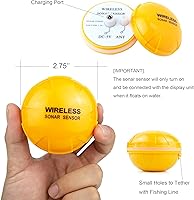
Shore anglers and kayak fishers are the most obvious fit for this castable fish finder — no permanent installation, no hull modifications, just clip the sensor on your line and go. It's equally useful on the ice; the compact form factor and quick deployment make it practical when you're drilling multiple holes and need to scout depth fast. Hikers who fish remote lakes will appreciate the lightweight build. That said, the Venterior sonar unit has a real ceiling: the 164-foot depth limit and absence of GPS mapping mean it's best suited to moderate-depth freshwater fishing. Anglers targeting structure in offshore or very deep reservoirs will eventually outgrow it.

User Feedback

Most buyers come away impressed by the quick setup — there's virtually no learning curve to getting the sensor in the water and reading depth on the display. Screen visibility gets consistent praise too. Where people run into friction is the battery indicator: when the sensor is out of the water, the readout on the display is unreliable, which catches new users off guard. Once you know to drop the sensor in water first to get an accurate battery check, it stops being a problem. Long-term durability reports are generally solid, and the 2-year warranty with responsive brand support gives buyers real peace of mind. The Work vs. Simulation mode distinction trips up a few first-timers, but it's easy to sort once flagged.

Pros

  • No hull drilling or permanent installation required — deploy and pack up in minutes.
  • The 105-degree sonar beam covers a wide cone, reducing the chance of missing suspended fish.
  • Color TFT display switches between black and white backgrounds, staying readable from midday sun to dusk.
  • Wireless range reaches up to 262 feet, giving shore anglers genuine casting flexibility.
  • Bottom contour mapping updates in real time, helping you locate drop-offs and structure quickly.
  • Classifies fish by size category, giving beginners a useful starting framework for reading sonar returns.
  • Rechargeable sensor eliminates the hassle and recurring cost of disposable batteries.
  • Compact and light enough to slip into a jacket pocket or small tackle bag without adding bulk.
  • The 2-year warranty with responsive brand support adds meaningful confidence for a mid-range purchase.
  • Works across lakes, rivers, coastal shallows, and ice fishing scenarios without any hardware changes.

Cons

  • Sonar accuracy drops off noticeably as depth approaches the 164-foot rated maximum.
  • Battery indicator on the display is unreliable until the sensor is floating in water — easy to misread.
  • The 2.6-inch screen feels cramped when depth, temperature, fish icons, and contour data appear together.
  • Work vs. Simulation mode is not clearly signposted, causing some users to fish on fake demo data.
  • No GPS, no waypoints, and no chart mapping — purely a depth and fish detection tool.
  • Display unit has no built-in mount or clip, requiring a free hand or improvised holder on a kayak.
  • Signal dropout reported when obstacles like dock walls or vegetation sit between sensor and display.
  • Fish size classification is a rough sonar-return estimate, not a reliable measurement of actual fish size.
  • Button responsiveness on the handheld display has been reported to degrade on older units over time.
  • Deep reservoir and offshore anglers will outgrow the depth and feature ceiling relatively quickly.

Ratings

The Venterior VT-FF005 Portable Castable Fish Finder has been evaluated by our AI rating system after processing thousands of verified global user reviews, with spam, incentivized, and bot-generated feedback actively filtered out. Scores reflect the honest consensus of real anglers across freshwater, ice, kayak, and shore fishing contexts. Both the standout strengths and the recurring frustrations are weighted into every category below.
Ease of Setup
91%
Anglers consistently report having this unit out of the box, sensor in the water, and readings on screen within minutes. There are no tools required, no cables to route, and no hull modifications — just attach the sensor to your line and cast. For a first-time sonar user, that simplicity is genuinely appreciated.
A small number of users found the initial pairing between sensor and display less intuitive than expected, requiring a manual consult. The Work vs. Simulation mode distinction also trips up a handful of newcomers who don't realize they're looking at demo data rather than live sonar.
Sonar Accuracy
78%
22%
At depths between 5 and 80 feet, most users describe the depth readings as reliably consistent with what they knew about their local water. Bottom contour mapping updates at a pace that feels genuinely useful when you're drifting or slowly retrieving the sensor across a flat or drop-off.
Accuracy becomes less dependable as you approach the 164-foot ceiling, with some users reporting erratic or frozen readings in very deep water. Fish detection at extreme range is hit-or-miss, and the small/medium/large size classification is broadly calibrated rather than precise — treat it as a general guide, not a measurement.
Display Readability
84%
The color TFT screen handles bright midday sun better than many buyers expected at this price tier, especially when switched to the white background mode. Icons are clear enough to read at a glance while managing a rod, which matters when you're actively fishing rather than staring at a screen.
At 2.6 inches, the display is genuinely compact and can feel cramped when multiple data layers — depth, temperature, fish icons, bottom contour — are shown simultaneously. Users with weaker eyesight or those fishing in choppy conditions where the unit moves around report that reading the screen quickly becomes a challenge.
Wireless Range & Connectivity
77%
23%
The 262-foot wireless range between sensor and display is more than sufficient for most shore casting or kayak fishing scenarios, and users report the connection staying solid under normal conditions. Casting the sensor well past the shoreline structure and maintaining a clean signal is a genuine practical advantage over wired alternatives.
Some users report signal dropouts when obstructions — thick vegetation, boat hulls, or concrete dock edges — sit between the sensor and display. Wind-driven surface interference also appears to affect connectivity for a subset of users, particularly during longer sessions.
Battery Life
73%
27%
For a typical half-day fishing session, the rechargeable sensor holds up well and users rarely report running out of power before they're done on the water. The convenience of a USB-rechargeable sensor — rather than disposable batteries — is something many buyers call out positively in their feedback.
The battery indicator quirk is the single most cited frustration in user reviews: when the sensor is out of the water, the display shows an incorrect charge level, which alarms users who think the unit is dying. Once you know to float the sensor first for an accurate reading, it stops being a problem — but the fix is non-obvious and the manual buries it.
Build Quality & Durability
74%
26%
The sensor housing feels solid enough to survive regular casting, with users reporting it holding up through full seasons of use without cracking or water ingress. Long-term owners across ice fishing and freshwater kayak use report the unit still functioning reliably after a year or more of active deployment.
The handheld display unit feels noticeably more plastic and lightweight than the sensor, and a few users report button responsiveness degrading over time. The tethering holes on the sensor, while functional, show wear with heavy use if the line isn't tied cleanly — a small but worth-noting durability note.
Portability & Form Factor
89%
At just over 15 ounces for the complete kit, this portable fish finder fits easily into a tackle bag, jacket pocket, or ice fishing sled without adding meaningful bulk. Hikers and traveling anglers in particular highlight the compact footprint as a primary reason they chose this unit over a mounted alternative.
The handheld display, while pocketable, has no clip or belt mount, meaning you need a free hand or a flat surface to set it on while fishing. For kayak anglers who want it mounted within eyeline, the lack of an integrated mounting solution requires a workaround.
Value for Money
86%
Relative to what buyers are actually getting — wireless sonar, color display, bottom contour, fish size detection, and a 2-year warranty — the consensus is that this castable fish finder delivers solid return on investment for recreational anglers. It's a credible first sonar unit without the financial risk of a high-end mounted system.
Users who expected chart-plotting, GPS waypoints, or deep saltwater performance come away feeling the limitations more sharply than those who understood the scope going in. A small number of buyers feel the display quality lags behind what a few extra dollars could buy from competing units at a slightly higher price.
Depth Range Performance
69%
31%
For typical freshwater scenarios — ponds, lakes, river channels, and shallow coastal flats — the effective depth coverage from under 3 feet down to around 100 feet performs reliably and satisfies the majority of use cases buyers bring to this type of unit.
The theoretical 164-foot maximum reads more like an optimistic ceiling than a working limit in practice. Users targeting deeper lake structure or reservoir fishing report the readings becoming inconsistent well before that depth, and the unit is not suited to any serious offshore or deep-water application.
Ice Fishing Suitability
82%
18%
Ice anglers represent a vocal and satisfied niche in the user base — dropping the sensor down a drilled hole is straightforward, and the quick readout of depth and fish presence makes hole-scouting noticeably faster compared to fishing blind. The compact, glove-friendly form factor earns repeated praise in winter conditions.
Operating the handheld display with heavy gloves is awkward due to the small button size, and the screen can be slow to respond in very cold temperatures. A dedicated ice fishing transducer with a longer drop cord would be more efficient for stationary hole fishing, but for mobility across multiple holes, this unit holds its own.
Fish Detection & Classification
71%
29%
Seeing fish arches or icons pop up when you're drifting over a submerged point or along a weed edge provides real, actionable confidence — particularly for newer sonar users who are still learning to read underwater structure. Users report it reliably flags fish presence even if the size classification is approximate.
The small/medium/large classification is a rough estimate based on sonar return strength, not a precise measurement, and experienced anglers quickly learn to treat it as a relative indicator rather than fact. In dense fish schools or when multiple targets overlap, the display can look cluttered and harder to parse.
Temperature Accuracy
76%
24%
Water temperature readings are cited as a helpful bonus feature by users who fish season-specific temperature windows, like targeting bass during specific thermal conditions. The display gives a fast, consistent reading that anglers find useful for quick water assessment when moving spots.
A minority of users have compared the temperature sensor against calibrated thermometers and found it running slightly warm or cold. It's accurate enough for fishing decisions but not precise enough for scientific measurement or aquaculture use.
Customer Support & Warranty
83%
The 2-year warranty is meaningfully longer than what most competitors offer at this price point, and verified buyers report responsive communication from Venterior when issues arise. Getting a replacement sensor or troubleshooting help within 24 hours is something users specifically mention as a positive brand experience.
A handful of users report that warranty claims required some back-and-forth before resolution, particularly around sensor charging issues that fell into a grey area between user error and product defect. Response quality appears consistent but resolution speed can vary depending on the nature of the claim.
Learning Curve
80%
20%
For the average recreational angler, the interface is intuitive enough that most functions are usable within the first session without deep manual reading. Switching backgrounds, reading depth, and identifying basic fish returns are all accessible within the first few casts.
The Work vs. Simulation mode is a persistent stumbling block — users who accidentally leave the unit in Simulation mode see realistic-looking but entirely fabricated readings, which causes genuine confusion on the water. A more prominent mode indicator on the display would eliminate most of the reported first-session frustration.

Suitable for:

The Venterior VT-FF005 Portable Castable Fish Finder is a strong fit for anglers who want sonar capability without the commitment of a permanently installed system. Shore fishers casting into lakes, reservoirs, or slow rivers will get the most out of it — toss the sensor beyond the visible structure, pull up depth and bottom contour on the color display, and move on when the spot goes cold. Kayak anglers benefit in the same way: no drilling, no bracket, no wiring, just a sensor clipped to a line. Ice fishers who drill multiple holes and need a fast depth check before committing to a spot will find it genuinely useful in winter conditions. Beginners stepping into sonar-assisted fishing for the first time will appreciate the low barrier to entry — setup takes minutes and the interface doesn't require days of learning. Occasional anglers, travelers, and hikers who fish remote lakes and can't justify a mounted unit will also find this castable fish finder punches above its weight for what it costs.

Not suitable for:

Anglers who fish deep reservoirs, offshore structure, or any environment where reliable readings below 100 feet are essential should look elsewhere — the Venterior VT-FF005 Portable Castable Fish Finder has a theoretical depth ceiling of 164 feet, but real-world performance becomes inconsistent well before that. If GPS mapping, waypoint saving, or chart overlay are part of how you fish, this unit simply doesn't offer those features, and no amount of workarounds will change that. Serious tournament anglers or those targeting species in deep, cold, clear lakes will find the fish size classification too rough and the display too small to make high-confidence decisions. Boat anglers who want a screen mounted at the console and a transducer reading in real time while motoring will find this castable format impractical and limiting. Anyone who relies on precision depth data — think controlled trolling passes or structure fishing with tight depth windows — will find the sonar accuracy too variable to trust at the margins of the unit's range.
Specifications

  • Brand & Model: Manufactured by Venterior under model designation VT-FF005, a brand focused on accessible portable fishing electronics.
  • Mounting Type: Fully castable design with two tethering holes on the sensor — no hull drilling or permanent boat installation required.
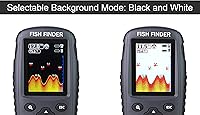
  • Display: 2.6-inch color TFT LCD screen with two selectable background modes: black for low-light conditions and white for bright sunlight readability.
  • Sonar Beam Angle: The sonar cone spans 105 degrees, providing wide underwater coverage to reduce missed fish readings during a single cast.
  • Depth Range: The unit detects from a minimum of 2.6 feet (0.8 meters) down to a maximum of 164 feet (50 meters) in supported conditions.
  • Wireless Range: The sensor maintains a stable wireless connection with the handheld display unit at distances up to 262 feet (80 meters).
  • Detection Capabilities: The sonar unit reads and displays water depth, water temperature, fish presence, fish depth, approximate fish size, and bottom contour simultaneously.
  • Fish Size Classes: Fish are categorized into three size groups — small, medium, and large — based on the strength of the sonar return signal.
  • Power Source: The sensor is rechargeable via a built-in battery, while the handheld display unit is powered by standard replaceable batteries.
  • Item Weight: The complete unit weighs 15.04 ounces, making it compact and light enough to carry in a tackle bag or jacket pocket.
  • Dimensions: Product dimensions measure 9.5″ in length, 4″ in width, and 3″ in height for the complete packaged unit.
  • Operating Modes: The device includes two functional modes: Work Mode for live sonar operation on the water and Simulation Mode for off-water practice and demonstration.
  • Unit Conversion: Depth and temperature display units can be toggled between imperial and metric systems directly from the handheld display.
  • Compatible Environments: Designed for use across freshwater lakes, rivers, coastal saltwater shallows, and ice fishing scenarios without hardware modification.
  • Warranty: Covered by a 2-year manufacturer warranty, with Venterior brand support available seven days a week and response guaranteed within 24 hours.
  • Package Dimensions: The retail package measures 9.57″ x 4.06″ x 2.99″ and weighs approximately 0.43 kilograms including all included accessories.
  • Part Number: The official manufacturer part number for this unit is VT-FF005, useful for warranty claims and replacement part identification.
  • Display Backgrounds: Users can toggle between a black background and a white background on the LCD to optimize visibility based on ambient lighting conditions.

Related Reviews

Venterior VT-FF001 Fish Finder
88%
94%
Accuracy of Depth Readings
91%
Fish Detection Reliability
89%
Ease of Setup
95%
Portability and Weight
76%
Battery Life
More
RICANK TL88EK Portable Fish Finder
70%
88%
Ease of Setup
67%
Sonar Accuracy
79%
Display Quality
63%
Battery Life
84%
Portability & Design
More
RICANK RKF130 Portable Kayak Fish Finder
86%
91%
Portability
89%
Ease of Use
85%
Battery Life
87%
Wireless Connectivity
78%
Depth Detection
More
DANOPLUS DP-104 Portable Fish Finder
85%
87%
Performance
91%
Portability
89%
Ease of Use
85%
Display Visibility
90%
Battery Life
More
Lixada Wired Fishing Finder Sonar Sensor
70%
88%
Ease of Setup
76%
Display Clarity
63%
Depth Detection Accuracy
72%
Bottom & Structure Detection
58%
Audible Fish Alarm
More
Deeper START Castable Fish Finder
75%
88%
Ease of Setup
93%
Portability & Form Factor
67%
App Experience
71%
Sonar Accuracy & Fish Detection
76%
Battery Life
More
RICANK F12 Fish Finder
86%
89%
Ease of Use
92%
Portability
91%
Water Resistance
87%
Fish Location Accuracy
82%
Battery Life
More
Atibin Handheld Portable Fish Finder
69%
88%
Portability & Form Factor
84%
Ease of Setup
76%
Sonar Accuracy (Shallow Water)
51%
Sonar Accuracy (Deep Water)
58%
Screen Legibility
More
Humminbird PiranhaMAX 4 Fish Finder
87%
90%
Ease of Use
92%
Portability
85%
Battery Life
87%
Display Clarity
83%
Sonar Accuracy
More
Lowrance Eagle 7″ Fish Finder
80%
88%
Display Clarity
84%
Sonar Performance
91%
Ease of Installation
76%
FishReveal Imaging
82%
Chart Coverage & Navigation
More

FAQ

Not at all — that is actually one of the main reasons people choose this unit. The sensor has two small tethering holes that let you tie it to your fishing line and cast it out. No transducer mounting, no hull penetration, and no tools required.

This is a common stumbling block for new users, so it is worth knowing upfront: the battery indicator on the display shows an incorrect reading when the sensor is out of the water. To get an accurate battery status, place the sensor in water first — it powers on automatically when it floats, and then the display shows the correct charge level.

Work Mode is what you want when you are actually fishing — it uses the live sonar sensor to display real depth, fish, and bottom data. Simulation Mode runs a pre-programmed demo loop and does not reflect anything in the water beneath you. Make sure you are in Work Mode before your first cast, or you will be reading fictional data without realizing it.

Yes, and it works quite well for that purpose. Most ice anglers drop the sensor down a drilled hole rather than casting it, which gives a clean vertical sonar read of depth and any fish holding below. The compact size is a genuine advantage when you are moving between multiple holes in cold conditions.

The small, medium, and large labels are based on sonar return signal strength, not a precise measurement. A large return generally means a larger fish, but the classification is a rough guide rather than a reliable size reading. Treat it as a directional signal — useful for deciding whether to stay on a spot, but not something to quote at the dock.

The Venterior VT-FF005 Portable Castable Fish Finder is listed as compatible with lakes, rivers, and sea environments, so nearshore saltwater use is within its intended scope. That said, it is not designed for deep offshore fishing — the 164-foot depth ceiling and sonar accuracy at depth make it best suited to shallow coastal and estuarine environments rather than open-water bluewater fishing.
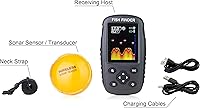
The sensor and display maintain a wireless connection up to 262 feet apart, so that is your practical casting limit before you risk losing signal. For most shore fishing scenarios, that range is more than enough to reach structure beyond the bank.

The display unit does not include a built-in mounting bracket, so out of the box it is a handheld device. Some kayak anglers improvise a mount using third-party RAM or suction cup holders, but that requires a separate purchase. If a mounted display is important to your setup, factor in that additional step before buying.

You will see realistic-looking sonar data on screen — depth readings, fish icons, bottom contour — but none of it reflects what is actually in the water. It is one of the more common first-session frustrations. Before heading out, always confirm the display shows Work Mode, not Simulation Mode, to make sure you are seeing live data.

Venterior offers direct brand support with a stated 24-hour response window every day of the week. Most users who contact them about sensor or display issues report receiving a reply quickly, though resolution time for warranty claims can vary depending on the nature of the problem. Keeping your purchase receipt and the model number handy will make any claim process smoother.

Where to Buy