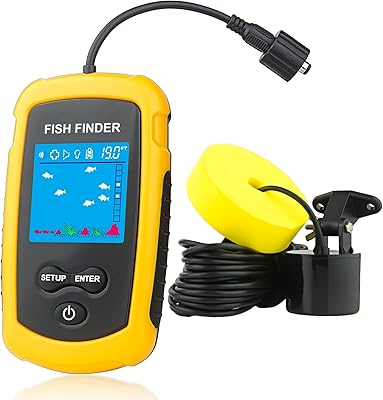
Overview

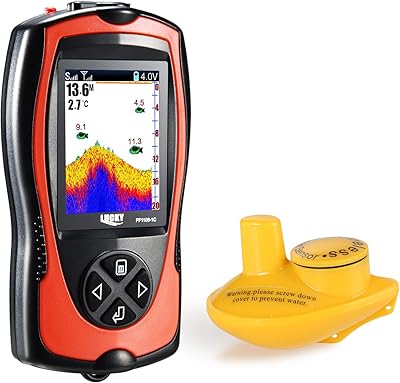
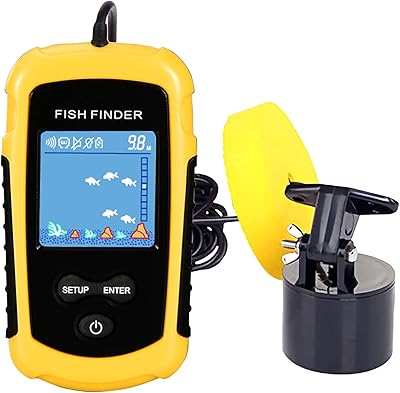
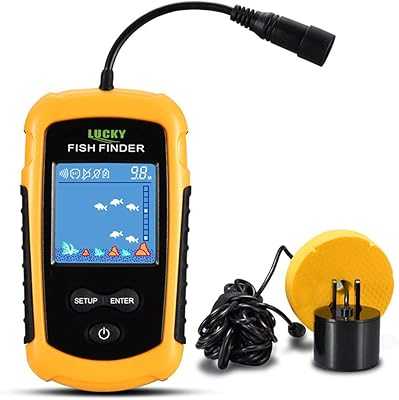
The LUCKY Y2020-CLA Wireless Handheld Fish Finder sits in an interesting spot in the market — practical enough for serious weekend anglers, yet approachable enough for someone just getting started with sonar-assisted fishing. What sets it apart from budget-tier competition is its dual-mode operation: you can cast the transducer wirelessly across open water or switch to wired mode for deeper depth readings. It handles ice fishing, kayak sessions, boat trips, and bank fishing without complaint. The built-in rechargeable battery is a genuine convenience over units that eat through disposable batteries. One thing worth being clear about upfront — this is a depth and fish locator, not a GPS or chartplotter. Set expectations accordingly.
Features & Benefits

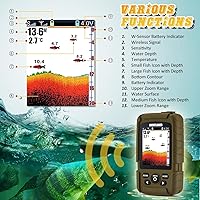
The 125kHz sonar transducer runs on a 90-degree beam angle, giving solid wide-area coverage — especially useful in shallower water where you want to scan a broad column rather than a narrow cone. The 2.8-inch LCD display is compact but functional, showing water depth, approximate fish positions, and rough fish size at a glance. Switching modes changes what you get: wireless tops out at around 147ft depth detection while extending casting distance to 328ft, whereas wired mode pushes depth detection up to 328ft. The sonar ball comes with a glow-in-the-dark cap for low-light sessions, and the unit itself floats if dropped overboard — a small but genuinely reassuring detail for anyone fishing from a kayak or ice platform.

Best For

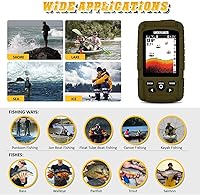
This handheld fish finder earns its place most among ice fishing enthusiasts — drop the transducer through the hole and you get instant depth and fish activity feedback without any permanent rigging. Kayak anglers benefit equally since the whole package is lightweight and won't clutter a small craft. Bank and shore fishers can cast the wireless transducer out to gauge depth before committing to a spot. It's also a strong pick for beginners and occasional anglers who fish a few times a year and can't justify a mounted, full-feature sonar system. If you travel and fish, pack-and-go portability is where this portable fish finder truly delivers its best value.

User Feedback

Across close to 290 ratings, the LUCKY sonar unit holds a 4.1-out-of-5 average — a score that reflects a largely satisfied user base with a few consistent caveats. Buyers frequently praise ease of setup and the wireless casting convenience, with depth readings described as accurate and reliable in calm, open water. Battery life is another recurring positive, especially among ice fishers who value the extended runtime in save mode. On the flip side, the 328ft wireless range doesn't always hold up in real-world conditions, and the small LCD screen can wash out in direct sunlight. Fish size readings are approximate at best, so don't go in expecting the precision of a high-end mounted unit.

Pros

  • Dual wireless and wired modes give you genuine flexibility across different fishing setups.
  • Drop-in transducer design makes ice fishing setup fast, clean, and hardware-free.
  • Rechargeable battery is far more convenient than units that drain disposable cells.
  • The 90-degree sonar beam covers a wide water column, well-suited for shallower environments.
  • Battery save mode pushes runtime past 10 hours for demanding all-day sessions.
  • Waterproof and buoyant — the transducer floats if dropped overboard instead of sinking.
  • Glow-in-the-dark sonar cap makes tracking the transducer position straightforward during night fishing.
  • Lightweight and compact enough to fit in a kayak hatch or tackle bag without issue.
  • Straightforward setup straight out of the box — no technical knowledge or tools required.
  • Works across multiple environments: ice, kayak, small boat, and bank fishing.

Cons

  • Wireless range rarely hits the 328ft spec in real fishing conditions — expect noticeably less.
  • The 2.8-inch LCD washes out in bright sunlight, making readings hard to interpret outdoors.
  • Fish size indicators are rough approximations only — not reliable enough for precise judgment calls.
  • Wireless depth detection caps at 147ft, which falls short for deeper lakes or reservoirs.
  • No GPS, no mapping, and absolutely no chart overlay of any kind.
  • Fish species identification is impossible — the screen shows size icons, not biological data.
  • The included 25ft extension cable may feel restrictive on larger boats or wider setups.
  • Screen resolution is not detailed enough to read subtle depth contours or distinguish fish arches.
  • No option to fall back on standard disposable batteries if the built-in charge runs out mid-trip.

Ratings

The LUCKY Y2020-CLA Wireless Handheld Fish Finder has been evaluated across 15 performance categories by our AI review engine, which processed verified buyer feedback from global markets while actively filtering out incentivized, bot-generated, and spam submissions. Scores reflect the full spectrum of real owner experience — from the capabilities buyers consistently applaud to the friction points that resurface across hundreds of honest accounts. Both genuine strengths and documented limitations are transparently represented in every category below.
Sonar Accuracy
72%
28%
In calm, shallow water, depth readings return consistently and reliably — anglers fishing lakes and rivers under 100ft report accurate bottom readings and reasonable fish detection. The 90-degree beam provides solid wide-area coverage, and the unit is dependable enough for locating fish schools during ice fishing sessions where water conditions are controlled.
Fish size indicators are rough approximations at best, and the unit struggles to deliver precise readings in deeper or choppier water. Buyers comparing it against higher-frequency professional units frequently note that the 125kHz transducer misses smaller fish or returns ambiguous signals in complex underwater terrain.
Wireless Range
61%
39%
For casual shore casting and bank fishing, the wireless mode works well enough — toss the sonar ball 50 to 100ft out and you get useful depth and fish presence data quickly. In calm, flat water with minimal interference, many anglers report consistent and reliable performance comfortably within that practical everyday range.
The advertised 328ft wireless range is consistently challenged in real-world use, with a significant number of buyers reporting signal dropouts well before that distance. Wind, surface chop, and local wireless interference all noticeably degrade performance, making the spec figure a ceiling rather than a dependable everyday benchmark.
Battery Life
83%
Battery performance is one of the most consistently praised aspects of this handheld fish finder. Standard use delivers a dependable 5 to 6 hours, and engaging save mode pushes that past 10 hours — a genuine practical advantage for ice fishers who spend full days on frozen water without access to charging.
There is no fallback option for standard disposable batteries if the built-in charge runs out mid-trip, which means a dead unit stays dead until it reaches a USB charger. A subset of buyers have also reported that battery capacity degrades noticeably after extended ownership and repeated heavy charge cycling.
Display Quality
58%
42%
The 2.8-inch LCD does its job adequately in shaded or overcast conditions, presenting depth, fish icons, and size estimates in a layout that is easy to read at a glance. Anglers fishing early mornings, under cloud cover, or from enclosed ice shelters rarely raise visibility complaints about this portable fish finder.
Direct sunlight is a persistent problem — the screen washes out badly in bright outdoor conditions, which is a significant drawback for a unit primarily used outside. It lacks both brightness adjustment and any anti-glare coating, making it a consistent weak point during summer fishing or midday sessions in exposed environments.
Portability
87%
At around 1.1 kg fully packaged, the LUCKY sonar unit fits into a tackle bag, backpack, or kayak hatch without taking up meaningful space or adding noticeable weight. Travelers, campers, and kayak anglers consistently cite portability as a primary reason they chose this unit over any mounted or heavier alternative.
The 25ft wired extension cable adds some bulk when packed alongside the transducer and display, and coiling it neatly for storage requires a moment of deliberate effort. Larger boat users seeking maximum cable length for deep wired deployment will also find the included cable length limiting for their setup.
Ease of Setup
91%
Virtually every buyer group — from first-time sonar users to experienced anglers trying a new unit — praises how quickly this portable fish finder goes from box to water. No software, no complex pairing, and no tools are required; the wireless transducer connects automatically once it hits the surface.
For beginners unfamiliar with reading sonar displays, interpreting fish icons and size indicators correctly takes some trial and error in the field. The included documentation is functional but sparse, and new users occasionally misread depth data until they develop an intuitive feel for how the unit behaves in different water conditions.
Depth Detection
74%
26%
Wired mode performs reliably down to its 328ft ceiling, covering the vast majority of freshwater fishing scenarios most buyers encounter. For boat and kayak anglers fishing deeper lakes, switching to wired delivers noticeably more stable and accurate depth readings than wireless mode can provide at comparable depths.
Wireless mode caps depth detection at 147ft, which is inadequate for offshore, deep reservoir, or highland lake scenarios where depths routinely exceed that threshold. Buyers specifically targeting deep-water fishing will hit that ceiling quickly and find the wireless depth performance a meaningful limitation for their needs.
Build Quality
78%
22%
The waterproof housing holds up well against rain and splashes in typical fishing conditions, and the buoyant transducer design is a practically useful safety net for kayak and ice anglers who risk dropping gear overboard. The overall construction feels solid enough to withstand regular outdoor and field use.
The unit does not feel premium in hand — the plastic housing is functional but lightweight in a way that reads as budget-tier to buyers accustomed to higher-end sonar equipment. A handful of owners have also reported minor button wear and cable connector looseness developing after months of frequent use.
Value for Money
76%
24%
For beginners and occasional anglers, the LUCKY sonar unit delivers a meaningful range of sonar capabilities at a price that does not require a serious financial commitment. Dual-mode operation, buoyant waterproof construction, and USB rechargeability represent a genuinely competitive specification set within the mid-range portable fish finder category.
Buyers who have owned higher-spec fish finders before often find the display quality, wireless range consistency, and fish detection precision underwhelming relative to the asking price. The unit sits in a competitive bracket where spending modestly more can get you a significantly better screen and more dependable sonar performance.
Versatility
82%
18%
Few portable sonar units at this price tier genuinely perform across four distinct fishing environments, and this handheld fish finder handles ice, kayak, boat, and bank fishing without requiring configuration changes or additional accessories. That cross-environment flexibility is a genuine selling point for anglers without a fixed single-style fishing routine.
While it technically functions across multiple environments, performance in each is modest — it does not excel the way a purpose-built ice flasher or a mounted chartplotter would in their respective niches. Multi-environment versatility comes at the cost of peak performance depth in any individual fishing context.
Ice Fishing Performance
88%
Drop-in transducer deployment through an ice hole is fast, clean, and genuinely practical — no mounting hardware, no rigging, no boat required. Battery save mode suits cold-weather conditions particularly well, and user feedback from ice anglers is disproportionately positive compared to every other use case this unit supports.
Extremely cold temperatures can affect LCD responsiveness and battery output in ways the product specs do not fully disclose, and a handful of cold-climate buyers have noted sluggish display behavior in very low temperatures. Keeping the unit tucked inside a jacket between drops helps, but that is a workaround rather than a designed solution.
Night Fishing
79%
21%
The glow-in-the-dark sonar cap is a thoughtful inclusion that makes tracking transducer position in dark water noticeably easier during evening or nighttime sessions. The fish alert alarm adds a practical layer by signaling detections audibly, so anglers do not need to stare at the screen throughout a low-light session.
The LCD is not bright enough to be effortlessly readable in very dark conditions, and anglers fishing without ambient light may need a separate torch to check readings clearly. The unit functions adequately for night fishing but was not purpose-designed for it, and the display limitation becomes a recurring inconvenience after dark.
Signal Stability
68%
32%
In calm, flat water the signal is steady and readings update consistently, giving anglers a reliable picture of depth and fish activity beneath the transducer. Users fishing still ponds, early-morning lakes, and sheltered ice holes report the most stable and satisfying signal experience across all buyer feedback.
Signal consistency drops noticeably in moving water, heavy chop, or when the transducer is not held stationary — conditions that represent a meaningful share of real fishing scenarios. Readings can jump, stutter, or drop out briefly when the sonar ball is disturbed by current or surface wave action.
Transducer Durability
71%
29%
The sonar ball itself handles regular drop-in use reliably, and the buoyant design provides genuine protection against the most common accident in fishing — losing gear to the water. The anti-bite plastic float on the wired cable also adds a practical layer of protection in environments with active, aggressive fish.
The wired extension cable is the most reported durability weak point, with some buyers noting fraying or connector looseness after extended use — particularly when the cable is regularly coiled and uncoiled. The transducer housing is plastic rather than rubberized, offering limited impact protection if the unit is knocked against a hard surface.
User Interface
84%
The controls are minimal and logical — most buyers navigate the basic functions within minutes of powering on the unit for the first time. Mode switching between wireless and wired is intuitive, and the fish alert system activates without any menu-diving, which is exactly what anglers mid-session need from a portable unit.
More experienced sonar users will find the interface too limited to adjust sensitivity, filter settings, or display preferences in any meaningful way. There is no backlight control, no sensitivity tuning, and no surface clutter filtering — constraints that become increasingly noticeable as users grow more experienced with sonar equipment.

Suitable for:

The LUCKY Y2020-CLA Wireless Handheld Fish Finder is a practical choice for anglers who move between different fishing environments rather than staying fixed to one permanent boat setup. Ice fishers get the most out of it — the drop-in transducer works through a hole without any mounting hardware, and the extended battery life in save mode holds up through a long cold session. Kayak and small-boat anglers will appreciate how compact and light the whole kit is, with no rigging involved and minimal space taken up in a hatch or dry bag. Shore and bank fishers can cast the wireless transducer ahead of them to check depth and fish presence before committing to a spot. Beginner and occasional anglers who want to try sonar-assisted fishing without a major financial commitment will find this handheld fish finder a reasonable, low-barrier entry point. Travelers and campers who fish opportunistically — a lake here, a river there — will also find it easy to justify tossing in a bag.
Not suitable for:

If you fish professionally or compete at any serious level, this portable fish finder simply will not meet your expectations for precision or reliability. The display is small and lacks the resolution needed to confidently interpret fish arch readings the way a dedicated chart-style sonar can. Anglers who fish primarily in deep water — offshore saltwater or deep freshwater reservoirs — will find the depth ceiling limiting, especially in wireless mode where detection tops out around 147ft. The wireless range has drawn consistent real-world feedback about falling short of its rated spec, making it a less dependable tool if long-range casting is central to your style. Anyone who needs GPS mapping, waypoint marking, or chart overlay should look elsewhere entirely, as the LUCKY Y2020-CLA Wireless Handheld Fish Finder offers none of those capabilities. Anglers who frequently fish in bright, direct sunlight will also find the 2.8-inch LCD a recurring source of frustration.
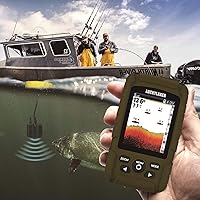
Specifications

  • Brand & Model: This unit is manufactured by LUCKY under model designation Y2020-CLA.
  • Display: The device features a 2.8-inch LCD screen that shows water depth, approximate fish location, and estimated fish size simultaneously.
  • Sonar Frequency: The transducer operates at 125kHz, a frequency well-suited for wide-area detection in freshwater and shallow coastal environments.
  • Beam Angle: The sonar cone covers a 90-degree beam angle, providing broad horizontal water column coverage beneath and around the transducer.
  • Wireless Range: In wireless mode, the sonar transducer can be cast up to 328ft (100m) from the handheld display unit.
  • Wired Depth: When operated in wired mode using the included extension cable, the unit detects depth down to 328ft (100m).
  • Wireless Depth: Wireless mode supports depth detection up to 147ft (45m), which is adequate for most inland lakes, rivers, and reservoirs.
  • Extension Cable: A 25ft (7.62m) wired extension cable with an anti-bite plastic float is included for wired transducer operation.
  • Power Source: The handheld unit is powered by a built-in rechargeable lithium battery that charges via a standard USB connection.
  • Battery Life: Standard operation yields approximately 5 to 6 hours per charge; activating battery save mode extends runtime to over 10 hours.
  • Waterproofing: The main unit is waterproof against rain and splashes, and the sonar transducer is buoyant and will float if accidentally dropped into water.
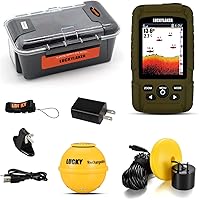
  • Sonar Ball Cap: A glow-in-the-dark transparent replacement cap for the sonar ball is included, improving transducer visibility during low-light and night fishing sessions.
  • Fishing Types: The unit is designed and tested for use across ice fishing, kayak fishing, boat fishing, and bank or shore fishing.
  • Mounting Type: The transducer supports thru-hull mounting for more permanent boat installation, in addition to handheld drop-in use.
  • Package Weight: The complete packaged unit weighs approximately 1.1 kg, keeping it manageable for transport and travel.
  • Pkg Dimensions: The packaged unit measures 9.8 x 6.57 x 4.29 inches, compact enough to fit in most tackle bags or backpacks.

Related Reviews

LUCKY FF-1108-1C Wireless Fish Finder
87%
85%
Performance
92%
Portability
89%
Ease of Use
88%
Display Clarity
77%
Sonar Range/Depth Detection
More
Atibin Handheld Portable Fish Finder
69%
88%
Portability & Form Factor
84%
Ease of Setup
76%
Sonar Accuracy (Shallow Water)
51%
Sonar Accuracy (Deep Water)
58%
Screen Legibility
More
Lixada Wired Fishing Finder Sonar Sensor
70%
88%
Ease of Setup
76%
Display Clarity
63%
Depth Detection Accuracy
72%
Bottom & Structure Detection
58%
Audible Fish Alarm
More
Deeper START Castable Fish Finder
75%
88%
Ease of Setup
93%
Portability & Form Factor
67%
App Experience
71%
Sonar Accuracy & Fish Detection
76%
Battery Life
More
Venterior VT-FF005 Portable Castable Fish Finder
80%
91%
Ease of Setup
78%
Sonar Accuracy
84%
Display Readability
77%
Wireless Range & Connectivity
73%
Battery Life
More
RICANK F12 Fish Finder
86%
89%
Ease of Use
92%
Portability
91%
Water Resistance
87%
Fish Location Accuracy
82%
Battery Life
More
HawkEye Fishtrax 1C Fish Finder
83%
91%
Portability
87%
Sonar Accuracy
89%
Ease of Use
72%
Screen Size
68%
Battery Life
More
RICANK TL88EK Portable Fish Finder
70%
88%
Ease of Setup
67%
Sonar Accuracy
79%
Display Quality
63%
Battery Life
84%
Portability & Design
More
Venterior VT-FF001 Portable Fish Finder
76%
93%
Ease of Setup
91%
Portability
62%
Sonar Accuracy
67%
Display Readability
58%
Battery Life
More
Garmin Striker 4cv 3.5-inch Fish Finder
79%
88%
Sonar Image Quality
91%
Value for Money
87%
Ease of Installation
93%
Ice Fishing Performance
61%
Screen Visibility
More

FAQ

Setup is genuinely straightforward. Charge the LUCKY Y2020-CLA Wireless Handheld Fish Finder fully via the included USB cable, then power on the display. For wireless mode, toss the sonar ball into the water and it pairs automatically with the unit. For wired mode, connect the 25ft extension cable to the transducer and lower it into position. Most buyers report being up and running within a few minutes of opening the box.
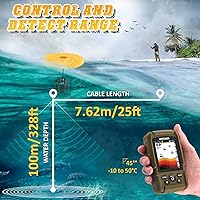
The practical difference comes down to depth versus casting distance. In wireless mode, you can cast the transducer up to 328ft away but depth detection is limited to around 147ft — ideal for bank fishing or scouting open water. In wired mode, your range is limited by the 25ft cable, but depth detection extends down to 328ft, which is more useful when fishing over deeper water from a boat or kayak. Use wireless when distance matters and wired when depth matters.

No, and it is worth being clear about that upfront. The handheld fish finder displays fish as icons with an estimated size indicator, but it cannot identify species in any way. It gives you a general sense of where fish are positioned in the water column and roughly how large they are, which is useful for locating schools or individual fish — but species-level identification is beyond what any sonar unit in this class can do.

It genuinely works well for ice fishing — arguably better than for most other scenarios. You drop the transducer through the hole and the unit immediately starts reading depth and fish activity with no mounting hardware required. Battery life in save mode comfortably handles long cold-weather sessions, which is exactly what ice fishers need. It is one of the most frequently praised use cases among verified buyers.

LUCKY does not officially certify or market this portable fish finder for saltwater use. Many anglers use similar sonar units inshore without immediate problems, but long-term exposure to saltwater accelerates corrosion on the transducer housing and contacts. If saltwater is your primary environment, rinse the transducer thoroughly with fresh water after every outing, and seriously consider whether a purpose-built saltwater-rated unit would be a smarter long-term investment.

The unit charges via a standard USB cable connected to the port on the handheld display — no proprietary charger needed. Charge time is not officially specified, but based on the battery capacity typical of units like this, plan for roughly 2 to 3 hours for a full charge. Charging the night before your trip is a good habit rather than trying to top it up on the way out.

It works quite well for this scenario. Wireless mode lets you cast the sonar ball out ahead of your position to check depth and spot fish presence in areas you cannot physically reach, which can genuinely help you decide where to drop your line. Just keep in mind that real-world wireless range often falls short of the stated 328ft maximum depending on water surface conditions and any local interference, so treat that figure as a ceiling rather than a guarantee.

Honestly, treat it as a best-case figure. Quite a few buyers have reported that real-world range falls noticeably short of 328ft, particularly in choppy water or areas with wireless interference. For the vast majority of fishing situations you will not need anything close to that distance, but if maximum casting range is a key part of how you fish, it is worth managing your expectations before purchasing.

This is one of the more consistent criticisms from real users. The 2.8-inch LCD can be difficult to read in strong direct sunlight — it does not have high brightness or an anti-glare finish. Shading the screen with your hand or positioning your body to block the sun helps considerably. It is an honest trade-off that comes with keeping the LUCKY sonar unit compact and portable; if sunlight readability is a dealbreaker for you, a higher-end unit with a color display and boosted brightness would be a better fit.

Yes — the transducer does support thru-hull mounting if you want a more permanent installation on a boat hull. That said, the handheld display unit is designed to be held or set on a surface rather than bracket-mounted to a console like a traditional chartplotter. For kayaks and small aluminum boats, the drop-in handheld approach tends to be the simpler and more practical choice anyway, and most buyers in that category use it exactly that way.