Overview

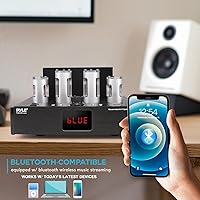
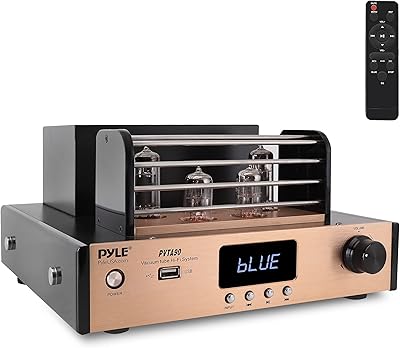
The Pyle PVTA80 Bluetooth Vacuum Tube Amplifier is one of the more accessible ways to get into tube audio without spending a fortune. Four glowing tubes sit exposed on the top panel — part amplifier, part living room centerpiece — and they genuinely turn heads. Modern touches like Bluetooth and USB connectivity keep the unit relevant beyond just legacy gear. That said, the advertised 500W figure is a peak power rating, not a continuous RMS measurement, so real-world output is considerably more modest. At its price point, this tube amp receiver is aimed squarely at casual home listeners, not purists chasing high-end fidelity.
Features & Benefits

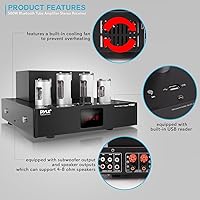
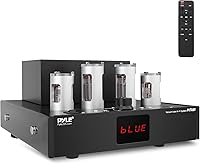
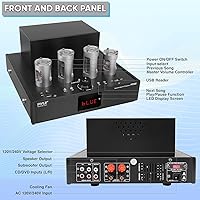
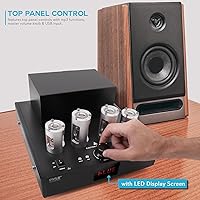
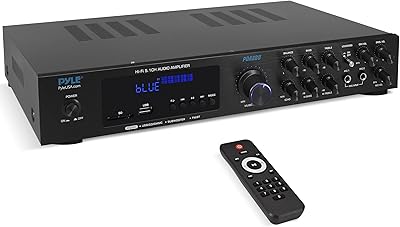
The four top-mounted vacuum tubes aren't purely decorative — they do contribute a warmer, slightly colored sound signature that many listeners find more pleasing than clinical solid-state output. Bluetooth pairing works reliably with phones, tablets, and laptops, making wireless playback genuinely convenient for everyday use. A built-in USB reader and two CD/DVD inputs give you flexibility across both modern and older source formats. Two speaker outputs handle 4–8 ohm loads, and there's a dedicated subwoofer output if you want to add low-end punch. The top-panel control layout with LED display is intuitive, and a built-in cooling fan helps manage heat during extended listening sessions.

Best For

This vacuum tube stereo unit makes the most sense for listeners who want a warm, characterful sound without committing to a serious audiophile budget. It's a natural fit for small living rooms or desktop setups where the visual impact of four glowing tubes genuinely adds something to the space. People transitioning from purely digital playback who are curious about the tube sound experience will find it approachable. It also works well for anyone who still plays CDs or keeps music on USB drives, since those inputs are genuinely useful here. As a gift, it has real visual wow factor — few amps at this price look this distinctive.

User Feedback

Across several hundred reviews, the pattern is fairly consistent. Buyers frequently praise the warm sound character and the glow of the tubes, which seem to meet or exceed expectations at this price. Bluetooth connectivity draws positive comments for ease of use, though a handful of users report range dropping off faster than expected in larger spaces. The fan noise comes up often enough to deserve mention: in quiet rooms or during soft passages, some listeners find it genuinely distracting. A few longer-term owners also raise questions about build quality and how straightforward tube replacement would be down the line. Overall sentiment leans positive, but with clear-eyed caveats.

Pros

  • Four glowing vacuum tubes on the top panel create a genuinely eye-catching aesthetic that stands out from typical black-box amplifiers.
  • The warm, slightly colored sound signature is noticeably more pleasing than budget solid-state amps for casual listening.
  • Bluetooth pairing with phones, tablets, and laptops is reliable and straightforward for daily wireless use.
  • USB reader and dual CD/DVD inputs offer real flexibility for listeners who use multiple source formats.
  • A dedicated subwoofer output lets you expand the low-end response with an external sub.
  • The included remote control adds everyday convenience without needing to reach the top-panel controls.
  • Top-panel LED display and intuitive controls make navigation easy even without the remote.
  • At its price tier, this tube amp receiver offers tube audio aesthetics at a fraction of traditional tube amp costs.
  • Over 450 buyer reviews average a solid 4.0 out of 5, reflecting broadly positive real-world satisfaction.

Cons

  • The built-in cooling fan produces audible noise that can be distracting during quiet or low-volume listening.
  • Advertised 500W is a peak rating — actual continuous output is significantly lower and should not be taken literally.
  • Bluetooth range drops off faster than expected in larger rooms or spaces with interference.
  • Some longer-term owners report concerns about overall build quality and component longevity.
  • Tube replacement accessibility is unclear, which raises questions about long-term serviceability.
  • The unit is fairly large and heavy at nearly 12 pounds, which limits true desktop portability.
  • No phono preamp input means vinyl listeners will need a separate preamp stage to connect a turntable.
  • Sound quality, while warm and pleasant, lacks the resolution and detail that dedicated hi-fi equipment provides.

Ratings

Our AI-generated scores for the Pyle PVTA80 Bluetooth Vacuum Tube Amplifier are derived from deep analysis of verified global buyer reviews, with spam, bot-submitted, and incentivized feedback actively filtered out before scoring. The ratings reflect a balanced synthesis of what real owners genuinely praise and where they consistently run into frustration. Both the strengths and the trade-offs are represented transparently, so you can make a clear-eyed decision before buying.
Sound Quality
73%
27%
The warm, euphonic character that tube amplification adds to music is the most consistently praised aspect of this unit. Listeners who stream pop, jazz, or acoustic genres report a noticeably more pleasant, rounded tone compared to budget solid-state receivers, making extended listening sessions genuinely enjoyable.
Audiophiles and detail-oriented listeners find the sound coloration too soft, with a lack of clarity in the high frequencies. The overall resolution is limited by the price tier, and those accustomed to higher-end equipment will notice a ceiling on fidelity fairly quickly.
Value for Money
78%
22%
For the asking price, getting four functional vacuum tubes, Bluetooth streaming, USB input, and a subwoofer output in a single unit is genuinely competitive. Buyers who treat this as a lifestyle audio piece rather than a precision instrument consistently feel they received more than they paid for.
The value perception drops for buyers who purchased primarily on the strength of the 500W power claim, which is a peak figure rather than continuous RMS output. If expectations are set by that number, disappointment follows quickly when real-world volume headroom proves more modest.
Build Quality
61%
39%
The chassis feels reasonably solid for the price bracket, and the double-sided fiber circuit board is a genuine engineering step up from cheaper single-layer alternatives. The top-panel layout, with tubes and controls integrated cleanly, gives the unit a more intentional look than most budget competitors.
Several longer-term owners report concerns about component durability and the quality of internal connectors. The overall feel does not inspire confidence about multi-year reliability, and a subset of reviews flag unit-to-unit consistency issues suggesting quality control could be tighter.
Aesthetics & Design
88%
Four glowing vacuum tubes mounted on an open top panel create a visual presence that genuinely sets this unit apart from every standard black-box receiver at the price point. In a living room or on a media shelf, it functions as a conversation piece that happens to also play music.
The aesthetic appeal is subjective, and buyers looking for a minimal or modern industrial look may find the exposed tube layout visually busy. The unit is also quite large and heavy at nearly 12 pounds, which limits placement flexibility in tighter spaces.
Bluetooth Performance
74%
26%
Day-to-day pairing with phones, tablets, and laptops is reliable and takes only a few seconds once the Bluetooth input is selected. For typical living room streaming — phone on a coffee table or a laptop on a desk — the connection holds steady without frequent dropouts.
Bluetooth range is a recurring complaint in larger rooms or spaces with structural interference. Some users report signal degradation beyond roughly 20 feet, and the Bluetooth version is not specified in product materials, making it hard to set expectations before purchase.
Power Output
54%
46%
For small to medium rooms with efficient 4–8 ohm speakers, the unit produces enough volume for comfortable everyday listening at moderate levels. Users pairing it with bookshelf speakers in an apartment or study report satisfying output for background and casual foreground listening.
The 500W advertised figure is a peak measurement that has little bearing on actual sustained output, and this misleads a meaningful number of buyers. Those expecting to drive larger speakers or fill bigger rooms are frequently let down, and the lack of a published RMS figure makes fair comparison difficult.
Input Versatility
81%
19%
The combination of USB reader, two CD/DVD inputs, and Bluetooth covers an unusually wide range of source formats for a unit at this price. Users who maintain mixed music libraries — part streaming, part physical media, part USB drives — find this tube amp receiver genuinely accommodating without additional switchers.
There is no phono preamp input, which excludes direct turntable connection and will surprise some buyers drawn to the retro tube aesthetic who assumed vinyl compatibility was included. An auxiliary 3.5mm input is also absent, limiting connectivity for some portable devices.
Ease of Setup
84%
Unboxing to first sound takes under ten minutes for most users. The top-panel controls are clearly labeled, inputs are easy to identify, and the included remote means you rarely need to reach over to the unit once it is in place. Bluetooth pairing adds no friction for most modern devices.
The manual is minimal and does not adequately explain the nuances of speaker matching or subwoofer output configuration, leaving less experienced buyers to figure things out through trial and error. Those connecting a CD player or USB drive for the first time may need to experiment with input selection.
Fan Noise
47%
53%
The cooling fan does its job effectively — there are no credible reports of overheating failures, and the thermal management approach using an active fan is appropriate given the heat that vacuum tubes generate during normal operation.
The fan runs continuously whenever the unit is on, and its noise is audible enough to bother listeners in quiet rooms, particularly at low volumes or during soft musical passages. This is the single most recurring complaint across buyer reviews and is a genuine quality-of-life issue for sensitive listeners.
Remote Control
71%
29%
Having a remote included at this price point is a genuine convenience, and the basic functions — input selection, volume, and playback control — are covered without unnecessary complexity. It reduces the need to interact with the top-panel controls once the unit is positioned on a shelf.
The remote is made from lightweight plastic and feels insubstantial. Its IR range and angle sensitivity are reported as inconsistent by some buyers, requiring direct line-of-sight aiming to function reliably, which limits practical usability from across a room.
Subwoofer Integration
76%
24%
The dedicated subwoofer output is a meaningful addition that allows users to meaningfully expand bass response beyond what their main speakers produce. For listeners pairing this vacuum tube stereo unit with compact bookshelf speakers, adding a powered sub through this output noticeably rounds out the sound.
There is no crossover frequency adjustment on the subwoofer output, which means fine-tuning the bass handoff point requires a sub with its own onboard controls. Users with passive subwoofers or basic powered subs without adjustable crossovers may find the low-frequency blending uneven.
Longevity & Durability
58%
42%
Units that are used within their intended scope — moderate volumes, efficient speakers, ventilated placement — appear to hold up reasonably well across the first year of ownership. The cooling fan extending tube life by managing heat is a practical engineering decision that helps here.
Longer-term reliability data is mixed, with a subset of owners reporting failures or degradation beyond the 12–18 month mark. Tube replacement logistics are also unclear, as compatible tube specifications are not well documented, making future servicing uncertain for non-technical users.
Controls & Interface
79%
21%
The top-panel control layout puts everything within reach — volume, input selection, and playback — in an intuitive arrangement. The front LED display confirms the active input clearly, which removes guesswork when switching between Bluetooth, USB, and disc sources.
The volume knob on some units is reported as having a slightly uneven channel balance at very low settings, a common trait in budget potentiometers. Button feedback is also described as soft and imprecise, which makes quick adjustments less satisfying than on higher-end units.

Suitable for:

The Pyle PVTA80 Bluetooth Vacuum Tube Amplifier is a strong match for casual home listeners who are curious about tube audio but aren't ready to drop serious money on audiophile-grade equipment. If you want your living room setup to look as interesting as it sounds — four glowing tubes on the top panel will absolutely do that job — this tube amp receiver delivers real visual character alongside functional audio. It suits people who stream music daily from a phone or tablet via Bluetooth, but also those who still keep a CD collection or load music onto USB drives, since all those inputs are genuinely present and usable. Desktop setups and smaller rooms are where it performs most comfortably, both in terms of scale and acoustic output. It also makes a genuinely striking gift for a music lover who appreciates a retro-modern aesthetic without requiring a high-end audio budget.
Not suitable for:

Serious audiophiles or anyone prioritizing measured, high-fidelity sound reproduction should look elsewhere — the Pyle PVTA80 Bluetooth Vacuum Tube Amplifier is not designed to compete with dedicated hi-fi separates or boutique tube amplifier brands. The 500W power figure is a peak rating, not a continuous RMS measurement, so buyers expecting room-filling output at concert-level volumes will likely be disappointed by the real-world performance. The built-in cooling fan generates audible noise, which becomes a genuine irritant during quiet late-night listening sessions or in acoustically sensitive rooms. Those planning to run high-impedance or demanding speaker loads should verify compatibility carefully, as this vacuum tube stereo unit is best matched with efficient, standard 4–8 ohm speakers. Anyone concerned about long-term repairability or tube replacement accessibility should also weigh that uncertainty before buying, as user experiences on durability have been mixed over time.
Specifications

  • Brand: Manufactured by Pyle, a consumer electronics brand known for accessible audio equipment across home and portable categories.
  • Model Number: The unit carries the model designation PVTA80, which identifies this specific tube amplifier configuration within the Pyle lineup.
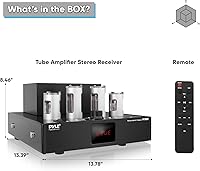
  • Dimensions: The amplifier measures 13.78″ wide by 13.39″ deep by 8.46″ tall, making it a substantial desktop or shelf unit.
  • Weight: The unit weighs 11.82 pounds, reflecting the internal transformer and chassis construction typical of amplifier designs.
  • Peak Power: Rated at 500W peak output, which represents maximum instantaneous power rather than continuous RMS delivery under sustained listening conditions.
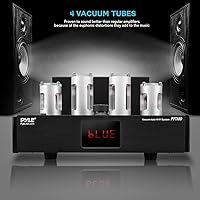
  • Vacuum Tubes: Four vacuum tubes are mounted on the top panel, contributing to the warm, euphonic sound coloration characteristic of tube-based amplification.
  • Bluetooth: Built-in Bluetooth wireless streaming allows cable-free pairing with smartphones, tablets, laptops, and other compatible devices.
  • Inputs: The unit includes one USB reader port and two CD/DVD audio inputs for connecting both digital storage and optical disc players.
  • Outputs: Two speaker outputs support 4–8 ohm speaker loads, and one dedicated subwoofer output allows connection of an external powered subwoofer.
  • Controls: Top-panel controls include an input selector, master volume knob, and playback buttons with a front-facing LED display for source feedback.
  • Remote Control: A remote control is included in the box, allowing input selection and basic playback functions from a distance.
  • Cooling System: A built-in cooling fan is integrated into the chassis to manage heat generated by the tubes and internal components during operation.
  • Circuit Board: The amplifier uses a double-sided fiber circuit board, which provides improved electrical routing compared to single-sided board designs.
  • Speaker Impedance: Compatible with speakers rated between 4 and 8 ohms, covering the most common impedance range found in home audio bookshelf and floor-standing speakers.
  • Availability: The product was first listed for sale in September 2020 and has accumulated over 450 verified customer reviews since launch.
  • Average Rating: The unit holds an average customer rating of 4.0 out of 5 stars across 451 reviews on Amazon as of available data.
  • Power Cable: A power cable is included in the package, allowing immediate setup without sourcing additional accessories.
  • Audio Output Mode: The amplifier operates in stereo output mode, delivering two-channel audio to connected speakers with subwoofer expansion support.

Related Reviews

Pyle PVTA90 Vacuum Tube Stereo Amplifier
74%
78%
Sound Quality
61%
Build Quality
82%
Value for Money
79%
Bluetooth Performance
84%
Input Versatility
More
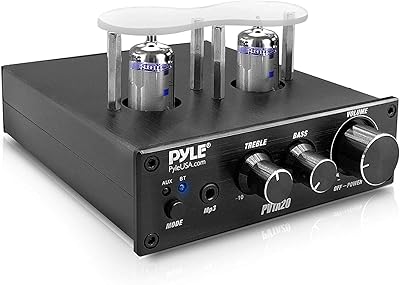
Pyle PVTA20 Bluetooth Vacuum Tube Amplifier
78%
84%
Sound Warmth & Tone
89%
Bluetooth Connectivity
61%
Build Quality & Durability
58%
Power Output Honesty
86%
Input Versatility
More
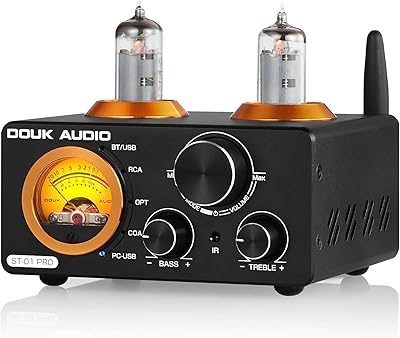
Douk Audio ST-01 PRO
74%
84%
Sound Character & Warmth
88%
Value for Money
91%
Input Versatility
67%
Build Quality
93%
Visual Design & VU Meters
More
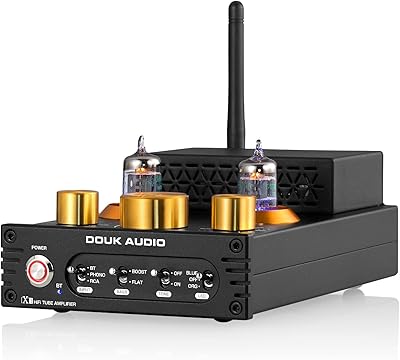
Douk Audio X1
Douk Audio X1
78%
78%
Sound Quality
71%
Phono Stage Performance
84%
Bluetooth Performance
83%
Power Output & Speaker Driving
76%
Build Quality
More
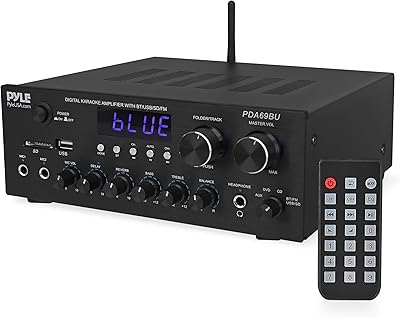
Pyle PDA69BU Stereo Amplifier Receiver
75%
83%
Bluetooth Connectivity
74%
Sound Quality
79%
Build Quality
86%
Value for Money
88%
Input Versatility
More
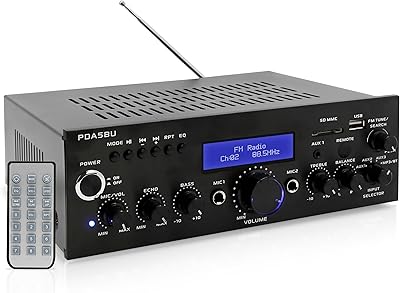
Pyle PDA5BU Bluetooth Stereo Amplifier
72%
83%
Value for Money
88%
Input Versatility
79%
Karaoke Performance
71%
Bluetooth Reliability
46%
Power Output
More
Pyle PTAU23 Stereo Amplifier
74%
83%
Value for Money
89%
Input Versatility
91%
Ease of Setup
61%
Audio Quality
74%
Microphone Performance
More
Pyle PDA8BU
Pyle PDA8BU
72%
83%
Value for Money
81%
Karaoke Performance
72%
Bluetooth Connectivity
61%
Power Output & Volume
58%
Build Quality
More
Pyle PMX3500PH
Pyle PMX3500PH
72%
83%
Value for Money
51%
Power Output Accuracy
88%
Input Versatility
67%
Bluetooth Performance
78%
Microphone Mixing & Echo
More
Pyle PT6060CHAE
Pyle PT6060CHAE
72%
81%
Value for Money
88%
Input Versatility
83%
Karaoke Performance
67%
Bluetooth Reliability
61%
Build Quality
More

FAQ

The built-in fan runs continuously whenever the unit is powered on — it is not thermally triggered. This is worth knowing upfront because in a quiet room, especially at low volumes, the fan noise is audible. It is not loud, but sensitive listeners do notice it during soft passages or late-night sessions.

That 500W figure is a peak power rating, which reflects the maximum instantaneous output the amp can produce for a very brief moment. The continuous RMS output — what actually matters for real listening — is considerably lower. For a small to medium room with reasonably efficient speakers, this tube amp receiver will perform fine, but do not expect it to fill a large open space at high volumes.

Unfortunately, there is no built-in phono preamp stage, so you cannot plug a standard turntable directly into the inputs and expect correct sound. If you want to use a record player, you will need an external phono preamp between the turntable and this vacuum tube stereo unit. Moving-magnet cartridge users should budget for that additional component.

Pairing is straightforward — power the unit on, select the Bluetooth input, and it shows up as discoverable on your phone or tablet within seconds. Most users report a stable connection for everyday streaming. Range can be a limitation in larger spaces or rooms with thick walls, so keeping your source device within about 20–25 feet is a reasonable expectation.

The unit is rated for 4–8 ohm speakers, which covers the vast majority of home bookshelf and floor-standing speakers on the market. Efficient speakers — those rated around 87 dB sensitivity or higher — will get the most usable volume out of the available continuous power. Very large, power-hungry speakers may not reach satisfying volume levels.

It is genuinely one of the more approachable ways to hear what tube amplification sounds like without a significant financial commitment. The warm, slightly rounded sound character is noticeable and pleasant for most music genres. Just go in with realistic expectations: this is an entry-level product, not a reference-grade audio component.

Yes, there is a dedicated subwoofer output on the unit. You would connect a powered subwoofer directly to that output using an RCA cable. It is a useful addition that allows you to extend the low-frequency response beyond what your main speakers can deliver on their own.

The tubes do generate heat, which is why the cooling fan is built in. The top panel will get warm during use, and the tubes themselves reach temperatures that make touching them uncomfortable or potentially harmful. Keep the unit in a well-ventilated spot and away from flammable materials. Children and pets should not be left unsupervised near it when running.

Tube replacement is technically possible since the tubes are socketed on the top panel, but the ease of doing so depends on sourcing compatible replacement tubes and your comfort level with basic electronics. This is an area where some longer-term owners have raised questions, and Pyle customer support would be the right contact for confirming exact tube specifications before purchasing replacements.

Yes, the package includes the amplifier, a remote control, and a power cable, so basic setup can happen immediately. You will need to supply your own speaker wire and speakers, and if you want to connect a CD player, turntable, or USB drive, those source devices are separate. The setup process itself is simple — inputs are clearly labeled and the top-panel controls are intuitive.