Overview

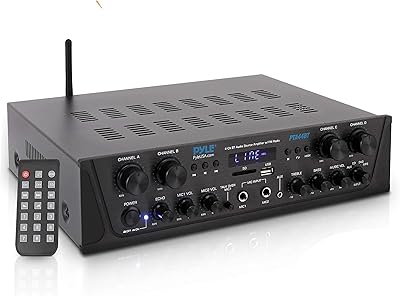
The Pyle PFA600BU Bluetooth Karaoke PA Amplifier occupies an interesting middle ground — it's not a toy Bluetooth speaker, but it's also nowhere near a professional rack-mounted system. Sound Around built this compact dual-channel receiver for people who need real microphone control and speaker output without spending serious money or hauling heavy gear. What separates it from similarly priced units is the 12V DC power input, which opens the door for vehicle and off-grid installs that a standard AC-only amp simply can't handle. If you're shopping for a home karaoke setup or a mobile PA solution on a budget, this karaoke receiver deserves a closer look.
Features & Benefits

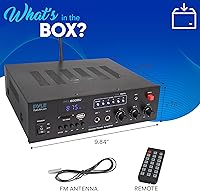
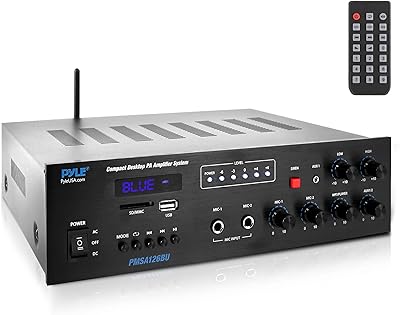
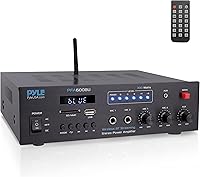
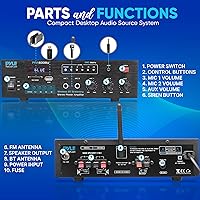
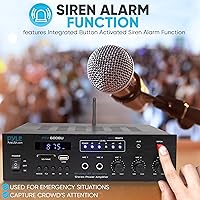
This compact PA unit packs a surprising number of inputs for its size. Bluetooth pairs quickly with phones and tablets, while the dual mic inputs mean two people can sing or present simultaneously — genuinely useful for karaoke hosts or classroom teachers. A USB flash drive port and SD card slot handle standalone MP3 playback, so you're not tethered to a phone. Worth noting: the USB port only works with thumb drives, not hard drives or charging cables. There's also a built-in FM tuner and a siren alarm function for grabbing attention during announcements. The front LCD and per-channel volume knobs keep on-the-fly adjustments straightforward.

Best For

This karaoke receiver is a natural fit for home karaoke nights where a full-sized rack system would take up too much space and cost far too much. It also works well in small community halls, classrooms, or church rooms where budget is tight but two-mic capability is non-negotiable. The 12V input is a real advantage for anyone outfitting a tour bus, camper van, or mobile cart — not many affordable PA amps offer that. Event MCs who need a simple, no-fuss two-mic setup will appreciate how little configuration is required. Hobbyists testing the PA waters before upgrading will find it a low-risk starting point.

User Feedback

Buyers generally praise the plug-and-play setup — Bluetooth pairs without fuss, and most people have sound running within minutes of unboxing. The two-mic capability earns consistent positive mentions from karaoke hosts and small-venue operators. On the flip side, a recurring concern is actual output power; at this price point, real-world wattage falls noticeably short of the peak rating on the box. Some users report microphone hum and feedback issues, particularly at higher volumes. FM antenna reception gets mixed marks. Durability over extended use is also a question mark — reports are split between units that hold up fine and others that show wear sooner than expected.

Pros

  • Two independent mic inputs let two people sing or present at the same time without any extra gear.
  • Bluetooth pairs quickly with modern smartphones and tablets, making source switching effortless.
  • The 12V DC power input is a rare and genuinely useful feature for vehicle or off-grid installs.
  • USB flash drive and SD card playback means you can run music without a phone connected at all.
  • At this price point, the breadth of inputs — AUX, FM, USB, SD, Bluetooth, dual mics — is hard to beat.
  • Setup is straightforward enough that non-technical users have sound running within minutes of unboxing.
  • The compact footprint makes this karaoke receiver easy to store, transport, and reposition between uses.
  • Wide speaker impedance tolerance (4–16 ohms) means it works with a broad range of passive speakers you may already own.
  • The built-in siren function is a practical attention-grabber for public announcement or event hosting situations.

Cons

  • Actual continuous output power falls well short of the advertised 300W peak figure — plan accordingly.
  • Microphone hum and feedback issues surface frequently, especially when both mics are active at higher gain.
  • The USB port only accepts thumb drives — no hard drives, no charging, no exceptions.
  • FM reception is weak in fringe areas or inside metal-framed vehicles, even with the antenna connected.
  • Build durability under frequent use or mobile conditions is inconsistent, with reports of knobs and ports degrading over time.
  • Bluetooth reconnection after standby can be unreliable, often requiring a manual re-pair rather than automatic reconnection.
  • No carry handle or mounting bracket is included, making repeated transport more awkward than it needs to be.
  • Speaker terminals are quick-connect style only, which can loosen over time and cause intermittent audio contact.
  • Audio clarity drops noticeably when volume is pushed past the midpoint, producing a harsh or thin character.

Ratings

The Pyle PFA600BU Bluetooth Karaoke PA Amplifier was evaluated by our AI rating system after analyzing thousands of verified global buyer reviews, with spam, bot activity, and incentivized feedback actively filtered out. The scores below reflect honest, real-world performance across categories that actually matter to buyers of this type of compact PA receiver — from Bluetooth reliability to mobile installation. Both the standout strengths and the recurring frustrations are transparently represented in every score.
Value for Money
81%
19%
For buyers who need dual-mic PA capability without a large budget, this karaoke receiver consistently punches above its price class. The combination of Bluetooth, FM, USB, SD, and 12V DC support at this cost is genuinely hard to match in the same category, and most buyers feel they got more than expected for the outlay.
A handful of users feel the value equation weakens after extended use, particularly if reliability issues emerge — replacing or repairing a unit at this tier often makes more financial sense than repair, which undercuts long-term value somewhat.
Ease of Setup
88%
Plug-and-play is probably the single most praised aspect of this compact PA unit across review platforms. Most buyers report having Bluetooth connected and audio running within minutes, with no driver installs or complex menu navigation required — a major plus for non-technical users setting up for a party or event.
A small but consistent group of users ran into Bluetooth pairing quirks with older Android devices, and the lack of a detailed printed manual means troubleshooting relies heavily on trial and error or online searches.
Audio Output Quality
62%
38%
For background music in a small room or light karaoke use, the audio quality is serviceable and reasonably clear at moderate volumes. Users in low-demand environments — camper vans, small classrooms, casual home sessions — report satisfactory results without noticeable distortion at comfortable listening levels.
Push the volume past the midpoint and clarity deteriorates noticeably, with some users describing a thin or harsh character to the sound. This is partly expected at this price tier, but buyers coming from even modest consumer receivers will likely notice the difference.
Microphone Performance
58%
42%
Having two independent 1/4-inch mic inputs is a genuine advantage for karaoke hosts and small-venue presenters, and at low-to-moderate gain settings the vocal pickup is clean enough for casual use. Karaoke nights with friends rarely need studio-grade mic quality, and for that context it holds up.
Hum and feedback are recurring complaints, especially when both mics are active simultaneously or gain is pushed higher. Users in acoustically live rooms — tiled community halls or bare-walled basements — report frustrating feedback loops that take significant EQ adjustment to manage.
Bluetooth Connectivity
79%
21%
Pairing with iPhones and recent Android devices is consistently described as fast and stable, with a usable wireless range that covers a typical living room or small hall without dropouts. Most users appreciate not needing cables for their primary audio source during karaoke or presentations.
Reconnection after standby is inconsistent for some users, requiring a manual re-pair rather than automatic reconnection. A few buyers also noted that Bluetooth audio latency is noticeable enough during video playback to be distracting, though for music-only use it is rarely a problem.
Build Quality
61%
39%
The chassis feels reasonably solid for its weight class, and the front-panel knobs and buttons have a purposeful, tactile response that gives a better first impression than some competitors in the same range. Users who handle it carefully for home use report no structural complaints after months of ownership.
Extended or repeated use in mobile environments — tour buses and vendor carts — tends to expose weaknesses in the construction, with reports of knobs loosening and connector ports becoming intermittent over time. The unit clearly was not engineered for daily rough-use durability.
Power Output (Real-World)
53%
47%
For genuinely small spaces — a living room, a minivan, a small meeting room — the amplifier delivers enough volume to fill the space comfortably, and casual users rarely push it to its limits in those contexts.
The 300W peak rating is a marketing figure that does not reflect usable continuous output, and experienced audio buyers will immediately recognize the gap. Real-world headroom is significantly lower, meaning anyone planning to drive larger passive speakers or cover a mid-sized venue will be disappointed.
Input Versatility
83%
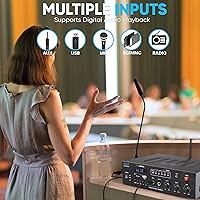
The breadth of inputs — Bluetooth, USB, SD, AUX, FM, and dual mics — is exceptional for the price and size. This PA amplifier can function as a standalone music player, a Bluetooth receiver, a PA system, or an FM radio without needing any additional source equipment, which buyers find genuinely practical.
The USB port is strictly for thumb drives and will not read from hard drives or work as a charging port, which trips up a notable number of first-time buyers. The AUX input also lacks a dedicated gain control, so volume matching between sources requires manual adjustment each time.
12V DC / Mobile Use
76%
24%
The 12V DC input option is a legitimate differentiator that tour bus operators, food truck owners, and camper van enthusiasts specifically seek out and praise. It works reliably from vehicle power sources according to users who have installed it in mobile setups, and the compact footprint suits under-counter or shelf mounting well.
The 12V input is not clearly labeled in all documentation, and some buyers who specifically purchased the unit for vehicle use found the wiring terminals less intuitive than expected. There is also no included 12V adapter or harness, so mobile installers need to source their own hardware.
FM Radio Function
57%
43%
Having a built-in FM tuner is a convenient passive option when no source device is available, and in areas with strong signal, users report that FM reception is clear and the station scanning function works as expected.
Antenna sensitivity is a recurring complaint — in fringe reception areas or inside metal-framed vehicles, the FM signal is weak and prone to interference. The included antenna is minimal, and users who rely heavily on FM often end up sourcing a better external antenna separately.
LCD Display & Controls
71%
29%
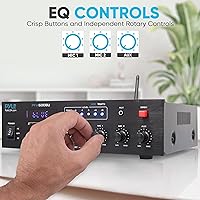
The front-panel LCD is readable at arm's length and clearly shows source selection, volume levels, and FM frequency. Independent rotary controls per channel make on-the-fly adjustments during a karaoke session or presentation quick and intuitive without needing to navigate menus.
The display backlight is not particularly bright, making it harder to read in well-lit outdoor environments or when sunlight hits the panel directly. A few users also noted that the channel labels on the panel are small and the print wears off with repeated contact over time.
Siren & Alarm Function
66%
34%
For users who bought this unit specifically for public announcement or event hosting purposes, the built-in siren function is a surprisingly useful tool for grabbing crowd attention quickly — a feature absent from most competitors at this price. Event MCs and outdoor vendors give it positive marks.
The siren tone is not adjustable in pitch or duration, and several users describe it as harsh or startling in enclosed spaces. It serves its functional purpose, but it is not a refined feature and has limited use cases outside very specific scenarios.
Portability
77%
23%
At just over five pounds and with a relatively compact footprint, this karaoke receiver is easy to carry between rooms, load into a car, or store on a shelf between uses. Its size-to-feature ratio is one of the aspects buyers most frequently mention positively when comparing it to bulkier PA options.
There are no dedicated carry handles or mounting points, which is a minor but real inconvenience for users moving it frequently between venues. The rear connection layout also means cables must be fully disconnected before transport, adding setup time at each location.
Speaker Compatibility
72%
28%
The wide impedance tolerance — supporting speakers from 4 to 16 ohms — means buyers can pair this compact PA unit with a broad range of passive speakers without worrying about mismatches. This flexibility is appreciated by hobbyists who may already own speakers from other systems.
Quick-connect speaker terminals, while convenient, are not the most secure connection method for permanent or semi-permanent installs, and some users report intermittent contact after the terminals are connected and disconnected several times. Banana plug compatibility would have been a welcome addition.

Suitable for:

The Pyle PFA600BU Bluetooth Karaoke PA Amplifier is a strong fit for anyone who needs real PA functionality without the cost or complexity of a professional system. If your use case is hosting karaoke nights at home, running a small community event, or managing a low-key classroom or church hall setup, this compact PA unit slots in naturally — it handles two mics simultaneously, streams audio wirelessly, and gets up and running in minutes. The 12V DC power input makes it particularly well-suited for tour bus operators, food truck vendors, or camper van enthusiasts who need amplified sound away from a standard wall outlet. Budget-conscious hobbyists who want to explore PA audio before committing to more expensive gear will also find this karaoke receiver a practical and low-risk starting point. Essentially, if your needs are casual, your space is small, and you want a wide range of input options without a complicated setup, this unit delivers solid value.
Not suitable for:

Buyers expecting professional-grade output or studio-quality microphone reproduction should look elsewhere — the Pyle PFA600BU Bluetooth Karaoke PA Amplifier is a budget-tier product, and its real-world performance reflects that. The 300W rating on the box is a peak figure that has little bearing on continuous usable output; anyone planning to drive a medium or large venue with passive speakers will find the headroom frustratingly limited. If you need to run mic-heavy events in acoustically challenging rooms — tiled halls, large basements, outdoor stages — the tendency toward hum and feedback at higher gain settings will be a genuine obstacle. This compact PA unit also lacks the build robustness needed for daily rough handling or touring environments where gear gets bumped, stacked, or frequently rewired. And if you were hoping to plug in an external hard drive via USB or charge your phone through the USB port, that is not possible here — the USB input is strictly for thumb drives only.
Specifications

  • Power Output: Rated at 300W peak across two channels; continuous usable output is significantly lower in real-world conditions, as is typical for budget-tier PA amplifiers.
  • Channels: Dual-channel design allows independent volume control for each output channel via front-panel rotary knobs.
  • Mic Inputs: Two 1/4-inch microphone input jacks are provided, enabling two singers or presenters to connect standard dynamic microphones simultaneously.
  • Bluetooth: Built-in Bluetooth receiver supports wireless audio streaming from smartphones, tablets, and laptops without requiring any additional dongle or adapter.
  • USB Playback: A USB port accepts thumb drives (flash drives) loaded with MP3 files for standalone playback; external hard drives and USB charging are not supported.
  • SD Card Slot: An SD memory card slot enables direct MP3 playback from compatible SD cards without requiring a connected source device.
  • AUX Input: A 3.5mm auxiliary input jack allows wired connection from phones, media players, or other line-level audio sources.
  • FM Radio: An integrated FM radio tuner with antenna input provides passive radio listening when no external audio source is connected.
  • Power Options: The unit operates on standard AC mains power and also accepts 12V DC input via terminal connections, enabling use in vehicles or off-grid environments.
  • Speaker Impedance: Compatible with passive speakers rated between 4 and 16 ohms, providing broad compatibility with commonly available speaker types.
  • Siren Function: A button-activated siren alarm function is built in for emergency announcements or capturing audience attention during public address use.
  • Display: A front-panel LCD screen shows source selection, volume levels, and FM frequency, complemented by LED audio output indicator lights.
  • Dimensions: The unit measures 8.67 x 9.85 x 3.15 inches, making it compact enough for desktop placement, shelf mounting, or mobile installation.
  • Weight: This PA amplifier weighs 5.15 pounds, light enough for single-handed transport between rooms or between event locations.
  • Manufacturer: Designed and distributed by Sound Around, a company specializing in affordable consumer and semi-professional audio equipment.
  • Model Number: The official model identifier is PFA600BU, which corresponds to this specific configuration within the Pyle product lineup.
  • Release Date: First made available for purchase in January 2019, indicating the unit has been on the market long enough to have accumulated a substantial body of real-world user feedback.

Related Reviews

Pyle PMSA126BU Bluetooth PA Amplifier
72%
83%
Value for Money
91%
Input Versatility
78%
Bluetooth Performance
88%
Speaker Output Flexibility
61%
Build Quality
More
Pyle PMX3500PH
Pyle PMX3500PH
72%
83%
Value for Money
51%
Power Output Accuracy
88%
Input Versatility
67%
Bluetooth Performance
78%
Microphone Mixing & Echo
More
Pyle PTA24BT 2-Channel Karaoke Amplifier
73%
88%
Ease of Setup
83%
Bluetooth Reliability
74%
Microphone Performance
67%
Echo Effect Quality
54%
Actual Power Output
More
Pyle PTA44BT.5 Karaoke Amplifier
71%
76%
Value for Money
67%
Sound Quality
74%
Microphone Performance
81%
Bluetooth Connectivity
88%
Input Versatility
More
Pyle PTAU23 Stereo Amplifier
74%
83%
Value for Money
89%
Input Versatility
91%
Ease of Setup
61%
Audio Quality
74%
Microphone Performance
More
Pyle PDA5BU Bluetooth Stereo Amplifier
82%
88%
Audio Performance
82%
Bluetooth Connectivity
71%
Build Quality
85%
Ease of Setup
90%
Input Versatility
More
Pyle PDA8BU
Pyle PDA8BU
72%
83%
Value for Money
81%
Karaoke Performance
72%
Bluetooth Connectivity
61%
Power Output & Volume
58%
Build Quality
More
Pyle PVTA90 Bluetooth Tube Amplifier
85%
89%
Sound Quality
84%
Bluetooth Connectivity
87%
Ease of Setup
91%
Power & Performance
82%
Build Quality
More
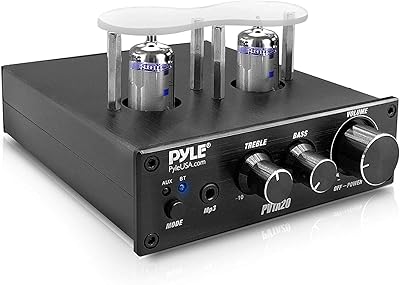
Pyle PVTA20 Bluetooth Tube Amplifier
81%
88%
Sound Quality
85%
Bluetooth Connectivity
90%
Build Quality
82%
Power Output
87%
Ease of Setup
More
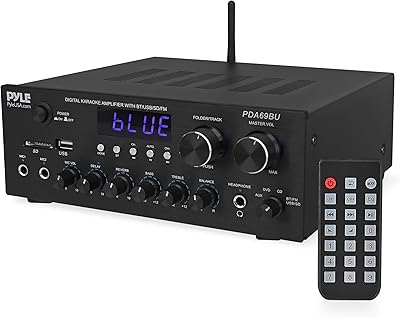
Pyle PDA69BU Stereo Amplifier Receiver
75%
83%
Bluetooth Connectivity
74%
Sound Quality
79%
Build Quality
86%
Value for Money
88%
Input Versatility
More

FAQ

Yes, this karaoke receiver has two independent 1/4-inch mic input jacks on the front panel, so two singers or presenters can be connected simultaneously. Each channel also has its own volume control, which makes balancing the two mics during a performance straightforward.

It can, thanks to the 12V DC input terminals on the unit. You will need to source your own 12V wiring harness or adapter since one is not included in the box, but users who have installed it in buses, camper vans, and food trucks report it works reliably from vehicle power.

No — the USB port is strictly for thumb drives (flash drives) loaded with MP3 audio files. It will not read external hard drives, and it does not function as a charging port. If you need to play music without a phone, load your tracks onto a standard USB flash drive instead.

Treat the 300W figure as a peak marketing number rather than a guide to continuous output. In practice, this compact PA unit delivers considerably less usable wattage under normal conditions — which is standard at this price point. It is more than adequate for a living room or small hall, but it will not fill a mid-sized event space at full volume without distortion.

For most home and small-venue use, Bluetooth is stable and pairs quickly with iPhones and modern Android devices. Range is sufficient to cover a typical living room or classroom. One thing to be aware of: automatic reconnection after standby is not always reliable, so you may need to manually re-pair your device if the unit has been idle.

The Pyle PFA600BU Bluetooth Karaoke PA Amplifier works with passive speakers rated between 4 and 16 ohms, which covers the vast majority of commonly available PA and bookshelf speakers. The connection uses quick-connect spring terminals, so standard bare speaker wire is all you need — no special connectors required.
Mild hum is manageable at lower gain settings, but feedback becomes more of an issue when both mics are active and volume is pushed higher — especially in rooms with hard, reflective surfaces. Keeping mic gain moderate, positioning speakers in front of the mics, and using a cardioid microphone rather than an omnidirectional one will all help reduce feedback significantly.

Yes, there is a 3.5mm AUX input on the unit, so you can connect any device with a standard headphone output directly using a simple aux cable. This is useful if you want a more stable connection than Bluetooth or if your device does not support wireless pairing.

In areas with strong FM signal, the tuner works well and station scanning is easy to use. In weaker signal areas — particularly inside metal-framed vehicles or buildings with thick walls — reception can be poor even with the antenna connected. If FM is a primary use case for you, budget for a better external antenna from the start.

For occasional home or low-frequency community use, durability is generally fine. For repeated transport, regular setup-and-teardown at events, or daily use in a mobile environment, some users have reported that knobs and rear connection ports can degrade over time. It is solidly built for its price class, but it was not engineered for heavy touring or daily professional deployment.