Overview

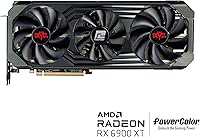
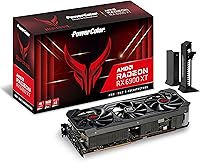
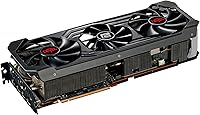
The PowerColor Red Devil RX 6900 XT Graphics Card arrived in late 2020 as AMD's answer to the high-end GPU market, and PowerColor's Red Devil treatment gave it a strong identity beyond the reference design. The Red Devil line has long been associated with serious cooling hardware and factory-tuned clock speeds, and this card is no exception. It sits at the top of AMD's RDNA 2 stack, competing directly with Nvidia's RTX 3080 and 3090 in performance territory. That said, it's a physically large card — over 13 inches long — and it demands a capable power supply, so buyers should plan accordingly. On the secondary market today, it remains a legitimate option for enthusiasts.
Features & Benefits

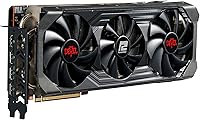
The triple-fan cooling system is one of the most practical aspects of this card — it keeps temperatures in check even under sustained gaming loads, and flipping to Silent BIOS mode makes it genuinely quiet for a GPU of this class. The 16GB of GDDR6 memory is backed by AMD's Infinity Cache, which effectively boosts real-world bandwidth well beyond what the 256-bit bus alone would suggest — a smart design choice that holds up well in texture-heavy titles. PCIe 4.0 and HDMI 2.1 output cover modern display needs, including 4K at 120Hz. Factory clock speeds start at 2105MHz in OC mode, with boosts reaching 2340MHz. Hardware ray tracing is present, though AMD's implementation here is capable rather than dominant when compared to Nvidia's Ampere architecture.

Best For

This Red Devil card is most at home in an enthusiast's full-tower build. At 1440p, it's genuinely overkill in the best possible way — frame rates stay high even in demanding titles. At 4K, the 16GB VRAM buffer means you're rarely hitting a memory wall in games with high-resolution texture packs. Content creators who rely on GPU-accelerated rendering or video encoding will appreciate the raw compute headroom RDNA 2 offers. It's also a natural pick for anyone already invested in the AMD ecosystem, where FreeSync and RSR provide real practical value without extra cost. One non-negotiable: your case needs to fit a 13-plus-inch card, and your PSU should be rated at 850W or higher.

User Feedback

Across roughly 345 ratings, the RX 6900 XT Red Devil holds a 4.2 out of 5, and the pattern in reviews is fairly consistent. Buyers regularly praise the build quality and cooling — the card runs cool and quiet in Silent mode, which is a real differentiator for an air-cooled GPU at this performance level. The main friction points are practical: the card's length causes fitment issues in mid-tower and compact cases, and the power draw is substantial enough that a marginal PSU will cause problems. A small number of reviewers reported DOA units or early fan bearing issues, though these don't appear to be systematic. Some AMD users note that driver stability has historically been inconsistent, which is worth factoring into your decision.

Pros

  • The triple-fan cooling system keeps temperatures genuinely low even during long gaming sessions.
  • Silent BIOS mode makes this Red Devil card remarkably quiet for a high-end GPU.
  • 16GB of GDDR6 VRAM provides real breathing room for 4K textures and memory-intensive workloads.
  • AMD Infinity Cache meaningfully boosts effective memory bandwidth beyond what the 256-bit bus implies.
  • Factory overclock ships ready to push performance without requiring manual tuning.
  • HDMI 2.1 output supports 4K at 120Hz, making it future-ready for high-refresh 4K displays.
  • PCIe 4.0 support ensures the card pairs well with modern platforms without bottlenecking.
  • Build quality is consistently praised by buyers — this feels like a premium, well-engineered product.
  • FreeSync and RSR support add real value for AMD monitor users at no extra cost.
  • Strong 4.2 out of 5 rating across hundreds of real user reviews reflects broad buyer satisfaction.

Cons

  • At over 13 inches long, the RX 6900 XT Red Devil simply will not fit many mid-tower and compact cases.
  • Power consumption is substantial — a quality 850W or higher PSU is a genuine requirement, not a suggestion.
  • AMD's ray tracing performance trails Nvidia Ampere, so it is not the right pick for ray tracing-focused builds.
  • A small but notable number of buyers reported DOA units or early fan bearing failures.
  • AMD Radeon driver software still has occasional stability and compatibility issues that Nvidia users rarely face.
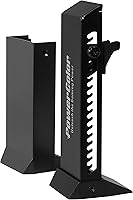
  • The card's physical weight adds stress to motherboard PCIe slots in builds without GPU support brackets.
  • This GPU launched in 2020, so newer-generation alternatives may offer better efficiency at similar price points.
  • No Nvidia-exclusive features like DLSS 3 or Reflex, which matter in competitive or frame-rate-sensitive gaming.

Ratings

Our AI-generated scores for the PowerColor Red Devil RX 6900 XT Graphics Card are derived from deep analysis of verified global buyer reviews, with spam, incentivized, and bot-flagged submissions actively filtered out before scoring. The result is an honest, balanced picture — where this card genuinely excels and where real users have run into friction. Both the strengths and the frustrations are reflected transparently in every category below.
Gaming Performance
91%
At 1440p, this Red Devil card is essentially unconstrained — frame rates stay high even in the most demanding open-world titles. At 4K, it holds its own well, and the 16GB VRAM buffer means it rarely hits memory limits that trip up cards with less headroom.
In a few CPU-limited or well-optimized esports titles, the performance advantage over mid-range cards shrinks enough that some buyers question whether the premium tier is warranted. It also launched in 2020, so newer GPU generations have since closed or exceeded its rasterization lead.
Thermal Management
89%
The triple-fan Red Devil cooler is one of the genuinely standout aspects of this card — GPU junction temperatures stay controlled even during extended gaming sessions, and the heatsink design gives the fans room to breathe without spinning aggressively. Users running demanding workloads for hours reported no throttling concerns.
The sheer physical size required to achieve those temperatures means the card produces noticeable airflow noise in OC BIOS mode under sustained load. It also displaces significant case airflow, so builds with tight or restrictive cases may see slightly warmer ambient temperatures from the GPU exhaust.
Noise Level
84%
Silent BIOS mode is legitimately effective — at modest to medium loads, the card is among the quieter options in its performance class, which buyers working in shared spaces or open-room setups particularly appreciated. Fan stop functionality at idle keeps things whisper-quiet during light desktop use.
Switch to OC mode under a heavy game and the fans are clearly audible, especially in cases without sound dampening. A handful of reviewers also reported fan bearing noise developing after extended use, which is worth monitoring over a long ownership period.
Build Quality
88%
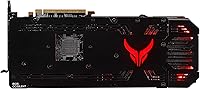
PowerColor's Red Devil lineup has a reputation for premium construction, and this card lives up to it — the backplate is solid, the shroud feels substantial, and the overall fit and finish is noticeably higher than reference or budget AIB designs. Long-term owners report no structural degradation after years of use.
The card's 5.28-pound weight is a real concern in builds without a GPU support bracket, as the PCIe slot carries that load continuously. A small number of buyers flagged cosmetic inconsistencies on the shroud edges out of the box, though these were purely aesthetic.
VRAM & Memory
93%
Sixteen gigabytes of GDDR6 is a genuine competitive advantage — in 4K gaming with high-resolution texture mods, or in creative workloads like large Blender scenes and 4K video timelines, the memory headroom is tangible and avoids the stuttering that memory-constrained cards exhibit. AMD Infinity Cache amplifies effective bandwidth further.
The 256-bit bus width is a technical limitation that AMD's Infinity Cache partially compensates for, but in scenarios pushing memory bandwidth hard — like sustained compute tasks — the architecture shows its ceiling compared to wider-bus designs. This is mostly irrelevant for gaming but relevant for professional workflows.
Ray Tracing
63%
37%
Hardware ray tracing is present and functional in supported titles — enabling it in games like Cyberpunk 2077 or Control does produce the expected visual improvements, and for buyers who simply want the feature available, it delivers. In less ray-tracing-intensive titles, the performance cost is manageable.
Compared to Nvidia's Ampere cards, AMD RDNA 2 ray tracing performance is a noticeable step behind — at 4K with RT enabled, frame rates drop enough that FSR upscaling becomes a practical necessity rather than an optional enhancement. Buyers who prioritize ray tracing above all else should weigh this honestly before committing.
Cooling System Design
86%
The dual BIOS toggle is a thoughtful hardware feature — flipping to Silent mode requires no software, survives driver reinstalls, and gives users immediate acoustic control without compromising stability. The fan design includes a stop mode at idle, which is a small but appreciated quality-of-life detail.
The triple-slot footprint required by the cooling solution is a real tradeoff in multi-GPU or heavily populated PCIe builds. In cases with poor airflow design, the downward-exhausting cooler can recirculate warm air, slightly undermining the otherwise solid thermal performance.
Display Connectivity
87%
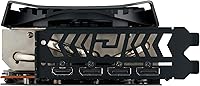
HDMI 2.1 support is a forward-looking inclusion that makes this card compatible with 4K/120Hz TVs and next-generation monitors without adapters. Multiple DisplayPort outputs cover multi-monitor desktop setups cleanly, and the 8K output capability gives the card longevity as display standards evolve.
The output configuration lacks a USB-C display output, which some creator workstations and newer monitors rely on. Buyers with USB-C or Thunderbolt display setups will need an active adapter, and compatibility with those adapters is not always guaranteed.
Power Efficiency
58%
42%
The card does extract strong performance for the power it draws relative to its launch-era competitors, and in Silent BIOS mode power consumption drops meaningfully without a dramatic performance penalty — a worthwhile tradeoff for users in warm climates or with modest case cooling.
Total board power at full load is substantial, requiring a quality 850W or higher PSU and adding real cost to electricity bills during extended gaming or compute sessions. For users coming from mid-range cards, the jump in power draw can be a genuine system-level concern that involves PSU upgrades.
Physical Size & Fit
54%
46%
For buyers in full-tower cases, the size is simply a non-issue — the card installs cleanly, the triple-slot design provides structural rigidity, and the large surface area of the cooler is exactly why thermal performance is so good. Those with appropriate cases rarely mention size as a concern.
At over 13 inches in length and three slots wide, this is one of the larger GPUs on the market, and it is a documented fitment problem for a meaningful portion of buyers. Reviews citing incompatibility with mid-tower cases are among the most common negative feedback points in the entire review pool.
Driver & Software
67%
33%
AMD's Radeon Software suite has matured considerably and now includes useful tools like Radeon Anti-Lag, performance overlays, and easy fan tuning without requiring third-party software. For mainstream gaming on popular titles, driver stability is generally solid and update cadence has improved.
Compared to Nvidia's driver ecosystem, AMD's software still draws more complaints — occasional game-specific bugs, less consistent hotfix response times, and edge cases in older or niche titles are recurring themes in user feedback. Less technically confident buyers may find troubleshooting more frustrating than they expect.
Value for Money
74%
26%
At current secondary market pricing, PowerColor's flagship AMD GPU represents a more defensible purchase than it did at original MSRP — buyers who find it at a fair used price are getting high-end RDNA 2 performance with a premium cooling solution that holds up well over time.
Newer GPU generations offer better performance-per-watt and improved ray tracing at comparable price points, which makes evaluating this card's value heavily dependent on what the market is asking at the time of purchase. Paying close to original launch pricing in today's market is difficult to justify.
Reliability & QC
78%
22%
The overwhelming majority of buyers experience no hardware issues — the card runs stably for years under regular gaming and workload conditions, and PowerColor's build quality reputation is generally well-earned based on the volume of positive long-term ownership reports in the review pool.
A small but persistent minority of reviews report DOA units or fan bearing failures appearing within the first year of use. While these do not represent a systematic problem, they are frequent enough to suggest buyers should purchase from a seller offering a clear warranty and return window.
FSR & Upscaling
81%
19%
AMD FidelityFX Super Resolution works across all GPU brands, but it is a natural pairing with this card — enabling FSR Quality or Balanced mode in 4K titles recovers meaningful frame rates with acceptable visual fidelity, making demanding games playable with ray tracing enabled where they otherwise would not be.
FSR image quality, while improved in later versions, still produces softer output than native resolution rendering, and the temporal stability of FSR 1.0 in particular is noticeably behind Nvidia's DLSS in supported titles. Buyers who are sensitive to image sharpness may find FSR a necessary compromise rather than a transparent enhancement.

Suitable for:

The PowerColor Red Devil RX 6900 XT Graphics Card is a strong match for enthusiast PC builders who want top-tier AMD performance without settling for a reference cooler. If you're gaming at 1440p and want frame rates that stay high even in the most demanding titles, this card delivers that headroom comfortably. At 4K, the 16GB VRAM buffer genuinely matters — texture-heavy open-world games and high-resolution asset packs will push lesser cards to their limits, while this one holds steady. Content creators doing GPU-accelerated video encoding, 3D rendering, or compute workloads will also find the RDNA 2 architecture pulls real weight outside of gaming. It's equally well-suited to anyone already running an AMD-centric system who wants to take full advantage of FreeSync monitors and Radeon Super Resolution without extra investment. Just make sure your case can fit a card over 13 inches long and that your power supply is rated at 850W or above.
Not suitable for:

The PowerColor Red Devil RX 6900 XT Graphics Card is a poor fit for anyone building in a mid-tower or compact case — at over 13 inches long and occupying three slots, it physically won't fit many popular smaller enclosures. Buyers on tighter budgets should also think carefully, since the power demands are real and a low-quality PSU will cause stability issues, adding hidden cost to the build. If ray tracing performance is a priority, it's worth knowing that AMD's RDNA 2 ray tracing is functional but noticeably behind what Nvidia's Ampere architecture delivers, so dedicated ray tracing enthusiasts may find Nvidia options more satisfying. Casual gamers running at 1080p would be paying for performance they will never actually use. And if you have a history of frustration with GPU driver software, AMD's ecosystem has improved but still carries more rough edges than Nvidia's, which is a legitimate consideration for less technical users.
Specifications

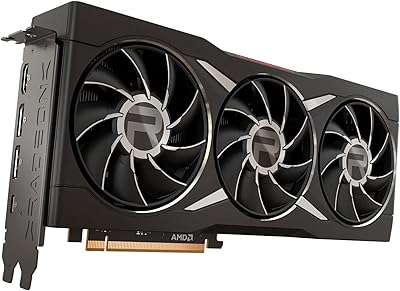
  • GPU Model: The card is built on the AMD Radeon RX 6900 XT chip, the flagship of AMD's RDNA 2 lineup.
  • Architecture: AMD RDNA 2 architecture delivers improved performance-per-watt over the prior generation.
  • Stream Processors: 5120 stream processors handle compute and rendering workloads across gaming and creative applications.
  • VRAM: 16GB of GDDR6 memory provides ample headroom for 4K gaming, high-resolution textures, and GPU-accelerated creative tasks.
  • Memory Interface: A 256-bit memory bus is paired with AMD Infinity Cache to deliver effective bandwidth well above what the bus width alone suggests.
  • Memory Speed: GDDR6 memory operates at 16 Gbps, supporting fast data throughput for both gaming and compute workloads.
  • Game Clock: The card runs at 2105MHz in OC mode and 2015MHz in Silent BIOS mode under typical gaming conditions.
  • Boost Clock: Boost clocks reach up to 2340MHz in OC mode and 2250MHz in Silent mode under sustained favorable conditions.
  • PCIe Interface: PCIe 4.0 x16 connectivity ensures full bandwidth compatibility with modern AMD and Intel platforms.
  • Display Outputs: The card provides multiple DisplayPort outputs alongside one HDMI 2.1 port supporting 4K at 120Hz and up to 8K resolution.
  • Max Resolution: Supported maximum display resolution is 7680x4320, covering both high-refresh 4K and entry-level 8K display setups.
  • Cooling System: A triple-fan Red Devil cooler with large heatsink fins manages thermals across both performance and low-noise operating modes.
  • BIOS Modes: A dual BIOS switch lets users toggle between OC mode for maximum performance and Silent mode for reduced fan noise.
  • Ray Tracing: Hardware-accelerated ray tracing is supported natively, though performance in RT workloads trails Nvidia Ampere-generation cards.
  • Infinity Cache: AMD Infinity Cache is included on-die, significantly improving effective memory bandwidth for gaming and reducing latency.
  • Card Dimensions: The card measures 13.07 x 6.02 x 2.44 inches and occupies three expansion slots in a standard PCIe chassis.
  • Card Weight: At 5.28 pounds, the card is heavy enough that a GPU support bracket is advisable to prevent PCIe slot stress over time.
  • Power Requirement: A quality 850W or higher power supply is recommended to ensure stable operation under peak gaming and compute loads.
  • FSR Support: AMD FidelityFX Super Resolution is supported, allowing upscaled performance in compatible titles across all GPU brands.

Related Reviews
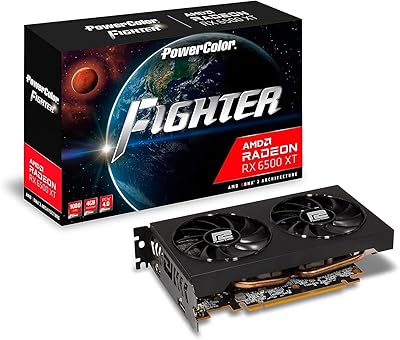
PowerColor Fighter AMD Radeon RX 6500 XT 4GB Graphics Card
82%
91%
Value for Money
89%
1080p Gaming Performance
85%
Build Quality
88%
Power Efficiency
84%
Setup & Installation
More
AMD Radeon RX 6950 XT Graphics Card
72%
92%
4K Gaming Performance
94%
VRAM Capacity & Bandwidth
51%
Power Consumption
48%
Physical Size & Case Fit
67%
Driver Stability
More
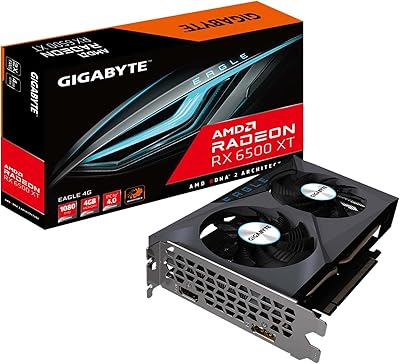
GIGABYTE Radeon RX 6500 XT Eagle 4GB Graphics Card
83%
92%
Value for Money
88%
Gaming Performance (1080p)
90%
Cooling System Efficiency
63%
4K Performance
84%
Build Quality
More
PowerColor Hellhound AMD Radeon RX 6600 8GB Graphics Card
85%
91%
Value for Money
88%
Gaming Performance (1080p)
85%
Cooling Efficiency
75%
Noise Level Under Load
90%
Ease of Installation
More
Sapphire Radeon RX 7900 XT Graphics Card
78%
91%
Rasterization Performance
63%
Ray Tracing Performance
93%
VRAM Capacity
88%
Build Quality
84%
Thermal Management
More
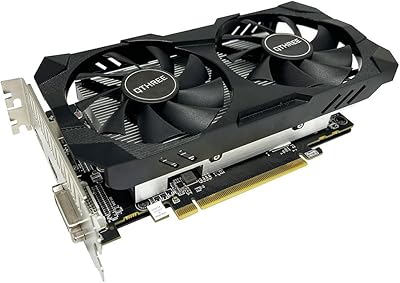
QTHREE Radeon RX 560 XT 8GB Graphics Card
68%
61%
Value for Money
53%
Gaming Performance
88%
Installation & Setup
67%
Thermal Performance
58%
Fan Noise
More
GIGABYTE RX 7700 XT 12GB Graphics Card
83%
88%
1440p Gaming Performance
91%
Thermal Performance
83%
Noise Level
93%
Build Quality
76%
Value for Money
More
XFX Speedster QICK319 RX 7700 XT 12GB GDDR6 Graphics Card
85%
92%
Gaming Performance
87%
Cooling Efficiency
90%
Price-to-Performance Ratio
62%
Compatibility with Motherboards
88%
Build Quality
More
ASRock RX 7900 XT Phantom Gaming 20GB OC Graphics Card
86%
94%
4K Gaming Performance
91%
Cooling Efficiency
70%
Size/Case Compatibility
89%
Build Quality
96%
Visual Quality & Resolution
More
PowerColor Hellhound AMD Radeon RX 7900 XTX 24GB Graphics Card
86%
94%
Gaming Performance
89%
Cooling Efficiency
91%
4K/8K Capability
87%
Build Quality
92%
Compatibility with AAA Games
More

FAQ

You should have at least an 850W power supply, and it should be from a reputable brand with solid amperage on the 12V rail. A budget PSU that technically meets wattage on paper can still cause crashes or instability under peak GPU load, so do not cut corners here.

That really depends on your specific case. The card is just over 13 inches long and occupies three slots, which is larger than many mid-towers can handle. Check your case's maximum GPU length spec before buying — many popular mid-towers cap out around 12 inches, which would be too short.

In OC BIOS mode under a demanding game, the fans are audible but not intrusive. Switch to Silent BIOS mode and the difference is noticeable — it becomes one of the quieter high-end air-cooled cards at comparable load levels. Most users who care about acoustics just leave it on Silent mode permanently.

Yes, it handles 4K gaming well. The 16GB of VRAM means you can run high-resolution texture packs without hitting memory limits, and the Infinity Cache helps keep performance smooth in bandwidth-demanding scenes. Expect strong frame rates in most titles at 4K, though ray tracing at that resolution will require some compromises.

At rasterized workloads — which covers the vast majority of games — the two cards trade blows depending on the title and resolution. The RX 6900 XT Red Devil has a significant VRAM advantage with 16GB versus the RTX 3080's 10GB, which can matter in newer, more texture-heavy games. Where Nvidia pulls ahead is ray tracing performance, where Ampere's dedicated RT hardware is meaningfully faster.

Yes, FreeSync is fully supported. If you already have an AMD FreeSync monitor, you can take advantage of adaptive sync for smoother, tear-free gaming without any additional cost or configuration steps.

Absolutely. The 16GB VRAM is genuinely useful for high-resolution video timelines and complex 3D scenes in software that supports GPU acceleration. Keep in mind that some professional creative applications are still more optimized for Nvidia's CUDA platform, so it is worth verifying your specific software's GPU compatibility before committing.

It includes multiple DisplayPort outputs and one HDMI 2.1 port. The HDMI 2.1 connection supports 4K at 120Hz and even 8K output, which is relevant if you are planning a next-generation display setup. For most users running two or three monitors, the output options here are more than sufficient.

The large majority of buyers have no issues, and the 4.2 out of 5 rating reflects that. A small number of reviews mention DOA units or early fan bearing failures, but these do not appear to be widespread. As with any premium GPU, buying from a seller with a clear return and warranty policy is wise.

AMD's Radeon driver software has improved considerably over the years, but it still occasionally has rough edges that Nvidia users rarely encounter, such as game-specific bugs or less consistent software updates. For most popular titles this is a non-issue, but if you are running niche software or older games, it is worth checking AMD's community forums to see if there are any known compatibility notes for your specific use case.

Where to Buy