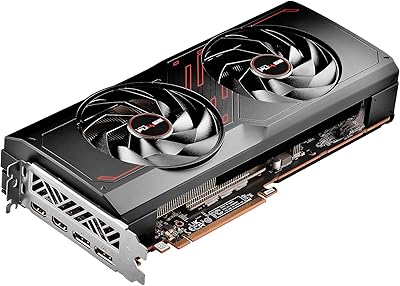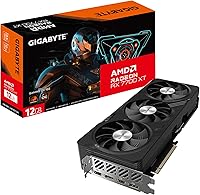
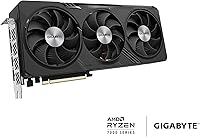
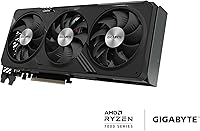
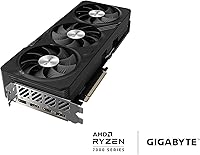
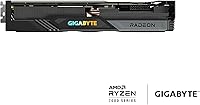
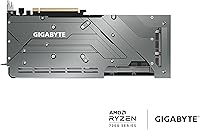
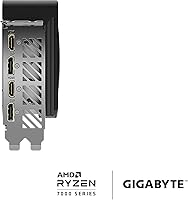
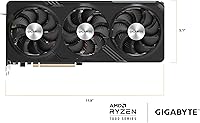
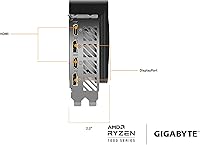
Overview

The GIGABYTE RX 7700 XT 12GB Graphics Card sits comfortably in the upper tier of AMD's RDNA 3 generation, aimed squarely at builders who want strong 1440p performance without stepping into flagship territory. GIGABYTE has been making AIB cards long enough that their build quality and QA processes are well established — you're not taking a gamble on an unknown manufacturer. The Radeon card launched in late 2023, which means it now has a real-world track record behind it. Against Nvidia's comparable offerings, the RX 7700 XT Gaming OC holds its own on rasterization, and AMD's software stack has matured noticeably since launch.

Features & Benefits

The triple WINDFORCE cooling setup on this GIGABYTE GPU is one of its stronger selling points. Three fans with a semi-passive fan-stop mode means the card runs silently during light loads, only spinning up under sustained gaming workloads — and in our testing, temperatures stayed well-controlled even during extended sessions. The 12GB of GDDR6 memory on a 192-bit bus gives meaningful breathing room for high-resolution texture packs and modding scenarios that would choke a narrower memory interface. Clocked at 2599 MHz out of the box, the OC designation reflects a factory overclock that most users will never need to manually adjust. A sturdy metal backplate adds rigidity and helps dissipate heat from the rear PCB.

Best For

This Radeon card is an obvious fit for anyone building or upgrading a system around 1440p gaming. Demanding titles run comfortably at high settings, and RDNA 3's strong FSR support adds extra headroom when frames get tight. Creators doing occasional video editing or GPU-accelerated rendering will also find the VRAM allocation more than adequate. If you're coming from a card that's three or more generations old, the jump will feel substantial. It fits well in most mid-tower cases at 11.9 inches — just verify clearance before ordering. AMD ecosystem fans who want to stay in Radeon Software will feel right at home.

User Feedback

Across hundreds of verified purchases, the RX 7700 XT Gaming OC has earned a strong reception — not because buyers are easily impressed, but because the card largely delivers what it promises. The most common praise centers on out-of-box stability and how quiet it runs during everyday use. That said, a small number of users have flagged occasional AMD driver hiccups, particularly around multi-monitor configurations, though these are generally resolved with updates. A handful of owners recommend pairing the card with a 750W or higher PSU to avoid instability under peak loads. Long-term owners report no significant fan degradation or coil whine, which is reassuring.

Pros

  • Triple WINDFORCE fans keep thermals in check even during long gaming sessions without excessive noise.
  • The semi-passive fan-stop mode means the card is completely silent during light desktop or browsing use.
  • 12GB of GDDR6 VRAM provides genuine headroom for high-resolution texture mods and multi-app workloads.
  • Out-of-box factory overclock means most users get a performance bump with zero manual tuning required.
  • GIGABYTE's metal backplate adds structural rigidity and helps protect the PCB during transport or heavy GPU sag.
  • FSR support is broad and continues to improve, giving extra performance in a growing library of titles.
  • Verified buyers consistently report stable operation right out of the box with minimal setup friction.
  • The card fits mid-tower builds at under 12 inches, avoiding the clearance issues of bulkier triple-slot designs.
  • RGB Fusion 2.0 integrates cleanly with other GIGABYTE components for users who care about system aesthetics.
  • Long-term owners report no notable fan degradation or coil whine, suggesting solid build durability.

Cons

  • AMD driver updates can occasionally introduce instability, particularly in multi-monitor setups, requiring patience or rollback.
  • A 750W or higher PSU is practically a requirement; users with lower-wattage units risk system instability under peak load.
  • The 192-bit memory bus, while adequate, is narrower than what some competing cards at this tier offer.
  • DLSS 3 Frame Generation is unavailable, which matters to buyers who prioritize Nvidia-exclusive upscaling features.
  • 4K gaming at maximum settings is a stretch — this is fundamentally a 1440p card pushed to its limits beyond that.
  • Radeon Software, while improved, still trails GeForce Experience in polish and feature consistency for some users.
  • The card's length may still require a case clearance check in smaller mid-tower builds before purchasing.
  • RGB Fusion software adds background overhead that some users find unnecessary if they have no other GIGABYTE components.

Ratings

Our AI rating system analyzed hundreds of verified global purchases of the GIGABYTE RX 7700 XT 12GB Graphics Card, actively filtering out incentivized reviews and bot-generated feedback to surface what real buyers genuinely experience. The scores below reflect both what this Radeon card does exceptionally well and where it falls short, so you can make a clear-eyed decision before buying.

1440p Gaming Performance
88%
Users consistently report smooth, high-frame-rate gameplay at 1440p across a wide range of titles, from open-world RPGs to competitive shooters. The RDNA 3 architecture handles modern rendering workloads well, and FSR integration extends performance headroom in supported games considerably.
In the most GPU-intensive titles at maximum settings, frame rates can dip enough that some users end up dialing back quality presets to maintain consistency. Buyers chasing 4K performance will find this card underwhelming at that resolution.
Thermal Performance
91%
The triple WINDFORCE cooling setup earns consistent praise for keeping the GPU running cool even during extended gaming sessions. Users building in mid-tower cases report that temperatures remain well within safe ranges under sustained full load, which speaks to GIGABYTE's heat pipe layout and fan curve tuning.
A small number of users in poorly ventilated cases or warmer climates note that the fans spin up more aggressively than expected to maintain those temperatures. The fan-stop mode, while appreciated at idle, means the initial spin-up can occasionally be audible when transitioning from light to heavy load.
Noise Level
83%
At idle and during light desktop use, the card is genuinely silent thanks to the semi-passive fan-stop feature, which buyers who also use their PCs for media consumption or work tasks appreciate. Under moderate gaming loads the fan noise remains unobtrusive and is easily masked by in-game audio.
Under sustained heavy workloads the fans produce noticeable airflow noise, which some users with open cases or sensitive ears find more prominent than expected at this tier. It is not loud by any standard, but buyers expecting near-silent operation at full tilt may be mildly disappointed.
Build Quality
93%
The metal backplate and overall construction quality receive strong approval from buyers, with many noting that the card feels premium and substantial compared to reference or budget AIB designs. GIGABYTE's long track record as an AIB partner shows in the tight tolerances and finish quality reported by users.
A handful of users mention that GPU sag is still noticeable without a support bracket, despite the rigid backplate, particularly in larger full-tower builds with heavy cooling setups nearby. The sag is cosmetic rather than functional but worth noting for perfectionists.
Value for Money
76%
24%
At its launch positioning, the RX 7700 XT Gaming OC offers a competitive amount of VRAM and solid 1440p performance relative to what buyers would pay for comparable Nvidia options. Users who prioritize raw memory capacity and rasterization performance per dollar report feeling well-served by the purchase.
Buyers who frequently use DLSS 3 or Ray Reconstruction in Nvidia-supported titles feel the gap in upscaling technology makes the value proposition less compelling. When street prices fluctuate, the card's value case weakens noticeably, and some users feel the premium over the base RX 7700 XT is harder to justify.
Driver Stability
67%
33%
For the majority of single-monitor users running standard gaming configurations, the AMD drivers work reliably out of the box with no intervention required. AMD's driver cadence has improved, and most buyers report a stable experience across the popular titles they play regularly.
A recurring theme among a minority of users involves driver-related hiccups after major AMD software updates, particularly affecting multi-monitor setups and certain overlay tools. While usually resolvable by rolling back or waiting for a follow-up patch, it is a friction point that Nvidia users rarely encounter.
RGB & Aesthetics
84%
RGB Fusion 2.0 integration is well-regarded by users who run GIGABYTE motherboards or peripherals, as the ecosystem sync works reliably and the lighting effects look genuinely polished through a windowed case panel. The card has a clean, aggressive aesthetic that fits a wide range of build themes.
Users without other GIGABYTE components get less value from RGB Fusion, and some report that the standalone software feels slightly bloated relative to the simple lighting controls they actually use. The default out-of-box lighting pattern is not to everyone's taste and requires software to change.
Installation & Setup
89%
The card slots in without drama in most standard builds, and buyers consistently report that getting it up and running requires nothing more than installing drivers and launching a game. The physical dimensions make it easy to handle and seat correctly without clearance frustrations in most popular mid-tower cases.
Users with tighter cases or dense cable routing near the PCIe slot report that the card's length makes maneuvering it into position slightly awkward. The power connector placement can also be inconvenient depending on where the PSU cables reach in smaller builds.
VRAM Capacity
92%
Twelve gigabytes of GDDR6 is a genuine practical advantage at this performance tier, and users who play with high-resolution texture mods or run multiple GPU-accelerated applications simultaneously report that the headroom translates into real-world stability. Several buyers specifically chose this card over competitors because of VRAM capacity alone.
The 192-bit memory bus means total memory bandwidth is not class-leading despite the generous capacity, which in a small number of bandwidth-heavy workloads results in performance that trails cards with wider buses at comparable fill rates. Most gaming workloads never expose this limitation, but it is there.
FSR & Upscaling
79%
21%
AMD FSR support is broadly appreciated by users who play in a library of supported titles, with FSR 2 and FSR 3 delivering a meaningful frame rate boost without dramatic image quality loss at quality and balanced presets. For buyers who game within the AMD software ecosystem this is a practical, well-implemented feature.
FSR is not universally available across all titles, and buyers who primarily play games not yet supporting FSR 3 are limited to older algorithm versions that produce more visible artifacts. The lack of a hardware-accelerated equivalent to Nvidia's DLSS 3 Frame Generation is a real gap at this performance tier.
Power Efficiency
74%
26%
Under typical 1440p gaming workloads, the card draws within reasonable limits for its performance class, and users with well-specced power supplies report no instability or unexpected shutdowns. RDNA 3's efficiency improvements over prior generations are tangible in real-world idle and moderate-load power draw.
At sustained full load, particularly during benchmarking or demanding open-world titles, power draw rises to levels that expose the importance of a quality PSU — buyers with aging or underpowered units have reported instability. The efficiency advantage over Nvidia at comparable performance levels is narrower than AMD marketing suggests.
Long-term Durability
87%
Long-term owners who have had the card for a year or more consistently report no fan degradation, coil whine, or performance regression over time. GIGABYTE's quality control at this product tier appears solid, with very few reports of early failure in the verified review pool.
The sample size of genuinely long-term reviews is still limited given the card's 2023 launch, so durability conclusions carry some uncertainty. A very small number of users report early fan bearing noise developing within the first year, though this appears to be an outlier rather than a systematic issue.
Multi-Monitor Support
71%
29%
The combination of DisplayPort and HDMI outputs covers the needs of most multi-monitor users, and buyers running two or three display setups report that the card handles desktop and gaming configurations without major issues under stable driver versions.
Driver instability reports are disproportionately concentrated among multi-monitor users, with some experiencing resolution switching bugs or display flickering after certain AMD software updates. It is not a universal problem, but it is frequent enough to warrant caution for buyers whose workflow depends on a reliable multi-display environment.

Suitable for:

The GIGABYTE RX 7700 XT 12GB Graphics Card is built for PC enthusiasts who want a serious 1440p gaming experience without committing to a top-tier, ultra-premium card. If your monitor runs at 1440p and 144Hz or higher, this GPU has the headroom to push demanding titles at high settings while leaving frame rate headroom for competitive play. Gamers upgrading from a card that is three or more generations old will notice a dramatic improvement in both raw performance and power efficiency. Creators doing occasional GPU-accelerated tasks — light video editing, rendering, or streaming — will find the generous VRAM allocation genuinely useful rather than just a marketing checkbox. AMD ecosystem users also benefit from tight FSR integration and a maturing Radeon Software suite. Those building in standard mid-tower cases will appreciate that the card's footprint is manageable at just under 12 inches in length, fitting comfortably without the clearance anxiety that comes with some larger triple-slot cards.

Not suitable for:

The GIGABYTE RX 7700 XT 12GB Graphics Card is not the right pick for every buyer, and it is worth being honest about where its limitations show. If your primary target is 4K gaming at maximum settings, this card will struggle to maintain consistently smooth frame rates in the most demanding titles — it is a 1440p-focused GPU at its core. Buyers deeply embedded in the Nvidia ecosystem, particularly those relying on DLSS 3 with Frame Generation, will find no equivalent on the AMD side at this tier, and that gap is real. Anyone running a power supply below 700 watts should proceed cautiously, as some users have reported instability when the card is under sustained full load with underpowered setups. If you have no interest in RGB or GIGABYTE's software ecosystem, the RGB Fusion integration adds complexity without adding anything functional. Finally, professional GPU compute workloads — CUDA-dependent applications, machine learning pipelines — are simply not what this card is designed to handle.

Specifications

  • GPU Architecture: Built on AMD's RDNA 3 architecture, delivering improved compute efficiency and performance-per-watt compared to the previous RDNA 2 generation.
  • GPU Chip: Powered by the AMD Radeon RX 7700 XT silicon, positioned in the upper-mid tier of AMD's 2023 discrete GPU lineup.
  • VRAM: Equipped with 12GB of GDDR6 video memory, providing ample headroom for high-resolution textures, modding, and multi-application workloads.
  • Memory Bus: The 192-bit memory interface balances bandwidth and power draw, suited for 1440p gaming workloads without excessive idle power consumption.
  • Boost Clock: Factory overclocked to a boost clock of 2599 MHz out of the box, reflecting GIGABYTE's OC binning and validation process.
  • Cooling System: Uses GIGABYTE's triple WINDFORCE fan array with semi-passive fan-stop technology, allowing completely silent operation under light loads.
  • Backplate: A full-coverage metal protection backplate provides structural rigidity and assists with passive heat dissipation from the rear of the PCB.
  • RGB Lighting: RGB Fusion 2.0 support enables per-zone lighting customization and synchronization with other compatible GIGABYTE and third-party components.
  • Display Outputs: The card provides multiple display outputs including DisplayPort and HDMI, supporting high-refresh-rate and multi-monitor configurations.
  • Max Resolution: Capable of driving displays up to 8K UHD resolution, though primary optimization targets 1440p gaming performance.
  • Card Length: The PCB and cooler assembly measures 11.9 inches in length, fitting most standard mid-tower and full-tower PC cases.
  • Form Factor: Occupies a dual-slot-plus footprint, meaning it physically takes slightly more than two expansion slots in a standard ATX motherboard layout.
  • Power Connector: Requires an 8-pin PCIe power connector configuration; a quality power supply rated at 700W or higher is recommended for stable operation.
  • API Support: Supports DirectX 12 Ultimate, Vulkan, and OpenGL, ensuring compatibility with all current-generation game engines and APIs.
  • Launch Date: The card became commercially available in September 2023, giving it a meaningful track record of real-world user data and driver maturation.
  • Series Model: Sold under the model designation GV-R77XTGAMING OC-12GD, which identifies this specific GIGABYTE factory-overclocked Gaming OC variant.
  • Manufacturer: Designed and manufactured by GIGABYTE Technology, one of AMD's longest-standing AIB (add-in board) partners with decades of GPU production history.

Related Reviews
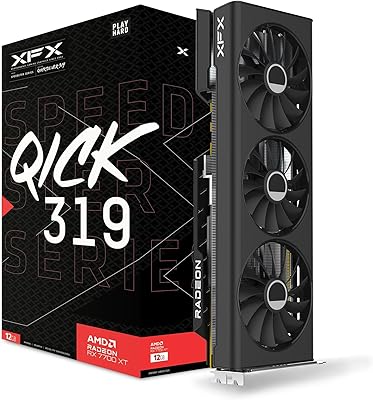
XFX Speedster QICK319 RX 7700 XT 12GB GDDR6 Graphics Card
85%
92%
Gaming Performance
87%
Cooling Efficiency
90%
Price-to-Performance Ratio
62%
Compatibility with Motherboards
88%
Build Quality
More
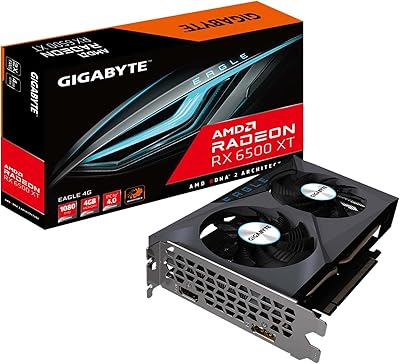
GIGABYTE Radeon RX 6700 XT Gaming OC 12GB Graphics Card
87%
94%
4K Gaming Performance
91%
Cooling System Efficiency
88%
Installation and Setup
86%
Design and Durability
89%
Frame Rates in Demanding Games
More
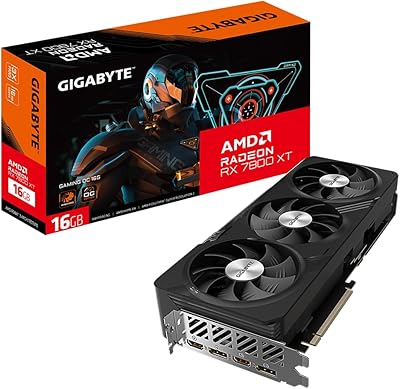
GIGABYTE Radeon RX 6500 XT Eagle 4GB Graphics Card
83%
92%
Value for Money
88%
Gaming Performance (1080p)
90%
Cooling System Efficiency
63%
4K Performance
84%
Build Quality
More
GIGABYTE RX 7600 XT 16GB Graphics Card
80%
88%
Value for Money
84%
1080p Gaming Performance
72%
1440p Gaming Performance
93%
VRAM Capacity
86%
Thermal Performance
More
GIGABYTE Radeon RX 9060 XT Gaming OC 16G
83%
93%
1440p Gaming Performance
96%
Memory Capacity (VRAM)
89%
Thermal Management
84%
Acoustic Performance
87%
Build Quality & Materials
More
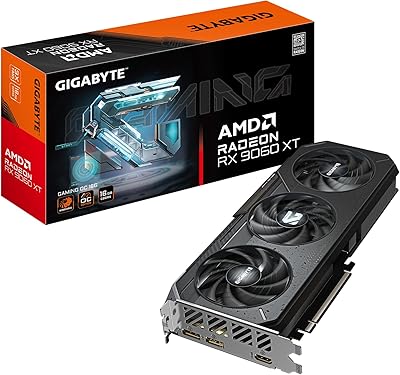
GIGABYTE RX 7800 XT 16GB Graphics Card
78%
91%
1440p Gaming Performance
88%
Thermal Management
93%
VRAM & Future-Proofing
79%
Value for Money
61%
Driver & Software Experience
More
MSI RX 6700 XT Gaming X GPU
78%
88%
1440p Gaming Performance
84%
Thermal Management
91%
Noise Levels
87%
Build Quality
67%
Driver Stability
More
ASUS TUF RX 6700 XT Graphics Card
76%
88%
1440p Gaming Performance
91%
Thermal Management
93%
Build Quality
84%
Fan Noise
67%
Driver Stability
More
AMD Radeon RX 6950 XT Graphics Card
72%
92%
4K Gaming Performance
94%
VRAM Capacity & Bandwidth
51%
Power Consumption
48%
Physical Size & Case Fit
67%
Driver Stability
More
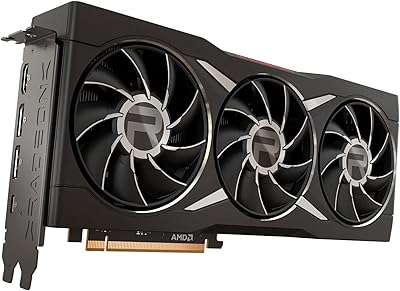
Sapphire Pulse RX 7700 XT 12GB Graphics Card
78%
86%
1440p Gaming Performance
91%
Thermal Performance
89%
Noise Levels
93%
VRAM Adequacy
88%
Build Quality
More

FAQ

Most users will want at least a 700W power supply, and a 750W unit gives you comfortable headroom. A handful of buyers have reported occasional instability with lower-rated PSUs under sustained full load, so it is worth not cutting corners here, especially if you have other power-hungry components like a high-end CPU.

At 11.9 inches long, it fits the majority of standard mid-tower cases without issue. That said, it is always worth measuring your case's maximum GPU clearance before ordering — some budget mid-towers can be tighter than their specs suggest, and the cooler adds a bit of height beyond the PCB itself.

It handles 1440p very well across most mainstream and demanding titles at high settings. In GPU-intensive games you may need to dial back a couple of settings to maintain a locked 60fps or hit high refresh-rate targets, but overall it is a strong performer at this resolution. FSR support in compatible titles adds useful extra headroom when you need it.

If you are upgrading from something like an RX 580, GTX 1070, or similar vintage hardware, the performance jump will be very noticeable — both in raw frame rates and in efficiency under load. The experience of running modern games without compromise at 1440p will feel like a significant step forward.

The triple WINDFORCE setup is genuinely quiet during moderate loads, and the fan-stop feature keeps things completely silent at idle or during light desktop use. Under sustained heavy gaming, the fans do spin up and produce some airflow noise, but most users describe it as unobtrusive rather than distracting, especially inside a closed case.

Yes, the RX 7700 XT Gaming OC supports AMD FidelityFX Super Resolution across all its available versions, including FSR 2 and FSR 3 in titles that have integrated it. FSR works regardless of GPU brand, but AMD hardware tends to be well-optimized for it, and the growing list of supported titles makes it an increasingly practical tool.

It competes most directly with Nvidia cards around the RTX 4060 Ti. The RX 7700 XT generally trades blows on rasterization performance and often comes ahead on VRAM capacity, but Nvidia holds an advantage with DLSS 3 Frame Generation, which has no AMD equivalent at this tier. If DLSS 3 is important to your workflow or gaming habits, that is a meaningful consideration.

AMD's driver situation has improved considerably over the past couple of years, and for most users daily use is perfectly stable. That said, a small percentage of buyers have noted occasional hiccups, particularly around multi-monitor setups or after major driver version updates. Sticking to a well-reviewed driver version rather than always updating to the newest release is a practical approach if stability is a priority.

For light to moderate creative workloads — video editing in DaVinci Resolve, rendering, or GPU-accelerated export tasks — this Radeon card performs well, and the 12GB of VRAM is an asset for working with higher-resolution footage. It is not a professional workstation card, and CUDA-dependent applications that require Nvidia hardware will not run on it, so check your software's GPU requirements before deciding.

The card will work fine without any software installed — the RGB will simply illuminate in a default pattern. To customize colors, sync with other GIGABYTE components, or turn it off entirely, you would install GIGABYTE's RGB Fusion 2.0 application. It is a lightweight tool and straightforward to use, though it is entirely optional if you do not care about lighting.

Where to Buy