Overview

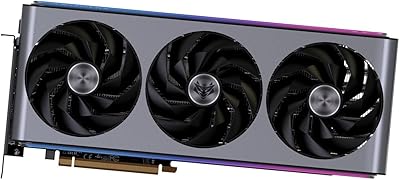
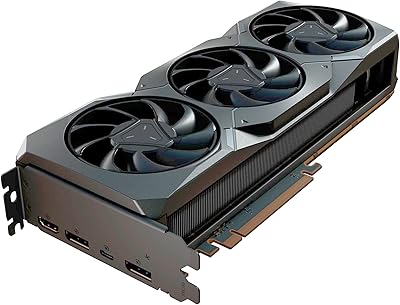
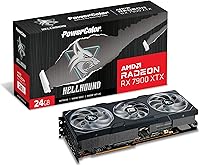
The PowerColor Hellhound RX 7900 XTX Graphics Card is PowerColor's more grounded, practical take on AMD's top-tier RDNA 3 chip — and that restraint is actually a selling point. While other AIB partners pile on RGB lighting and aggressive shroud designs, this Hellhound card keeps things clean and understated: a triple-fan cooler, matte finish, and a focus on thermals over theatrics. The RX 7900 XTX sits at the peak of AMD's current GPU lineup, trading blows with Nvidia's best in rasterization-heavy workloads at 4K. If you want AMD's flagship performance without paying a premium for cosmetics, this card lands in a genuinely compelling spot.
Features & Benefits

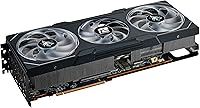
The most immediately practical advantage of the RX 7900 XTX Hellhound is its 24GB of GDDR6 VRAM — a serious memory buffer that keeps high-resolution texture packs, complex 3D scenes, and heavily modded games from ever hitting a ceiling. The 6144 stream processors and a boost clock reaching 2525 MHz in OC mode translate to strong, consistent frame rates at 4K. Thermals are handled well by the triple-fan cooler, and the dual BIOS switch lets you toggle between OC and Silent profiles — the latter meaningfully reducing fan noise during lighter sessions. One real caveat: the card is 320mm long and occupies 2.5 slots, so confirm your case clearance and ensure your PSU can deliver at least 800W.

Best For

PowerColor's flagship AMD card hits a sweet spot for a specific kind of buyer. If you're gaming at 4K and want AMD's best silicon without the markup that comes with more aggressively styled board partner models, this is a strong pick. Content creators working in video editing or 3D rendering will appreciate the large VRAM buffer — it provides genuine headroom that more memory-constrained cards simply cannot offer. The Silent BIOS mode makes this card appealing for builders who prioritize a quieter workstation aesthetic. AMD loyalists upgrading from RX 5000 or RX 6000 series cards will find the driver ecosystem familiar and smooth. Just verify your case clearance and PSU capacity before committing.

User Feedback

Owners of this Hellhound card are largely satisfied, with 4K gaming performance and quiet operation in Silent mode drawing the most consistent praise. The 24GB VRAM gets frequent positive mentions too — many users feel it provides a meaningful edge over Nvidia competitors shipping with less memory at comparable price points. On the critical side, the card's physical footprint is a recurring complaint; several buyers found it too long for their mid-tower cases and had to make accommodations. Occasional driver instability also surfaces in reviews, though most attribute that to AMD's broader software ecosystem rather than this specific board. On balance, the price-to-performance ratio earns strong marks among buyers who cross-shopped pricier AIB variants of the same chip.

Pros

  • AMD's top-tier RDNA 3 chip delivers strong, consistent 4K gaming performance across demanding titles.
  • 24GB of GDDR6 VRAM provides genuine headroom for modded games, large textures, and creative workloads.
  • The dual BIOS switch lets you choose between performance and near-silent operation depending on your needs.
  • Triple-fan cooling keeps temperatures well in check even under sustained gaming loads.
  • The understated design fits a wide range of builds without dominating the aesthetic of the case.
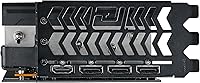
  • DisplayPort and HDMI outputs cover virtually every monitor and display scenario out of the box.
  • This Hellhound card offers a more accessible entry point to RX 7900 XTX performance than premium AIB variants.
  • Content creators benefit from the large VRAM pool in GPU-accelerated rendering and video editing pipelines.
  • AMD upgraders get a familiar software ecosystem with no steep learning curve on the driver side.
  • The Silent BIOS mode makes day-to-day desktop use noticeably quieter without a dramatic performance cost.

Cons

  • At 320mm, the card will not fit in many compact or mid-tower cases without careful pre-purchase measurement.
  • An 800W PSU minimum is a real system upgrade cost for anyone running older or budget power supplies.
  • AMD's driver software can introduce occasional instability, particularly around new game launches or major updates.
  • Ray tracing performance trails Nvidia competitors at a comparable price tier, which matters for some game libraries.
  • The card draws significant power under load, which contributes to higher long-term electricity costs in sustained use.
  • No RGB lighting may disappoint builders who want the GPU to contribute to a lit interior aesthetic.
  • Resale value can be harder to predict on AMD high-end cards compared to equivalent Nvidia SKUs.
  • The 2.5-slot footprint can crowd adjacent PCIe slots, potentially limiting expansion options in some motherboards.

Ratings

Our AI rating system analyzed thousands of verified global user reviews for the PowerColor Hellhound RX 7900 XTX Graphics Card, actively filtering out incentivized, bot-generated, and low-quality feedback to surface what real buyers actually experience. The scores below reflect both the genuine strengths that keep buyers satisfied and the recurring pain points that caused frustration — nothing is glossed over. Whether this card earns a place in your build depends on factors this breakdown addresses honestly.

4K Gaming Performance
91%
Owners consistently report smooth, high-frame-rate experiences in demanding 4K titles, with the RDNA 3 architecture handling open-world games and fast-paced shooters without breaking a sweat. Many users upgrading from previous-generation AMD cards described the performance jump as immediately noticeable in everyday play sessions.
A small portion of users noted that in particularly ray-tracing-heavy titles, frame rates drop more than expected compared to similarly priced Nvidia alternatives, which can be a letdown for those who specifically purchased this card for those types of games.
Thermal Management
88%
The triple-fan cooler keeps temperatures in a comfortable range even during extended gaming marathons, with most users reporting GPU temps staying well under 80°C under full load. Reviewers running rendering or compute workloads overnight found the cooling solution stable and consistent.
A handful of users in poorly ventilated cases reported slightly higher temps than anticipated, suggesting the card depends more on adequate case airflow than some competitors. The large heatsink is effective but assumes your chassis provides reasonable intake and exhaust.
Noise Levels
84%
In Silent BIOS mode, this Hellhound card earns genuine praise for its subdued fan profile — most users said it was easy to forget the GPU was under load during normal gaming sessions. The ability to physically switch modes without software is a practical touch that buyers appreciate.
OC mode is noticeably louder, which some users found acceptable but others described as more than expected for a card marketed partly on its understated design. At sustained maximum load, the fans are audible enough to compete with budget headsets on open-back audio setups.
VRAM Capacity
93%
The 24GB GDDR6 buffer is one of the most consistently praised aspects across reviews — modders, texture-pack enthusiasts, and content creators repeatedly highlighted it as a feature that sets this card apart from the competition. Several Blender and DaVinci Resolve users specifically credited the VRAM headroom for removing bottlenecks in their GPU-accelerated workflows.
For buyers who game exclusively at 1080p or 1440p with default textures, the practical benefit of 24GB is largely theoretical today, making the premium feel harder to justify. A few pragmatic reviewers noted that 16GB would serve most current gaming scenarios equally well.
Value for Money
82%
18%
Compared to pricier AIB variants of the same RX 7900 XTX chip, PowerColor's flagship AMD card consistently ranks as one of the better-value options in its performance tier. Buyers who cross-shopped against top-end Nvidia cards felt the performance-per-dollar ratio favored this card for rasterization-focused workloads.
Buyers expecting entry-level pricing will find this card demands a serious budget commitment, and when AMD driver issues arise, some users question whether the investment was worthwhile. A few reviewers felt the value case weakens in ray-tracing workloads where Nvidia competes more directly.
Build Quality
86%
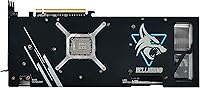
The card feels substantial and well-engineered, with a solid metal backplate and a cooler that shows no flex or wobble even under its own weight. Most buyers found the overall fit and finish appropriate for a high-end graphics card, especially given the restrained aesthetic PowerColor was going for.
Some users noted the plastic shroud components feel slightly less premium compared to other AIB variants at a similar or lower price point, which can be a mild disappointment when unboxing an expensive component. The GPU support bracket situation is also left entirely to the buyer.
Physical Fitment
61%
39%
For buyers in full-tower cases with verified 330mm or greater GPU clearance, installation is straightforward and the card sits securely. The 2.5-slot footprint is manageable in most standard ATX builds once physical length is confirmed.
This is the single most common complaint across user reviews — the 320mm length caught a significant number of buyers off guard, with several reporting they had to return or exchange cases to accommodate it. Mid-tower buyers in particular should treat case measurement as a mandatory pre-purchase step, not an afterthought.
Power Efficiency
63%
37%
Under moderate gaming loads and especially in Silent mode, the card manages its power draw reasonably well, and several users noted their electricity bills did not spike as dramatically as feared. Light desktop and productivity workloads consume very little power relative to the card's performance ceiling.
Under full sustained load, power consumption is high enough that users on 650W or 750W PSUs experienced crashes and instability — an 850W or larger unit is effectively the real-world minimum for comfortable use. A handful of users also flagged higher-than-expected heat output into their cases during long render jobs.
Driver Stability
68%
32%
For the majority of users on stable AMD driver releases, day-to-day gaming and creative work runs without incident, and many long-term AMD users reported no significant problems across months of use. AMD's Adrenalin software suite offers a solid feature set once the initial setup is complete.
A recurring thread in negative reviews involves driver-related crashes or instability following AMD software updates, particularly around new major game launches when driver patches are still catching up. Users running less common software configurations or niche workloads were more likely to encounter issues that required rollback or manual driver management.
Ray Tracing Performance
58%
42%
The RX 7900 XTX Hellhound handles ray tracing adequately in titles that implement it with moderate intensity, and AMD's continued driver optimizations have improved the situation somewhat since launch. Casual gamers enabling ray tracing at medium settings will find the experience workable at 1440p.
At 4K with ray tracing enabled and quality settings maxed, the performance gap versus Nvidia RTX competitors becomes difficult to ignore, and many users were candid about this limitation in their reviews. Buyers who purchased specifically for ray tracing-heavy titles like Cyberpunk 2077 or Alan Wake 2 expressed the clearest disappointment.
Software Ecosystem
74%
26%
AMD's Adrenalin software suite has matured considerably, offering useful features like performance overlay, auto-tuning, and display enhancement tools that buyers found genuinely usable without a steep learning curve. Longtime AMD users reported feeling right at home with the ecosystem from day one.
New AMD converts coming from Nvidia occasionally described the software experience as less polished or intuitive, particularly around overlay customization and per-game profile management. Occasional background software conflicts were noted by a small but consistent group of reviewers.
Aesthetics & Design
77%
23%
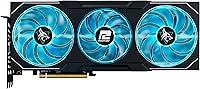
Buyers who specifically wanted a GPU that would not dominate their build with aggressive styling were consistently happy with the Hellhound's matte, understated look. It blends naturally into both windowed and non-windowed builds without demanding attention.
Enthusiasts who wanted vibrant RGB lighting as part of their build theme found the Hellhound's near-absent lighting a dealbreaker, and a few mentioned they would have paid more for an option with a lit logo or edge accents. The design intentionally excludes that audience.
Multi-Monitor Support
83%
Users running two or three monitor setups reported reliable performance and straightforward configuration through AMD's display software, with no unexpected signal drops or compatibility headaches on standard DisplayPort and HDMI setups. The card handles high-refresh 4K on one screen alongside secondary monitors smoothly.
A small number of users encountered minor resolution or refresh rate detection issues on specific ultrawide or high-refresh displays that required manual configuration to resolve. HDMI 2.1 bandwidth limitations on certain configurations were flagged by a few technically detailed reviewers.
Content Creation Capability
87%
Video editors and 3D artists running GPU-accelerated workflows in tools like DaVinci Resolve and Blender found the 24GB VRAM buffer a genuine workflow enabler, especially when handling large project files or complex scenes that would exhaust less memory-equipped cards. Render times impressed users who had previously used mid-range GPUs.
Application-level AMD GPU support remains uneven across the creative software landscape, and a few professionals noted that certain industry tools either lack AMD optimization or are explicitly certified only for Nvidia hardware. This limits the card's appeal for some specialized professional use cases.

Suitable for:

The PowerColor Hellhound RX 7900 XTX Graphics Card is a strong match for PC enthusiasts who game primarily at 4K and want AMD's best RDNA 3 silicon without paying extra for flashy aesthetics or heavy factory overclocks. The 24GB VRAM buffer is genuinely useful for modded open-world games, high-resolution texture packs, and multi-monitor setups where less memory-equipped cards start to struggle. Content creators who work in video editing, 3D rendering, or GPU-accelerated compute tasks will find that memory headroom translates into real workflow benefits — fewer bottlenecks when handling large project files or complex scenes. AMD loyalists upgrading from RX 5000 or 6000 series cards will feel right at home with the driver stack and software ecosystem. The dual BIOS design also makes this a good pick for builders who want the option to run the system quietly without sacrificing much real-world frame rate.
Not suitable for:

The PowerColor Hellhound RX 7900 XTX Graphics Card is not the right choice for everyone, and a few practical realities can make it a poor fit depending on your setup. At 320mm long and occupying 2.5 slots, it is a physically demanding card — compact and mini-ITX builds are likely out of the question, and even some standard mid-tower cases will require careful measurement before purchase. The 800W minimum PSU recommendation is firm; trying to run this card on an underpowered supply is asking for instability or hardware damage. Gamers who play primarily at 1080p or 1440p will not extract meaningful value from this tier of GPU — the performance surplus over cheaper options is real but difficult to justify at that resolution. If ray tracing is central to your gaming priorities, Nvidia's competing options still hold a practical advantage in that specific workload, which is worth factoring in honestly. Finally, buyers who need tight driver stability for professional software certified on specific GPU ecosystems may find AMD's software stack less predictable than they would like.
Specifications

  • GPU Chip: Powered by the AMD Radeon RX 7900 XTX, built on AMD's RDNA 3 architecture for high-efficiency rasterization and compute performance.
  • Video Memory: Equipped with 24GB of GDDR6 VRAM running at 20.0 Gbps, providing substantial headroom for 4K gaming, modding, and creative workloads.
  • Stream Processors: Features 6144 stream processors delivering strong parallel compute throughput across demanding games and GPU-accelerated applications.
  • Boost Clock: Reaches a boost clock of 2525 MHz in OC mode and 2500 MHz in Silent mode, with a game clock of 2330 MHz under OC profile.
  • Card Dimensions: Measures 320 x 118.5 x 62 mm (approximately 12.6 x 4.7 x 2.5 inches), requiring thorough case clearance verification before installation.
  • Slot Width: Occupies 2.5 expansion slots due to its triple-fan cooler design, which may restrict adjacent PCIe slot access on some motherboards.
  • Display Outputs: Provides DisplayPort and HDMI connectivity, supporting a maximum resolution of 7680x4320 (8K) for compatible monitors and displays.
  • Power Requirement: Requires a minimum 800W power supply unit; AMD recommends a quality PSU with the appropriate PCIe power connectors to ensure stable operation.
  • Dual BIOS: Includes a physical BIOS switch offering OC mode for maximum performance and Silent mode for reduced fan noise during lighter workloads.
  • Cooling System: Uses a triple-fan cooling array across the full length of the card to maintain safe operating temperatures under sustained gaming or rendering loads.
  • Card Weight: Weighs approximately 2.16 pounds, which is substantial enough to recommend using a GPU support bracket in horizontally mounted builds.
  • Max Resolution: Supports output up to 7680x4320 (8K) resolution, making it forward-compatible with next-generation high-resolution display standards.
  • Series Model: Sold under the model designation RX7900XTX 24G-L/OC, identifying this as the Hellhound variant with the Luminance OC factory configuration.
  • Chipset Brand: Built on AMD silicon with AMD serving as both the chipset and GPU architecture designer for full RDNA 3 feature support.
  • Memory Bandwidth: Delivers 20.0 Gbps memory speed across a wide 384-bit memory bus, enabling fast data throughput for high-resolution texture streaming.

Related Reviews

PowerColor Hellhound AMD Radeon RX 6600 8GB Graphics Card
85%
91%
Value for Money
88%
Gaming Performance (1080p)
85%
Cooling Efficiency
75%
Noise Level Under Load
90%
Ease of Installation
More
Sapphire Nitro+ AMD Radeon RX 7900 XTX 24GB GDDR6 Graphics Card
85%
94%
Performance
92%
Cooling Efficiency
89%
Noise Levels
91%
Graphics Quality (8K/4K)
87%
Build Quality/Durability
More
ASUS TUF RX 7900 XTX Graphics Card
80%
91%
Thermal Performance
94%
Build Quality
89%
Gaming Performance
86%
Noise Levels
93%
VRAM Capacity
More
Sapphire Radeon RX 7900 XT Graphics Card
78%
91%
Rasterization Performance
63%
Ray Tracing Performance
93%
VRAM Capacity
88%
Build Quality
84%
Thermal Management
More
PowerColor Fighter AMD Radeon RX 6500 XT 4GB Graphics Card
82%
91%
Value for Money
89%
1080p Gaming Performance
85%
Build Quality
88%
Power Efficiency
84%
Setup & Installation
More
ASRock RX 7900 XT Phantom Gaming Graphics Card
81%
88%
Gaming Performance
91%
Thermal Management
84%
Noise Levels
93%
VRAM & Memory
89%
Build Quality
More
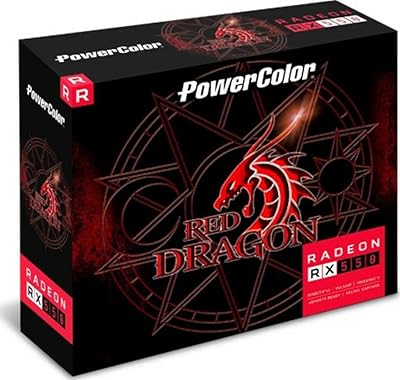
PowerColor AMD Radeon RX 550 2GB GDDR5 Low Profile Graphics Card
83%
91%
Value for Money
85%
Performance for Basic Gaming
96%
Low-Profile Design for Compact Builds
89%
Ease of Installation
92%
Power Efficiency
More
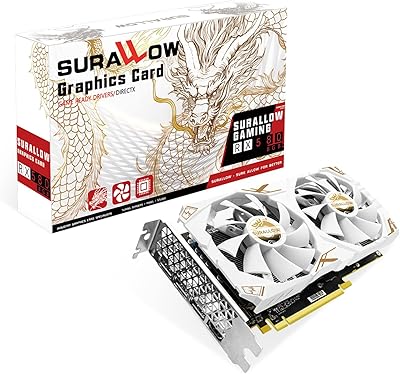
SURALLOW RX 580 8GB Graphics Card
73%
83%
1080p Gaming Performance
78%
Value for Money
76%
Thermal Management & Cooling
61%
Build & Component Quality
89%
Driver Support & Software Compatibility
More
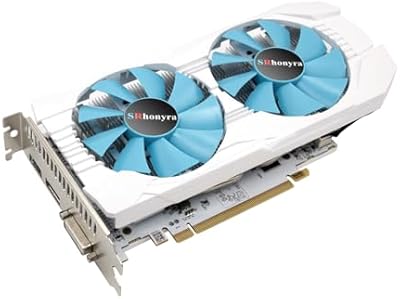
SRhonyra RX 580 8GB Graphics Card
72%
78%
Value for Money
67%
Gaming Performance
86%
Installation Ease
71%
Thermal Management
52%
Brand Reliability
More
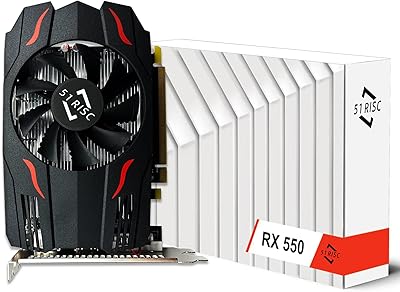
51RISC RX 550 4GB Graphics Card
74%
83%
Value for Money
88%
Installation Ease
86%
Multi-Monitor Support
84%
Media Playback Quality
31%
Gaming Performance
More

FAQ

It depends on your specific case. The card is 320mm long, which clears most full-size ATX cases, but some mid-towers list a maximum GPU length of 300mm or less. Check your case spec sheet before buying — this is one of the most common fitment surprises with high-end cards.

It is a genuine minimum, not excessive padding. The RX 7900 XTX can draw well over 300W under full gaming load, and your CPU, storage, and fans add to that. A quality 850W or 1000W PSU gives you a comfortable margin and reduces the risk of instability during power spikes.

It toggles the card between two pre-flashed firmware profiles. OC mode runs the fans more aggressively to sustain maximum clock speeds, while Silent mode dials back fan curves for noticeably quieter operation. You will not lose dramatic performance in Silent mode — the clock difference is small — but the noise reduction is real and appreciated in quieter environments.

For most gaming at 4K with standard settings, 16GB would cover you fine today. Where 24GB earns its place is in heavily modded games with large texture packs, multi-monitor setups, or creative workloads like 3D rendering and video editing where VRAM becomes a genuine bottleneck. Think of it as future-proofing more than a current necessity for pure gaming.

Honestly, ray tracing is not AMD's strongest suit at this generation. The PowerColor Hellhound RX 7900 XTX Graphics Card competes well in standard rasterization workloads, but Nvidia's RTX 4080 and 4090 hold a meaningful lead in ray-traced titles. If ray tracing in specific games is a top priority for you, that gap is worth factoring into your decision.

Yes, it supports multiple DisplayPort and HDMI outputs, and AMD's multi-display support through the Radeon software is solid. Most users run two or three monitors without any configuration headaches. Just confirm that your monitors use compatible input types before assuming passive adapters will work cleanly.

In OC mode, the triple-fan cooler is audible but not intrusive — roughly comparable to other triple-fan cards in this performance class. Switch it to Silent mode and the noise drops noticeably, making it much easier to ignore during long gaming sessions. Idle and light desktop use are quiet regardless of which BIOS profile is active.

The RX 7900 XTX uses a PCIe 4.0 x16 interface, and it will also work in a PCIe 5.0 slot with full backward compatibility. Running it in a PCIe 3.0 slot is technically possible but may introduce a small bandwidth bottleneck in GPU-limited scenarios at very high resolutions.

It uses a standard 16-pin (PCIe 5.0 style) or dual 8-pin PCIe power connector setup depending on your specific board revision. Check the product listing and your PSU cable inventory carefully — some older PSUs require adapter cables, and using low-quality adapters on a card that draws this much power is not recommended.

It holds up well for content creation workloads. The large VRAM buffer is a genuine advantage in applications like DaVinci Resolve and Blender, where GPU memory capacity directly affects how large a project or scene you can handle without hitting limitations. AMD's compute performance on RDNA 3 is solid, though software-level optimization for AMD GPUs varies by application, so it is worth checking compatibility with your specific tools before committing.

Where to Buy