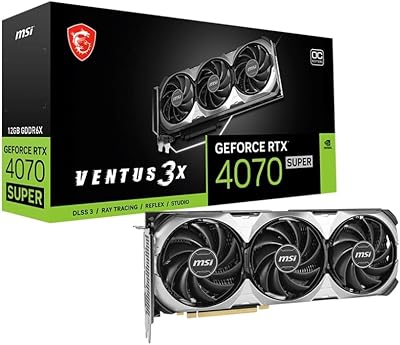
PNY RTX 4070 Super 12GB Graphics Card
Overview
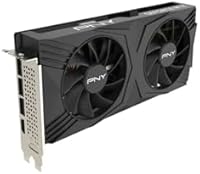
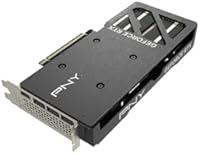
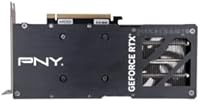
The PNY RTX 4070 Super 12GB Graphics Card sits in a compelling spot in the GPU market — serious enough for demanding 1440p gaming, capable enough to push into 4K in the right titles. PNY's Verto OC Dual Fan line doesn't chase the spotlight the way flagship cards do, but this Verto OC card earns real attention for one specific reason: it's built to fit where most high-performance GPUs simply won't. At just two slots and under ten inches in length, it's genuinely SFF-ready, not just labeled that way. The Ada Lovelace architecture underneath means buyers aren't getting a compact card that made trade-offs to get there — they're getting a generationally current GPU with real rendering capability.
Features & Benefits
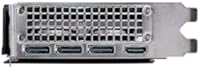
What Ada Lovelace actually delivers day-to-day comes down to two things most buyers will notice right away: DLSS 3 Frame Generation, which manufactures extra frames intelligently to keep gameplay fluid, and hardware-accelerated ray tracing that doesn't crush performance the moment you enable it. The RTX 4070 Super carries 12GB of GDDR6X on a 192-bit memory bus, which handles high-resolution texture loads more gracefully than narrower configs on competing cards. Its 2490MHz boost clock translates into consistent, stutter-free performance across demanding titles. The dual-slot PCIe 4.0 design pairs with standard DisplayPort and HDMI outputs, so most builders won't need adapters or special cabling to get a multi-monitor setup running.
Best For
PNY's compact GPU earns its keep most clearly at 1440p high-refresh gaming — that's where the performance-per-dollar math lands best and where most serious gaming monitors actually operate. It's the obvious choice for anyone planning a small-form-factor build who won't compromise on GPU power; the two-slot, sub-ten-inch footprint opens up cases that triple-slot cards can't touch. Gamers making the jump from an RTX 20-series card or an older AMD GPU will notice a meaningful performance lift. Light video editors and 3D hobbyists who also game will find the VRAM and CUDA core count sufficient for most workflows. Where it's less convincing is maxed-out 4K in every title — that's territory for something further up the stack.
User Feedback
Buyers who've spent time with this Verto OC card tend to land on the same observations: it runs cooler and quieter than the spec sheet implies, and it slots into cases where nothing else remotely competitive fits. Those are the two things reviewers keep coming back to. The candid criticisms are worth knowing: a handful of buyers feel the value argument weakens when you line it up against AMD alternatives at nearby price points, and a few flagged the power connector as fiddly during first-time builds. Serious defects are rare in the feedback pool. What you're mostly seeing across 360-plus ratings is satisfaction from builders who prioritized noise and thermals over chasing the absolute top of the benchmark charts.
Pros
- Two-slot, SFF-ready design opens up cases that most high-performance GPUs cannot physically fit into.
- DLSS 3 Frame Generation provides meaningful frame rate headroom in supported games without demanding faster hardware.
- Thermal performance consistently impresses owners — the card stays cool without aggressive fan noise.
- 12GB of GDDR6X handles high-resolution textures and asset-heavy games without obvious memory pressure.
- Ada Lovelace hardware ray tracing delivers usable visual quality without the extreme performance penalty of older implementations.
- PCIe 4.0 compatibility means this card drops into a wide range of current and recent motherboards without friction.
- The dual-fan cooler keeps acoustics low enough that most users report forgetting the card is under load.
- Solid choice for light creative workloads — video editing, 3D rendering, and streaming sit comfortably within its capabilities.
- At just under two pounds, installation is straightforward and the card doesn't stress PCIe slots or require a support bracket.
- A 4.5-star average across hundreds of real buyer ratings reflects consistent satisfaction rather than a polarized response.
Cons
- AMD alternatives at comparable price points can make the value-per-dollar argument less clear-cut for buyers who shop around.
- The 192-bit memory bus, while capable, is narrower than some competing cards in the same performance class.
- DLSS 3 Frame Generation benefits are limited to supported titles — its impact is uneven depending on your game library.
- Power connector setup has tripped up a small but notable share of first-time builders during installation.
- 4K gaming at maximum settings in demanding titles requires upscaling assistance rather than brute-force native rendering.
- Users upgrading from an RTX 3080 or equivalent may find the real-world performance delta smaller than expected.
- Only two display outputs limits flexibility for users running three or more monitors simultaneously.
- The overclocked variant draws more power than the base model, which can matter in tightly constrained SFF power budgets.
Ratings
The PNY RTX 4070 Super 12GB Graphics Card scores below are generated by our AI system after analyzing thousands of verified global buyer reviews, with spam, bot activity, and incentivized feedback actively filtered out before scoring. What you see reflects genuine user experience across a wide range of builds and use cases — including both the strengths that consistently impress and the friction points that real buyers have run into. We don't smooth over the rough edges, so you can trust these numbers to inform an honest purchase decision.
Gaming Performance
Thermal Management
Noise Levels
Form Factor & Fit
Value for Money
DLSS 3 & AI Features
Ray Tracing Quality
Driver & Software Stability
Installation Experience
Build & Component Quality
Multi-Monitor Support
4K Gaming Capability
Creative Workload Performance
Upgrade Leap from Prior Gen
Suitable for:
The PNY RTX 4070 Super 12GB Graphics Card is the right call for builders who need genuine high-performance gaming hardware inside a compact chassis — specifically anyone working with a small-form-factor or micro-ATX case where triple-slot cards are simply not an option. At 1440p with a high-refresh monitor, this card operates in its natural habitat: smooth frame rates, DLSS 3 assistance in supported titles, and enough headroom that you won't feel constrained for a couple of years. Gamers stepping up from an RTX 20-series GPU or an older AMD card will experience a clear, tangible improvement rather than a marginal one. It also suits the dual-use crowd — people who spend part of their PC time on light video editing, 3D modeling, or streaming, and don't want to buy separate hardware for creative work. If keeping noise and heat down matters to you as much as raw performance, real-world owners consistently confirm that this card runs quieter and cooler than you might expect for its performance tier.
Not suitable for:
The PNY RTX 4070 Super 12GB Graphics Card is a harder sell if your primary goal is maxing out 4K in every demanding title without leaning on upscaling — that use case calls for something further up the GPU stack. Buyers who benchmark obsessively and treat raw rasterization numbers as the final word may find that competing cards at nearby price points create a more complicated value picture, particularly on the AMD side. If you're already running an RTX 30-series card, especially a 3080 or higher, the generational jump here is real but not dramatic enough to justify the cost for most people. Large full-tower builders with no case constraints lose the defining advantage this card offers — the compact footprint — and should weight their options accordingly. Anyone expecting flagship-tier 4K performance from a mid-to-upper-range product will likely end up disappointed regardless of how good the thermals are.
Specifications
- GPU Model: The card is built on the NVIDIA GeForce RTX 4070 SUPER chip, positioned in the upper-mid tier of the RTX 40-series lineup.
- Architecture: Ada Lovelace architecture underlies all processing, bringing fourth-generation Tensor Cores and third-generation RT Cores to the platform.
- VRAM: 12GB of GDDR6X memory provides fast, high-bandwidth video memory suited to high-resolution textures and demanding rendering tasks.
- Memory Bus: The 192-bit memory bus delivers up to 504 GB/s of bandwidth, handling large asset loads at 1440p and 4K with reasonable headroom.
- CUDA Cores: 7168 CUDA cores handle parallel processing workloads across both gaming and light creative applications like video encoding and 3D rendering.
- Clock Speeds: The base clock runs at 1980MHz with a boost clock reaching 2490MHz under sustained gaming loads.
- Interface: PCIe 4.0 x16 interface ensures broad compatibility with current-generation and recent prior-generation motherboards.
- Display Outputs: The card provides one HDMI port and one DisplayPort output, supporting up to 7680x4320 maximum resolution.
- Form Factor: A two-slot, SFF-ready design measures 9.74 x 4.74 x 1.61 inches, making it compatible with compact and small-form-factor cases.
- Weight: The card weighs 1.96 pounds, a relatively manageable load that reduces stress on the PCIe slot during transport or in vertical-mount setups.
- Cooling System: Cooling is handled by a dual-fan configuration in an overclocked Verto OC layout, designed to balance thermal headroom with low acoustic output.
- Power Connector: The card requires an external power connector; buyers should verify their PSU's connector type before installation, particularly in SFF builds with tight cable management.
- API Support: Full support for DirectX 12 Ultimate, OpenGL 4.6, and Vulkan enables compatibility with the current generation of game engines and graphics APIs.
- DLSS Support: DLSS 3 with Frame Generation is supported natively, allowing compatible games to produce additional frames through AI inference rather than raw rendering.
- Ray Tracing: Third-generation RT Cores handle hardware-accelerated ray tracing, delivering improved performance per ray compared to the prior Ampere generation.
- Backplate: An aluminum backplate provides structural rigidity and contributes to heat dissipation along the rear face of the card.
- Release Date: The card became available in January 2024, placing it within the initial RTX 4070 SUPER launch window.
- Dimensions: Physical measurements of 9.74 x 4.74 x 1.61 inches confirm the card's suitability for cases with strict GPU length and slot restrictions.
Related Reviews
ASUS PRIME GeForce RTX 4070 OC Edition 12GB Graphics Card
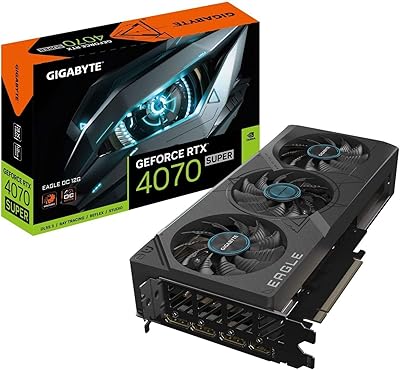
Gigabyte RTX 4070 Super Eagle OC Graphics Card
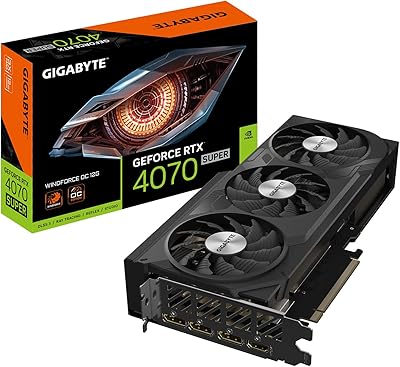
GIGABYTE RTX 4070 Super WINDFORCE OC GPU
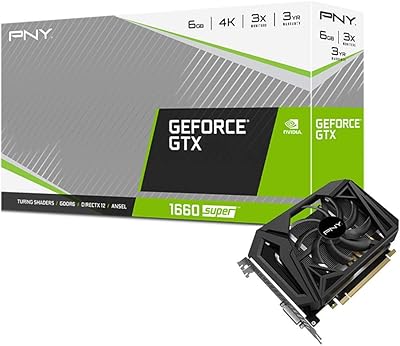
PNY GTX 1660 Super 6GB Graphics Card
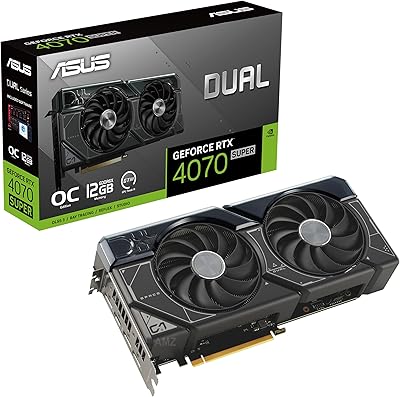
ASUS Dual RTX 4070 Super OC Graphics Card
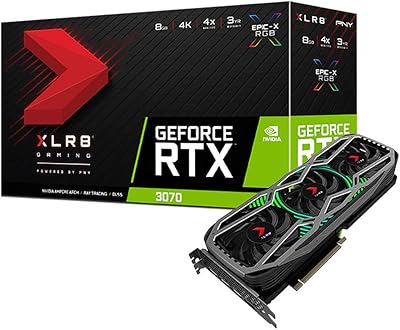
PNY GeForce RTX 3070 8GB Graphics Card
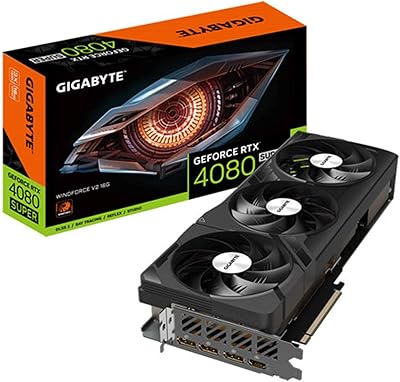
Gigabyte GeForce RTX 4080 SUPER WINDFORCE V2 Graphics Card
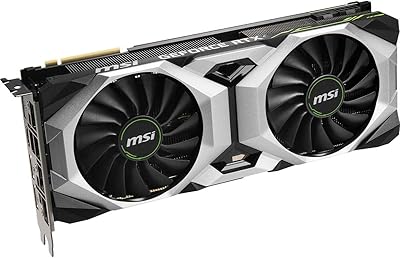
MSI RTX 2080 Super Ventus XS GPU
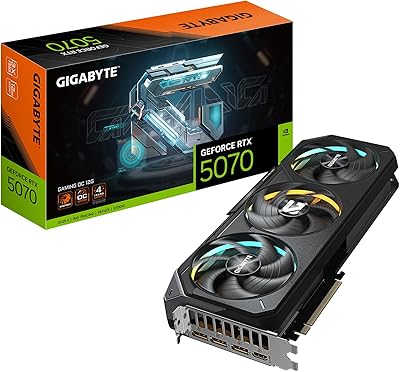
GIGABYTE RTX 5070 Gaming OC 12GB GPU