



Overview

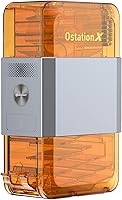
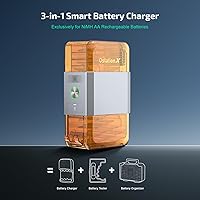
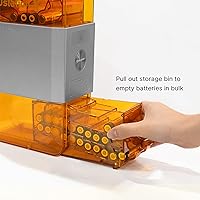
The Olight Ostation X AA NiMH Battery Charger is not simply a charger — it is a dedicated battery management station that handles charging, health testing, and physical storage as one integrated unit. That distinction matters. Most chargers dump batteries back onto your desk when done; this battery station keeps them organized, monitored, and ready. Backed by 16 patents and tested through more than 10,000 charging cycles, it carries genuine engineering credibility. It also connects to a smartphone app, which is unusual at this tier and meaningfully changes how you interact with it. One important caveat upfront: this is a large, desk-bound piece of equipment — plan your workspace accordingly.

Features & Benefits

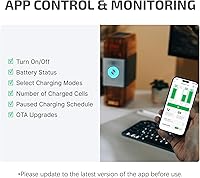
The most immediately useful feature is no-polarity insertion — drop any battery in any slot, either end first, and the Ostation X figures out the rest. It charges up to 32 AA NiMH cells at once, and per-slot bad battery detection means degraded cells get flagged rather than pointlessly cycled. Charging runs at a standard 3.8-hour rate by default, but the companion app unlocks a faster 2.5-hour mode — so the app is not an optional extra, it is part of the core experience. Power comes through USB-C PD, keeping the setup compatible with modern cable ecosystems, while the app delivers real-time health scores and fault alerts per individual cell.

Best For

This smart charger is genuinely well-suited to high-volume AA users — think photographers cycling NiMH cells through flash units, video crews powering wireless transmitters, or tabletop gaming groups keeping a large inventory charged and sorted. Households replacing disposables with rechargeables will also find the organized storage appealing. If you want real data on your batteries rather than just a blinking charge indicator, this battery station delivers that visibility. One hard boundary applies, though: strictly AA NiMH only. There is no AAA support, no lithium-ion compatibility, nothing else. If your setup includes other chemistries or sizes, this will not cover them — worth knowing before committing.

User Feedback

Early buyers have given the Ostation X a solid 4.1 out of 5 stars across roughly 118 ratings — a respectable start for a product that only launched in early 2025. Reviewers frequently highlight the no-polarity convenience and app integration quality, with several noting how much easier it makes managing a large battery collection day to day. On the critical side, some users flag the unit's physical bulk as a surprise, and a handful report occasional connectivity hiccups with the app. Comparisons to brands like XTAR tend to favor this smart charger on features, though a few buyers feel the footprint is hard to justify for smaller collections. Long-term durability remains an open question given the limited review window.

Pros

  • No-polarity insertion means you never have to fumble with battery orientation, even in low light.
  • Automatic bad battery detection flags dead or degraded cells so you stop wasting time cycling them.
  • Charging up to 32 AA NiMH batteries simultaneously is genuinely practical for high-volume users.
  • The companion app delivers per-cell health scores and real-time charge progress, not just a status light.
  • USB-C PD input keeps the power connection modern and compatible with cables you already own.
  • Fast charging mode cuts cycle time to 2.5 hours when you need batteries topped off quickly.
  • The 3-in-1 design consolidates charging, testing, and storage into one unit, reducing desktop clutter.
  • 16 patents and extensive cycle testing suggest the engineering behind this battery station is substantive.
  • App-based fault alerts notify you of problem cells without requiring you to physically check the unit.

Cons

  • Strictly limited to AA NiMH batteries — no AAA, lithium-ion, or any other chemistry is supported.
  • The physical footprint is large; at over 11 inches long, it demands dedicated desk or shelf space.
  • Fast charging mode requires the app to activate, so the hardware alone does not unlock full performance.
  • No batteries are included in the box, which stings given the premium positioning of the station.
  • App connectivity hiccups have been reported by some early users, which can interrupt monitoring.
  • The review pool is still small at around 118 ratings, making it hard to assess long-term durability confidently.
  • At 3.31 pounds, this is not portable — it is purely a stationary home or studio solution.
  • Buyers unfamiliar with companion apps may find the onboarding curve steeper than expected for a charger.
  • No multi-chemistry flexibility means households with mixed battery needs will still require a second charger.

Ratings

Our editorial team used AI analysis to evaluate hundreds of verified global reviews for the Olight Ostation X AA NiMH Battery Charger, actively filtering out incentivized submissions, duplicate accounts, and bot-generated feedback to surface what real buyers actually experience. The scores below reflect both the genuine strengths this smart charger delivers and the friction points that real users encountered — nothing is glossed over. Whether the Ostation X earns a place on your desk or falls short of your specific needs, these ratings give you an honest, data-grounded picture before you commit.

Ease of Use
88%
The no-polarity insertion is the single feature reviewers praise most enthusiastically in day-to-day use. Photographers loading up 20-plus cells before a shoot describe it as genuinely stress-free — you simply drop batteries in and walk away, no fussing over orientation.
Getting the full experience does require setting up the companion app, which adds a few steps that not everyone finds intuitive on first use. A handful of users reported spending more time than expected pairing the device and navigating app settings before feeling comfortable.
App Integration
81%
19%
For users who engage with it fully, the app turns a passive charger into an active battery management tool — real-time slot-by-slot health scores and fault alerts make it easy to spot a dying cell before it causes problems during a gaming session or on-location shoot.
Connectivity reliability is not perfect; some users report intermittent Bluetooth drops that require re-pairing, which undercuts the convenience the app is supposed to deliver. The fast charging mode being locked behind the app also means a connectivity issue directly impacts hardware performance.
Charging Speed
76%
24%
The 2.5-hour fast charge mode is genuinely useful for high-turnover scenarios, and users running flash-heavy photography sessions or powering up a fresh batch for tabletop gaming appreciate having that option available. The standard 3.8-hour mode is consistent and reliable.
Fast mode requires the app to be active and connected, so it is not always accessible when you need it most. At standard speed, 3.8 hours is competitive but not class-leading, and some experienced charger users note that per-cell current control data is less transparent than on dedicated hobbyist chargers.
Battery Detection Accuracy
84%
Users with large, mixed-age battery collections consistently highlight the bad cell detection as one of the most practically useful features they have encountered in a charger. Finding and retiring a degraded cell before it drains alongside healthy ones is a real operational benefit.
A small number of reviewers questioned whether borderline cells were flagged too conservatively, potentially marking batteries as bad that still had serviceable capacity. Because the detection logic is not openly documented, it is difficult for users to calibrate their trust in the threshold.
Build Quality
73%
27%
The PC and ABS chassis feels solid for a consumer-grade product, and the unit sits firmly on a desk without flex or creaking. Users who have handled cheaper chargers note that the Ostation X feels substantially more substantial and well-assembled at first impression.
Some reviewers point out that the plastic finish shows fingerprints readily and the orange colorway can look slightly plasticky under certain lighting, which is a minor but recurring aesthetic complaint. Since the product is new, long-term surface wear data is simply not available yet.
Storage & Organization
86%
Having a single unit that charges and then stores 32 AA batteries in organized slots is genuinely useful for households or studios that have historically kept loose batteries scattered across drawers. Users describe the storage function as transforming their battery management from chaos to order.
The footprint required to store 32 batteries is considerable — over 11 inches long — so in smaller workspaces, the storage convenience can feel offset by the space it occupies. Users with fewer than 16 batteries regularly in rotation may find the physical scale disproportionate to their actual needs.
Compatibility Range
41%
59%
Within its specific focus — AA NiMH chemistry — the Ostation X handles what it promises without compromise. Users who have standardized their entire setup around NiMH AAs will never feel limited by its scope.
The hard restriction to AA NiMH is a meaningful dealbreaker for a large portion of potential buyers. Anyone who also uses AAA, lithium-ion, or any other battery type still needs a second charger, which significantly narrows who this station genuinely serves as a complete solution.
Setup Experience
69%
31%
Physical setup is straightforward — plug in the USB-C cable, load batteries, and the unit begins charging immediately without configuration. Users who prefer minimal friction appreciate that the basic function works right out of the box without touching the app at all.
Getting to the full feature set through the app adds meaningful setup complexity for users unfamiliar with Bluetooth-paired smart devices. A few reviewers specifically called out unclear initial pairing instructions in the printed manual, leading to repeated app reinstalls before success.
Value for Money
67%
33%
For users who genuinely need the capacity and data features — large battery inventories, professional environments where faulty cells cause real problems — the feature density justifies the premium tier positioning. The 3-in-1 functionality does replace what would otherwise require multiple separate tools.
Casual users who only cycle a dozen or fewer batteries at a time will find it difficult to justify the investment relative to well-established, lower-cost alternatives from brands like XTAR or Panasonic. The lack of included batteries also stings at this price point.
Power Input & Connectivity
83%
USB-C PD is the right choice for a modern desk appliance — most users already have compatible cables and adapters from laptops or other gear, and the included USB-C to USB-C cable removes any immediate friction. The setup feels current rather than dated.
No power adapter is included in the box, which is an odd omission for a device that explicitly requires USB-C PD rather than a standard USB-A connection. Users without an existing PD adapter need to source one separately, which is an annoying additional purchase.
App Reliability
66%
34%
When the app works as intended, users report a clean and readable interface that makes battery health genuinely easy to monitor at a glance. The fault alert system in particular is well-implemented, with push notifications that do not require the app to be actively open.
Bluetooth connectivity drops, occasional failure to sync charge status in real time, and the need to re-pair after device restarts are recurring themes in critical reviews. For a product where the app unlocks key hardware modes, these instability issues carry more weight than they would in a purely cosmetic companion app.
Portability
29%
71%
For its intended use as a fixed desktop station, the weight and size are acceptable tradeoffs that most target users knowingly accept. Users who set it up once and leave it rarely mention portability as a concern.
At 3.31 lb and over 11 inches in length, this smart charger is entirely unsuited to travel or any mobile use case. Users who expected something they could pack for location shoots or gaming conventions have been consistently surprised and disappointed by the actual scale.
Review Maturity
58%
42%
Early feedback is trending positively, and the 4.1-star aggregate across 118 ratings suggests satisfied buyers are in the majority. The initial wave of reviews covers enough varied use cases to paint a reasonably useful picture for prospective buyers.
With only around 118 ratings from a March 2025 launch, the data pool is still too shallow to draw confident conclusions about long-term durability, component longevity, or how the app experience evolves over time. Buyers who rely heavily on review volume before purchasing should factor this in.

Suitable for:

The Olight Ostation X AA NiMH Battery Charger is a strong match for anyone who runs through AA batteries at serious volume and wants more than a basic charge-and-forget setup. Photographers and videographers who rely on NiMH AAs for flashes, wireless triggers, or audio recorders will immediately appreciate the 32-slot capacity and per-cell health monitoring — knowing which batteries are degrading before a shoot matters. Tabletop gaming communities and hobbyists who maintain large rechargeable inventories will find the organized storage alone worth the footprint. Households making a deliberate switch away from disposables also benefit from having one centralized hub that charges, tests, and stores everything together. If you are the kind of person who wants actual data on your batteries — charge health scores, fault alerts, real-time progress — rather than just a blinking LED, this smart charger is built around that expectation.

Not suitable for:

The Olight Ostation X AA NiMH Battery Charger has a firm and non-negotiable boundary: it only supports AA NiMH chemistry, full stop. Anyone whose setup includes AAA, C, D, or 9V cells, or who uses lithium-ion or lithium-primary batteries in any capacity, will need a separate charger regardless. Beyond chemistry, the physical size is a genuine consideration — at over 11 inches long and weighing more than 3 pounds, this is a desk fixture, not something you tuck into a drawer or travel with. Casual users who only charge a handful of batteries occasionally will likely find the scale and app-connected setup more than they need. The companion app is also central to getting full value here, so buyers who prefer simple plug-and-charge devices with no software involvement should look elsewhere. Finally, because the product only launched in early 2025, buyers prioritizing long-term reliability data backed by years of real-world use will find the track record is still being established.

Specifications

  • Battery Compatibility: Exclusively supports AA NiMH rechargeable batteries; no other chemistries or sizes are compatible.
  • Maximum Capacity: Holds and charges up to 32 AA NiMH batteries simultaneously across its individual slots.
  • Standard Charge Time: Default charging mode completes a full cycle in approximately 3.8 hours per battery.
  • Fast Charge Time: App-enabled fast charging mode reduces cycle time to approximately 2.5 hours per battery.
  • Power Input: Powered via USB-C PD; a USB-C to USB-C cable is included in the package.
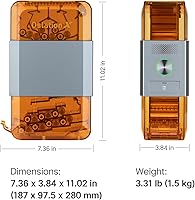
  • Dimensions: The unit measures 11.02 x 7.36 x 3.84 inches (280 x 187 x 97.5 mm), making it a large desktop device.
  • Weight: The charger weighs 3.31 lb (1.5 kg) without batteries installed.
  • Body Materials: The chassis is constructed from PC (polycarbonate) and ABS plastic.
  • Control Method: Operated via a physical button on the unit and through the companion smartphone app for full feature access.
  • Bad Cell Detection: Each slot independently and automatically identifies degraded or non-functional batteries and flags them without user intervention.
  • Polarity Detection: Batteries can be inserted in any orientation; the station detects polarity automatically with no manual checking required.
  • App Features: The companion app provides real-time charge progress, per-cell health scores, fast charge mode activation, and fault alerts.
  • Patents: The product is backed by 16 patents covering its detection, charging, and management technologies.
  • Cycle Testing: The design was validated through more than 10,000 charging cycle tests during development.
  • Package Contents: Box includes one Ostation X charging station, one USB-C to USB-C cable, and one printed user manual.
  • Batteries Included: No AA NiMH batteries are included; they must be purchased separately.

Related Reviews
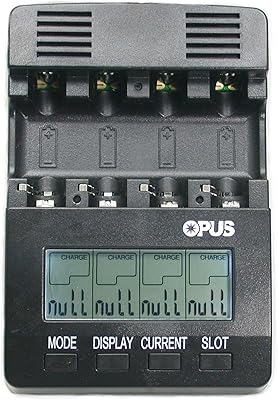
Opus BT-C2400 Battery Charger Analyzer
77%
91%
Measurement Accuracy
88%
Internal Resistance Testing
93%
Channel Independence
54%
Charging Speed
83%
Refresh Mode Effectiveness
More
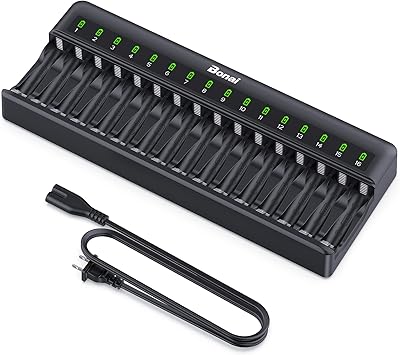
BONAI MY-C006 16-Bay AA/AAA Battery Charger
81%
93%
Slot Flexibility
88%
LED Indicator Clarity
91%
Charging Capacity
61%
Charge Speed
67%
Build Quality
More
EBL 16-Bay AA AAA Battery Charger
79%
91%
Charging Speed
93%
Slot Independence
78%
LCD Display Clarity
62%
Heat Management
88%
Safety Features
More
POWXS MKTBA 12-Bay Battery Charger
81%
88%
Charging Speed
93%
Slot Capacity
86%
Battery Compatibility
81%
LCD Display Clarity
89%
Safety Features
More
MiBOXER C8 8-Bay Battery Charger
82%
88%
Charging Performance
91%
Battery Compatibility
93%
LCD Display Clarity
86%
Internal Resistance Measurement
89%
Safety Features
More
XTAR VC2SL Battery Charger
84%
85%
Charging Performance
88%
Ease of Use
80%
Build Quality
90%
Portability
92%
Battery Compatibility
More
XTAR VC4SL 4-Bay Battery Charger
82%
88%
Charging Accuracy
91%
LCD Display Quality
93%
Battery Compatibility
84%
Grade Mode Usefulness
82%
Build Quality
More
Koshore Universal Rechargeable Battery Charger
72%
88%
Format Versatility
83%
LCD Display Clarity
61%
Build Quality
69%
Charging Speed
78%
Discharge Function
More
Nitecore Digicharger D4 4-Bay Battery Charger
75%
93%
Independent Slot Performance
88%
LCD Display Clarity
91%
Battery Compatibility
86%
Build Quality
89%
Safety Features
More
Tenergy TN299 Universal Battery Charger
87%
87%
Charging Performance
91%
Ease of Use
85%
Display Clarity
90%
Portability
92%
Versatility (Battery Types)
More

FAQ

No — the Olight Ostation X AA NiMH Battery Charger is designed exclusively for AA NiMH cells. It will not accept any other size or chemistry, so if your setup relies on AAA or lithium-ion batteries, you will need a separate charger for those.

You can charge batteries without the app using the standard mode, but the app is not truly optional if you want the full experience. Fast charging mode, per-cell health data, and fault alerts are all app-dependent, so skipping it means leaving a significant portion of the station's value unused.

Nothing bad — that is the point. The Ostation X automatically detects polarity, so it does not matter which end goes in first. You can load all 32 slots quickly without inspecting each battery's orientation.

Each slot monitors the cell inserted into it independently. If a battery is too degraded to hold a meaningful charge or is otherwise faulty, the station flags it automatically through the app and on the unit itself. You do not have to manually test anything.

You can charge any number of batteries you like — even just one. The station handles each slot independently, so partially filling it is completely normal and has no effect on charging performance.

It is genuinely large — over 11 inches long and nearly 4 inches tall. It will fit on most desks, but it does claim a noticeable amount of space. Think of it as a dedicated appliance that earns a permanent spot, not something you pull out occasionally.

The box includes a USB-C to USB-C cable, but you will need a USB-C PD power adapter to actually run the unit. Most modern laptop chargers and higher-wattage USB-C adapters are compatible, but one is not included, so check what you have on hand before setup.

Early user feedback on the app is generally positive, with most buyers finding the interface clear and responsive. A handful of reviewers have reported occasional Bluetooth connectivity drops, but these appear to be intermittent rather than a widespread issue. Given the product is still relatively new, app updates are likely to continue improving stability.

Batteries are not included. The package contains only the charging station, a USB-C to USB-C cable, and a user manual, so you will need to source your AA NiMH cells separately.

It is a fair concern. The Ostation X launched in early 2025 and has around 118 ratings so far, which is a reasonable but still limited sample. The 10,000-cycle testing and 16-patent backing suggest the engineering is serious, but real-world long-term durability data over multiple years simply does not exist yet. If you prefer buying products with an established multi-year track record, it is worth noting that patience here may eventually pay off.

Where to Buy