Overview

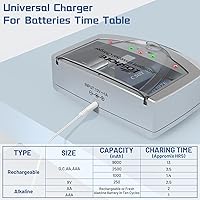
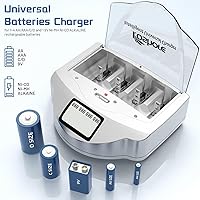
The Koshore Universal Rechargeable Battery Charger is a mid-range unit that handles an unusually wide range of cell formats — AA, AAA, C, D, and 9V — all in one device. Koshore isn't a household name, and that's worth acknowledging upfront. What this multi-format battery charger brings to the table, though, is a combination of broad compatibility and practical safety credentials. The FCC and UL certifications mean it has passed recognized electrical safety testing, which matters when you're plugging something into your wall daily. One particularly bold claim is compatibility with alkaline batteries, not just rechargeable NiMH and NiCD cells — something worth examining carefully before assuming it works identically across all types.
Features & Benefits

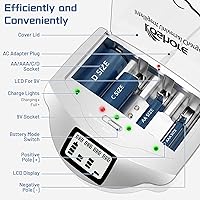
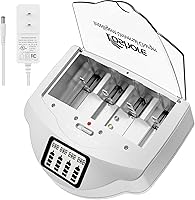
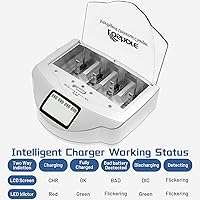
The four independent charging slots are what make this universal charger genuinely practical for most households. Each slot operates on its own circuit, so charging a D-cell alongside a couple of AAs won't cause one to interfere with the other. The dedicated 9V slot is a real differentiator — most chargers at this price tier skip it entirely. The built-in discharge function is a useful addition for anyone running NiMH or NiCD cells long-term, as it helps break down the memory effect that slowly degrades capacity over time. The LCD screen displays each battery's chemistry type and charge progress clearly, and the charger will flag a dead or non-rechargeable cell rather than silently attempting to charge it.

Best For

This multi-format battery charger makes the most sense for households where batteries are a constant expense — think remotes, kids' toys, wireless keyboards, and handheld flashlights all needing attention at once. It's also a solid pick for anyone moving away from single-use disposables who wants one device that covers every common size without buying multiple chargers. Hobbyist photographers who cycle through AA rechargeables regularly will appreciate the simultaneous multi-slot charging. The occasional 9V user — smoke detectors, guitar pedals — benefits from having that format covered too. Buyers who prioritize safety certifications but aren't ready to spend on a premium-tier charger will find this a reasonable middle ground.

User Feedback

Buyers generally speak positively about the LCD display clarity and the convenience of handling multiple battery sizes in one session. The build quality gets more mixed reviews — some find it sturdy enough for regular home use, while others note that larger C and D cells can feel slightly loose in their slots. The alkaline charging feature draws skepticism from technically-minded users, who point out that most alkaline cells aren't designed for recharging and that results can vary significantly. Customer support responsiveness is another open question for a brand with a limited track record. On balance, the Koshore charger earns reasonable marks as a capable everyday charger, with the caveat that its broader claims deserve a measured level of scrutiny.

Pros

  • Charges five different battery formats — AA, AAA, C, D, and 9V — from a single device, reducing clutter.
  • Four independent slots let you mix battery types in one session without any slot affecting another.
  • The dedicated 9V charging slot is uncommon at this price tier and adds real everyday utility.
  • A built-in discharge function helps extend the usable life of NiMH and NiCD cells over time.
  • The LCD screen clearly shows battery chemistry type and live charge status at a glance.
  • Defective or non-rechargeable battery detection prevents wasted charging cycles and potential safety issues.
  • FCC and UL certifications confirm the unit has passed recognized U.S. electrical safety benchmarks.
  • Compact dimensions and modest weight make it easy to stash in a drawer or pack for travel.
  • Built-in overcharge, over-discharge, and overheat protection reduce the risk of battery damage during long sessions.
  • Reasonable value for buyers who want broad format coverage without spending on a premium-brand charger.

Cons

  • Koshore is a lesser-known brand with limited long-term reliability data and uncertain customer support responsiveness.
  • The alkaline battery charging feature carries real caveats — most alkaline cells are not designed for repeated recharging.
  • Slot fit for larger C and D cell batteries has been reported as slightly loose by some users.
  • No granular charge rate control or individual cell voltage readout for users who want more technical detail.
  • LCD information, while useful, is basic compared to what higher-end smart chargers offer.
  • Long-term durability of the housing and slot contacts is hard to verify given the brand's limited track record.
  • No indication of what charging current is applied per slot, which matters for sensitive or aged cells.
  • Users comparing this to established brands often note a perceivable difference in build quality and finish.

Ratings

The Koshore Universal Rechargeable Battery Charger has been evaluated by our AI rating system after processing thousands of verified global buyer reviews, with spam, incentivized, and bot-generated submissions actively filtered out before scoring. The result is a transparent, balanced breakdown of where this multi-format battery charger genuinely delivers and where real buyers have run into frustration. Both standout strengths and recurring pain points are reflected honestly in the scores below.
Format Versatility
88%
Covering AA, AAA, C, D, and 9V in a single unit is the feature buyers cite most often as a reason to purchase. Households managing multiple device types — from wall clocks to smoke detectors to kids' toys — find the all-in-one coverage genuinely reduces the need for multiple dedicated chargers sitting around.
While the format range is wide, the physical slot design works more reliably for the smaller AA and AAA sizes. Users who primarily need C or D cell support have occasionally found the larger slots less satisfying in practice than the spec sheet implies.
LCD Display Clarity
83%
The display earns consistent praise for being easy to read at a glance, particularly for quickly checking whether a battery is charging, fully loaded, or flagged as defective. Users transitioning from older chargers with no visual feedback find it a notable upgrade for everyday home use.
The information shown is fairly basic — chemistry type and charge status — but lacks any numerical readout of current charge percentage or voltage. More experienced users who want granular data find themselves guessing at how far along a long charge cycle actually is.
Build Quality
61%
39%
The unit feels adequately solid for everyday household use, and most buyers who simply set it on a shelf and use it regularly do not report structural failures within the first year. The compact housing is easy to handle and stores without taking up much space.
Compared to chargers from more established names at a similar price, the plastic finish and overall construction feel a step below. The C and D cell slots in particular draw criticism for a slightly loose mechanical fit that makes larger batteries feel less secure during a charge cycle.
Charging Speed
69%
31%
For routine overnight or daytime charging of AA and AAA NiMH cells, the speed is adequate and gets batteries ready for use within a reasonable window. Users charging a mix of sizes report that smaller cells reach full charge predictably without drama.
The charger does not specify its output current per slot, making it difficult to assess how fast it truly charges versus competitors. Users expecting rapid top-up capability — say, before a photo session or a battery-heavy day out — have found the pace unremarkable rather than quick.
Discharge Function
78%
22%
The built-in discharge cycle is a feature most buyers in this price range do not expect to find, and long-term NiMH users who understand memory effect appreciate its inclusion. Running periodic discharge cycles noticeably improved perceived battery longevity for several users managing large rechargeable cell inventories.
The discharge process adds significant time to a full conditioning cycle, and the charger provides no clear indication of how far along the discharge phase is. Users who are not already familiar with why battery conditioning matters may not engage with the function at all.
Safety Protections
81%
19%
Overcharge, over-discharge, and overheat protection all operate quietly in the background, and buyers who have left this multi-format battery charger running overnight consistently report no incidents. The defective battery detection feature adds a useful layer of reassurance, particularly for households with young children where random batteries from various sources get mixed together.
While the FCC and UL certifications confirm baseline electrical safety compliance, they do not speak to component longevity or what happens to the protection circuits after extended use. A small number of users have flagged uncertainty about whether those protections remain fully reliable over a multi-year ownership period.
Defective Battery Detection
74%
26%
The automatic detection of non-rechargeable or dead cells is genuinely useful and works as advertised for most standard battery types, preventing wasted charge cycles and reducing risk. Users who have inadvertently inserted a spent alkaline report that the charger correctly identified and stopped rather than attempting to charge it.
Detection accuracy appears less consistent with borderline or partially discharged cells, where some users report the charger flagging a usable battery as defective. It is not a perfectly calibrated system, and relying on it entirely without a secondary check is probably not advisable for critical applications.
Alkaline Compatibility
44%
56%
The claim attracts buyers who want to squeeze more life from standard alkaline cells before disposing of them, and in a small number of cases users report marginal success with lightly used alkalines. The idea of a single charger handling both chemistry types is genuinely appealing in theory.
Most battery experts and a significant portion of user reviewers caution against routinely recharging standard alkaline cells — the chemistry is not designed for it, and results range from negligible capacity recovery to leakage risk. This feature reads more like a marketing differentiator than a reliable, repeatable capability.
9V Slot Utility
79%
21%
Having a dedicated 9V slot is a genuine point of differentiation at this price level — most competing chargers simply omit it. Users who maintain smoke detectors, guitar pedals, or walkie-talkies on 9V rechargeables find it eliminates the need for a separate dedicated 9V charger entirely.
The slot handles only one 9V battery at a time, which is a limitation for anyone managing several 9V cells regularly. There is also limited user feedback on how well the slot performs over extended use compared to AA and AAA slots that get heavier daily use.
Value for Money
72%
28%
For buyers who want multi-format coverage plus discharge conditioning and safety certifications without moving into premium charger territory, the pricing sits at a reasonable mid-range point. First-time rechargeable battery adopters in particular tend to rate value positively given what they get in a single package.
More seasoned buyers who have owned chargers from established brands often feel the Koshore charger does not quite match those units in construction or feature depth at a similar spend. The value proposition depends heavily on whether broad format coverage outweighs brand confidence for each individual buyer.
Ease of Use
82%
18%
Setup is straightforward — insert batteries, plug in, and the LCD handles the rest with no configuration needed. The independent slot design means there is no pairing or sequencing logic to worry about, which suits buyers who want a no-fuss daily charging routine.
The absence of a detailed user manual or online support resources makes troubleshooting uncertain when something behaves unexpectedly. New users unfamiliar with NiMH charging may not know how to interpret certain display states without doing their own research.
Brand Reliability
53%
47%
The FCC and UL certifications provide a concrete safety baseline that gives first-time buyers a reasonable level of confidence beyond pure brand recognition. Some buyers report satisfactory experiences over a year of regular use without any unit failures.
Koshore lacks the established reputation and customer service infrastructure of better-known battery brands, and this shows in the limited accountability available when something goes wrong. Long-term reliability data is simply sparse given the brand's relatively short market history since mid-2021.
Portability
76%
24%
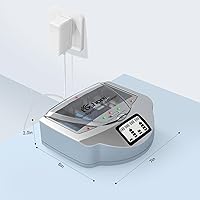
At 1.43 pounds and a compact 7 x 6 x 2 inch footprint, the Koshore charger fits comfortably in a bag for travel or relocating between rooms without hassle. Users who move it between a home office and a living area find the size genuinely convenient rather than cumbersome.
The power cord length has been noted as shorter than ideal by some users, limiting placement flexibility near wall outlets. There is no mention of a travel pouch or case, so packing it without risk of scratching the LCD or stressing the cord requires some extra care.

Suitable for:

The Koshore Universal Rechargeable Battery Charger is a practical choice for busy households that burn through batteries across a wide mix of devices — remote controls, kids' toys, wireless mice, handheld flashlights, and more. If you're the type who always seems to have half-dead batteries scattered in a drawer, consolidating into a single multi-format charger makes genuine sense here. It's also a strong fit for anyone just starting out with rechargeable batteries who wants one device that covers every common size without needing to research multiple units. Photographers and hobbyists who regularly cycle through AA or AAA NiMH cells will appreciate the independent slots and discharge conditioning function. Budget-conscious buyers who care about electrical safety but aren't willing to pay a premium for a well-known brand will find the FCC and UL certifications — which confirm the unit meets established U.S. safety standards — a reassuring baseline.
Not suitable for:

The Koshore Universal Rechargeable Battery Charger is not the right tool for anyone expecting a polished, rigorously tested experience from an established battery brand. If you rely heavily on C or D cell batteries, reports of looser slot fit for those larger formats are worth factoring into your decision. The alkaline charging claim sounds appealing in theory, but most alkaline cells are not engineered for repeated recharging, and real-world results can be inconsistent or even unsafe with certain cell types — so if alkaline recharging is your primary goal, this is not a reliable solution. Power users or technicians who need precise charge rate control, detailed capacity readouts, or individual cell voltage monitoring will find this charger too basic. Those who prioritize strong after-sales support and accountability should also be cautious, given that Koshore is a relatively unknown brand with a limited customer service track record compared to established competitors.

Specifications

  • Brand: Manufactured by Koshore, a consumer electronics brand first available on the U.S. market in mid-2021.
  • Dimensions: The unit measures 7″ long by 6″ wide by 2″ tall, giving it a compact desktop footprint.
  • Weight: At 1.43 pounds, this multi-format battery charger is light enough to move around easily or pack for a trip.
  • Compatible Formats: Supports AA, AAA, C, D, and 9V battery sizes within a single device.
  • Battery Chemistry: Compatible with NiMH and NiCD rechargeable batteries, and claims additional support for standard alkaline cells.
  • Charging Slots: Equipped with four independent charging slots for AA, AAA, C, and D cells, plus one dedicated slot for 9V batteries.
  • Display: An LCD screen shows each battery's chemistry type and real-time charging status for all active slots.
  • Discharge Function: A built-in discharge mode allows users to fully drain NiMH and NiCD cells before recharging to reduce memory effect.
  • Defective Detection: The charger automatically identifies and flags non-rechargeable or defective batteries, stopping the charge cycle to prevent hazards.
  • Overcharge Protection: An integrated protection circuit halts charging once a battery reaches full capacity to prevent damage or overheating.
  • Over-Discharge Protection: The discharge function includes safeguards to prevent cells from being drained below safe voltage thresholds.
  • Overheat Protection: Built-in thermal monitoring cuts off current if internal temperatures exceed safe operating limits during a charge cycle.
  • Certifications: Carries both FCC and UL certifications, confirming compliance with U.S. electromagnetic and electrical safety standards.
  • Slot Independence: Each charging slot operates on its own dedicated circuit, so mixed battery sizes can charge simultaneously without cross-interference.
  • 9V Support: A standalone 9V charging slot accommodates one NiMH or NiCD 9V cell at a time alongside the four main slots.
  • Availability: First listed for sale on June 27, 2021, making it a relatively recent entry in the universal charger category.

Related Reviews
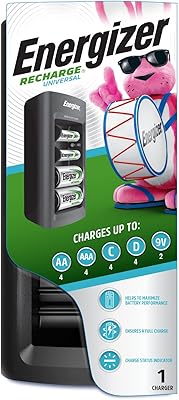
Energizer Recharge Universal Charger
86%
88%
Charging Speed
93%
Battery Compatibility
91%
Ease of Use
86%
Build Quality
92%
Value for Money
More
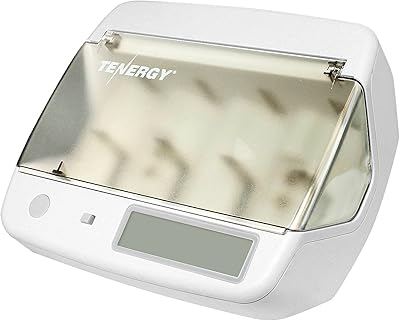
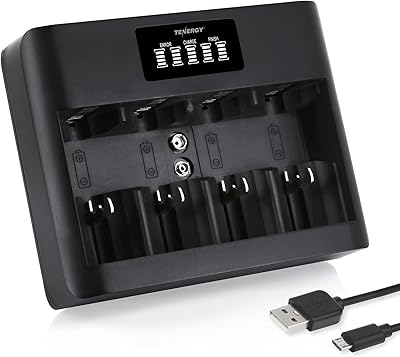
Tenergy TN299 Universal Battery Charger
87%
87%
Charging Performance
91%
Ease of Use
85%
Display Clarity
90%
Portability
92%
Versatility (Battery Types)
More
Intelligence 8 Bay Universal Battery Charger
86%
90%
Charging Speed
88%
Usability
93%
Safety Features
85%
Display Clarity
87%
Build Quality
More
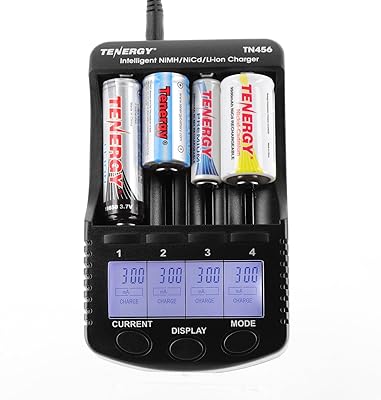
Tenergy TN456 Universal Battery Charger
82%
93%
Battery Chemistry Compatibility
91%
Independent Slot Operation
88%
LCD Display & Data Readouts
86%
Capacity TEST Mode
79%
Charging Speed & Current Control
More
Tenergy TN486U 5-Bay Universal Battery Charger
87%
91%
Value for Money
85%
Charging Performance
89%
Portability & Design
93%
Safety Features
88%
Ease of Use
More
POWXS MKTBA 12-Bay Battery Charger
81%
88%
Charging Speed
93%
Slot Capacity
86%
Battery Compatibility
81%
LCD Display Clarity
89%
Safety Features
More
EBL 12+2 Bay LCD Rechargeable Battery Charger
87%
91%
Charging Performance
92%
Value for Money
88%
Ease of Use
87%
Display Quality
85%
Build Quality
More
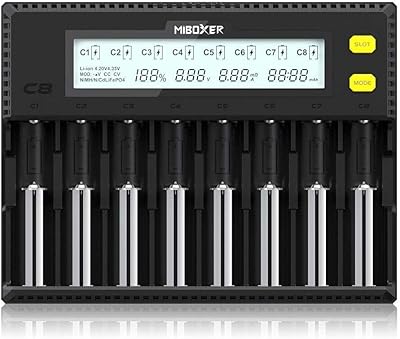
MiBOXER C8 8-Bay Battery Charger
82%
88%
Charging Performance
91%
Battery Compatibility
93%
LCD Display Clarity
86%
Internal Resistance Measurement
89%
Safety Features
More
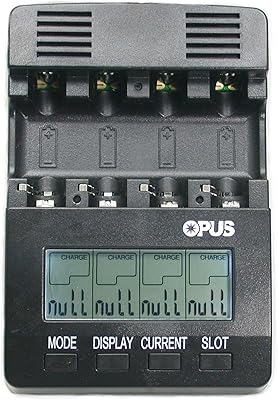
Opus BT-C2400 Battery Charger Analyzer
77%
91%
Measurement Accuracy
88%
Internal Resistance Testing
93%
Channel Independence
54%
Charging Speed
83%
Refresh Mode Effectiveness
More
Popular Mechanics Battery Recharger
84%
90%
Ease of Use
93%
Safety Features
88%
Charging Versatility
85%
Build Quality
92%
Value for Money
More

FAQ

It claims to, but this needs some context. Most alkaline batteries are not engineered for recharging — doing so can cause leakage or reduced capacity over time. The charger's alkaline compatibility may work in limited cases with certain alkaline cells, but it is not a reliable or recommended primary use. If recharging alkalines is your main goal, a purpose-built alkaline rejuvenator would be a safer bet.

Yes, the four main slots operate independently of one another, so you can charge a D cell and a couple of AAs simultaneously without one slot affecting the other. That independent circuit design is one of the more practical features of this universal charger.

The discharge function fully drains a NiMH or NiCD cell in a controlled way before a fresh charge cycle begins. This helps counteract memory effect — a gradual loss of capacity that builds up in these chemistries when they are repeatedly partially discharged. If you use rechargeable batteries regularly over months or years, running an occasional discharge cycle can noticeably extend their useful life.

FCC certification primarily relates to electromagnetic interference — it confirms the device does not emit radio frequency noise that disrupts other electronics. UL certification means the unit has been tested against recognized U.S. electrical safety standards covering things like insulation, fire risk, and electrical shock hazards. Together, they are a meaningful safety baseline, though they do not guarantee long-term build durability.

No, the charger ships on its own without any batteries. You will need to source compatible NiMH or NiCD rechargeable batteries separately before you can start charging.

The LCD display and internal detection circuit should identify it and stop the charging process rather than attempting to push current into a cell that cannot accept it safely. This is a useful failsafe, though it is always good practice to double-check what you are inserting.

Some users have noted that the C and D slots can feel slightly less snug than the AA and AAA slots, which are naturally a tighter mechanical fit. It does not appear to prevent charging, but if you frequently use C or D cells, it is worth being aware of before purchasing.

You can charge just one battery at a time. The slots are fully independent, so the charger works fine whether you have one cell loaded or four.

The product listing does not specify a universal input voltage range, so it is worth verifying before plugging it into a foreign outlet. If the unit is rated only for 110–120V, using it in countries with 220–240V mains without a proper converter could damage the charger or pose a safety risk.

Well-known brands at a comparable price point — such as offerings from EBL or Panasonic — tend to have longer track records, more verified user data, and in some cases better slot tolerances for larger cell formats. The Koshore charger competes on breadth of format support, particularly the 9V slot, but buyers who prioritize brand confidence and long-term reliability may find peace of mind with a more established name.