Overview

The EBL 16-Bay AA AAA Battery Charger is built for people who measure their battery usage in bulk — think households running a dozen wireless devices, photographers burning through flash cells on a shoot, or hobbyists keeping fleets of gadgets alive. One thing worth establishing early: this NiMH charging station works exclusively with NiMH AA and AAA cells. Lithium-ion or alkaline batteries are out entirely, so if that describes your situation, look elsewhere. For everyone else, the standout design choice is the 16 independent charging slots, each operating on its own circuit, paired with a fast-charge system that can top off a full load in as little as a couple of hours.
Features & Benefits

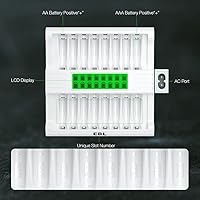
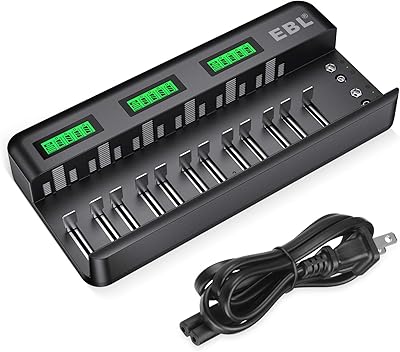
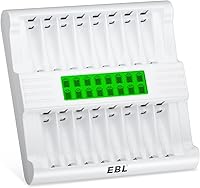
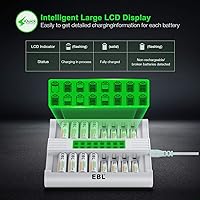
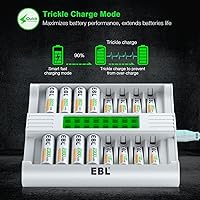
The most practical aspect of this 16-bay charger is that each slot functions completely independently — charge one battery or all sixteen, in any mix of AA and AAA, without the paired-slot hassle common on cheaper units. A dedicated LCD readout for each bay shows real-time charge status and, usefully, flags cells that are dead or non-rechargeable before they waste a full cycle. The fast-charge system pushes up to 2000mA per slot, meaning most standard AA cells reach capacity within a few hours rather than overnight. Once a cell is full, the unit drops into trickle maintenance mode automatically. The 100-240V universal input means the included cable is the only accessory you need, anywhere in the world.

Best For

This NiMH charging station makes the most sense for people who go through batteries at a pace where singles and pairs just don't cut it anymore. Parents juggling kids' toys, remotes, and gaming controllers all running simultaneously will immediately appreciate having sixteen slots ready at once. Wildlife and travel photographers who rely on flash units or GPS trackers benefit from refreshing a full set before a session rather than mid-shoot. The universal voltage input also makes it a smart companion for international travel — just pack the cable and go. Even light workshop or small-business environments where radios, meters, and handheld tools all need rechargeable cells will find the EBL charger a practical, no-fuss fit.

User Feedback

Across a substantial pool of buyer reviews, the EBL charger holds a strong 4.4-star average, and the praise is consistent: users call out charge speed and LCD clarity as standout strengths. The ability to charge odd numbers of batteries — say, three or seven — without leaving slots wasted is a recurring point of genuine appreciation. That said, the criticism worth taking seriously centers on two things: the unit runs noticeably warm under a full sixteen-cell load, which a handful of reviewers flag; and for anyone who only charges a few batteries at a time, the physical footprint feels oversized for the task. A few users also note the LCD washes out slightly in direct bright light.

Pros

  • All 16 slots operate independently, so you can charge any number of batteries in any mix without pairing restrictions.
  • Fast-charge technology means most cells are ready in a couple of hours rather than sitting overnight.
  • Each bay has its own LCD readout, making it easy to spot a dead or non-rechargeable cell at a glance.
  • Automatic trickle maintenance mode kicks in after a full charge, helping extend the lifespan of your NiMH cells.
  • Universal voltage input means the EBL charger works internationally with just a plug adapter — no converter needed.
  • Comprehensive built-in safety protection covers overcharging, overheating, short-circuits, and reverse-polarity insertion.
  • Handles both AA and AAA cells in any combination across all 16 bays from a single device.
  • No setup or pairing required — insert batteries and charging begins automatically.
  • Arrives with an AC cable included, removing the need to source a separate wall adapter.
  • Steady 4.4-star consensus across a large reviewer base reflects reliable real-world performance, not just out-of-box impressions.

Cons

  • The unit runs noticeably warm during full 16-bay loads, which may concern users placing it on wood surfaces or enclosed shelves.
  • The LCD display washes out in bright ambient light, making individual slot statuses harder to read without shading the unit.
  • Physical footprint is substantial — this is not a charger you slot into a tight drawer or carry casually in a bag.
  • No slot prioritization means you cannot speed up a single battery while others charge alongside it.
  • Occasional misidentification of healthy cells as defective requires removing and reinserting the battery to reset.
  • The included AC cable is shorter than ideal, often forcing users to rely on an extension cord for flexible placement.
  • No conditioning or deep-refresh cycle for heavily discharged cells that may benefit from a recovery charge.
  • Contact wear has been noted by some long-term users after months of heavy daily cycling.
  • Charge time for high-capacity cells trends toward the longer end of the published window, not the faster end.
  • Buyers who rarely need more than a handful of batteries at once are paying for capacity they may almost never use.

Ratings

The EBL 16-Bay AA AAA Battery Charger earns a well-rounded profile across more than 850 verified global purchases, and the scores below reflect an AI-assisted analysis that actively filtered out incentivized and bot-generated reviews to surface what real buyers actually experienced. Strengths around charging speed and slot flexibility come through clearly, but so do recurring friction points around heat output and physical bulk — both are accounted for honestly in every category below.
Charging Speed
91%
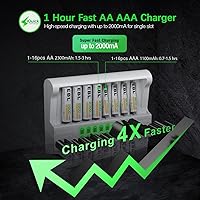
For households running low on charged cells before a road trip or game night, the fast-charge system is a genuine relief — most standard AA cells are ready well within a few hours rather than the next morning. Buyers who switched from slower 4-bay units consistently describe the time savings as the single biggest upgrade.
The fastest charge times apply to lower-capacity cells; larger 2500mAh or 2700mAh AAs push toward the longer end of the charge window. A small number of reviewers also noted that charge times crept up slightly after months of heavy daily use.
Slot Independence
93%
The ability to drop in any number of batteries — one, seven, thirteen, whatever you have — without needing to fill pairs or groups is something buyers mention again and again as a practical differentiator. Photographers refreshing a partial set of flash batteries between shoots find this especially valuable.
There is no priority charging option, so all occupied slots share the same per-bay current ceiling. If you need one specific battery fast while others charge alongside it, there is no way to allocate more power to that single slot.
LCD Display Clarity
78%
22%
Having a dedicated readout for each bay — rather than a single shared display cycling through channels — lets you scan the whole unit at a glance and immediately spot any cell that is flagged as defective or non-rechargeable. Users who inherited old mixed battery collections appreciate this as an easy way to sort dead cells from healthy ones.
In bright rooms or near windows, the green LCD backlight washes out noticeably, making it harder to read individual slot statuses without shading the unit. A handful of reviewers specifically wished for a higher-contrast or brighter display option.
Heat Management
62%
38%
Under light loads — say, six to eight batteries — the EBL charger runs at a perfectly comfortable temperature and raises no concerns. The built-in thermal protection does appear to function as intended, cutting intervention before anything reaches a dangerous threshold.
Running all sixteen bays simultaneously produces noticeable warmth on the casing, enough that some users moved the unit away from enclosed shelves or wooden surfaces as a precaution. This is the most consistent complaint across long-term reviewers and is worth factoring in if you plan to use it at full capacity regularly.
Safety Features
88%
The multi-layer protection stack — covering overcharge, short-circuit, reverse polarity, and over-current scenarios — gives buyers genuine confidence, especially in homes with children who might insert batteries incorrectly. Reviewers who have owned budget chargers that damaged cells appreciate having automatic safeguards they can actually trust.
While the safety systems work, a few users noted the charger does not loudly alert when it detects a bad cell — the LCD flags it silently, which can be easy to miss if you walk away and come back later without scanning each bay.
Build Quality
74%
26%
The casing feels solid enough for daily home use, and the battery contacts hold cells snugly without wobble. Most buyers who have owned the unit for six months to a year report no structural issues with normal use.
A subset of longer-term reviewers noted that the battery contacts can show early wear after heavy cycling, occasionally requiring a firm push to seat cells properly. The plastic casing, while adequate, does not inspire the same confidence as metal-bodied competitors at higher price points.
Trickle Charge & Battery Longevity
83%
Automatically dropping to a maintenance trickle once cells are full is a meaningful feature for anyone who charges overnight or leaves batteries in the unit during the day. Several reviewers who track battery cycle health report their NiMH cells are holding capacity well after a year of regular use.
The trickle mode cannot be manually disabled, which is fine for most users but may be a minor irritation for those who prefer complete control over the charge endpoint. There is also no conditioning or refresh cycle for deeply discharged cells.
Universal Voltage Compatibility
89%
Accepting any wall voltage from 100 to 240V with no adapter needed makes this NiMH charging station genuinely plug-and-go across the US, Europe, Asia, and beyond. Travel photographers and international workers mention this as a quiet but important convenience.
The included cable uses a standard two-prong plug, so in some countries a physical plug adapter (not a voltage converter) is still required. The cable itself is functional but on the shorter side, which can limit placement options near outlets.
Physical Size & Portability
59%
41%
For users who have a dedicated drawer or shelf for charging gear, the footprint is a non-issue — it sits flat, stays put, and handles a full household battery rotation without needing to be moved. The roughly one-pound weight means it is not difficult to relocate when needed.
For occasional users or people with limited counter space, the unit simply takes up more room than a 4- or 8-bay alternative would. It is not a charger you toss in a travel bag without noticing it is there, and several reviewers wished for a more compact form factor.
Ease of Use
86%
There is no setup process, no pairing, and no app — plug it in, drop in batteries, and the charger handles everything automatically. Buyers who are not technically inclined consistently describe the experience as completely effortless.
The lack of any manual controls also means no customization — charge rate, mode selection, and slot prioritization are all fixed. Power users coming from more configurable chargers may find this limiting.
Bad Battery Detection
77%
23%
The automatic identification of non-rechargeable or dead cells before a charge cycle begins is a practical safeguard that saves time and protects healthy batteries from being stressed alongside problem cells. Users sorting through inherited or unlabeled battery collections find this feature particularly useful.
Detection accuracy is not perfect — a few reviewers reported that occasionally a healthy cell was flagged as bad, requiring removal and re-insertion to clear the error. The system also does not distinguish between different failure types, just flags a cell as unusable.
Value for Money
81%
19%
For a 16-bay independent-slot charger with a fast-charge system and per-bay LCD readouts, the asking price sits comfortably below what most comparable multi-bay units cost. Buyers who calculate the long-term savings from switching a household off disposables tend to view the investment as paying off relatively quickly.
Occasional users who only charge a handful of batteries every few weeks may find the price harder to justify against a simpler 4-bay option. If you do not need the full 16-slot capacity regularly, you are paying for headroom you may rarely use.
Cable & Power Cord Quality
66%
34%
The included AC cable removes the need to source a separate wall adapter, which is a small but genuine convenience out of the box. The connection to the unit itself is firm and does not rattle or loosen with normal plug-and-unplug use.
The cord length is modest, and several buyers noted they needed an extension cable to reach their preferred outlet placement. The cable also feels thinner than expected for a charger this size, which raised durability questions for a few long-term users.
NiMH Compatibility Range
84%
Handling both AA and AAA in any combination across all sixteen slots means one unit covers virtually every common consumer NiMH cell format. For households running a mix of AAA remotes and AA toys and flashlights simultaneously, that flexibility has real daily value.
The strict NiMH-only limitation is a hard boundary — this charger will not work with lithium, nickel-cadmium, or any other cell chemistry. Buyers who discover this after purchase tend to leave frustrated reviews, which is worth knowing before committing.

Suitable for:

The EBL 16-Bay AA AAA Battery Charger is built for anyone whose relationship with batteries goes well beyond the occasional TV remote. Large families cycling through AA cells across wireless controllers, kids' toys, flashlights, and smart home sensors will find the 16-slot independent design genuinely useful on a daily basis rather than as an occasional luxury. Photographers and outdoor enthusiasts who depend on dedicated flash units, GPS trackers, or headlamps between sessions get real value from a charger that can refresh a full working set in just a few hours. The universal voltage input also makes it a smart pick for frequent international travelers who want one reliable unit that works straight out of a bag in any country. Small workshops, maker spaces, or light commercial environments where handheld meters, radios, and portable tools all run on rechargeable cells will appreciate having enough bays to service multiple devices simultaneously without juggling charge cycles.
Not suitable for:

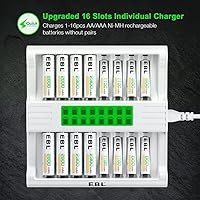
If your battery lineup includes anything other than standard NiMH AA or AAA cells, the EBL 16-Bay AA AAA Battery Charger is simply not compatible — lithium-ion, nickel-cadmium, and alkaline chemistries are all outside its scope, and no amount of workarounds will change that. Occasional users who only need to refresh four or six batteries every week or two will likely find the unit oversized for their actual needs, both physically and in terms of what they are paying for. Anyone with limited counter or shelf space should think carefully before committing, because this NiMH charging station is not compact by any reasonable measure. If you need one battery charged fast in isolation while the rest sit idle, the absence of slot prioritization means you cannot redirect power to speed up a single cell. And buyers hoping for a configurable experience — adjustable charge rates, conditioning cycles, or mode selection — will find the fully automatic, fixed-behavior design frustrating.
Specifications

  • Brand: Manufactured by EBL, a consumer electronics brand specializing in rechargeable battery solutions.
  • Model Number: This charger carries the official model designation RM78.
  • Battery Compatibility: Supports NiMH AA and AAA rechargeable cells only; lithium-ion, nickel-cadmium, and alkaline batteries are not compatible.
  • Charging Slots: Features 16 independent charging bays, each operating on its own circuit with no paired-slot requirement.
  • Charge Time: Fully charges one to sixteen batteries within approximately one to three hours depending on individual cell capacity.
  • Output Current: Delivers up to 2000mA output per slot using iQuick fast-charge technology.
  • Output Voltage: Provides a regulated 1.2V output per bay, matched to standard NiMH cell voltage.
  • AC Input: Accepts universal AC input ranging from 100V to 240V, making it compatible with wall outlets worldwide.
  • Display: Each of the 16 bays has its own dedicated LCD readout showing real-time charge status for that individual cell.
  • Safety Systems: Incorporates MCU-controlled protection against overcharging, overheating, short-circuiting, over-current, and reverse-polarity insertion.
  • Trickle Charge: Automatically switches each fully charged cell to a low-current maintenance mode to prevent overcharging and preserve battery longevity.
  • Bad Cell Detection: Intelligently identifies and flags non-rechargeable or defective cells before initiating a charge cycle.
  • Dimensions: Measures 1.2″ deep by 6.2″ wide by 6.3″ tall, providing a compact footprint relative to its 16-slot capacity.
  • Weight: Weighs approximately 1 pound, light enough to relocate easily but not intended as a portable travel accessory.
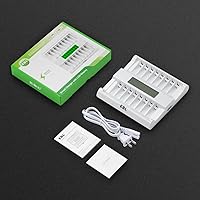
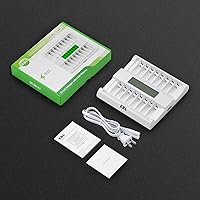
  • Included Accessories: Ships with an AC power cable; no separate wall adapter or additional accessories are required.
  • Availability Date: First made available for purchase in September 2020.

Related Reviews

BONAI MY-C006 16-Bay AA/AAA Battery Charger
81%
93%
Slot Flexibility
88%
LED Indicator Clarity
91%
Charging Capacity
61%
Charge Speed
67%
Build Quality
More
Opus BT-C2400 Battery Charger Analyzer
77%
91%
Measurement Accuracy
88%
Internal Resistance Testing
93%
Channel Independence
54%
Charging Speed
83%
Refresh Mode Effectiveness
More
POWXS MKTBA 12-Bay Battery Charger
81%
88%
Charging Speed
93%
Slot Capacity
86%
Battery Compatibility
81%
LCD Display Clarity
89%
Safety Features
More
EBL 12+2 Bay LCD Rechargeable Battery Charger
87%
91%
Charging Performance
92%
Value for Money
88%
Ease of Use
87%
Display Quality
85%
Build Quality
More
MiBOXER C8 8-Bay Battery Charger
82%
88%
Charging Performance
91%
Battery Compatibility
93%
LCD Display Clarity
86%
Internal Resistance Measurement
89%
Safety Features
More
Intelligence 8 Bay Universal Battery Charger
86%
90%
Charging Speed
88%
Usability
93%
Safety Features
85%
Display Clarity
87%
Build Quality
More
MiBOXER C4 4-Bay Battery Charger
86%
88%
Charging Performance
91%
Usability & Ergonomics
89%
Battery Compatibility
85%
Build Quality
93%
Display & Visuals
More
EBL C880 40-Slot Battery Charger
84%
88%
Charging Performance
82%
Build Quality
85%
Ease of Use
90%
Cooling Efficiency
91%
Safety Features
More
Olight Ostation X AA NiMH Battery Charger
69%
88%
Ease of Use
81%
App Integration
76%
Charging Speed
84%
Battery Detection Accuracy
73%
Build Quality
More
Tenergy TN160 12-Bay AA/AAA Battery Charger
83%
91%
Charging Reliability
58%
Battery Compatibility
83%
Per-Slot Display Clarity
86%
Refresh & Conditioning Function
88%
Build Quality & Durability
More

FAQ

You can charge any number from one to sixteen — there is no minimum. Each bay operates independently, so dropping in three or nine batteries works exactly the same as filling every slot. You will never waste a charge cycle waiting to fill the unit.

No. The EBL 16-Bay AA AAA Battery Charger is designed exclusively for NiMH rechargeable cells in AA and AAA sizes. Inserting alkaline or lithium batteries is not supported and the charger will flag them as incompatible — do not attempt it.
It depends on the capacity of your cells. Lower-capacity AAA batteries and standard AA cells typically finish in around an hour and a half to two hours. Higher-capacity AA cells, like 2500mAh or 2700mAh variants, will push toward the two-to-three-hour end of the window. Running all 16 slots simultaneously does not meaningfully slow down individual charge times.

Yes, within reason. Once a cell reaches full capacity, the charger automatically drops to a low-current trickle maintenance mode, which prevents overcharging. That said, it is generally good practice not to leave any charger running unattended on flammable surfaces, especially at full load, since the unit does run warm with all 16 bays in use.

It does generate noticeable warmth — particularly when all 16 slots are occupied. Under lighter loads it stays perfectly comfortable, but at full capacity some users have moved it off wooden desks or away from enclosed shelves out of caution. The built-in thermal protection is active and functional, so it will shut down before reaching a dangerous temperature, but the surface warmth is a real characteristic worth planning around.

Yes, the 100-240V universal input means the electronics inside handle any standard wall voltage worldwide. You will likely still need a physical plug adapter for countries with different outlet shapes, but you do not need a voltage converter. The included AC cable is all you need to get started.

Each of the 16 bays has its own dedicated readout that shows the current charge status for that individual cell — whether it is actively charging, fully charged, or flagged as defective or non-rechargeable. It is a genuinely useful feature for sorting through a mixed collection of old batteries. The one practical limitation is that the display can be hard to read in bright daylight or near a sunny window, as the green backlight is not particularly high-contrast.

The charger includes reverse-polarity protection, so inserting a cell backwards will trigger a fault flag on that bay's LCD rather than damaging the battery or the unit. Just remove it, flip it around, and reinsert — it will begin charging normally.

It measures about 6.2 inches wide and 6.3 inches tall, with a depth just over an inch. Whether it fits in a drawer really depends on the drawer, but it is not a compact unit — it is designed to sit on a shelf or counter. If you are expecting something close to the size of a 4-bay charger, this NiMH charging station will be noticeably larger.

Each bay's LCD readout will update to indicate a completed charge state for that slot. There is no audible alert, so if you walk away and come back later, you will need to glance at each bay's display to confirm. Once fully charged, the unit quietly switches to trickle maintenance mode on its own — no manual intervention required.