Overview

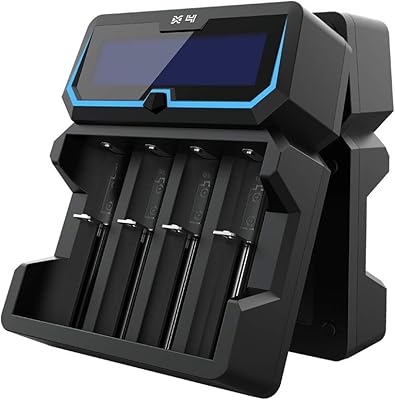
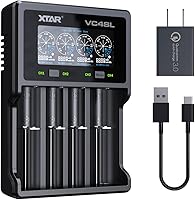
The XTAR VC4SL 4-Bay Battery Charger is a meaningful step up from its predecessor, the VC4S, adding a USB-C input port and a bundled 18W QC3.0 adapter to an already capable platform. XTAR is not a mass-market name, but among flashlight enthusiasts and battery hobbyists it carries genuine credibility. What separates this four-bay charger from cheaper alternatives is its ability to handle Li-ion and Ni-MH chemistries at the same time, applying the correct charging method to each. At its mid-range price point it competes with units from Nitecore and Opus, but it leans harder into diagnostic visibility than most rivals in the same bracket.
Features & Benefits

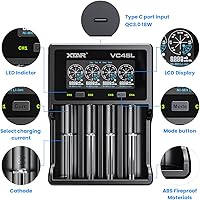
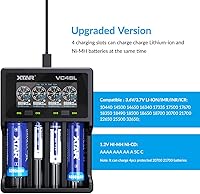
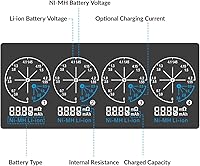
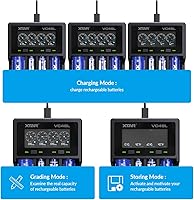
The LCD readout is where the VC4SL justifies itself beyond basic charging. Each bay independently reports voltage, current, accumulated capacity, internal resistance, and battery chemistry in real time—that internal resistance display alone is something many chargers at this price quietly omit. Five selectable currents, from a gentle 0.25A up to a brisk 3A, let you balance speed against cell longevity depending on the situation. Grade Mode is essentially a discharge-then-recharge cycle that reveals a battery's true usable capacity, which is invaluable for sorting through a mixed batch of older cells. Storage Mode is equally practical, parking a Li-ion cell at roughly 3.6V—the sweet spot for long-term preservation rather than leaving it fully charged.

Best For

This XTAR unit is built for people who treat batteries as actual gear worth managing carefully. Flashlight collectors and EDC users cycling through 18650s and 21700s will get the most from the 3A fast option and the per-slot diagnostics. Amateur radio operators and RC hobbyists who juggle AA Ni-MH packs alongside cylindrical Li-ion cells will appreciate the mixed-chemistry support working without any awkward workarounds. It also makes a strong case for anyone upgrading from a basic two-bay charger who has been charging blind, with no feedback on cell health. That said, if your battery needs are limited to a few AAs for household remotes, this four-bay charger is genuinely more hardware than the job requires.

User Feedback

With roughly 312 ratings settling at 4.4 stars, the VC4SL earns a broadly positive reception—though that sample size means a cluster of critical reviews still carries real weight. Buyers consistently highlight the accuracy of the readings and praise the sturdy construction for a charger in this price range. The bundled adapter divides opinion: casual users find it perfectly adequate, while those pushing 3A across multiple bays simultaneously report more reliable results with a higher-output dedicated supply. A recurring complaint involves slot-to-slot consistency, with a small number of buyers noting minor current variations between bays. Against alternatives like the Nitecore D4, opinions split fairly evenly—XTAR fans value the interface detail, while others prefer the competition's simpler, quicker setup.

Pros

  • Real-time LCD readout covers voltage, current, capacity, internal resistance, and chemistry for each bay independently.
  • Grade Mode gives you an objective capacity test, making it easy to cull weak cells from a mixed batch.
  • Storage Mode parks Li-ion cells at an optimal voltage, genuinely extending long-term battery health.
  • Five selectable charge currents from 0.25A to 3A let you prioritize speed or longevity depending on the cell.
  • Handles Li-ion and Ni-MH simultaneously with chemistry-appropriate charging methods applied automatically.
  • Compatible with an unusually wide range of cylindrical formats, from compact 10440 cells up to large 32650s.
  • USB-C input modernizes the connection standard compared to older micro-USB or barrel-jack competitors.
  • Solid build quality is a consistent point of praise across buyer reviews.
  • Multiple hardware protections cover the most common real-world accident scenarios reliably.
  • XTAR has a dependable reputation in the enthusiast community and backs the unit with responsive customer support.

Cons

  • The bundled 18W adapter can bottleneck performance when charging multiple bays at high current simultaneously.
  • Minor slot-to-slot current inconsistencies have been flagged by a subset of buyers, which matters for precision use.
  • The interface has a learning curve; new users may need the manual to navigate Grade and Storage modes confidently.
  • Only cylindrical cells are supported, so anyone needing to charge prismatic or pouch-style batteries is out of luck.
  • At roughly 312 ratings, the user feedback pool is still relatively small for drawing firm long-term reliability conclusions.
  • The charger adds no value for casual household users who would be better served by a much simpler, cheaper unit.
  • Pushing full 3A on a single bay while other slots are active may require an aftermarket power supply for consistent results.
  • No wireless or app connectivity for users who want remote charge monitoring capabilities.

Ratings

The scores below for the XTAR VC4SL 4-Bay Battery Charger were generated by our AI system after analyzing verified purchaser reviews worldwide, with spam, bot activity, and incentivized feedback actively filtered out. Each category reflects the honest distribution of real buyer experiences—strengths and frustrations weighted equally. Where users consistently disagreed, scores reflect that tension rather than smoothing it over.
Charging Accuracy
88%
Buyers who test their cells with reference meters consistently report that the VC4SL delivers charge within a tight tolerance of the selected current. For enthusiasts cycling expensive 21700 cells, that reliability matters—overcharging by even a small margin accelerates degradation, and this unit largely avoids that.
A minority of users detected slight current variance between individual bays, particularly at the 3A setting. It is not universal, but for those precision-testing multiple cells simultaneously, bay-to-bay inconsistency is a frustrating variable to account for.
LCD Display Quality
91%
The display is one of the most consistently praised aspects across the review pool. Being able to see internal resistance, real-time current, and accumulated capacity on a single screen—without navigating menus—is genuinely useful when managing a rotation of cells across different devices.
The LCD is functional rather than polished; viewing angles are acceptable but not wide, and in brightly lit rooms the contrast can look a little washed out. A small number of buyers wished the text were larger, especially when reading from across a workbench.
Battery Compatibility
93%
The range of supported formats is one of the broadest at this price tier—from compact 10440 cells used in small flashlights all the way up to chunky 32650s, plus standard AA and AAA Ni-MH. Users managing diverse gear rarely hit a cell type the VC4SL cannot handle.
Compatibility is limited strictly to cylindrical cells. Anyone who also needs to charge prismatic lithium packs, pouch cells, or proprietary battery formats will need a separate solution, which is a real limitation for mixed-device households.
Grade Mode Usefulness
84%
For buyers inheriting a mixed lot of used 18650s—from old laptops or flashlights—Grade Mode is a practical revelation. It runs a full discharge-recharge cycle and spits out a real capacity figure, letting you immediately sort keepers from cells that have degraded below useful thresholds.
The process is slow by design, often taking several hours per cell, which frustrates users who want quick results. A handful of reviewers also noted that repeated Grade Mode cycles on already-stressed cells seemed to accelerate rather than reveal their decline.
Build Quality
82%
18%
The housing feels solid for a charger in this segment—no creaking plastic, no flex in the bay sliders. Buyers who have owned budget chargers in the past tend to notice the difference immediately, particularly in how securely cells seat into the spring contacts.
It does not feel premium in the way that significantly pricier units do. The plastic finish attracts scratches and fingerprints quickly, and a few long-term owners reported that the bay sliders developed slightly more play after extended use.
Storage Mode Practicality
79%
21%
Users who store seasonal gear—like camping headlamps or emergency radios—appreciate having a dedicated mode that automatically brings cells to the 3.6V storage sweet spot. It removes the guesswork and is something most competing chargers in this range simply do not offer.
Casual buyers frequently overlook this feature entirely because it is not explained on the packaging. Unless you read the manual or already know about storage voltage best practices, you may never discover it exists, which limits its real-world adoption rate.
Charge Speed
76%
24%
At 3A on a single bay, the VC4SL can top up a standard 3000mAh 18650 in well under two hours, which is genuinely fast for this class of charger. Users who drain cells heavily—running high-powered flashlights or vaping devices—find that turnaround time meaningful.
Speed drops noticeably when multiple bays are active simultaneously, especially with the bundled 18W adapter near its output ceiling. Buyers who want 3A across all four slots at once will be disappointed without a higher-wattage external power supply.
Bundled Adapter Quality
63%
37%
The included QC3.0 18W adapter is a step up from the bare USB cables bundled with cheaper chargers, and for single or dual-bay everyday use it performs without complaint. Users who charge one or two cells at a time rarely find any reason to replace it.
For a charger marketed around 3A fast charging, the 18W adapter feels like a bottleneck. Several reviewers flagged that it runs warm under sustained multi-bay loads, and a portion of buyers upgraded to a higher-output supply within a few weeks of purchase.
Internal Resistance Testing
81%
19%
Having internal resistance displayed passively during every charge session means you build a picture of each cell's health over time without any extra steps. Hobbyists who label their cells and track performance find this data genuinely actionable for rotation decisions.
The readings should be treated as indicative rather than laboratory-grade. Compared to a dedicated impedance analyzer, the VC4SL figures can vary slightly depending on cell temperature and contact quality, so drawing firm conclusions from marginal differences is not advisable.
Ease of Use
72%
28%
For standard charging, the experience is straightforward—insert a cell, select a current if needed, and the charger handles the rest. New users upgrading from a basic two-bay unit generally find the core operation intuitive within the first session.
The multi-mode functionality—switching between Grade, Storage, and standard charge—requires consulting the manual, and the button behavior is not immediately obvious. A few reviewers described pressing the wrong mode accidentally and not noticing until the cycle had already begun.
Value for Money
78%
22%
Relative to the diagnostic feature set on offer—capacity testing, internal resistance display, storage mode, and multi-chemistry support—the VC4SL delivers meaningful capability per dollar compared to feature-stripped alternatives at a similar price.
Buyers who only need basic charging without the diagnostic extras may feel they are paying for features they will never use. And when you factor in that a better power adapter is often a necessary accessory purchase, the effective total cost creeps higher than the sticker suggests.
Size & Portability
83%
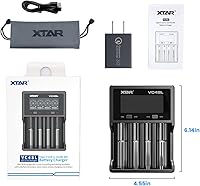
At 4.8 ounces and a compact 6.14″ x 4.54″ footprint, the unit tucks easily into a bag for travel or sits unobtrusively on a workbench. Users who move between a home setup and a field kit appreciate that it does not demand dedicated shelf space.
The four-bay layout does mean it is noticeably wider than two-bay alternatives, which can be awkward in tight spaces or power strip arrangements where socket spacing is limited. It is not a dealbreaker, but it is worth checking your setup beforehand.
Safety Protections
87%
The combination of reverse-polarity detection, short-circuit cutoff, overcharge termination, and thermal protection covers the scenarios most likely to cause damage in everyday use. Buyers coming from unprotected budget chargers report greater peace of mind leaving this unit unattended.
Protection systems have not been independently stress-tested in any publicly available third-party review, so confidence in edge-case scenarios—like a deeply damaged cell—relies primarily on XTAR's own claims and the absence of widely reported failure incidents.
USB-C Input Modernization
85%
Switching from the older connection standard to USB-C is a welcome change for users who have standardized their desks around USB-C hubs and cables. It removes the need to keep a dedicated legacy cable just for the charger, which is a small but genuinely appreciated quality-of-life improvement.
The USB-C port is input-only and does not support USB Power Delivery negotiation beyond QC3.0, so users with high-wattage PD adapters will not unlock any additional performance. It is USB-C in form but not in its fullest functional sense.

Suitable for:

The XTAR VC4SL 4-Bay Battery Charger is a strong fit for anyone who treats rechargeable cells as a serious investment rather than a disposable convenience. Flashlight enthusiasts, EDC hobbyists, and amateur radio operators who regularly cycle 18650, 21700, or mixed Ni-MH packs will find the per-slot diagnostics and selectable charge currents genuinely useful in day-to-day rotation. If you have ever wondered whether an aging cell is still worth keeping, the Grade Mode capacity test answers that question objectively rather than forcing you to guess. People stepping up from a basic two-bay charger will notice an immediate difference in the level of feedback and control available. The USB-C input and included QC3.0 adapter also make it a practical choice for anyone who prefers modern cabling standards and wants a single charger that handles both Li-ion and Ni-MH without swapping units.
Not suitable for:

The XTAR VC4SL 4-Bay Battery Charger is probably more hardware than most casual users need, and that gap becomes a real cost consideration. If your entire battery usage consists of a few AA cells for a TV remote or a wall clock, a simpler and far cheaper charger will serve you just as well without the learning curve of multiple operating modes. The bundled 18W adapter can feel limiting for those who want to push 3A across several bays simultaneously, meaning you may end up spending extra on a more capable power supply to unlock the full charging speed. Users who primarily charge proprietary battery packs for cordless tools or cameras will find the VC4SL incompatible with their needs, as it only supports cylindrical cells. Additionally, buyers who just want to drop in batteries and forget about them may find the interface and mode options more involved than they want to deal with.
Specifications

  • Brand: Manufactured by ShenZhen XTAR Electronics Co., Ltd, a brand well-regarded in the enthusiast battery community.
  • Model Number: The official model designation is XTAR VC4SL, an incremental upgrade over the earlier VC4S platform.
  • Charging Bays: Features 4 fully independent charging bays, each capable of operating at its own current and reporting its own diagnostics.
  • Chemistries: Supports Li-ion and IMR/INR/ICR cells at 3.6V/3.7V as well as Ni-MH and Ni-CD cells at 1.2V, simultaneously if needed.
  • Cell Formats: Accepts cylindrical Li-ion formats from 10440 through 32650, and Ni-MH/Ni-CD sizes from AAAA down to C.
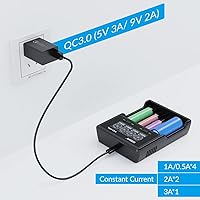
  • Charge Currents: Offers five selectable input currents per slot: 0.25A, 0.5A, 1A, 2A, and 3A, with a maximum of 3A on a single active bay.
  • Input Port: Uses a USB-C input port compatible with QC3.0 fast charging, replacing the older micro-USB connector found on prior XTAR models.
  • Included Adapter: Ships with a US Quick Charge 18W QC3.0 wall adapter, which is sufficient for standard single or dual-bay charging sessions.
  • Display: An LCD screen on each channel shows real-time voltage, charge current, accumulated capacity, internal resistance, and detected battery type.
  • Operating Modes: Provides three operating modes: standard charge, Grade Mode for capacity testing via a discharge-recharge cycle, and Storage Mode for long-term preservation voltage.
  • Protections: Built-in hardware protections cover reverse polarity insertion, short-circuit events, overcharge conditions, and thermal overheating.
  • Output Voltage: Regulated output voltage is 5V DC, applied with chemistry-appropriate charge profiles for each supported cell type.
  • Dimensions: The unit measures 6.14″ in length, 4.54″ in width, and 1.3″ in depth, keeping the footprint compact on a workbench or shelf.
  • Weight: The charger itself weighs 4.8 ounces, making it light enough to pack for travel without adding meaningful bulk.
  • Package Contents: The retail box includes the VC4SL charger, one USB-C cable, one QC3.0 18W wall adapter, and a printed user manual.
  • Warranty: XTAR provides a 24-month warranty with customer support contact available for issue resolution within 24 hours of inquiry.

Related Reviews

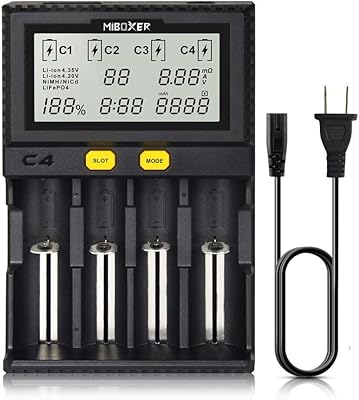
MiBOXER C4 4-Bay Battery Charger
86%
88%
Charging Performance
91%
Usability & Ergonomics
89%
Battery Compatibility
85%
Build Quality
93%
Display & Visuals
More
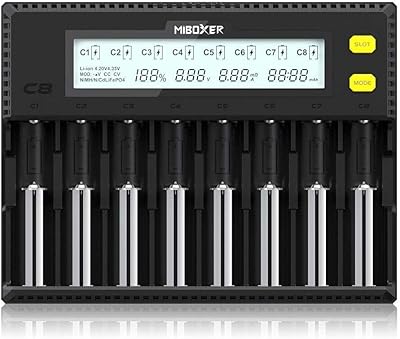
MiBOXER C8 8-Bay Battery Charger
82%
88%
Charging Performance
91%
Battery Compatibility
93%
LCD Display Clarity
86%
Internal Resistance Measurement
89%
Safety Features
More
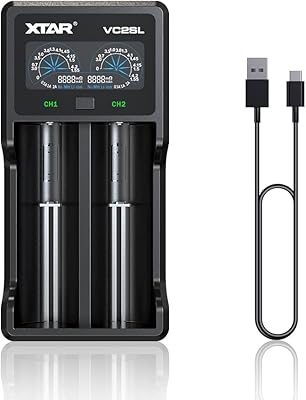
XTAR VC2SL Battery Charger
84%
85%
Charging Performance
88%
Ease of Use
80%
Build Quality
90%
Portability
92%
Battery Compatibility
More
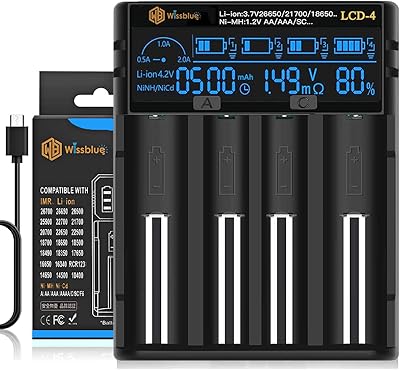
WISSBLUE LCD-4 4-Slot 18650 Battery Charger
81%
88%
LCD Display Quality
86%
Charging Speed
91%
Battery Compatibility
83%
Build Quality
67%
Capacity Reading Accuracy
More
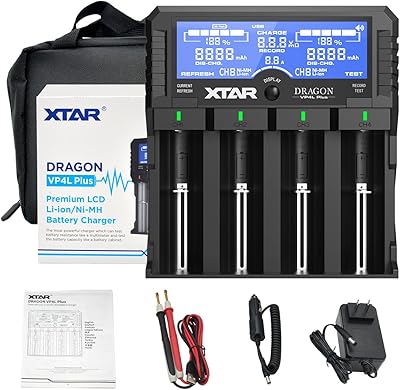
XTAR Dragon VP4L Plus Battery Charger
85%
89%
Charging Performance
90%
Battery Testing Accuracy
83%
Ease of Use
88%
Build Quality
92%
Versatility (Battery Compatibility)
More
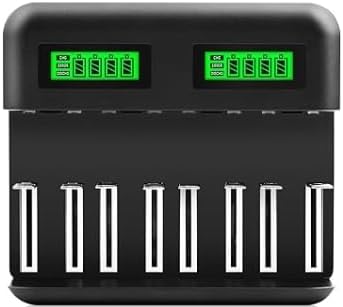
Intelligence 8 Bay Universal Battery Charger
86%
90%
Charging Speed
88%
Usability
93%
Safety Features
85%
Display Clarity
87%
Build Quality
More
Tenergy TN160 12-Bay AA/AAA Battery Charger
83%
91%
Charging Reliability
58%
Battery Compatibility
83%
Per-Slot Display Clarity
86%
Refresh & Conditioning Function
88%
Build Quality & Durability
More
Tenergy TN486U 5-Bay Universal Battery Charger
87%
91%
Value for Money
85%
Charging Performance
89%
Portability & Design
93%
Safety Features
88%
Ease of Use
More
XTAR X2 Smart 2-Slot Battery Charger
86%
92%
Charging Speed
88%
Ease of Use
76%
Portability
85%
Build Quality
94%
Compatibility with Battery Types
More
EBL 12+2 Bay LCD Rechargeable Battery Charger
87%
91%
Charging Performance
92%
Value for Money
88%
Ease of Use
87%
Display Quality
85%
Build Quality
More

FAQ

Yes, you can. The XTAR VC4SL 4-Bay Battery Charger detects the chemistry in each bay independently and applies the correct charging profile to each cell, so a Li-ion and a Ni-MH can run simultaneously without any conflict or manual switching required.
Grade Mode runs a full discharge followed by a controlled recharge cycle and reports the cell's actual usable capacity at the end. It is most useful when sorting through a batch of used or older cells to identify which ones are still healthy and which have degraded. You do not need to run it on every charge—it is best used as an occasional diagnostic tool rather than a routine step.

Storage Mode charges or discharges a Li-ion cell to approximately 3.6V, which is widely considered the safest voltage for long-term storage. Leaving a Li-ion fully charged for weeks or months accelerates capacity degradation, so if you are putting batteries away for an extended period, using this mode first is genuinely worth the extra minute.

It depends on what you are doing. For everyday charging at 1A per bay or lower, the bundled adapter handles the load without issue. If you want to push two or more bays at 2A or 3A simultaneously, a higher-output power supply will give you more consistent and reliable results. Some buyers report slightly reduced current delivery per slot when the adapter is working near its limit.

The two main changes are the addition of a USB-C input port and the inclusion of an 18W QC3.0 adapter in the box. The VC4S used a different connection standard, so if USB-C compatibility or modern fast-charge input matters to your setup, the VC4SL is the version to buy.

Yes, the VC4SL is designed to accommodate protected 21700 batteries, which are slightly longer than unprotected versions. The sliding bay contacts adjust to fit, so you should not need to force anything into place.

The internal resistance figure the VC4SL displays is useful as a relative indicator—great for spotting a cell that is significantly weaker than others in a batch. For absolute precision measurements, a dedicated battery analyzer would be more reliable, but for practical sorting and health-checking purposes, the readings are consistent enough to act on.

Yes, any USB-C adapter that supports QC3.0 will work. If you already have a higher-wattage QC3.0 or compatible USB-C PD adapter on your desk, you can skip the bundled one entirely and potentially get better sustained performance at higher charge currents.

The VC4SL works with both flat-top and button-top cylindrical cells. The spring-loaded contacts accommodate the slight height difference between the two, so you do not need to limit yourself to one type.

The charger includes overcharge protection and is designed to terminate the charge cycle automatically once a cell reaches its target voltage. Leaving batteries in after charging is complete is generally safe, though as a general habit it is better practice to remove cells once charging finishes, particularly with older or already-stressed batteries.

Where to Buy