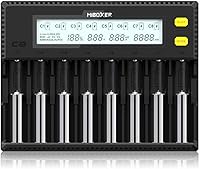
MiBOXER C8 8-Bay Battery Charger

Overview
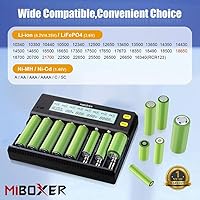
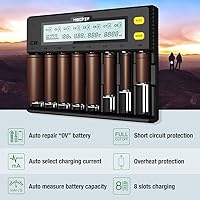
The MiBOXER C8 8-Bay Battery Charger sits in a comfortable spot between entry-level chargers and professional-grade gear — capable enough for serious hobbyists, without the complexity that intimidates casual users. This 8-bay charger handles Li-ion, LiFePO4, Ni-MH, and Ni-Cd cells across an impressive range of cylindrical formats, from compact 16340s to chunky 26650s, plus everyday AA and AAA rechargeables. Build quality feels solid for this price tier — fire-retardant housing, thoughtful circuit protection, and a feature set that signals genuine engineering investment. If you manage a drawer full of mixed cells, this is worth your attention. If you only charge AA batteries once a month, it is probably more charger than you need.
Features & Benefits
Each of the eight bays operates completely independently, which means you can slot in a 21700 beside a AA Ni-MH cell and both charge at their own rates without compromise. Per-bay current is adjustable up to 1.5A on four channels simultaneously, and the large LCD surfaces voltage, capacity, internal resistance, and elapsed charge time for every slot — genuinely useful data for anyone evaluating cell health. One critical safety note: if you are charging LiFePO4 or 4.35V Li-ion cells, you must manually select the correct chemistry. The charger defaults to 4.2V Li-ion, and getting that wrong is a real safety risk, not a minor inconvenience. A battery activation function also helps recover over-discharged cells that most chargers would simply abandon.
Best For
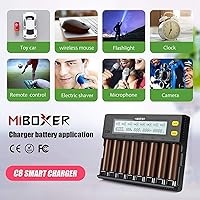
This multi-chemistry charger earns its keep in a few specific scenarios. If you collect high-drain 18650 or 21700 cells for flashlights or DIY power banks, eight independent slots with per-slot diagnostics is a real advantage. Photographers using RCR123 or 16340-powered lights will appreciate the precise voltage readout. It also works well for households running a mix of lithium and Ni-MH rechargeables — one charger, no juggling. The internal resistance display makes it practical for anyone who wants to rotate or retire cells based on actual performance data rather than guesswork. That said, if your battery needs are limited to a few AA cells for a remote, this is simply more charger than the situation calls for.
User Feedback
With over 1,500 ratings averaging 4.6 out of 5, this 8-bay charger has built a strong and credible track record. Buyers consistently praise the LCD display for its readability and the sheer volume of per-slot information it surfaces at a glance. Long-term users tend to confirm that capacity readings remain reliable over time, which reinforces trust in the unit as a diagnostic tool. The recurring criticism is the manual chemistry selection step — a handful of buyers found this confusing out of the box, and it is a legitimate learning curve worth acknowledging upfront. Some feedback also points to inconsistent support response times, though reports of actual hardware failure remain uncommon relative to the overall rating volume.
Pros
- Eight independent bays charge completely different battery types simultaneously without any cross-bay interference.
- The LCD display surfaces voltage, capacity, internal resistance, and mode per slot — genuinely actionable data at a glance.
- Battery activation function recovers over-discharged cells that most basic chargers would simply reject.
- Broad chemistry support covers Li-ion, LiFePO4, Ni-MH, and Ni-Cd in one device, reducing the need for multiple chargers.
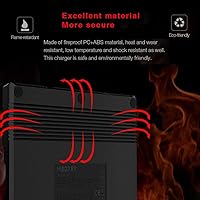
- Fire-retardant housing and visible error codes on reverse-polarity or short-circuit events add meaningful peace of mind.
- Internal resistance readings help identify aging or weak cells in a batch before they cause problems in the field.
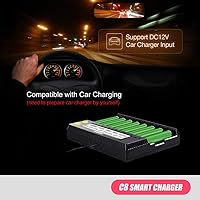
- DC 12V car adapter compatibility makes this 8-bay charger a practical option for camping, overlanding, or field photography.
- Long-term users consistently report stable and reliable capacity readings across extended ownership periods.
- Compatible with a wide range of cylindrical sizes from compact 16340s up to large 26650s, covering most real-world use cases.
Cons
- Manual chemistry selection for LiFePO4 and 4.35V Li-ion is easy to miss and carries a genuine safety risk if skipped.
- The 12V car adapter for mobile charging is not included in the box, adding an unannounced extra cost.
- Maximum 1.5A per channel means large or deeply depleted cells take several hours to fully charge.
- Manufacturer customer support response times are frequently criticized as slow and inconsistent in long-term owner feedback.
- Bay contact springs may weaken over time with heavy daily use, reducing long-term reliability for high-volume users.
- The LCD backlight dims after just one minute of inactivity, which is inconvenient when monitoring slow overnight charges.
- Internal resistance readings are useful as relative indicators but lack the precision of dedicated cell-testing instruments.
- The physical footprint is meaningfully larger than compact 4-bay alternatives, which can be a real constraint in small workspaces.
Ratings
The MiBOXER C8 8-Bay Battery Charger has been evaluated by our AI rating system after processing thousands of verified global reviews, with spam, incentivized, and bot-generated feedback actively filtered out. The scores below reflect genuine buyer experiences across real-world use cases — from flashlight hobbyists running large 18650 inventories to households juggling mixed battery chemistries. Both what this multi-chemistry charger does well and where it genuinely falls short are represented without bias.
Charging Performance
Battery Compatibility
LCD Display Clarity
Internal Resistance Measurement
Safety Features
Build Quality
Ease of Use
Charging Speed
Car Charging Support
Value for Money
Display Information Depth
Multi-Chemistry Flexibility
Physical Footprint
Customer Support
Suitable for:
The MiBOXER C8 8-Bay Battery Charger is genuinely well-matched to anyone who lives and breathes rechargeable cells as part of a hobby or professional routine. Flashlight collectors who cycle through 18650 and 21700 cells regularly will appreciate having eight independent slots running simultaneously, each reporting its own voltage and capacity data without interfering with its neighbors. Outdoor photographers relying on 16340 or RCR123-powered lighting rigs benefit from the per-slot diagnostics, which take the guesswork out of knowing exactly how charged each cell is before a shoot. Households that have accumulated a mix of Ni-MH AA rechargeables for remotes and clocks alongside lithium cells for higher-drain devices will find this 8-bay charger a practical consolidation — one unit handles both chemistries without compromise. DIY power bank builders and makers who need to grade and sort cells by internal resistance before assembly will find the built-in resistance measurement genuinely useful rather than decorative. If you want a charger that also tells you when a cell is starting to age out of usefulness, this is one of the few options at this price tier that actually delivers that capability.
Not suitable for:
The MiBOXER C8 8-Bay Battery Charger is a poor fit for anyone who just needs a simple, low-maintenance solution for a handful of AA or AAA Ni-MH batteries — the feature depth adds cost and complexity that casual users will never recoup in practical value. If you are not already comfortable with concepts like charging chemistry, termination voltage, or internal resistance, the manual chemistry selection requirement for LiFePO4 and high-voltage 4.35V Li-ion cells introduces real safety responsibility that demands attention upfront; this is not a plug-and-forget device for those cell types. Buyers expecting instant fast-charge turnaround on large depleted cells will be frustrated — at 1.5A per channel, filling a fully drained 26650 takes meaningful time, and there are faster dedicated chargers available for that specific need. Those in tight living spaces should also factor in the physical footprint: at over seven inches wide, it is noticeably larger than a 4-bay unit and does not pack away conveniently. Finally, buyers who prioritize strong manufacturer after-sales support should approach with tempered expectations, as responsiveness from the brand has been a consistent weak point in long-term user feedback.
Specifications
- Number of Bays: The charger provides 8 independent charging bays, each operating entirely separately from the others with no shared current or interference.
- Max Charge Current: Each bay supports a maximum charge current of 1.5A for Li-ion and LiFePO4 cells, with up to four bays running at full current simultaneously.
- Supported Chemistries: Compatible chemistries include Li-ion, IMR, INR, ICR, LiFePO4, Ni-MH, and Ni-Cd, covering the most common rechargeable cylindrical cell types in everyday and hobbyist use.
- Output Voltages: Output terminates at 4.2V for standard Li-ion, 4.35V for high-voltage Li-ion, 3.6V for LiFePO4, and 1.48V for Ni-MH and Ni-Cd cells.
- Compatible Sizes: Supported cylindrical formats range from compact 10340 and 16340 cells up to 26650, plus standard AA, AAA, AAAA, C, and SC Ni-MH and Ni-Cd sizes, accommodating cells up to 73mm in length.
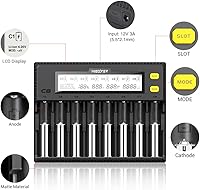
- LCD Display: The backlit LCD screen shows voltage, charge current, accumulated capacity in mAh, elapsed time, battery chemistry mode, and internal resistance individually for each occupied bay.
- Backlight Timeout: The LCD backlight automatically dims after one minute of user inactivity to reduce power draw during unattended long charging sessions.
- Input Power: The charger accepts DC 12V at 3A via a 5.5x2.1mm barrel connector, supporting both standard wall adapters and 12V car power sources for field use.
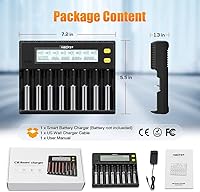
- Dimensions: The unit measures 7.2 x 5.5 x 1.3 inches, providing an 8-bay footprint that sits flat on a desk or workbench without significant vertical height.
- Weight: The charger weighs approximately 360g (around 13.4 oz) without cables, making it manageable for transport but not particularly suited to ultralight packing.
- Housing Material: The outer casing is constructed from fire-retardant PC and ABS plastic, chosen specifically for heat resistance and electrical safety during extended charging sessions.
- Safety Protection: Built-in protections include reverse-polarity detection and short-circuit interruption, with clear error codes displayed on the LCD rather than silent failures.
- Battery Activation: A dedicated activation mode can attempt to recover over-discharged cells that have dropped below normal detection thresholds, a function most basic chargers do not offer.
- Chemistry Selection: Standard Li-ion at 4.2V and Ni-MH cells are detected and selected automatically, but LiFePO4 and 4.35V high-voltage Li-ion require manual chemistry selection by the user before charging begins.
- Ni-MH Output Current: Ni-MH and Ni-Cd cells can be charged at up to 1A per bay across all eight slots simultaneously, independent of the Li-ion current configuration.
- Box Contents: The package includes the charger unit, one AC power adapter, and a printed user manual; no batteries or 12V car adapter cable are included.
- Model Number: The official model designation for this unit is C8, as listed by the manufacturer COSOOS under the MiBOXER product line.
- Internal Resistance Reading: The charger measures and displays the internal resistance of each cell in milliohms, providing a useful relative indicator of cell health and aging over time.
Related Reviews
Intelligence 8 Bay Universal Battery Charger
MiBOXER C4 4-Bay Battery Charger
ISDT N8 8-Slot AA/AAA Battery Charger
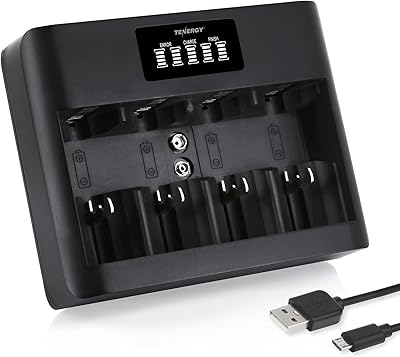
Tenergy TN486U 5-Bay Universal Battery Charger
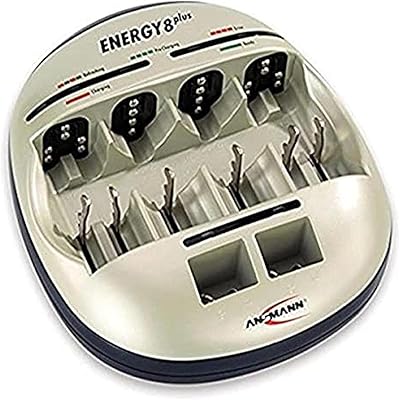
Ansmann Energy 8 Plus Battery Charger
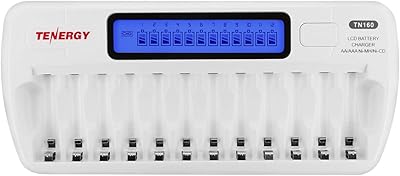
Tenergy TN160 12-Bay AA/AAA Battery Charger
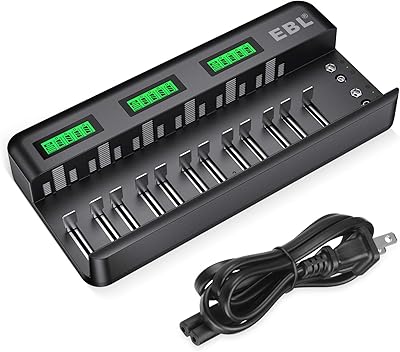
EBL 12+2 Bay LCD Rechargeable Battery Charger
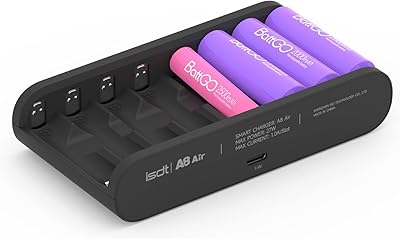
ISDT A8 Air 8-Slot Battery Charger
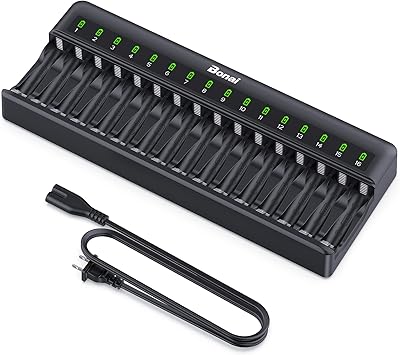
BONAI MY-C006 16-Bay AA/AAA Battery Charger