Overview

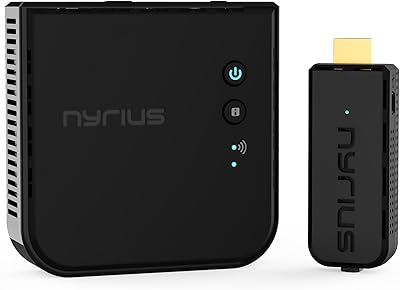
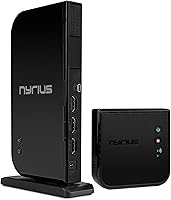
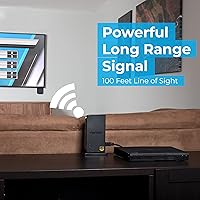
The Nyrius Aries Home+ Wireless HDMI Transmitter Receiver has been quietly solving a real household problem since 2014: how do you get video from one room to another without tearing up walls or running cables across the floor? Nyrius built their reputation specifically around wireless AV transmission, and this transmitter-receiver system reflects that focused approach. The setup is genuinely simple — plug the transmitter into your source, connect the receiver to your TV, and you're watching. No WiFi, no software installation, nothing to configure. That said, the 100ft range claim deserves some honest context: that figure assumes clear line of sight, and real-world performance through walls or floors will be noticeably shorter.
Features & Benefits

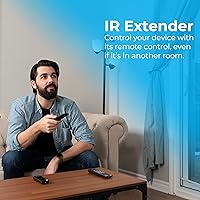
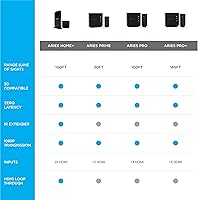
What separates the Aries Home+ from simpler one-input alternatives is its dual HDMI input setup on the transmitter — you can have a cable box and a gaming console both connected, switching between them without touching a single cable. There's also a loop-through HDMI output, meaning one source can feed both a wired TV and the wireless receiver simultaneously, a genuinely practical option for dual-room viewing. This wireless HDMI kit transmits full 1080p video over H.264 encoding, and Nyrius claims zero latency, though real-world results vary depending on distance and obstructions. The IR remote extender is a feature worth highlighting: it lets you control your source device from the receiver room, which removes the need to physically walk back to change inputs. Audio support includes 5.1 surround passthrough.

Best For

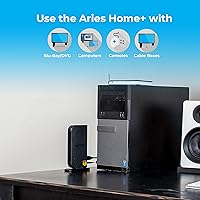
This transmitter-receiver system is a strong fit for homeowners who want to put a cable box or satellite feed on a TV in a different room — no in-wall wiring, no contractor needed. It's also well-suited to anyone building a dual-display home theater setup, where one source needs to appear on both a primary and a secondary screen at the same time. Gamers looking for low-latency wireless output for a PS4 or similar console may find this a workable option, though results will vary by environment. Small offices that need a clean, cable-free presentation display will also find it practical. One important boundary to set: this is an HDMI-native system, so it won't help users whose sources rely on USB-C or streaming apps only.

User Feedback

The Aries Home+ sits at 3.5 out of 5 stars across several hundred buyer reviews — a rating that deserves a straight reading rather than spin. On the positive side, buyers consistently praise the painless initial setup and the IR extender's reliability in open-plan layouts. Where things get complicated is range: multiple reviewers note that signal strength drops meaningfully when passing through more than one wall, particularly concrete or brick. A smaller but consistent thread raises long-term durability questions, with some units showing issues after roughly a year or more of continuous use. The warranty and customer support have drawn positive mentions. Shoppers cross-shopping with the Aries Prime should know that the Prime trades dual inputs for a lower price point — the right choice depends on how many sources you're juggling.

Pros

  • Plug-and-play setup requires no software, no WiFi, and no technical background to get running quickly.
  • Dual HDMI inputs let you keep two source devices connected and switch between them without re-cabling.
  • Loop-through output allows one source to feed both a wired display and a wireless display at the same time.
  • The IR remote extender lets you operate source devices from the receiver room without walking back to the transmitter.
  • Runs on its own dedicated frequency, so household WiFi congestion has no effect on signal stability.
  • Full 1080p video transmission keeps picture quality sharp on any modern HDTV or projector.
  • 5.1 surround sound passthrough means your audio setup does not take a hit when going wireless.
  • No router, no app, and no account required — the system is entirely self-contained and independent.
  • The one-year warranty and lifetime customer support have helped multiple buyers resolve hardware issues without hassle.

Cons

  • Real-world range through walls or concrete floors drops well below the advertised maximum distance.
  • A notable share of buyers report unit degradation or failure after 12 to 18 months of continuous use.
  • No 4K support — buyers with 4K sources and displays will need a different solution entirely.
  • Some units show wireless interference problems in environments with dense competing signals or thick obstructions.
  • The zero-latency claim is manufacturer-stated; actual latency varies with distance and wall composition.
  • No USB-C or DisplayPort compatibility means modern laptops without a native HDMI port require a separate adapter.
  • Bulkier than several competing single-input transmitters, which can be a factor when mounting options are tight.
  • The 3.5-star average across hundreds of reviews reflects a real and consistent split in buyer experience worth weighing carefully.

Ratings

Our scores for the Nyrius Aries Home+ Wireless HDMI Transmitter Receiver were generated by AI after systematically analyzing verified buyer reviews from global markets, with active filtering applied to remove spam, bot submissions, and incentivized feedback. Each category rating reflects an honest synthesis of real hands-on experiences — from multi-room home theater installations to everyday gaming setups — where neither the strengths nor the recurring frustrations have been softened. The result is a transparent scorecard that gives prospective buyers a realistic picture of where this transmitter-receiver system genuinely excels and where it falls short.
Signal Range
58%
42%
In open-plan living spaces and single-story layouts with minimal obstructions, buyers consistently report a clean, stable signal across the room. For straightforward setups where the transmitter and receiver share a clear path — think living room to kitchen or adjacent office — the wireless connection performs reliably and without dropout.
The 100ft maximum range assumes ideal, unobstructed line of sight, and real-world performance through even standard drywall is noticeably reduced. Multi-story homes with concrete floors or brick interior walls are the most problematic environments, with multiple reviewers reporting signal dropout at distances well under half the advertised maximum.
Video Quality
84%
Buyers who run this kit in well-suited environments consistently praise the sharpness and stability of the 1080p output, with no visible compression artifacts reported during cable TV viewing or Blu-ray playback. The H.264 encoding keeps the image clean across the transmission, and 3D passthrough functions correctly for those with compatible setups.
The system tops out at 1080p full HD, which is an increasingly significant limitation as 4K content and displays become the household standard. Buyers who have already invested in 4K source devices and TVs will find this wireless HDMI kit incompatible with their setup without accepting a meaningful visual downgrade.
Setup & Ease of Use
89%
The plug-and-play setup is among the most praised aspects across buyer feedback — connect the transmitter to a source, link the receiver to a TV, and the signal runs. No software, no router configuration, no technical expertise required. Buyers who dread complex AV installations specifically highlight how quickly and painlessly the initial setup completes.
A small number of buyers report that specific source and display combinations occasionally require a power cycle to establish the connection on first use. Optimizing unit placement for best signal — particularly in homes with structural obstacles — requires trial and error that the included documentation does not adequately address.
Latency Performance
71%
29%
In close-range setups with clear sight lines, most casual gamers and media viewers report the transmission feels instant with no perceptible delay during PS4 gameplay or cable TV channel changes. The dedicated wireless frequency keeps the signal path independent of home network traffic, which helps maintain consistent timing in favorable conditions.
The zero-latency claim is manufacturer-stated and not independently verified, and a portion of buyers — particularly those operating at longer distances or through walls — report measurable lag that proves distracting during gameplay. Buyers with high sensitivity to input timing should treat latency performance as environment-dependent rather than guaranteed.
Value for Money
62%
38%
For buyers whose homes align well with the system's strengths — open layouts, HDMI-based sources, single-floor setups — the convenience of a plug-and-play multi-room AV solution delivers real utility that can justify the cost over professional cable installation. The dual HDMI inputs and loop-through output add practical value that cheaper single-input competitors simply lack.
At its price point, buyers reasonably expect robust through-wall performance and long-term reliability, and the Aries Home+ falls short on both counts for a meaningful number of purchasers. When the system underperforms in a real-home environment, the price-to-performance ratio becomes difficult to defend against wired or lower-cost wireless alternatives.
Audio Performance
73%
27%
The 5.1 surround sound passthrough covers the audio needs of most home theater setups using Dolby Digital or DTS-encoded sources, and buyers using cable boxes or Blu-ray players with compatible receivers report clean audio delivery without dropout. For typical multi-room TV viewing, the audio holds up solidly alongside the video signal.
Support for newer object-based formats such as Dolby Atmos or DTS:X has not been confirmed by the manufacturer, limiting appeal for buyers with high-end immersive audio systems. Audiophiles and home theater enthusiasts who have invested in premium surround sound equipment may find the audio ceiling of this transmitter-receiver system a frustrating constraint.
Build Quality
54%
46%
The physical construction is adequate for a stationary AV component, and buyers who use it in a standard entertainment setup — powered on but not frequently moved — generally find the units hold up through the warranty period without obvious hardware issues. The included mounting hardware enables secure installation when wall-mounting is preferred.
A notable and recurring theme across reviews is reliability concerns emerging after 12 to 18 months of continuous use, with some buyers reporting degraded signal quality or complete unit failure well before the three-year mark. This durability pattern appears consistently enough across independent reviewers to suggest a structural weakness rather than random outliers.
IR Remote Function
82%
18%
The IR remote extender is one of the most consistently praised features across buyer feedback, allowing users to change channels, adjust volume, or switch inputs on devices in the transmitter room without leaving the couch. For practical multi-room setups, this feature alone removes a daily annoyance that most competing wireless kits fail to address.
The IR extender performs well within normal operating range but becomes unreliable when the system is pushed to its signal limits — through concrete or across multiple floors — sometimes dropping remote relay before the video signal itself degrades. There is no adjustable sensitivity or alternative pairing mode available to compensate for this.
Multi-Source Input
86%
Having two HDMI inputs on a single transmitter is a meaningful upgrade over basic single-input models, allowing a cable box and a gaming console to remain plugged in simultaneously and switch without re-cabling. Buyers running mixed-device households specifically call out this feature as a genuine daily quality-of-life improvement over cheaper alternatives.
Two inputs cover most common household setups, but buyers with three or more active source devices will still need a separate HDMI switch upstream of the transmitter, adding cost and cabling back into a system designed to eliminate it. There is no automatic input detection either, so switching between sources remains a manual step.
Loop-Through Output
79%
21%
The loop-through HDMI output is a genuinely useful feature for buyers who want one source appearing simultaneously on a primary wired TV and a wireless display in another room. Home theater setups serving two separate viewing areas benefit directly from this without needing external signal-splitting hardware, which competing kits in this category rarely offer.
The loop-through output only functions from the transmitter side, meaning the wired display must be physically near the transmitter — limiting usefulness when the intended local TV is located separately. Buyers hoping to feed a third or additional remote display will find that configuration is simply not supported by this system.
Signal Stability
67%
33%
Operating on a dedicated wireless frequency rather than the crowded 2.4GHz or 5GHz WiFi bands means the Aries Home+ is insulated from the household network congestion that undermines many competing wireless AV products. In environments packed with smart home devices, streaming boxes, and laptops, this independence delivers a tangible and noticeable stability advantage.
Despite WiFi independence, some buyers in dense urban environments or apartment buildings report intermittent interference from competing signals on adjacent frequencies, causing occasional picture stuttering or brief dropouts. No manual channel selection is available to users, so addressing interference is limited to physically repositioning the transmitter or receiver units.
Long-Term Reliability
51%
49%
Buyers who use the system intermittently rather than continuously — powering down between sessions rather than leaving it running around the clock — tend to report fewer reliability issues over time. Nyrius's customer support and one-year warranty have also helped some buyers navigate early hardware failures without losing their entire investment.
The most persistent concern in long-term buyer feedback is unit failure or degraded performance appearing around the 12-to-18-month mark — frequent enough across independent reviews to suggest a structural weakness, not isolated incidents. For buyers expecting this transmitter-receiver system to last reliably beyond two years, the risk profile sits uncomfortably high.
Customer Support
77%
23%
Nyrius's customer support receives notably positive feedback in reviews, with buyers reporting responsive communication and practical assistance when navigating hardware issues. The lifetime support policy — extending well beyond the standard one-year warranty window — provides a meaningful safety net that is genuinely uncommon at this product category and price level.
The one-year warranty window is shorter than the reported pattern of failures, meaning buyers who hit hardware issues at 18 months or beyond are outside coverage and absorb full replacement costs themselves. Warranty resolution typically involves unit replacement rather than repair, which can be time-consuming if the return and reshipment process is slow.
Physical Design
69%
31%
The units are compact enough to sit unobtrusively on an AV shelf without dominating the space, and the included mounting hardware allows surface or wall installation near the display. Buyers who want a clean installation without visible cable clutter generally find the physical footprint manageable alongside a standard TV entertainment center setup.
At 2.33 pounds combined and roughly the footprint of a small tablet, the units are bulkier than several competing single-input transmitters, making discreet placement inside tight AV cabinets more challenging. The plastic construction, while functional, does not convey the build confidence that buyers at this price point might reasonably expect to feel.

Suitable for:

The Nyrius Aries Home+ Wireless HDMI Transmitter Receiver is a practical choice for homeowners who want to extend a cable box, satellite receiver, or gaming console to a TV in a separate room without hiring an electrician or running cables through walls. It works especially well in open-plan homes or single-story layouts where the transmitter and receiver have a relatively clear, unobstructed path between them. Home theater enthusiasts who need one source to feed two displays simultaneously — one wired, one wireless — will find the loop-through output a genuinely useful option that most competing kits don't offer. Gamers using HDMI-based consoles who need a secondary screen in another room will appreciate the low-latency transmission, provided the physical environment between the two units is cooperative. Small offices or meeting rooms looking for a clean, cable-free way to push a laptop or media player feed to a presentation display are also well served by this transmitter-receiver system.

Not suitable for:

The Nyrius Aries Home+ Wireless HDMI Transmitter Receiver is not the right call for anyone expecting the full advertised range through dense construction materials like concrete or brick — real-world signal in those conditions can fall well short of the stated maximum, and that gap has frustrated a meaningful number of buyers. Anyone living in a multi-story home with thick floor-ceiling assemblies between the source and the destination display should lower their expectations considerably before committing. This wireless HDMI kit is also a poor fit for buyers whose sources rely on USB-C, DisplayPort, or built-in streaming apps rather than a physical HDMI output, since there is no workaround built into the system. Users who have already moved to 4K content and displays will need to look elsewhere entirely, as the kit tops out at 1080p. Finally, buyers who expect a single unit to run reliably for several years without issue should factor in the durability concerns raised consistently by a portion of long-term owners.
Specifications

  • Brand: Manufactured by Nyrius, a brand focused exclusively on wireless audio-video transmission products.
  • Model Number: Sold under model designation NAVS502, part of Nyrius's Aries Home+ product line.
  • Video Resolution: Transmits full 1080p HD video without compression artifacts, maintaining source quality at the receiving display.
  • 3D Support: Compatible with 3D video content when paired with a 3D-capable source device and a 3D-enabled display.
  • Max Range: Rated up to 100ft under clear, unobstructed line-of-sight conditions; expect shorter effective range through walls or floors.
  • HDMI Inputs: The transmitter unit includes two HDMI input ports, allowing two source devices to remain connected simultaneously without re-cabling.
  • Loop-Through: A wired HDMI loop-through output on the transmitter lets a single source feed both a local wired display and a remote wireless display at the same time.
  • Audio Support: Passes through up to 5.1 surround sound audio; compatibility with newer object-based formats like Dolby Atmos is not confirmed by the manufacturer.
  • Video Encoding: Encodes the transmitted signal using H.264 to maintain integrity across the wireless channel between transmitter and receiver.
  • IR Extender: Includes an IR remote extender that relays remote control signals back to the source room, so devices can be operated from where the receiver is located.
  • Network Dependency: Operates entirely on its own dedicated wireless frequency, requiring no WiFi router, network configuration, or internet connection.
  • Setup Type: Plug-and-play design with no software installation required; connection is established via HDMI cables and the two included power adapters.
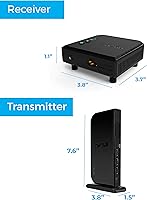
  • Dimensions: Each unit measures 7.5 x 7.6 x 1.5 inches, giving the transmitter and receiver a moderately compact tabletop footprint.
  • Weight: The complete kit, including both transmitter and receiver units, weighs 2.33 pounds combined.
  • Warranty: Backed by a one-year manufacturer warranty plus lifetime customer support that extends beyond the warranty coverage period.
  • Release Date: First available in October 2014, giving this product over a decade of real-world use and accumulated buyer feedback.

Related Reviews

Nyrius Aries Prime Wireless HDMI Transmitter Receiver
73%
91%
Ease of Setup
67%
Signal Stability
54%
Transmission Range
84%
Video Quality
78%
Latency Performance
More
DxInvb Wireless HDMI Transmitter and Receiver Kit
75%
91%
Ease of Setup
58%
Device Compatibility
74%
Wireless Range & Stability
69%
Video Quality
83%
Build Quality & Portability
More
TPUFO G02 Wireless HDMI Transmitter and Receiver
77%
91%
Ease of Setup
78%
Signal Stability
83%
Video & Image Quality
74%
Transmission Range
87%
Latency Performance
More
MpioLife Wireless HDMI Kit V6
74%
91%
Ease of Setup
78%
Wireless Range (Open Space)
47%
Through-Wall Performance
83%
Video Quality
69%
Latency & Responsiveness
More
Weeryyi Wireless HDMI Transmitter and Receiver 1080p
84%
92%
Value for Money
88%
Transmission Range
91%
Ease of Setup
89%
Video Quality
85%
Multi-Screen Support
More
Terzomen AirLink Wireless HDMI Transmitter Receiver
71%
88%
Ease of Setup
71%
Signal Stability
79%
Video Quality
76%
Audio Sync
63%
Wireless Range
More
Anytrox THT-020-8 Wireless HDMI Extender
78%
93%
Ease of Setup
78%
Video Quality
71%
Wireless Stability
82%
Audio-Video Sync
67%
Wireless Range
More
BRAIDOL TR50 Wireless HDMI Extender Kit
79%
93%
Ease of Setup
81%
Signal Stability
78%
Video Quality
83%
Latency Performance
74%
Wireless Range
More
TTQ TR60 Wireless HDMI Transmitter and Receiver
79%
93%
Ease of Setup
78%
Signal Stability
86%
Video & Image Quality
81%
Latency Performance
88%
Build Quality & Materials
More
IOGEAR GWHD11
IOGEAR GWHD11
75%
72%
Signal Stability
84%
Video Quality
61%
Wireless Range
91%
Setup & Ease of Use
83%
Audio Performance
More

FAQ

The honest answer is: it depends on what sits between the transmitter and the receiver. Through standard drywall, most buyers report a reliable signal. Through concrete, brick, or multiple floors, performance degrades noticeably and can drop out entirely. The 100ft maximum is a best-case figure under ideal, unobstructed conditions — treat it as a ceiling, not a guarantee.

No, not at all. The Aries Home+ runs on its own dedicated wireless frequency, completely independent of your home network. You plug in the transmitter, connect your HDMI source, plug in the receiver near your TV, and it works. No router, no app, no account setup required.

Yes, and this is one of the more practical advantages of this particular kit. The transmitter has two HDMI input ports, so both devices stay plugged in simultaneously. You switch between them without touching any cables, which is a noticeably better experience than single-input alternatives.

It lets one source device feed two separate displays at the same time — one TV connected via the wired HDMI output directly on the transmitter, and a second TV in another room receiving the wireless signal through the receiver. If you want the same content on your living room screen and a bedroom screen simultaneously, that is precisely what this feature is designed for.

Nyrius describes the transmission as zero latency, and in short-range, unobstructed setups many users find it responsive enough for everyday console gaming. That said, real-world latency can vary with distance and signal conditions, and the claim is manufacturer-stated rather than independently tested. Casual gamers are generally fine; players who are acutely sensitive to input timing may want to factor that uncertainty in.

The system supports 5.1 surround sound passthrough, but support for newer object-based formats like Dolby Atmos or DTS:X is not confirmed by Nyrius. If premium audio format compatibility is central to your home theater setup, it is worth contacting Nyrius support directly to verify before purchasing.

The Aries Prime is the simpler, more affordable sibling — it has a single HDMI input and a shorter rated range. If you only have one source device and a straightforward single-room setup, the Prime covers the basics for less money. The Aries Home+ makes more sense when you need dual inputs, the loop-through output for two simultaneous displays, or the extended range for a larger home.

The Nyrius Aries Home+ Wireless HDMI Transmitter Receiver includes the transmitter unit, the receiver unit, two power adapters, an HDMI cable, an IR remote extender, a remote control, and mounting hardware. Everything needed for a basic single-source wireless setup is provided out of the box.

This is worth being upfront about: a consistent thread in buyer reviews points to reliability issues developing somewhere around the 12-to-18-month mark for some units, particularly in setups where the system runs continuously. It is not a universal experience, and Nyrius customer support along with the warranty have resolved some of those cases. If long-term uninterrupted operation is critical for your setup, factor this into your decision.

No — this transmitter-receiver system tops out at 1080p full HD. If your source device and display are both 4K capable, you will either see a downscaled picture or run into compatibility issues depending on your equipment. Buyers who need wireless 4K transmission will need to look at a different product category entirely, as this kit was designed for and remains limited to 1080p.

Where to Buy