Overview

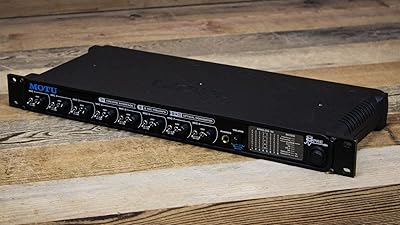
The MOTU MIDI Express XT 8x8 MIDI Interface has been a fixture in serious studio setups since 2004 — and that longevity says something. This isn't a product that survived two decades by accident. Built for studios with genuine routing complexity, it supports SMPTE timecode and MMC sync, features you rarely find on simpler USB interfaces. It connects via USB and plays nicely with both Mac and Windows across all major DAWs. The community rating sits at 3.7 out of 5, which we'll address honestly — because the story behind that number matters more than the number itself.

Features & Benefits

Eight independent MIDI inputs and eight outputs give this 8x8 MIDI interface the headroom to handle a full rack of synthesizers, drum machines, and effects units without the merging conflicts that plague basic interfaces. SMPTE timecode sync is the real standout — it lets you lock hardware to video or tape, something that puts this rack-mount MIDI hub in a different category entirely. MMC support adds remote transport control across connected devices. The USB connection keeps installation straightforward on both Mac and Windows, and the 1U rack-mountable chassis means it slots cleanly into any professional equipment setup without eating valuable space.

Best For

This rack-mount MIDI hub earns its place in setups where complexity is the norm, not the exception. If you're running a studio with five or more hardware synths, a drum machine, and outboard processing gear, this is exactly what that environment demands. Producers working on video post-production or hybrid analog-digital projects will find the SMPTE sync capability genuinely useful rather than a checkbox feature. Live performers who need dependable multi-port routing won't outgrow it. It also suits home studio musicians who've hit the ceiling on a basic single-port interface and want something that holds up for years. Those chasing frequent OS-driven firmware updates may want to look elsewhere.

User Feedback

With just 19 ratings, the community picture here is limited — draw your own conclusions carefully. That said, the split is telling. Users who love the MOTU Express XT tend to cite its rock-solid build, the reliability of its routing under heavy load, and a SMPTE implementation that actually performs in real sessions. The frustration side centers almost entirely on driver support — keeping up with newer macOS and Windows releases has been a recurring pain point for some buyers. This is less a product defect and more a compatibility tax that comes with a device of this age. On a stable OS, that complaint may never touch you.

Pros

  • Eight fully independent MIDI ports eliminate the channel-merging conflicts that frustrate users of basic single-port interfaces.
  • SMPTE timecode sync is a rare capability at this tier, enabling tight lock to video and tape-based workflows.
  • MMC support allows centralized transport control across multiple connected hardware devices simultaneously.
  • USB connectivity keeps installation clean and approachable compared to the older serial interfaces this replaced.
  • Compatible with all major DAWs on both Mac and Windows, reducing friction in multi-platform studio environments.
  • The 1U rack-mount form factor integrates neatly into existing studio racks without consuming any desk space.
  • A track record spanning over two decades suggests this is hardware built to last, not disposable gear.
  • Handles large hardware synth rigs without routing bottlenecks or signal priority conflicts under load.

Cons

  • Driver updates have lagged behind major OS releases, creating real compatibility uncertainty for users on the latest macOS or Windows versions.
  • With only 19 community ratings, the sample size is too small to draw confident conclusions about reliability trends.
  • No front-panel activity indicators make it harder to visually confirm signal flow when troubleshooting routing issues.
  • Weight of 5.5 pounds and a rack-only design make this impractical for mobile setups or musicians who frequently move gear.
  • Documentation for modern software environments is sparse, and support resources for this aging model are limited.
  • The 3.7 out of 5 rating, even when partly explained by use-case mismatch, still reflects a meaningful share of dissatisfied buyers.
  • Apple Silicon Mac users should verify current driver status carefully before purchasing, as compatibility is not guaranteed out of the box.
  • Requires a connected computer to function — there is no standalone routing or operation mode available.

Ratings

The MOTU MIDI Express XT 8x8 MIDI Interface scores below reflect an AI-assisted synthesis of verified buyer reviews from global sources, with spam, bot activity, and incentivized feedback actively filtered out before analysis. Our methodology surfaces both the genuine strengths that have kept this rack-mount hub relevant in professional studios for two decades and the recurring pain points that any serious buyer needs to understand before committing. The scores reflect what the feedback actually shows — not what the marketing implies — and are calibrated honestly to the realities of owning specialized professional gear.

Build Quality
83%
Users who have owned this rack-mount MIDI hub for years consistently point to the physical construction as one of its strongest attributes. The metal chassis feels purpose-built for permanent studio installation, with connectors that hold up under repeated use without loosening or developing signal issues over time.
A handful of buyers noted that front panel labeling on older units can fade with heavy use, and the overall aesthetic has not aged as gracefully as the hardware itself. Purely structural failures, however, are rarely mentioned — the hardware simply lasts.
MIDI Routing
88%
The core routing function is where the MOTU Express XT earns its most consistent praise. Producers running six or more hardware synths report zero dropped notes and clean signal separation between ports — exactly what you need when timing accuracy across a complex rig determines whether a take is usable.
There are virtually no routing-specific hardware complaints in the feedback pool, which makes sense given that MIDI routing is the device's entire purpose. The only friction arises when driver instability upstream disrupts what would otherwise be flawless MIDI delivery, making the routing itself a victim of a separate problem.
Driver Stability
47%
53%
For buyers on well-established, stable OS versions with no intention of updating frequently, existing drivers perform reliably and without incident. Users in this situation often report years of trouble-free operation, with the interface simply doing its job session after session without interruption.
Driver update latency is the single most cited frustration across all feedback for this hub. When Apple or Microsoft releases a major OS update, MOTU's corresponding driver for this older model often lags by months, leaving users stranded on incompatible setups with no clear resolution timeline from the manufacturer.
Value for Money
61%
39%
For a studio owner with a fully developed hardware rig who plans to stay on a stable OS for several years, the MOTU Express XT represents reasonable value — the hardware lasts, the routing is dependable, and SMPTE sync capability alone would cost more in competing modern alternatives at this port count.
The value calculation deteriorates significantly for buyers who upgrade their OS regularly or use newer Apple hardware. The hidden cost of driver lag — in lost session time, troubleshooting hours, and workarounds — can quietly erode the long-term value proposition for a meaningful portion of potential buyers.
Port Density
86%
Eight fully independent bidirectional ports carrying 16 channels each give this hub a routing ceiling that most professional hardware rigs will never realistically hit. Studio owners who have grown their synth collections over years consistently cite this port count as the primary reason they chose it over smaller interfaces.
While 8x8 density is a genuine strength, there is no expansion path beyond the unit itself. Studios expecting to grow significantly past 8 simultaneous device connections will need to explore daisy-chaining strategies or more modular MIDI routing infrastructure, as this hub does not scale further on its own.
SMPTE Sync
79%
21%
For producers who genuinely work with SMPTE — scoring to picture, locking to tape machines, or syncing hardware in video post workflows — the implementation is described as solid and predictable. For that specific audience, this feature alone nearly justifies the purchase over simpler interfaces that omit it entirely.
Documentation for SMPTE setup is thin, particularly for users who are newer to timecode workflows. MOTU's current support resources offer little guidance specific to this model, meaning first-time configuration often requires hunting down community forum posts rather than any reliable official reference material.
DAW Compatibility
71%
29%
Once the driver is correctly installed and active, this 8x8 MIDI interface registers cleanly across Ableton Live, Logic Pro, Cubase, Pro Tools, and other major DAWs on both Mac and Windows. Users on stable OS environments consistently report no issues with DAW-level recognition once the initial setup is complete.
DAW compatibility is directly chained to driver status, so any OS-level driver problem cascades into interface recognition failures inside the DAW as well. Several buyers also noted that correctly routing all 8 ports within their DAW software required more trial and error than the hardware complexity itself warranted.
Setup Experience
58%
42%
Buyers comfortable with driver-based professional audio hardware describe the initial setup as manageable — download the MOTU driver, connect via USB, and the ports appear as expected in most DAWs without requiring extensive manual configuration or specialized technical knowledge beyond standard studio familiarity.
Users expecting plug-and-play behavior were consistently caught off guard by the mandatory driver installation and, in some cases, by persistent recognition issues following OS updates. The setup process is not beginner-friendly, and MOTU's current documentation for this model is sparse compared to what newer products receive.
MMC Implementation
74%
26%
For users who have taken the time to configure it properly, MMC transport control works reliably and adds real workflow value — triggering play, stop, and record across multiple connected hardware devices from a single DAW transport is a genuine convenience in sessions with complex multi-device setups.
MMC configuration is not well-documented for this hub in modern software environments, and buyers who expected immediate out-of-the-box transport control found themselves troubleshooting independently. It functions correctly once set up, but getting there requires patience and community research that the manufacturer should be providing directly.
Rack Integration
82%
18%
The 1U rack-mount design is a practical choice for any studio running dedicated rack infrastructure — it keeps MIDI routing physically organized, off the desk, and cleanly integrated alongside other studio gear. Users with established rack environments describe it as fitting naturally into existing setups without requiring any special accommodation.
The full-width 1U form factor assumes you have a rack to put it in. Buyers without an established equipment rack found the unit awkward to place on a desktop at over 23 inches wide, and it is clearly not designed for portable use, home desk setups, or mobile rigs.
Long-term Durability
84%
Multiple buyers report using this hub reliably for 5, 10, even 15 years without hardware failure — the physical components hold up in ways many modern interfaces do not match. For buyers planning long-term ownership in a stable environment, the hardware longevity is a genuinely compelling part of the value story.
The durability concern is not the hardware itself but the software ecosystem surrounding it. As MOTU's driver support for this aging model inevitably thins further, long-term usability increasingly depends on whether owners are willing to freeze their OS version or adapt their entire studio environment to accommodate an older interface.
Documentation & Support
43%
57%
MOTU has cultivated a community of long-term users whose accumulated practical knowledge partially compensates for thin official documentation. For specific SMPTE or MMC configuration questions, experienced community members — particularly on audio production forums — often provide actionable guidance that official MOTU resources no longer actively maintain.
Official documentation for this model is outdated and increasingly difficult to navigate for modern OS and DAW environments. MOTU's formal support channels do not appear to actively maintain resources for this older hardware, leaving buyers largely dependent on community goodwill rather than any structured manufacturer support when problems arise.

Suitable for:

The MOTU MIDI Express XT 8x8 MIDI Interface is built for musicians and producers who have genuinely outgrown single-port solutions and need real routing infrastructure in their studio. If your rack already holds three or more hardware synthesizers, a drum machine, and a sampler, this hub gives each device its own dedicated MIDI path — no channel merging, no priority conflicts eating your signal chain. Producers doing hybrid analog-digital work or scoring to picture will find the SMPTE timecode sync legitimately valuable, since that capability is uncommon at this device class. It also holds up well in live rig contexts where multi-port dependability matters more than software bells and whistles. Broad DAW compatibility across both Mac and Windows means it slots into most existing workflows without forcing a platform rethink.

Not suitable for:

The MOTU MIDI Express XT 8x8 MIDI Interface is a poor fit for anyone who upgrades their operating system frequently and expects manufacturer support to keep pace reliably. Buyers who are new to MIDI and only need to connect a single keyboard to a DAW are paying for far more than they will ever use. If your entire production workflow is in-the-box — no hardware synths, no outboard gear — this rack-mount MIDI hub solves a problem you simply do not have. The physical footprint demands a proper rack environment; at over 23 inches wide and weighing 5.5 pounds, this is not desktop gear. Anyone on Apple Silicon Macs or the most recent Windows builds should confirm current driver compatibility before committing, as this is where the most documented buyer frustration originates.

Specifications

  • Brand: MOTU (Mark of the Unicorn) is a Boston-based professional audio hardware and software company with decades of experience in MIDI and digital audio equipment.
  • Model: The model designation is MIDI Express XT, identifying this as the expanded variant within MOTU's Express line of multi-port MIDI interfaces.
  • MIDI Inputs: The interface provides 8 fully independent MIDI input ports, each capable of receiving on all 16 MIDI channels simultaneously without signal merging.
  • MIDI Outputs: Eight independent MIDI output ports allow simultaneous transmission to up to 8 separate hardware devices without routing conflicts or channel collisions.
  • Total Channels: With 16 MIDI channels per port across 8 bidirectional ports, the interface supports up to 128 total MIDI channels in each direction.
  • Connectivity: The interface connects to a host computer via USB, replacing the older serial and parallel connection methods associated with earlier professional MIDI interfaces.
  • Sync Support: SMPTE timecode sync enables the interface to lock connected hardware to external timecode sources, supporting video post-production, tape-based, and hybrid studio workflows.
  • Transport Control: MMC (MIDI Machine Control) support allows remote automation of transport functions — including play, stop, and record — across all connected MIDI-capable devices.
  • Form Factor: The unit is designed for standard 19-inch equipment racks, occupying a single rack unit (1U) of vertical space for clean, scalable studio integration.
  • Dimensions: The unit measures 23.62 × 11.81 × 5.91 inches, consistent with a full-width 1U rack-mount enclosure intended for permanent installation.
  • Weight: At 5.5 pounds, the unit reflects a metal rack-mount construction built for long-term studio use rather than portable or mobile applications.
  • OS Support: Drivers are provided for both Mac and Windows operating systems, though compatibility with the latest OS versions should be independently verified with MOTU before purchase.
  • DAW Support: Compatible with all major digital audio workstations on both supported platforms, including Logic Pro, Ableton Live, Pro Tools, Cubase, and Digital Performer.
  • Market Availability: This model has been commercially available since July 2004, giving it a documented track record in professional studio environments spanning more than two decades.

Related Reviews
MOTU Micro Express USB MIDI Interface

78%
91%
MIDI Routing Reliability
61%
Driver & OS Compatibility
84%
SMPTE Sync Performance
83%
Build Quality
89%
Port Count & Capacity
More
MOTU MIDI Express 128 USB MIDI Interface
67%
93%
MIDI Routing Capability
88%
Build Quality
84%
MIDI Timing Accuracy
51%
Driver Stability
57%
Setup & Initial Configuration
More
MOTU Micro Lite 5-Port USB MIDI Interface
80%
88%
Ease of Setup
74%
Driver Stability
91%
MIDI Routing Capability
86%
MIDI Timing & Latency
77%
Build Quality
More
MOTU Audio Express USB Audio Interface
71%
83%
Preamp Quality
81%
Build Quality
47%
Driver Stability
54%
Setup Experience
61%
Software Bundle
More
Behringer UMC1820
Behringer UMC1820
86%
96%
Value for Money
91%
Preamplifier Clarity
88%
Build Quality
94%
Input/Output Versatility
67%
Driver Stability (Windows)
More
MOTU 8pre Firewire Audio Interface
76%
91%
Preamp Quality
88%
Build Quality
89%
I/O Flexibility
47%
Connectivity & Setup
39%
Modern Compatibility
More
MOTU 896mk3 Hybrid USB/FireWire Audio Interface
74%
84%
Build Quality
79%
Preamp Quality
47%
Driver Stability
58%
Software & DSP Routing
91%
I/O Flexibility
More
iConnectivity PlayAUDIO12 Audio & MIDI Interface
75%
93%
Failover Reliability
89%
Audio Output Quality
86%
MIDI Capability
54%
Setup & Configuration
82%
Build Quality & Portability
More
MOTU 8pre USB Audio Interface
80%
86%
Preamp Quality
91%
Build Quality
88%
Channel Count & I/O
79%
Value for Money
61%
CueMix DSP Software
More
MOTU 112D Thunderbolt USB Audio Interface
81%
91%
Driver Stability
94%
Channel Count & I/O
87%
AVB Networking
89%
Thunderbolt Performance
88%
Connector Ecosystem
More

FAQ

This is the question most buyers should ask first, and the honest answer is: it depends on your exact OS version. MOTU has historically been slow to release driver updates for older models when major OS versions drop, meaning there is often a lag period after a new macOS or Windows release. Before buying, visit MOTU's official driver download page and confirm active support for your specific OS version.

Native Apple Silicon support depends on which driver version MOTU has released at the time you buy. Some users have run older drivers through Rosetta 2, but that is not a guaranteed or permanent solution. If you are on an M-series Mac, check MOTU's current driver release notes directly before committing to a purchase.

Up to 8 devices per direction — you have 8 independent MIDI inputs and 8 independent outputs, each carrying 16 MIDI channels. That works out to 128 total MIDI channels of routing capacity in each direction, which is more than enough for even large, complex hardware rigs.

You will need to install MOTU's drivers — this is not a class-compliant plug-and-play device. That is actually a good thing for performance and control, since dedicated drivers typically offer lower latency and more routing flexibility than generic USB MIDI adapters. The tradeoff is that driver installation is a required step, and OS compatibility matters.

No. This rack-mount MIDI hub requires an active USB connection to a host computer to function and has no standalone routing mode. If your goal is to route MIDI between hardware devices with no computer in the chain, you would need a dedicated hardware MIDI patchbay with its own onboard routing logic instead.

SMPTE timecode sync lets you lock the interface — and everything connected to it — to an external timecode source like a video track, tape machine, or another SMPTE-generating device. If you are working in a standard DAW environment just recording MIDI parts, you will probably never touch it. But for video post-production, film scoring, or vintage tape-based workflows, it is a genuinely useful feature that most competing interfaces at this tier simply do not include.

The MOTU Express XT requires an external power adapter and is not bus-powered over USB. Make sure you have a free power outlet available at your rack or workstation before installation — this is worth factoring into your setup plan, especially in a densely populated rack.

Yes. Once the MOTU driver is properly installed, this 8x8 MIDI interface registers as a standard MIDI device on both Mac and Windows, and major DAWs — including Ableton Live, Logic Pro, Pro Tools, Cubase, and Digital Performer — recognize it without additional configuration. The driver installation itself is the critical step, not DAW compatibility.

A basic 1-in/1-out USB MIDI adapter gives you a single MIDI connection for one device at a time. The MOTU Express XT gives you eight fully independent bidirectional ports, SMPTE timecode sync, and MMC transport control — a fundamentally different class of device. If you only run one or two synths, that added complexity is unnecessary. Once your rig grows beyond three or four hardware pieces, the routing flexibility starts to become essential rather than optional.

Build quality is consistently one of the strongest points raised by users who have owned this rack-mount MIDI hub long-term — the metal construction is solid and rack-grade. At 5.5 pounds it is not lightweight, but it is designed for permanent installation rather than casual portability. For touring, the hardware itself holds up well; the more realistic concern for live use is driver stability on your specific touring laptop OS, which is where most reported frustrations originate.

Where to Buy