Overview

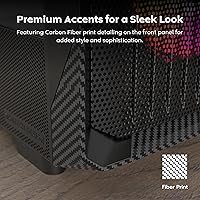
The Montech X5 ATX Mid-Tower PC Case enters a crowded field with a straightforward argument: give builders real airflow and a good-looking interior without forcing them to spend extra on accessories right out of the gate. At 18.7 x 9.1 x 17.9 inches, this mid-tower sits comfortably on most desks without dominating the space. It supports both ATX and Micro-ATX motherboards, covering a solid range of configurations. The carbon print accents on the front panel and the tempered glass side give it a finish that looks more expensive than its price tier suggests. For a product launched in mid-2025, pulling a 4.4-star average from early buyers is a genuinely encouraging start.
Features & Benefits

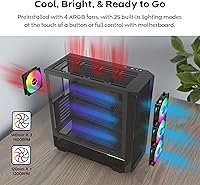
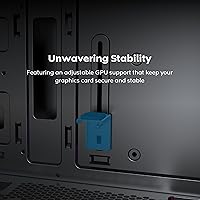
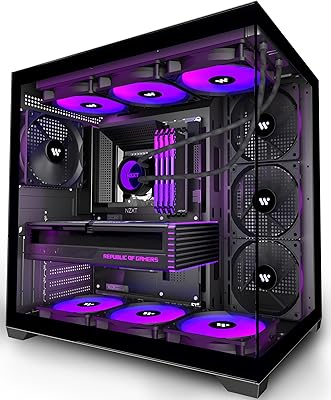
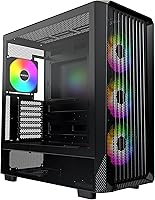
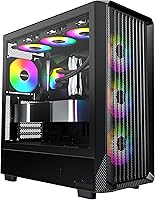
The X5 case ships with four fans already mounted — three 140mm units up front pulling air in, and a 120mm exhausting out the rear. That saves you a meaningful amount compared to sourcing fans separately, and the ARGB lighting they produce looks vibrant through the glass panel. GPU clearance stretches to 410mm, so even the longest RTX 50-series cards slot in without modification. The integrated GPU holder is a genuinely practical inclusion — heavy modern graphics cards sag under their own weight, and having an adjustable support stand bundled in the box is the kind of detail that usually costs extra elsewhere. Cable routing behind the enlarged shroud is generous, keeping builds looking tidy.

Best For

This Montech chassis makes the most sense for a few specific types of builders. First-timers who want a working airflow setup without hours of fan research will appreciate how ready-to-go it feels. It is also a strong pick for anyone running a long, heavy GPU — the 410mm clearance and the bundled support stand handle those cards without fuss. Aesthetics-focused builders on tighter budgets get the glass panel and lighting without boutique-case pricing. And if you are upgrading from a cramped older chassis where cable management was a constant headache, the expanded routing space here will feel like a real step forward. Practical and polished at the same time.

User Feedback

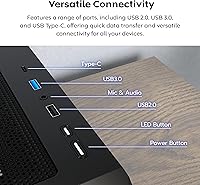
Early buyers have reacted positively, with most highlighting the pre-installed fans and the GPU holder as standout practical wins that simplify the build process. Fan noise under load is a point surfacing in forum discussions, and it is worth watching as more long-term reports accumulate. Some users have questioned whether the included fans match the performance of reputable aftermarket alternatives — a fair concern worth factoring in. Panel fitment and glass quality appear solid from early accounts, though the front I/O offering just one USB 3.0 and one USB 2.0 feels limited by current standards. Overall sentiment leans positive, but long-term durability data is still thin given how recently this chassis launched.

Pros

  • Four ARGB fans come pre-installed, so your airflow setup is ready on day one with no extra purchases.
  • GPU clearance of up to 410mm means even the longest current-gen graphics cards fit without any modification.
  • The bundled adjustable GPU holder tackles card sag out of the box — a practical inclusion most competitors charge extra for.
  • Tempered glass side panel showcases your build and the ARGB lighting without any visual obstruction.
  • Generous cable routing space behind the PSU shroud keeps builds looking clean without much effort.
  • Carbon fiber texture accents on the front panel give it a tactile, upscale feel that stands out at this price tier.
  • ATX and Micro-ATX compatibility makes this Montech chassis usable across a wide range of build configurations.
  • Early Amazon ratings average 4.4 out of 5, suggesting strong initial buyer satisfaction for a recently launched product.
  • Bottom-mount PSU placement helps with center-of-gravity stability and contributes to a tidier interior layout.

Cons

  • Front panel I/O is limited to one USB 3.0 and one USB 2.0 port, which feels sparse by current standards.
  • The quality of the included fans remains an open question compared to dedicated aftermarket options in a similar price range.
  • Long-term durability data is thin since the case only launched in mid-2025 — early adopters take on some unknown risk.
  • No native support for custom liquid cooling loops limits future upgrade paths for enthusiasts.
  • E-ATX motherboards are not supported, ruling this mid-tower out for high-end workstation or HEDT builds.
  • Fan noise behavior under sustained load has surfaced as a concern in early community discussions and needs more data.
  • At 15.1 pounds, the chassis is not especially lightweight, which matters if you move your rig frequently.
  • The USB port placement on the front panel has drawn some ergonomic complaints depending on desk and tower positioning.

Ratings

The scores below reflect our AI-powered analysis of verified global buyer reviews for the Montech X5 ATX Mid-Tower PC Case, with spam, incentivized submissions, and bot activity actively filtered out before any rating is calculated. Every category captures what real builders actually experienced — the genuine strengths that made them recommend this chassis, and the friction points they flagged after living with it. Nothing here is averaged into comfortable neutrality; where buyers were divided, the scores reflect that honestly.

Airflow Performance
88%
Builders consistently praise how ready-to-use the airflow setup feels right out of the box — four fans already positioned and spinning means most users never had to think about intake or exhaust configuration. For a first build or a quick upgrade, that confidence is a real asset.
Some experienced builders question whether the pre-installed fans match the static pressure and CFM output of dedicated aftermarket units, particularly in configurations with dense CPU coolers or radiators. Under sustained gaming loads, a handful of users noted the fans become audible.
Value for Money
91%
The combination of four pre-installed ARGB fans, a tempered glass side panel, and an included GPU support stand at this price tier is difficult to match from competing brands. Buyers frequently note that sourcing these components separately would cost noticeably more than the case itself.
Users who already own quality aftermarket fans may feel the bundled fans are redundant rather than additive, effectively paying for hardware they will replace. At this price point, the single USB 3.0 front port also feels like a cost-cutting decision that slightly undermines the overall package.
Build Quality & Materials
79%
21%
The steel chassis feels solid during the build process, and the carbon fiber texture accents on the front panel add a tactile dimension that surprises buyers who expected a purely cosmetic finish. Panel fitment has drawn broadly positive feedback for a product in this price category.
Long-term durability data is still limited given the recent launch date, so how the chassis holds up after a year or two of regular use remains an open question. A few buyers noted that some interior edges and panel tolerances feel marginally less refined than cases from more established competitors.
GPU Compatibility & Support
93%
The 410mm GPU clearance is one of the most practical specs on offer here — it accommodates even the longest triple-fan RTX 50-series cards without any bracket removal or creative fitting. The bundled adjustable GPU holder is a genuinely useful inclusion that directly addresses the sag problem heavy modern cards present.
The GPU holder's usability varies slightly depending on card thickness and PCIe cable routing angles, and a minority of users found fine-tuning the stand position more fiddly than expected. Vertical GPU mounting is not natively supported, which matters to a niche but vocal segment of builders.
Cable Management
84%
The enlarged PSU shroud and the expanded rear routing channels make a meaningful difference during the build process, especially for builders coming from older cases with minimal management space. Most users report the interior looks clean after assembly without needing to fight cables into position.
The routing cutouts, while generous by budget-case standards, are not as precisely positioned as those found in mid-towers from Fractal or Lian Li in a higher price bracket. Builders running very thick custom cables or multiple GPU power connectors may still find the rear space tighter than ideal.
Aesthetics & Visual Design
86%
The ARGB lighting from the front intake fans projects impressively through the tempered glass panel, and the carbon print accents on the front frame give the case a premium visual identity that reads as more expensive than it is. Buyers frequently mention it photographs and looks better in person than in product listings.
The front panel styling leans firmly into gaming-aggressive territory, which works for the target audience but may feel too loud for builders going for a clean, understated workstation aesthetic. ARGB sync compatibility with all motherboard ecosystems is worth verifying before purchase.
Thermal Management
81%
19%
With three large-diameter intake fans and a rear exhaust already installed, the case creates a positive pressure airflow path that keeps CPU and GPU temperatures reasonable in most mid-range to high-end configurations. Builders pairing it with air CPU coolers report comfortable idle and load thermals.
The case is not optimized for high-heat scenarios involving overclocked flagship CPUs alongside power-hungry GPUs simultaneously, where the stock fan configuration may need augmenting. There is no top exhaust fan slot called out in the spec sheet, which limits thermal headroom in very hot ambient environments.
Fan Quality
72%
28%
The pre-installed fans spin up reliably and the ARGB lighting output is vibrant and consistent across all four units, which is not always the case with budget bundled fans. For most casual and mid-range builds, the performance is entirely adequate without any immediate replacement pressure.
Experienced builders comparing airflow metrics against known-quantity fans from Noctua, be quiet!, or Arctic find the included units competitive only at lower RPMs. At higher speeds, the fan noise profile is less refined, and the bearing quality over multi-year continuous use is still unproven.
Noise Levels
68%
32%
At idle and light loads the system running in this chassis is genuinely quiet, and most users running desktop or light gaming workloads report no noticeable fan noise during typical use sessions.
Under sustained GPU and CPU loads the noise level increases to a point that several users flagged as distracting in quiet room environments. This is a chassis designed for airflow priority over acoustic dampening, and there is no sound-absorbing material anywhere on the panels to soften fan noise.
Front Panel I/O
54%
46%
The front I/O is straightforward and functional for basic needs — the USB 3.0 port handles fast external storage transfers and the layout is ergonomically positioned for typical tower placement on a desk.
One USB 3.0 and one USB 2.0 is a notably thin offering for a case launched in 2025, and builders who regularly connect peripherals, headsets, or USB hubs at the front will feel the limitation quickly. The absence of a USB-C front port is a real gap that competing cases at similar prices increasingly address.
Ease of Assembly
89%
The pre-installed fans eliminate one of the most common first-build frustrations, and the internal layout is logical enough that most builders report a smooth, low-stress assembly experience. The included GPU holder is simple to position and does not require reading documentation to figure out.
Builders installing very large air CPU coolers may need to plan component order carefully to avoid clearance conflicts near the top of the case interior. A small number of users found that aligning the front panel connector headers required more patience than expected given the routing channel positioning.
Tempered Glass Panel
82%
18%
The glass panel is thick enough to feel substantial when handling and opens up a clear, unobstructed view of the build interior, making the ARGB lighting genuinely enjoyable to look at during use. Removal and reinstallation via thumb screws is tool-free and reliable.
Like most tempered glass panels in this category, fingerprints and dust accumulate on the interior surface and require periodic cleaning to maintain the display effect. A few buyers noted minor fitment wobble depending on desk surface vibration, though this did not affect structural integrity.
Motherboard Compatibility
77%
23%
ATX and Micro-ATX support covers the vast majority of consumer builds, making this chassis broadly applicable across a wide range of hardware configurations without any adapter or modification.
The absence of Mini-ITX and E-ATX support narrows the audience on both ends — compact build enthusiasts and high-core-count workstation builders are excluded entirely, which is a meaningful limitation for a case positioned as versatile.
Interior Space & Layout
83%
The enlarged internal volume accommodates modern high-end components without the cramped feeling common in older mid-tower designs, and builders describe the layout as intuitive for routing power cables to both the motherboard and GPU simultaneously.
Storage mounting options are not extensively detailed in available specs, and builders with multiple drive bays or large storage arrays may find the configuration limiting. The top of the case interior could benefit from additional clearance for taller CPU air coolers in some configurations.

Suitable for:

The Montech X5 ATX Mid-Tower PC Case is a particularly strong fit for first-time builders who want to skip the fan-sourcing headache and get straight to assembling their system. If you are pairing a long, heavy flagship GPU — an RTX 4080, 5090, or anything in that class — the 410mm clearance and the bundled adjustable GPU holder give you room and physical support without any aftermarket additions. Builders upgrading from older, cramped cases will notice the difference immediately: the cable routing space and the enlarged PSU shroud make the interior feel organized rather than improvised. It also works well for anyone who wants a visually appealing build on a measured budget, since the ARGB fans and tempered glass deliver a premium-looking result without the premium price tag. If your desk space is standard and your motherboard is ATX or Micro-ATX, this mid-tower slots in without any real compromise.
Not suitable for:

The Montech X5 ATX Mid-Tower PC Case is not the right call for builders who prioritize connectivity, since the front panel offers just one USB 3.0 and one USB 2.0 port — a limitation that will frustrate anyone who routinely plugs in drives, headsets, or controllers at the front of their case. Enthusiasts who plan to run custom liquid cooling loops will also find the feature set underwhelming, as this chassis is built around air cooling and does not cater to that use case. The included fans are a genuine convenience, but experienced builders who already own high-performance aftermarket fans may see them as redundant rather than valuable. Because this is a relatively new product with a still-growing review base, buyers who require long-term durability data before committing should exercise some patience. ITX builders are excluded outright, and anyone needing E-ATX motherboard support should look elsewhere.
Specifications

  • Form Factor: ATX Mid-Tower design accommodates standard ATX and Micro-ATX motherboards, covering the most common build configurations.
  • Dimensions: The case measures 18.7 x 9.1 x 17.9 inches (L x W x H), fitting comfortably on most standard desks without excessive footprint.
  • Weight: Fully unloaded chassis weight is 15.1 pounds, reflecting a solid metal construction without being unwieldy to move or position.
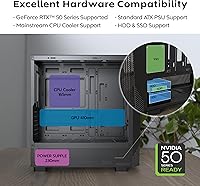
  • GPU Clearance: Internal GPU length clearance extends to 410mm, supporting current flagship cards including the RTX 50-series without requiring any modification.
  • Pre-installed Fans: Three 140mm ARGB fans are mounted at the front intake, and one 120mm ARGB fan is installed at the rear exhaust position.
  • GPU Holder: An adjustable GPU support stand is included in the box, designed to physically brace graphics cards of varying thicknesses against sag.
  • Side Panel: A tempered glass panel runs along the left side of the chassis, providing a clear view of internal components and lighting.
  • Front Panel I/O: The front I/O provides one USB 3.0 port and one USB 2.0 port for peripheral and storage device connectivity.
  • PSU Mounting: The power supply mounts at the bottom of the chassis, contributing to a lower center of gravity and a cleaner interior layout.
  • Cable Management: An extra-large PSU shroud combined with expanded rear routing channels gives builders organized space to hide and route cables neatly.
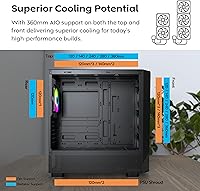
  • Cooling Method: The chassis is designed exclusively for air cooling, with pre-installed fans handling both intake and exhaust airflow out of the box.
  • Material: The chassis body is constructed from steel, with carbon fiber texture print accents applied to the front panel frame for visual detail.
  • Motherboard Support: Compatible with ATX and Micro-ATX form factors; E-ATX and Mini-ITX motherboards are not supported by this chassis.
  • Color: Available in black, with ARGB fan lighting providing customizable color effects visible through the tempered glass side panel.
  • Amazon Rating: The case holds a 4.4 out of 5 star rating based on 86 customer ratings as of its early availability period on Amazon.

Related Reviews
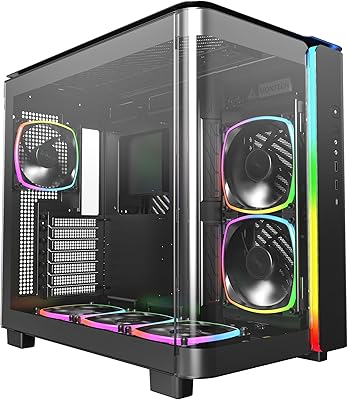
Montech KING 95 PRO ATX Mid-Tower PC Gaming Case
85%
91%
Cooling Performance
87%
Cable Management
88%
Build Quality
90%
Aesthetics
82%
Ease of Assembly
More
KEDIERS K4 ATX Mid Tower PC Case
80%
91%
Value for Money
93%
Aesthetic Design
74%
Build Quality
72%
Cooling Performance
84%
Ease of Assembly
More
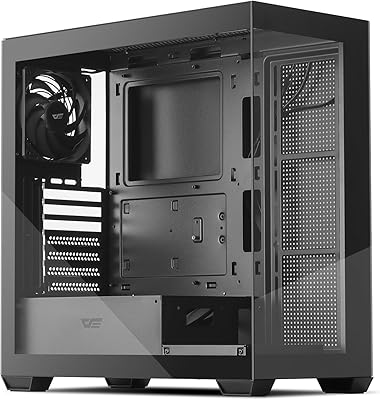
darkFlash DS900 ATX Mid-Tower PC Case
75%
76%
Build Quality
83%
Cooling Potential
91%
Aesthetics & Visibility
88%
Value for Money
74%
Cable Management
More
Vetroo AL800 Mid Tower ATX PC Case
76%
78%
Build Quality
84%
Tempered Glass Panel
76%
Airflow Performance
61%
Fan Included & Expandability
69%
Cable Management
More
SZSKYING CMSVB-1 Mid-Tower PC Gaming Case
74%
91%
Value for Money
88%
Included Fans
86%
Aesthetics & RGB
61%
Build Quality
74%
Airflow Performance
More
Zalman S4 Mid-Tower ATX PC Case
75%
72%
Build Quality
88%
Value for Money
91%
Ease of Assembly
67%
Airflow Performance
63%
Cable Management
More
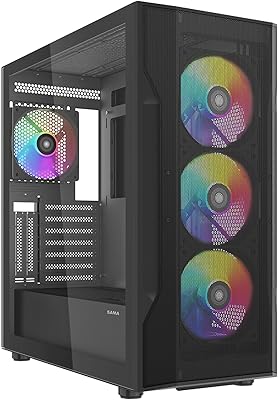
SAMA S40 Mid Tower ATX PC Case
79%
88%
Airflow Performance
83%
Included Fan Quality
79%
Build Quality & Finish
92%
GPU Compatibility
61%
Cable Management
More
Zalman S2 ATX Mid-Tower PC Case
76%
88%
Airflow Performance
63%
Build Quality
91%
Value for Money
86%
Ease of Assembly
84%
Cooling Expandability
More
Zalman S3 ATX Mid-Tower PC Case
74%
83%
Value for Money
71%
Build Quality
58%
Airflow & Cooling Performance
86%
Ease of Assembly
67%
Acrylic Side Panel
More
FOIFKIN F1 Mid-Tower Gaming PC Case
74%
83%
Cooling Performance
74%
Build Quality
61%
Cable Management
88%
Tempered Glass Panel
86%
ARGB Lighting
More

FAQ

Yes, GPU clearance goes up to 410mm, which covers even the longest current-gen cards including triple-fan RTX 4090 and 5090 designs. You should not need to remove any brackets or make modifications. That said, always double-check your specific card's length against your other component dimensions before committing.

The support stand is adjustable and designed to accommodate cards of varying thicknesses. It sits beneath the GPU and props it up from below, which is a practical approach for heavy modern graphics cards prone to sag. Most users find it straightforward to set up, though the exact fit will vary slightly depending on card design.

This is one area where community feedback is still accumulating since the case launched recently. Early reports suggest the fans are reasonably quiet at low to moderate loads, but some users have noted they can become audible during sustained heavy workloads. If near-silent operation is a hard requirement, you may want to monitor owner forums as more long-term data comes in.

Yes, the fan mounts are standard, so swapping in aftermarket 140mm fans at the front and a 120mm at the rear is straightforward. If you already own quality fans or prefer a specific brand, the case does not lock you into the included units.

The routing space behind the motherboard tray and the enlarged PSU shroud are notably generous for this price bracket. Builders who have used tighter mid-towers report a real difference in how manageable the process feels. You will not get the same depth as boutique cases, but for most standard builds it is more than workable.

The case is primarily designed around air cooling and ships configured for that purpose. Whether it can accommodate a specific AIO radiator depends on mounting location compatibility — check Montech's official specifications for radiator support details before assuming it will fit your cooler.

It officially supports ATX and Micro-ATX motherboards. E-ATX and Mini-ITX are not listed as compatible form factors, so if you are running either of those you will need to look at a different case.

Early user feedback suggests the panel fits well and feels solid. Tempered glass panels on mid-towers at this price point can sometimes feel a little loose, but reports on this chassis are generally positive regarding fitment. Removal is typically tool-free via thumb screws, which makes access during builds straightforward.

Honestly, for a lot of builders it will not matter much day-to-day, but if you regularly plug in USB drives, headsets, or other peripherals at the front of your case, one USB 3.0 and one USB 2.0 can feel limiting. It is a real trade-off worth considering, particularly if your desk does not give easy access to rear ports.

It is actually well-suited to first-time builders precisely because the fans come pre-installed and the cable management layout is forgiving. You are not walking in to a blank slate that requires sourcing accessories and figuring out airflow from scratch. Experienced builders will also find it competent, though they may end up swapping out the included fans for units they already prefer.

Where to Buy