Overview

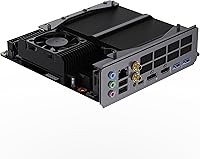
The MINISFORUM BD790I X3D Mini ITX Motherboard occupies a genuinely unusual corner of the PC hardware market — it is one of the very few ITX boards shipping with a soldered high-end CPU already on board, no socket hunting required. That CPU happens to be AMD's Ryzen 9 7945HX3D, a 16-core mobile chip that punches well above its weight class in both gaming and productivity workloads. Compared to building around a traditional desktop AM5 platform, you trade socket upgradability for a dramatically smaller footprint and lower idle power draw. For SFF enthusiasts and HTPC builders, that is often a trade worth making.

Features & Benefits

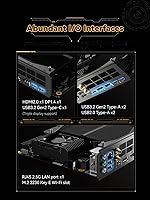
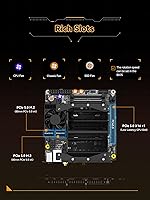
The BD790I X3D carries two PCIe 5.0 M.2 slots, which means pairing it with current-gen NVMe drives can push sequential reads close to 10 GB/s — genuinely useful if you work with large video files or run fast virtual machines. A full PCIe 5.0 x16 slot means you can still drop in a modern discrete GPU for serious gaming. DDR5 support stretches up to 96 GB, which covers demanding multi-app workloads without compromise. Connectivity is thorough: HDMI 2.1, DisplayPort 1.4, and USB-C cover triple-display setups, while WiFi 6E and Bluetooth 5.3 handle wireless without needing an add-in card. The pre-installed heatsink and active SSD cooler are practical inclusions that simplify the build.

Best For

This SFF board makes the most sense for builders who genuinely need CPU muscle in a tight enclosure. Think living room gaming rigs where a full tower is out of the question, or home lab setups where rack space or desk footprint matters. Content creators who want fast NVMe throughput and plenty of RAM without managing a sprawling ATX build will find the package appealing. It also suits buyers who simply want fewer moving parts — no worrying about CPU-motherboard compatibility, no fiddling with cooler mounting brackets. If you are fine with the fixed CPU and plan to stay on this platform for several years, the value density is hard to argue with.

User Feedback

Across roughly 115 ratings, the BD790I X3D holds a 4.2-star average, which reflects genuine satisfaction tempered by a few real concerns. Buyers consistently praise the board's build quality and how well it manages thermals under sustained load — the heatsink coverage earns specific mentions. On the critical side, BIOS maturity comes up repeatedly; early adopters have noted that firmware updates are necessary to resolve stability quirks, and community resources are thin compared to mainstream desktop platforms. Some users also flag uncertainty around long-term firmware support from MINISFORUM, which is a fair concern for a niche manufacturer. Gaming performance from the 3D V-Cache is well-regarded, though buyers should keep mobile-class power limits in perspective.

Pros

  • Soldered Ryzen 9 7945HX3D delivers genuine 16-core performance in a form factor most boards cannot touch.
  • 3D V-Cache noticeably tightens frame pacing in CPU-bound games compared to standard HX mobile chips.
  • Dual PCIe 5.0 M.2 slots push sequential read speeds that creators and power users will actually feel.
  • DDR5 support up to 96 GB gives the BD790I X3D workstation-grade memory headroom in a mini ITX footprint.
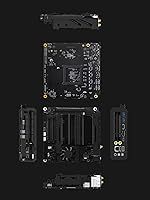
  • Pre-installed heatsink with broad board coverage simplifies the build and handles sustained loads without drama.
  • Full PCIe 5.0 x16 slot means you can pair a modern discrete GPU for a complete, capable gaming rig.
  • Triple-display output across HDMI 2.1, DisplayPort 1.4, and USB-C covers most multi-monitor setups out of the box.
  • WiFi 6E and Bluetooth 5.3 are included, so wireless is ready without sourcing or installing an add-in card.
  • Active SSD cooling prevents PCIe 5.0 drives from thermal throttling during extended transfers or heavy read workloads.
  • No CPU compatibility research needed — a meaningful time-saver for buyers who want a clean, focused build process.

Cons

  • The soldered CPU cannot be upgraded — if you want a faster chip, the entire board must be replaced.
  • BIOS maturity has been a real issue; early buyers encountered boot instability and memory training failures.
  • Firmware update releases are infrequent and poorly documented compared to major desktop motherboard brands.
  • DDR5 kit compatibility is pickier than on mainstream AM5 platforms, making RAM selection research essential.
  • Rear I/O USB port count feels light for a board at this price tier, often requiring an external hub.
  • Community support and troubleshooting resources are sparse — solving niche issues takes considerably more effort.
  • Warranty and post-purchase support from MINISFORUM remain inconsistent based on buyer reports.
  • Heatsink coverage makes accessing M.2 slots and certain board areas during assembly more cumbersome than expected.
  • Sustained all-core workloads will eventually reveal the mobile power ceiling versus a comparable desktop processor.
  • Compatible ITX cases that accommodate a discrete GPU add meaningful cost and selection friction to the build.

Ratings

The MINISFORUM BD790I X3D Mini ITX Motherboard has been scored by our AI system after analyzing verified buyer reviews from global markets, with spam, bot-generated, and incentivized feedback actively filtered out. Scores reflect the real distribution of praise and frustration found across hundreds of ownership experiences — nothing is glossed over. Both the standout strengths and the legitimate pain points are captured honestly in each category below.

CPU Performance
91%
Buyers building compact gaming rigs are consistently impressed by how much raw performance the soldered 7945HX3D delivers in such a small enclosure. The 3D V-Cache advantage is particularly noticeable in CPU-bound titles where frame pacing tightens up noticeably compared to standard HX variants.
A handful of users point out that the mobile power envelope means sustained all-core workloads — like long rendering sessions — throttle slightly compared to a desktop 7950X3D. The gap is real, even if it rarely matters for typical use cases.
Build Quality
88%
The board feels dense and well-constructed in hand, with a heatsink that covers the majority of the PCB surface and shows clear engineering intent rather than a cosmetic afterthought. Buyers report that component placement is tidy and the overall fit and finish is a step above what they expected from a niche manufacturer.
Some users noted that the retention clips on the M.2 slots feel slightly plasticky compared to premium desktop boards, and a few reported minor inconsistencies in the pre-applied thermal interface material coverage under the heatsink.
Thermal Management
84%
Under real gaming loads and multi-hour render jobs, the BD790I X3D holds temperatures in a range that most buyers found acceptable without needing aggressive fan curves. The active SSD cooler is a practical detail that keeps PCIe 5.0 drives from thermal throttling during fast file transfers.
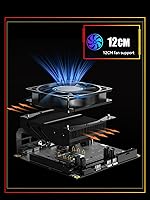
Without attaching an optional 120mm fan to the heatsink, sustained CPU-heavy workloads will push temperatures to the upper boundary of comfortable operation. Users in warmer ambient environments or poorly ventilated cases reported needing to add a fan fairly quickly.
Storage Performance
89%
Dual PCIe 5.0 M.2 slots are a standout feature for this form factor — video editors moving large project files and developers running fast virtual machines report genuinely tangible speed improvements over PCIe 4.0 setups they upgraded from. Nearly 10 GB/s sequential reads in a compact build is still a rare capability.
The PCIe 5.0 SSD ecosystem remains relatively expensive, so buyers who want to max out both slots will face a meaningful cost premium on top of the board itself. Some users also noted the slot placement makes cable management a bit fiddly in tighter ITX cases.
BIOS Maturity
61%
39%
Recent firmware updates have addressed several early stability issues, and buyers who purchased after the first few revision cycles report a noticeably smoother experience. Memory compatibility has improved with newer BIOS versions, with more DDR5 kits now posting reliably.
This is the most consistently flagged concern in buyer reviews. Early adopters encountered memory training failures, intermittent boot issues, and limited BIOS customization options compared to mainstream AM5 desktop boards. The update process itself lacks polish, and release notes are often sparse.
Memory Support
79%
21%
Support for up to 96 GB of DDR5 is genuinely generous for an ITX platform, and buyers running virtualization stacks or memory-hungry creative apps appreciate having headroom that typical mini PCs simply cannot match. Dual-channel configurations run stably once the right kit is selected.
DDR5 compatibility is pickier here than on major desktop platforms — some higher-frequency kits require manual timings or refuse to train at advertised speeds. Users relying on the XMP or EXPO profiles of enthusiast kits have had mixed results.
Connectivity & I/O
86%
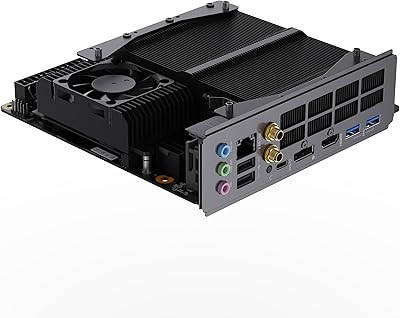
Triple-display support across HDMI 2.1, DisplayPort 1.4, and USB-C is well-regarded by users running multi-monitor productivity setups or connecting a TV alongside a desktop display. WiFi 6E performs reliably for buyers who cannot run Ethernet in their living room or office setup.
A few buyers felt the rear I/O USB port count is modest for a board at this tier — those building dense workstations or frequently connecting multiple peripherals mentioned relying on hubs more than they would prefer. A 2.5GbE wired port would have been appreciated.
PCIe Expansion
83%
The full PCIe 5.0 x16 slot opens up real GPU pairing possibilities, which separates this board from typical embedded mini PC solutions. Buyers who paired it with a mid-range discrete GPU report a well-balanced gaming rig that punches well above its physical size.
ITX cases with enough clearance for a full-length GPU can be expensive and limited in selection, which adds friction to the build process. Some users also noted that running both a GPU and two PCIe 5.0 SSDs simultaneously can stress the platform's power delivery under peak loads.
Ease of Assembly
82%
18%
Compared to sourcing a CPU, cooler, and motherboard separately, buyers appreciate that the BD790I X3D ships ready to drop RAM and storage into — the pre-installed heatsink removes one of the most anxiety-inducing steps for less experienced builders. The included documentation covers the basics adequately.
The dense heatsink coverage that aids thermals also makes accessing certain board areas during assembly more cumbersome than a bare board. A couple of users found the M.2 slot access in particular requires more care than expected given the heatsink overhang.
Noise Levels
85%
The fanless heatsink design means the board itself generates zero noise at idle and low loads, which is a real quality-of-life win for living room builds or quiet home office environments. Users report the overall system stays impressively quiet during light gaming and web browsing.
Once the CPU is under full load and an optional case fan kicks in, acoustic comfort depends heavily on the fan selected by the user rather than anything MINISFORUM controls. Light workloads are nearly silent, but peak performance does require moving some air.
Wireless Performance
81%
19%
WiFi 6E delivers strong real-world throughput for buyers who tested it on 6 GHz band routers, with stable latency during online gaming sessions — an important detail for a platform often placed in living room setups far from a router. Bluetooth 5.3 pairs reliably with controllers and headsets.
A small number of users reported occasional WiFi dropouts that were resolved by firmware updates, suggesting early driver stability was not fully polished. Antenna placement inside compact ITX cases can also limit signal strength depending on case material and orientation.
Value for Money
76%
24%
For buyers who understand what they are getting — a premium mobile CPU permanently attached to a compact, feature-rich ITX board — the price lands in a competitive range relative to buying a desktop CPU and high-end ITX motherboard separately. The integrated approach simplifies budgeting.
The non-upgradable CPU is the persistent asterisk on value. If AMD releases a compelling next-gen mobile processor, this board cannot benefit from it, which makes the long-term cost justification less clear for buyers who typically upgrade CPUs every few years.
Long-Term Support
58%
42%
MINISFORUM has demonstrated a willingness to push firmware updates post-launch, and several early stability issues were addressed within the first few months of availability. Buyers who purchased after the initial firmware wave report a more stable experience overall.
Compared to Asus, MSI, or Gigabyte, MINISFORUM's support infrastructure is limited — community forums are sparse, and response times for warranty claims or technical issues draw mixed feedback. For a platform you cannot simply swap the CPU out of, this is a legitimate long-term risk.
Community & Documentation
53%
47%
A small but growing community of SFF enthusiasts has begun sharing BIOS settings, compatible RAM lists, and case fitment guides across Reddit and dedicated forums, which partially offsets the thin official documentation.
For buyers used to the vast modding and troubleshooting resources available for mainstream desktop platforms, the BD790I X3D can feel isolating when something goes wrong. Official documentation is minimal, and finding verified answers to specific compatibility questions takes real effort.

Suitable for:

The MINISFORUM BD790I X3D Mini ITX Motherboard is purpose-built for a specific kind of buyer, and for that buyer it genuinely delivers. SFF enthusiasts who have been waiting for a compact platform that does not require sacrificing CPU muscle will find this board hits a sweet spot that is hard to replicate any other way. Home theater PC builders who want a nearly silent living room rig capable of handling AAA gaming and 4K media simultaneously are a natural fit, as are home lab users who need high core counts in a dense, low-power enclosure. Content creators working with large video files or running multiple virtual machines will appreciate the dual PCIe 5.0 M.2 slots and the headroom to load up to 96 GB of DDR5. Buyers who simply want to skip the CPU compatibility research and get straight to building will also appreciate that the hardest decision — choosing a processor — has already been made for them.

Not suitable for:

The MINISFORUM BD790I X3D Mini ITX Motherboard is a harder sell for anyone who values platform longevity and CPU upgradability above all else. Because the processor is permanently soldered to the board, there is no path to dropping in a next-generation chip when AMD releases one — the entire board would need to be replaced, which changes the long-term cost calculus significantly. Buyers who regularly push all-core workloads for hours at a time — think large 3D renders or heavy compilation tasks — should be aware that the mobile power envelope will eventually show a gap versus a full desktop 7950X3D under sustained load. Those who prefer the deep BIOS customization, large modding communities, and robust manufacturer support that come with mainstream desktop platforms from Asus, MSI, or Gigabyte may find MINISFORUM's ecosystem thin. Budget-focused builders should also think carefully, since squeezing the most out of this board requires investing in PCIe 5.0 SSDs and fast DDR5 kits, both of which carry a cost premium that adds up quickly.

Specifications

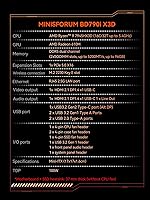
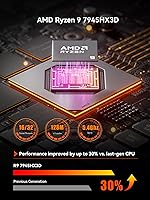
  • CPU: Features a soldered AMD Ryzen 9 7945HX3D processor built on Zen 4 architecture with 16 cores, 32 threads, and a boost clock reaching up to 5.4 GHz.
  • Cache: Total cache capacity is 144 MB combining L2 and L3 with AMD 3D V-Cache technology for reduced memory latency in gaming and data-intensive workloads.
  • Form Factor: Mini ITX form factor designed for compact system builds where space and footprint are primary constraints.
  • Memory Type: Supports DDR5 RAM with a maximum capacity of 96 GB across dual channels.
  • M.2 Storage: Equipped with two PCIe 5.0 M.2 slots capable of sequential read speeds approaching 10 GB/s with compatible NVMe drives.
  • GPU Slot: One full PCIe 5.0 x16 expansion slot accommodates a modern discrete graphics card for gaming or GPU-accelerated workloads.
  • Display Output: Supports up to three simultaneous displays via HDMI 2.1, DisplayPort 1.4, and a USB-C port with display output capability.
  • Wireless: Integrated WiFi 6E provides tri-band wireless connectivity, and Bluetooth 5.3 is included for peripheral and audio pairing.
  • Cooling Design: Ships with a pre-installed fanless heatsink covering approximately 80% of the board surface, with a 120mm fan mount supported and a dedicated active cooler for the M.2 SSD slots.
  • USB Connectivity: Rear I/O includes USB-A and USB-C ports supporting USB 3.2 Gen 2 speeds for external storage and peripheral connectivity.
  • Weight: The board weighs 2.61 pounds, reflecting the substantial integrated heatsink assembly included with the unit.
  • Package Size: Retail packaging measures 13.15 x 8.98 x 2.8 inches, accommodating the board and all included accessories.
  • Manufacturer: Designed and produced by Micro Computer (HK) Tech Limited, operating under the MINISFORUM brand.
  • CPU Socket: The processor is permanently soldered to the board; there is no removable CPU socket, which means the processor cannot be independently replaced or upgraded.
  • Power Architecture: Optimized for lower idle and load power consumption compared to a full desktop platform at a similar performance tier, making it suitable for compact, low-airflow enclosures.
  • Audio: Integrated audio output is supported via the rear I/O, with HD audio header support for front-panel chassis audio connections.
  • Fan Headers: Provides dedicated fan header support for system cooling fans, including the optional 120mm fan mount on the included heatsink.
  • Amazon Ranking: Ranked number 92 in the Computer Motherboards category on Amazon at the time of evaluation, reflecting strong market traction for a niche SFF product.

Related Reviews
MINISFORUM BD790I X3D ITX Motherboard
87%
94%
Gaming Performance
91%
Content Creation Capability
88%
Cooling Efficiency
85%
Build Quality
82%
Ease of Setup
More
ASRock A520M-ITX/AC Mini ITX Motherboard
87%
87%
Performance
91%
Build Quality
90%
Setup & Installation
85%
Wi-Fi and Bluetooth Connectivity
93%
Processor Compatibility
More
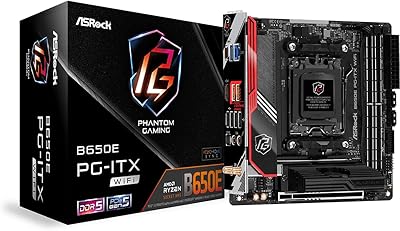
ASRock B650E PG-ITX WiFi Mini-ITX Motherboard
84%
88%
Performance
84%
Build Quality
91%
Wi-Fi Connectivity
72%
Overclocking Stability
89%
Compatibility
More
MINISFORUM 129i7 ITX Mini PC
85%
91%
Performance for Multitasking
78%
Gaming Capability (Light to Medium)
95%
Compactness and Design
89%
Customizability (RAM and Storage)
90%
Setup and Installation
More
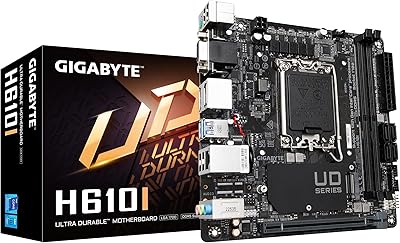
GIGABYTE H610I Mini-ITX Motherboard
85%
89%
Performance
85%
Build Quality
92%
Value for Money
91%
Ease of Installation
75%
Connectivity Options
More
ASRock B850i Lightning WiFi Mini ITX Motherboard
85%
91%
Performance
88%
Build Quality
93%
Overclocking Stability
89%
Connectivity
75%
Ease of Setup
More
GIGABYTE B550I AORUS PRO AX Mini-ITX Motherboard
84%
93%
Feature Density
88%
VRM & Power Delivery
91%
Wireless Connectivity
89%
Storage Options
74%
BIOS & Software
More
MINISFORUM 790S7 Mini ITX PC AMD Ryzen 9 7940HX
81%
88%
Overall Performance
65%
Thermals and Cooling
80%
Graphics Flexibility
90%
Build Quality
92%
Value for Money
More
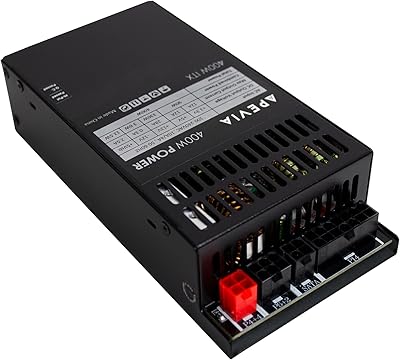
Apevia ITX-PFC400W 400W Flex ATX Power Supply
73%
88%
Modular Design
83%
Value for Money
91%
Form Factor Fit
54%
Fan Noise
63%
Cable Length
More
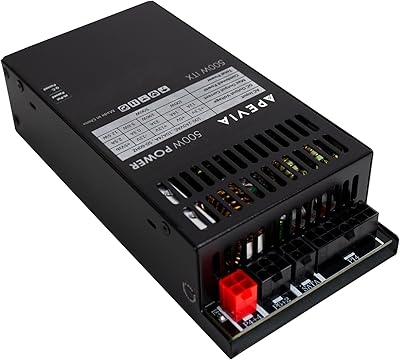
Apevia ITX-PFC500W 500W Flex ATX Power Supply
77%
88%
Cable Management
91%
Form Factor Compatibility
79%
Power Delivery & Rail Stability
54%
Fan Noise & Acoustics
72%
Build & Component Quality
More

FAQ

No, and this is the single most important thing to understand before buying. The Ryzen 9 7945HX3D is soldered directly to the board, so there is no CPU socket and no upgrade path. If you want a faster processor down the line, you would need to replace the entire board.

The board uses DDR5, and while it supports up to 96 GB, not every DDR5 kit plays nicely with it right out of the box. Buyers have had the best luck sticking to validated memory from MINISFORUM's compatibility list, especially for higher-speed kits. XMP and EXPO profiles have been hit or miss on some modules, so it is worth doing a quick check before ordering an enthusiast kit expecting it to run at advertised speeds without manual tuning.

It ships with a pre-installed fanless heatsink that covers most of the board surface — no separate CPU cooler purchase is needed. That said, under sustained heavy loads you will want to attach a 120mm fan to the heatsink mount, especially if your case does not have strong airflow. An active cooler for the M.2 slots is also included, which helps keep PCIe 5.0 drives from throttling.

Early units shipped with BIOS versions that had real stability problems — memory training failures and occasional boot quirks were commonly reported. MINISFORUM has pushed several firmware updates since launch, and boards purchased more recently appear to be in a much better state. It is still worth checking for a BIOS update immediately after your first boot regardless.

Yes, the PCIe 5.0 x16 slot supports modern discrete GPUs, and buyers have successfully paired the board with current-generation cards for gaming builds. The main practical challenge is finding a Mini ITX case that fits a full-length, dual-slot GPU — that narrows your case options and can add to the overall build cost.

In CPU-bound gaming scenarios, the 7945HX3D punches surprisingly close to the desktop 7950X3D thanks to the shared 3D V-Cache architecture. Where the gap shows up more clearly is in sustained all-core workloads — the mobile power limits mean the desktop chip will pull ahead during long rendering or compilation sessions. For gaming specifically, most users find the performance difference narrower than the spec sheet might suggest.

Yes. The MINISFORUM BD790I X3D Mini ITX Motherboard supports triple-display output through its HDMI 2.1, DisplayPort 1.4, and USB-C ports simultaneously. If you are also running a discrete GPU, display routing will depend on whether you connect monitors to the board or the GPU.

MINISFORUM typically offers a limited warranty on their boards, but buyer experiences with the support process have been mixed. Response times for warranty claims and technical issues are inconsistent compared to larger brands. Given that the CPU cannot be swapped out independently, it is worth registering the product and keeping purchase documentation in case something goes wrong.

At idle and during light use, the fanless heatsink design keeps the system nearly silent — it is a genuine benefit for living room builds. Under sustained gaming loads, noise level depends almost entirely on the case fan you attach to the heatsink and how aggressively your fan curve is tuned. The board itself produces no fan noise, but moving enough air to keep the 7945HX3D happy under full load will require at least one active fan.

It is a strong option for a compact home lab build. The 16-core CPU handles multiple simultaneous virtual machines well, DDR5 support up to 96 GB gives plenty of headroom for memory-hungry workloads, and the dual PCIe 5.0 M.2 slots keep storage throughput fast. The main consideration is that the soldered CPU means you are committing to this processor for the life of the board, so make sure the core count and IPC meet your expectations now and for the next few years.

Where to Buy