Mesqool CR1030 Emergency Hand Crank Weather Radio
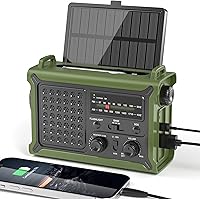
Mesqool CR1030 Emergency Hand Crank Weather Radio — image 1
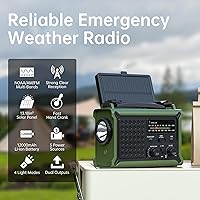
Mesqool CR1030 Emergency Hand Crank Weather Radio — image 2
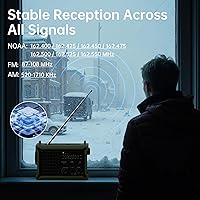
Mesqool CR1030 Emergency Hand Crank Weather Radio — image 3
Mesqool CR1030 Emergency Hand Crank Weather Radio — image 4
Mesqool CR1030 Emergency Hand Crank Weather Radio — image 5
Mesqool CR1030 Emergency Hand Crank Weather Radio — image 6
Mesqool CR1030 Emergency Hand Crank Weather Radio — image 7
Mesqool CR1030 Emergency Hand Crank Weather Radio — image 8
Mesqool CR1030 Emergency Hand Crank Weather Radio — image 9
78%
22%

Overview

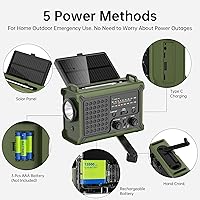
The Mesqool CR1030 Emergency Hand Crank Weather Radio lands in the mid-range space where serious preparedness buyers shop — not a throwaway gas-station radio, but not a professional-grade unit either. What sets it apart is its five power sources: solar, hand crank, built-in lithium battery, USB-C input, and a AAA backup slot. Few competitors at this price offer that kind of redundancy. Released in April 2025, it is a genuinely new product, so long-term reliability data is still thin. The army green build feels solid in hand, sized thoughtfully for a confident grip. Worth noting upfront: it uses an analog dial tuner, has no digital display, and covers only AM, FM, and NOAA — no shortwave.

Features & Benefits

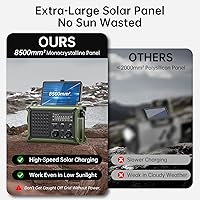
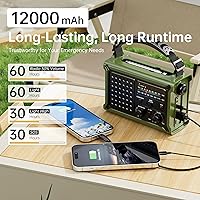
The standout on paper is the 8500mm² solar panel — roughly four times the surface area of the decorative panels found on budget models. A bigger panel means meaningfully faster solar charging, especially relevant on overcast days when smaller panels barely trickle. The hand crank has been redesigned with a larger copper coil and stronger magnet, and while it is noticeably smoother than cheap alternatives, treat it as a last-resort backup, not a phone-charging strategy. The 12000mAh battery is a genuine capacity claim, capable of keeping the radio running for days or topping off a smartphone. Dual USB-A and USB-C outputs let you charge two devices at once. The LED flashlight throws a solid focused beam, and the frosted reading lamp is a genuinely useful addition for tent use.

Best For

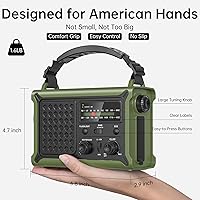
This emergency radio makes the most sense for storm-prone households — think hurricane belts, tornado corridors, or anywhere the grid goes down regularly and NOAA alerts matter. Campers and backpackers will appreciate having a phone charger, lantern, and weather radio packed into 1.6 pounds. It is also a strong pick for emergency preparedness kits where every item has to earn its slot by doing multiple jobs. The large tuning knob, clearly labeled controls, and straightforward operation make it a genuinely good gift for elderly family members who do not want to fuss with menus. If you are an avid shortwave listener or strongly prefer a digital frequency display, this weather radio is not the right fit — and that is worth knowing before you buy.

User Feedback

The Mesqool hand crank radio carries a strong average rating, though it launched in April 2025, so the review pool is still modest. Early buyers consistently praise signal clarity and the quality feel of the build — two things that often separate real emergency radios from shelf-fillers. A few reviewers noted that hand-cranking charges more slowly than expected, which honestly aligns with realistic performance for any crank-powered device. Some buyers confirmed the unit held up during actual power outages, which carries more weight than any spec sheet. On the downside, there is not yet enough long-term data to speak confidently about battery longevity or crank durability after heavy use — worth revisiting once a broader base of real-world feedback has accumulated.

Pros

  • Five independent power sources mean you are almost never left without a way to keep it running.
  • The oversized monocrystalline solar panel charges noticeably faster than the small decorative panels found on budget competitors.
  • A genuine 12000mAh battery capacity holds up to scrutiny — early buyers report it runs the radio and lights for extended periods.
  • Dual USB-A and USB-C outputs let you charge two devices at the same time, a practical edge during a blackout.
  • Signal clarity on NOAA and FM bands draws consistent praise, even in areas where cheaper radios struggle.
  • The frosted reading lamp is a surprisingly useful feature — soft, even light that does not kill your night vision.
  • Controls are large, clearly labeled, and easy to operate in the dark or under stress.
  • At under two pounds, this emergency radio is compact enough for a bug-out bag without dominating the space.
  • The SOS alarm and 3.5mm headphone jack add practical value that many radios at this price point skip.
  • Build quality feels noticeably more solid than typical budget-tier emergency radios in the same category.

Cons

  • No shortwave band support rules it out for listeners who monitor international or aviation frequencies.
  • The analog dial tuner makes precise station tuning harder than a digital display would allow.
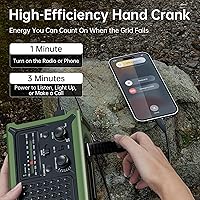
  • Hand-crank charging is genuinely slow — useful as a last resort, but not a reliable way to top up a modern smartphone.
  • Launched in April 2025, so long-term durability of the crank mechanism and battery remains unverified.
  • No alerts in power-off mode, meaning the radio must be switched on to receive NOAA weather warnings.
  • The army green color is the only available option, which may not suit buyers who prefer discreet or neutral aesthetics.
  • No Type-C charging adapter is included in the box, which is a minor but avoidable inconvenience.
  • The review pool is still relatively small, making it harder to assess how the unit holds up after months of real use.

Ratings

The scores below reflect an AI-driven analysis of verified global buyer reviews for the Mesqool CR1030 Emergency Hand Crank Weather Radio, with spam, bot activity, and incentivized feedback actively filtered out to ensure the results represent genuine user experiences. Each category captures both what real buyers praised and where they ran into frustration, so you get an honest picture rather than a polished highlight reel. This emergency radio earns strong marks in several critical areas, but a handful of limitations are reflected transparently in the scores.

Signal Reception
88%
Buyers in rural and suburban areas consistently report that NOAA and FM reception is noticeably cleaner than on cheaper competitors they previously owned. The extended antenna and noise-reduction circuitry make a real difference when tuning in weather alerts during a storm, which is exactly when you need the signal most.
A small number of users in dense urban environments or heavily wooded areas noted occasional static on AM frequencies. Fine-tuning with an analog dial can be frustrating when trying to nail a weak station, and the lack of a digital display makes it harder to return to a specific frequency precisely.
Solar Charging Speed
76%
24%
The oversized monocrystalline panel genuinely outperforms the decorative panels on budget radios — buyers who tested it side-by-side with older units noticed a meaningful difference in charge accumulation on partly cloudy days. Leaving it on a windowsill or dashboard for a few hours provides a useful top-up to the internal battery.
In realistic conditions — indirect light, an overcast sky, or a shaded campsite — charging slows down considerably. Several buyers expected faster results based on the listing description and found the solar input more of a slow trickle than a rapid charge, which can be disappointing if you are relying on it as your primary recharge method.
Hand Crank Performance
63%
37%
The reinforced crank arm is smoother and less fatiguing to operate than the flimsy mechanisms on ultra-budget radios, and users appreciate that it actually generates a usable charge rather than just spinning freely. In a pinch — no outlet, no sun — being able to crank even a small amount of power back into the battery is genuinely reassuring.
Expectations need to be calibrated here: multiple buyers report that sustained cranking for several minutes yields only a modest charge percentage on a smartphone, far short of what the marketing language implies. The crank is best understood as a true last-resort tool, not a practical everyday charging method, and buyers who expected more were consistently let down.
Battery Capacity
84%
Unlike many competitors that inflate mAh numbers dramatically, early buyers report the 12000mAh claim appears to hold up reasonably well in real use — running the radio and lights for multiple days during a prolonged outage without hitting empty. That kind of runtime genuinely matters when a storm knocks out power for 48 hours or more.
Because this radio launched in early 2025, there is not yet enough long-term data to confirm how battery capacity degrades after a year or two of charge cycles. A handful of buyers also noted that simultaneously running the radio, flashlight, and USB output drains the battery faster than expected, which is worth factoring into your planning.
Build Quality
82%
18%
Buyers frequently comment that the unit feels more solid and substantial than the price point suggests — the housing does not flex when gripped firmly, and the buttons have a satisfying tactile response. The army green finish has a practical, no-nonsense look that fits its intended use case rather than trying to look like a consumer gadget.
There is no official IP water-resistance rating, which concerns buyers who plan to use it in genuine outdoor or storm conditions. A few users also noted that the tuning knob, while large and easy to grip, can feel slightly loose after extended use, raising questions about long-term mechanical durability that only time will answer.
Ease of Use
91%
The control layout is refreshingly straightforward — large labeled buttons, a clearly marked tuning dial, and distinct switches for each function mean most users figure it out without opening the manual. Buyers who gifted it to elderly relatives specifically praised this simplicity, noting their family members could operate it confidently during an actual emergency.
The analog dial can make it tricky to return to an exact station after bumping the knob, and without a frequency display there is no way to confirm which precise frequency you are tuned to. Users who are accustomed to digital preset radios may find the tuning process a minor but genuine adjustment.
Flashlight Utility
79%
21%
The dual-mode LED flashlight impressed buyers who used it during actual power outages — the focused beam throws usable light at distance, and the two brightness settings let you conserve battery when you just need to navigate a dark hallway. Having both a spotlight and a soft reading lamp in one unit saves the trouble of packing a separate lantern.
The frosted reading lamp, while a useful touch, is not particularly bright at its lower setting — adequate for reading a map in a tent but not for detailed tasks in a fully dark room. A few buyers noted they wished the flashlight had a strobe or red-light mode for additional signaling versatility.
Phone Charging Output
71%
29%
Having both USB-A and USB-C output ports is a practical advantage that many single-output competitors lack — during a family emergency, being able to charge two phones simultaneously from one device is genuinely useful. Buyers confirmed that the 12000mAh reserve provides multiple full charges for a standard smartphone when the battery is topped up.
Charging speed via USB output is standard rather than fast-charge spec, so topping off a newer flagship phone takes longer than users accustomed to 25W or 45W wall adapters might expect. Output speed also drops noticeably when solar or crank input is being used simultaneously.
SOS Alarm
74%
26%
The 115-decibel alarm is genuinely loud — users who tested it indoors described it as startling and impossible to ignore, which is precisely what you want from an emergency signal. It activates quickly and does not require navigating a menu, which matters when seconds count.
There are no adjustable SOS patterns or tones, limiting its versatility for different signaling scenarios. Buyers also noted that sustained SOS alarm use drains the battery faster than passive radio listening, so it should be used strategically rather than left running.
Portability
77%
23%
At 1.59 pounds and roughly the size of a thick paperback book, this weather radio fits into a bug-out bag or camping pack without dominating the load. The included carrying strap adds a convenient way to hang it from a tent pole or carry it hands-free during an evacuation.
Compared to ultra-compact emergency radios that prioritize minimum weight, this unit is on the heavier side — backpackers counting every ounce may find 1.59 pounds a significant commitment for a single device. The army green housing is also available in only one color, limiting its appeal for buyers who prefer inconspicuous or neutral gear.
Value for Money
81%
19%
Given the combination of a large solar panel, credible battery capacity, dual USB outputs, dual lighting modes, and five power sources, buyers generally feel the asking price is fair for what is delivered. Compared to spending the same amount on a single-function budget radio and a separate power bank, this weather radio consolidates real utility into one purchase.
The lack of a USB-C adapter in the box feels like a cost-cutting move that leaves buyers needing to source one separately. Buyers who discover after purchase that shortwave and digital display are absent — features common in similarly priced alternatives — occasionally feel the value proposition is not quite as strong as it initially appeared.
NOAA Alert Coverage
86%
Coverage of all seven NOAA weather frequencies means buyers in any U.S. region can tune into their local emergency broadcast without worrying about missing a channel. Signal quality on NOAA bands specifically drew consistent praise from buyers in Gulf Coast and mid-Atlantic states where weather alerts are a seasonal necessity.
The absence of automatic alerting in power-off mode is a real functional gap for buyers who want passive overnight protection — the radio must be on and tuned correctly to receive warnings. There is also no alert volume control independent of the main volume knob, which some users found inconvenient.
Review Maturity
58%
42%
The reviews that do exist skew positively and include specific real-world accounts of use during power outages and camping trips, lending credibility to the early feedback. The high average rating is consistent across multiple verified buyer profiles, suggesting it is not an artifact of a single wave of incentivized reviews.
With a launch date of April 2025, the review pool is still relatively thin, making it statistically harder to identify rare but serious defects or failure patterns. Long-term durability questions — particularly around crank mechanism wear and battery cycle degradation — simply cannot be answered yet with the available data.

Suitable for:

The Mesqool CR1030 Emergency Hand Crank Weather Radio is built for people who take preparedness seriously without wanting to spend a fortune on professional-grade gear. It fits naturally into hurricane-prone households along the Gulf and Atlantic coasts, where losing power for days at a time is a real scenario, not a hypothetical. Campers and backpackers who want one device to handle weather alerts, phone charging, and nighttime lighting will find the multi-function design genuinely practical rather than gimmicky. The large tuning knob, clearly labeled buttons, and straightforward controls also make it a thoughtful gift for elderly relatives who need reliable emergency gear without a learning curve. If you have previously bought a cheap solar radio only to discover the panel barely trickles a charge in full sunlight, the oversized monocrystalline panel here is a meaningful step up that addresses exactly that frustration.

Not suitable for:

The Mesqool CR1030 Emergency Hand Crank Weather Radio is not the right pick for buyers who rely on shortwave frequencies to monitor international broadcasts or aviation bands — it covers only AM, FM, and NOAA, full stop. Hobbyist radio enthusiasts who prefer a precise digital frequency display will find the analog dial limiting, particularly when trying to lock onto a specific station quickly. Hand-crank charging is also not fast enough to serve as a meaningful power source for heavy smartphone users; if your primary need is a robust off-grid phone charger, a dedicated solar power bank will serve you far better. Because this is a newly launched product with a still-growing review base, buyers who want years of verified reliability data before committing may want to wait a few more months. And if you are shopping for something ultralight for long-distance backpacking, the 1.6-pound weight may feel like more than you want to carry.

Specifications

  • Brand & Model: Manufactured by Mesqool (model CR1030), a consumer electronics brand focused on emergency preparedness devices.
  • Dimensions: The unit measures 6.8×4.7×2.9 inches, sized to fit comfortably in one hand for extended use.
  • Weight: Complete unit weighs 1.59 pounds, balancing portability with the heft of a solid, non-flimsy build.
  • Battery: Built-in 12000mAh lithium-ion rechargeable battery provides the primary power reservoir for radio, lights, and USB output.
  • Power Sources: Supports five charging methods: built-in lithium battery, monocrystalline solar panel, hand crank generator, USB-C input (5V/2A), and 3×AAA alkaline batteries as a final backup.
  • Solar Panel: Features an 8500mm² monocrystalline solar panel, which captures more sunlight per unit area than polycrystalline alternatives and performs better in low-light conditions.
  • Radio Bands: Receives AM, FM, and all 7 NOAA weather alert channels; shortwave reception is not supported.
  • Tuner Type: Uses an analog dial tuner for station selection; there is no digital frequency display or preset memory function.
  • USB Outputs: Provides two simultaneous charging outputs: one standard USB-A port and one USB-C port, allowing two devices to charge at the same time.
  • Flashlight: Integrated 2-mode LED flashlight projects a focused beam with a stated range of up to 260 feet, with high and low brightness settings.
  • Reading Lamp: Secondary frosted LED reading lamp diffuses light for soft, even illumination and offers two brightness levels suitable for close-range use.
  • SOS Alarm: Built-in audible SOS alarm function is included for emergency signaling situations.
  • Headphone Jack: Equipped with a standard 3.5mm headphone jack for private listening without a Bluetooth connection.
  • Color: Available exclusively in Army Green; no other color variants are currently offered.
  • In the Box: Package includes the radio unit, a carrying strap, a USB charging cable, and an owner's manual; a USB-C power adapter is not included.
  • Availability: First listed for sale in April 2025, making it a recently introduced product with a growing but still limited field review history.

Related Reviews
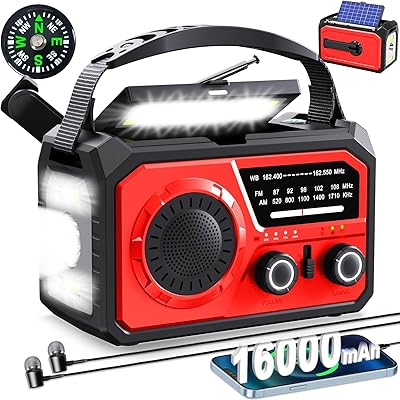
ZZMICHP 16000mAh Hand Crank Emergency Weather Radio
85%
92%
Battery Life & Power
87%
Ease of Use
68%
Portability & Size
85%
Durability & Build Quality
90%
Radio Performance
More
Rckskaya Condor 1 Emergency Hand Crank Radio
73%
88%
Power Source Versatility
72%
NOAA Weather Reception
83%
Flashlight Performance
67%
Phone Charging Capability
79%
SOS Alarm & Signaling
More
OnLyee CR1030 Emergency Weather Radio
76%
88%
Power Source Redundancy
83%
Hand Crank Durability
61%
Solar Charging Performance
79%
NOAA Reception Quality
67%
Battery Capacity & Phone Charging
More
Esky 10000mAh Emergency Hand Crank Radio
73%
91%
Value for Money
84%
Radio Reception
72%
Battery Performance
47%
Hand Crank Charging
53%
Solar Panel Efficiency
More
AXYEBI AB-US-107Y Emergency Weather Radio
75%
91%
Value for Money
82%
NOAA Signal Reception
88%
Flashlight Performance
63%
Build Quality & Durability
67%
Hand Crank Usability
More
Givoust MD-107R Hand Crank Emergency Weather Radio
75%
83%
NOAA Reception Quality
78%
Battery Life
81%
Charging Versatility
57%
Hand Crank Efficiency
66%
Build Quality & Durability
More
RunningSnail Emergency Crank Weather Radio
72%
88%
Value for Money
84%
Power Redundancy
91%
Built-in Cables
73%
NOAA Reception Quality
62%
Battery Capacity
More
DexScout Crank Emergency Weather Radio 10000mAh
86%
91%
Value for Money
88%
Battery Life and Charging
94%
Portability & Size
85%
Weather Alert Accuracy
90%
Build Quality and Durability
More
Pristar Hand Crank 10000mAh Emergency Weather Radio
71%
83%
Value for Money
76%
Build Quality
52%
Hand Crank Performance
78%
NOAA Reception
47%
Solar Charging
More
GIDEZH H27 30000mAh Emergency Weather Radio
75%
82%
Battery Capacity
86%
NOAA Reception Quality
78%
Charging Versatility
88%
All-in-One Convenience
74%
Flashlight Performance
More

FAQ

Honestly, the hand crank is best thought of as a true last-resort option rather than a practical phone charger. Cranking continuously for several minutes will give you a small percentage of charge — enough to make an emergency call, but not enough to meaningfully top off a modern smartphone. If phone charging during outages is your main priority, keep a dedicated power bank alongside this radio.

The 8500mm² monocrystalline panel performs better in low-light conditions than the smaller polycrystalline panels common on budget radios, but it still charges most efficiently in direct sunlight. Through a glass window, output will be reduced noticeably. On a heavily overcast day, charging will be slow — plan to supplement with USB-C input when sunlight is limited.

No — the radio needs to be switched on and tuned to a NOAA channel to receive weather alerts. It does not have an automatic power-on alert feature, so it will not wake you from sleep if a tornado warning is broadcast while the unit is off. If you want passive overnight alerting, look for radios specifically marketed with an alert-in-power-off mode.

Yes, the unit accepts 3 AAA alkaline batteries as a backup power source, which is one of the more practical design choices here. It means that even in a prolonged outage where solar and crank options are exhausted, a fresh set of standard batteries from any convenience store will get you back up and running.

The product does not carry an official IP water-resistance rating, and Mesqool does not advertise it as waterproof. It should handle light splashes reasonably well given its solid construction, but you should not submerge it or leave it out in heavy rain. For camping use, store it in a dry bag or inside your pack if wet weather is expected.

Yes, this weather radio covers all seven NOAA Weather Radio frequencies. You will need to tune to the correct local channel manually using the analog dial, as there is no automatic channel scanning or preset memory. A quick search for your region's NOAA frequency will tell you exactly where to set the dial.

Yes, you can charge the internal battery via the USB-C input port while simultaneously using the USB-A output port to charge a device. Just note that the input port and output ports are separate functions — the USB-C port labeled for input draws power in, while the USB-A and USB-C output ports push power out to your devices.

The SOS alarm is rated at 115 decibels, which is genuinely loud — roughly equivalent to a power drill at close range. At that volume, it should be audible from a meaningful distance in an outdoor environment, though thick walls or heavy wind will reduce range. It is a useful feature but should be seen as a supplement to other signaling methods, not a replacement for a dedicated personal locator beacon.

The crank mechanism uses an upgraded internal generator with a reinforced magnet and larger copper coil compared to basic budget models, and initial buyers report it feels sturdy. That said, this radio only launched in early 2025, so there is not yet enough long-term user data to say confidently how the crank holds up after years of regular use. For now, treat it as well-built for its class, but avoid using it as your sole charging method if longevity is a top concern.

It is actually a solid choice for that use case. The controls are intentionally simple — a large tuning knob, clearly printed labels, and physical buttons that do one obvious thing each. There are no apps, no Bluetooth pairing, and no menu systems to navigate. The main thing to do beforehand is tune it to the correct local NOAA channel and show them how to switch between the flashlight and reading lamp modes, and they should be self-sufficient from there.