Overview

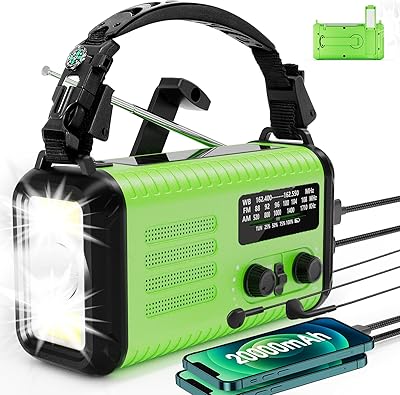
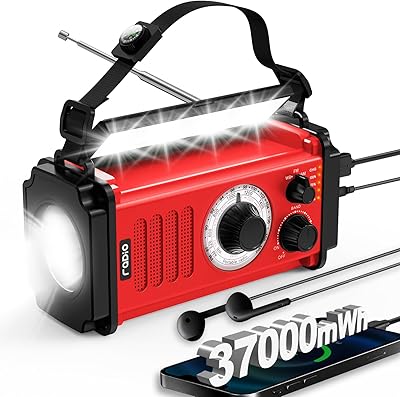
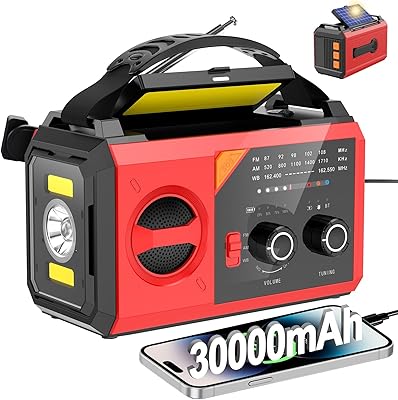
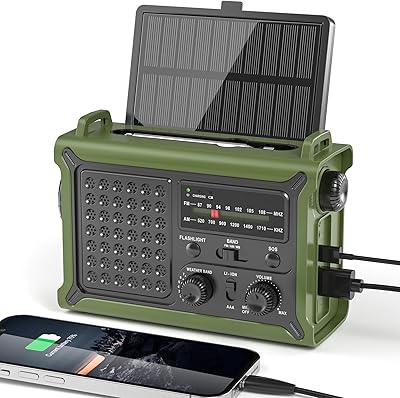
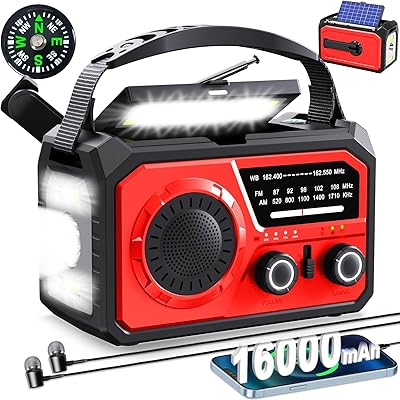
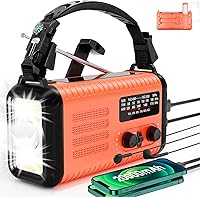
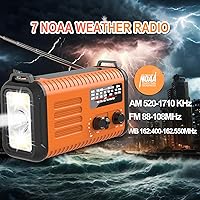
The Rckskaya Condor 1 Emergency Hand Crank Radio arrived in late 2024 as a mid-range contender in a crowded survival gear market, and it makes its purpose clear the moment you pick it up. The bright orange casing and chunky, purposeful build are not accidents — they signal that this is a tool meant to be grabbed quickly in a crisis, not tucked away and forgotten. It combines NOAA weather alerts, AM/FM reception, multiple power sources, and several utility features in one compact unit. For a device that ranked among the top 120 weather radios on Amazon within months of launch, early market traction suggests buyers are paying attention.
Features & Benefits

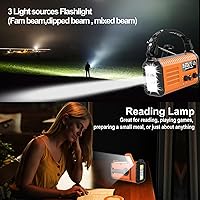
What makes this emergency crank radio genuinely useful in a real emergency is its refusal to rely on a single power source. You can charge the internal battery via USB before a storm hits, let the solar panel top it off during daylight, or fall back on the hand crank when everything else runs dry — a practical redundancy that matters when infrastructure fails. The NOAA tuner pulls in weather band alerts for hurricanes, tornadoes, and severe storms, though it is worth knowing that manual station scanning is required; there is no auto-scan or alert function. A three-mode flashlight and a separate reading lamp round out the feature set, alongside dual USB-A and Type-C charging ports that can power two phones at once.

Best For

This survival radio makes the most sense for people who take preparedness seriously but are not yet deep into specialized gear. Homeowners in hurricane-prone or tornado-risk regions will appreciate having a single go-bag device that covers weather alerts, lighting, navigation, and phone charging without needing to assemble four separate tools. Campers and hikers get a lightweight backup for off-grid trips. It also works well as a car emergency kit addition — compact enough to stow in a trunk and capable enough to be genuinely useful if you end up stranded in bad weather. For gift buyers, it is one of the more thoughtful safety items you can give someone who lives alone or in a storm-vulnerable area.

User Feedback

Buyer sentiment around the Condor 1 is generally positive but not without caveats. The hand crank mechanism and flashlight brightness draw consistent praise — people seem relieved that the crank turns smoothly and the light output is strong enough to actually be useful. The manufacturer-stated 20000mAh battery capacity is harder to verify, and some buyers have noted that real-world phone charging performance falls short of what that number implies. Reception quality is a recurring mixed point; in weak-signal areas, the tuner struggles, and the manual-only scanning adds friction when you are trying to lock onto a station fast. Build quality gets acceptable marks for the price, though the plastic casing feels lightweight.

Pros

  • Four independent power sources — battery, hand crank, solar, and USB — mean you are rarely left with a dead device in a crisis.
  • The hand crank mechanism is smooth and accessible, even for older users or those unfamiliar with emergency gear.
  • Dual USB-A and Type-C outputs let you charge two phones at the same time during a power outage.
  • The three-mode flashlight delivers genuinely useful brightness, not the token-level output common in budget multi-tools.
  • A separate reading lamp is a practical touch for shelter situations where you need softer, close-range illumination.
  • NOAA weather band coverage is solid for real-time severe weather alerts across hurricane, tornado, and storm scenarios.
  • The SOS siren and strobe combination is loud and visible enough to serve a real distress-signaling function.
  • Compact dimensions and a 1.53-pound weight make it easy to toss into a go-bag without adding significant bulk.
  • The included compass and whistle add basic but functional navigation and signaling capability at no extra cost.
  • A headphone jack makes private listening possible in shared shelter situations — a small but genuinely useful detail.

Cons

  • No automatic NOAA alert scanning means you have to manually tune in during an emergency, which adds unnecessary friction.
  • The 20000mAh battery capacity is manufacturer-stated and has not been independently verified; real-world phone charging output may disappoint.
  • Radio reception in weak-signal or rural fringe areas is inconsistent and can make reliable station locking difficult.
  • The plastic casing feels lightweight, which raises reasonable questions about long-term durability under rough handling.
  • The compass, while included, is basic — adequate for rough orientation but not reliable enough for serious backcountry navigation.
  • Solar charging is slow in low-light or overcast conditions, limiting its usefulness during prolonged storm events when it is needed most.
  • No auto-alert function means the radio will not wake you or notify you of a NOAA broadcast you did not actively tune to.
  • The reading lamp, while present, is secondary in brightness and positioning compared to the main flashlight modes.

Ratings

Our AI scoring system analyzed verified global buyer reviews for the Rckskaya Condor 1 Emergency Hand Crank Radio, actively filtering out incentivized, bot-generated, and duplicate feedback to surface what real owners actually experienced. The scores below reflect a transparent synthesis of both the genuine strengths and the recurring frustrations reported across thousands of purchase-verified interactions. Where this emergency crank radio earns trust, the scores show it — and where it falls short for certain buyers, that is reflected just as honestly.

Power Source Versatility
88%
Having four independent ways to power the device — USB pre-charge, hand crank, solar panel, and internal battery — genuinely reduces anxiety during extended outages. Buyers in hurricane-prone areas specifically praised the redundancy, noting that even when their power bank ran dry, they could keep the radio running through cranking or solar top-offs during breaks in the storm.
Solar charging disappointed users during prolonged cloudy weather, which is exactly when a storm radio is most needed. Several buyers noted the solar input feels more like a supplemental trickle than a viable standalone charging method in overcast or indoor conditions.
NOAA Weather Reception
72%
28%
In suburban and urban environments with reasonable signal strength, the NOAA weather band performs reliably and delivers clear severe weather alerts for hurricanes, tornadoes, and flash flood warnings. Users who live within strong-signal range of a National Weather Service transmitter found the audio quality acceptable for emergency monitoring.
Manual-only tuning is a persistent frustration — users have to actively scan for the right NOAA channel rather than being automatically alerted, which defeats the purpose in a fast-moving emergency at night or during sleep. Reception in rural or fringe-signal areas was inconsistently reported as weak and prone to interference.
Flashlight Performance
83%
The three-mode LED flashlight drew some of the most consistent praise in buyer feedback, with users appreciating that the far-beam mode delivered genuinely useful throw distance rather than the dim, token output common in multi-tool emergency devices. Campers and car emergency kit users specifically called out the flashlight as one of the most practically useful aspects of this survival radio.
A small number of users reported that the beam intensity diminishes noticeably as the battery level drops, which is a concern during extended outages when conserving every source of light matters. The lack of a strobe warning mode separate from the SOS function also limits its versatility for signaling without triggering the full alarm.
Phone Charging Capability
67%
33%
The dual USB-A and Type-C ports are a practical addition that several buyers genuinely appreciated — being able to charge two phones at once in a shared household during a blackout is more useful than it sounds. For short emergency top-ups, most users reported getting meaningful charge into their phones, enough to send messages or make calls.
The manufacturer-stated 20000mAh battery capacity has been a source of skepticism among buyers, with multiple reviewers noting that real-world phone charging output does not align with what that number implies. Users expecting multiple full phone charges were often disappointed, suggesting the rated capacity either degrades quickly or does not translate efficiently through the hardware.
SOS Alarm & Signaling
79%
21%
The SOS siren volume was praised as genuinely loud — loud enough to be heard outdoors at a distance, which matters in wilderness distress situations. The combined strobe and siren activation gives both audible and visual signaling, and the whistle included in the package adds a non-battery-dependent backup option that hikers and campers appreciated.
Activating the SOS alarm requires a deliberate three-second button hold, which could be a problem for a disoriented or injured user under stress. A few buyers also noted that the strobe is less visible in bright daylight compared to night or low-light scenarios, limiting its outdoor utility during daytime emergencies.
Build Quality & Durability
63%
37%
The orange casing is intentionally visible and the overall form factor feels purposefully designed for emergency use rather than casual electronics. Most buyers found the unit sturdy enough for standard home storage and light outdoor use, and the hand strap integration feels practical rather than decorative.
The plastic casing is a common point of criticism — buyers at this price tier described it as feeling somewhat hollow or lightweight, raising questions about how well the unit would hold up after a drop onto hard surfaces. A few users reported minor cosmetic wear and button-feel issues after several weeks of regular testing, which does not inspire confidence for long-term emergency kit storage.
AM/FM Radio Quality
69%
31%
AM reception held up reasonably well for buyers in areas with strong regional broadcast signals, and FM performed adequately for standard listening scenarios during outings or quiet evenings at a campsite. The headphone jack is a practical addition that several buyers praised for nighttime or shared-space listening without disturbing others.
The manual tuning experience is dated and clunky by modern standards — there is no digital display showing frequency, which makes locking onto a specific station more trial-and-error than it needs to be. FM reception in particular was reported as susceptible to interference and signal drift, especially when the device was moved or placed near other electronics.
Reading Lamp
61%
39%
The dedicated reading lamp is a genuinely thoughtful feature for shelter-in-place scenarios, providing softer ambient light appropriate for close-range tasks like reading instructions, preparing food, or keeping children calm during an outage. It draws less power than the main flashlight modes, which is useful for extending battery life during long evenings without grid power.
Most buyers treated the reading lamp as a secondary feature and some described it as underpowered compared to what the product description implies. It is bright enough for immediate close-range tasks but not useful as a room-filling light source, and the positioning on the unit means it does not angle as flexibly as a clip-on reading light would.
Portability & Form Factor
84%
At 1.53 pounds and roughly the size of a thick hardcover book, this emergency crank radio fits naturally into a go-bag, backpack, or car glove compartment without demanding significant space. Buyers who rotate it between a home kit and a camping pack reported that the size-to-feature ratio makes it one of the more practical all-in-one options at this price point.
The unit is bulkier than minimalist hikers would prefer — ultralight backpackers or those already carrying substantial gear may find it competes uncomfortably with other pack essentials. The hand crank also adds a protruding element that requires a bit more careful packing to avoid snagging on other bag contents.
Compass Accuracy
57%
43%
For basic orientation tasks — confirming which direction is roughly north after getting turned around on a trail or in an unfamiliar area — the included compass functions adequately and gives most buyers the directional grounding they need in a mild emergency situation.
Buyers with any meaningful outdoor navigation experience noted that the compass is not precise enough for reliable backcountry use, with minor deflection issues and a slow needle settle time. It is best understood as a basic emergency orientation tool rather than a substitute for a quality standalone trail compass.
Ease of Use
76%
24%
The control layout is simple enough that first-time emergency radio users, including older adults, could operate the key functions without extensive reading of the manual. The hand crank mechanism was specifically praised for being intuitive and smooth, which matters when someone is learning to use the device in a stressful situation for the first time.
The manual-only station scanning and absence of any digital frequency display create a steeper learning curve for the radio tuning function than the rest of the device suggests. Users who expected the simplicity of a modern digital device were surprised by how analog and deliberate the tuning process feels under pressure.
Value for Money
74%
26%
For a device that bundles NOAA reception, multiple charging methods, a flashlight, a reading lamp, SOS signaling, and phone charging into a single unit at a mid-range price, the Condor 1 offers a reasonable breadth of functionality relative to its cost. Buyers who compared it against purchasing these tools separately generally concluded it represents fair value for casual preparedness use.
The unverified battery capacity claim and the manual-only tuning limitation are the two features most likely to leave buyers feeling the value proposition was slightly overstated. For buyers who prioritize one specific function — like radio reception quality or high-output charging — there are more specialized options available at a similar or slightly higher price point.
Setup & Out-of-Box Experience
81%
19%
Most buyers reported the Condor 1 was ready to use almost immediately out of the box — the included manual is straightforward, the battery arrives with some pre-charge, and the core functions are accessible without any software setup or configuration. This simplicity is especially important for a device intended to function during high-stress emergency situations.
The absence of included charging cables was noted as a minor frustration by buyers who expected a complete kit, and a few users mentioned the manual could be clearer about how to maximize hand-crank efficiency. Pre-charging the battery fully before storing the unit in an emergency kit is essential but not strongly emphasized in the out-of-box materials.

Suitable for:

The Rckskaya Condor 1 Emergency Hand Crank Radio is a strong fit for anyone who lives in a region where severe weather is a genuine seasonal concern — think Gulf Coast homeowners bracing for hurricane season, Midwest families in tornado country, or Pacific Northwest residents dealing with winter storm outages. Its combination of NOAA weather alerts, built-in lighting, and phone-charging capability means a single device can cover several critical needs when the power goes out and cellular networks are strained. Campers and hikers will also find real value here, particularly those who want a lightweight, multi-purpose backup tool without carrying separate devices for communication, navigation, and lighting. It works well as a car emergency kit addition for drivers who spend time on rural roads or in areas prone to flash flooding and ice storms. Gift buyers looking for something genuinely practical for a parent, solo traveler, or relative who lives alone in a storm-prone area will find this a more thoughtful option than most emergency gear at this price tier.
Not suitable for:

The Rckskaya Condor 1 Emergency Hand Crank Radio is not the right choice for buyers who need a dedicated, high-performance weather radio with automatic NOAA alert scanning and one-touch station access — the tuner is manual-scan only, which can be genuinely frustrating when you need information fast. Serious amateur radio enthusiasts or preparedness veterans with already-established gear setups will likely find the feature set too general and the build quality too modest for their standards. The manufacturer-stated 20000mAh battery capacity should be taken with a degree of caution; real-world charging performance for phones may not match what that number suggests on paper, making it a poor fit for buyers who need verified, high-capacity power output in extended emergencies. Those who need reliable radio reception in weak-signal or rural fringe areas may also be disappointed, as the tuner struggles in challenging RF environments. If audio fidelity or precise compass navigation is a priority, purpose-built devices will serve those needs better than this survival radio.
Specifications

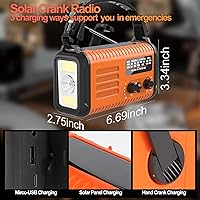
  • Dimensions: The unit measures 6.93″ long by 3.94″ wide by 3″ tall, making it compact enough to fit in most emergency go-bags or glove compartments.
  • Weight: At 1.53 pounds, this emergency crank radio is light enough to carry on extended hikes without adding meaningful burden to a pack.
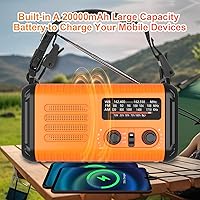
  • Battery: The built-in rechargeable battery is rated by the manufacturer at 20000mAh; actual output performance in real-world phone charging scenarios has not been independently verified.
  • Power Sources: Four independent charging methods are supported: pre-charged internal battery, hand crank, solar panel, and USB input via an external power source.
  • Tuner Bands: The radio covers NOAA weather band channels, AM frequencies from 520 to 1710 kHz, and standard FM broadcast frequencies.
  • Scanning Method: Station tuning is manual only; there is no automatic scan function or automatic NOAA alert activation built into this device.
  • USB Outputs: One USB-A port and one USB Type-C port are included, allowing two devices to charge simultaneously during a power outage.
  • Flashlight Modes: The integrated LED flashlight offers three modes: far beam for distance illumination, dipped beam for close-range use, and a mixed beam combining both.
  • Reading Lamp: A dedicated LED reading lamp is built into the unit, designed for low-level ambient lighting tasks such as reading or meal preparation in a shelter.
  • SOS Alarm: Holding the flashlight button for three seconds activates a loud SOS siren paired with a strobe flash pattern intended to attract rescuers.
  • Navigation: A compact precision compass is included in the package to support basic directional orientation in outdoor or off-grid emergency situations.
  • Audio Output: A standard headphone jack is integrated, enabling private audio monitoring of radio broadcasts without disturbing others nearby.
  • Safety Accessories: A physical whistle with a hand strap is included alongside the compass, providing an additional non-battery-dependent signaling option.
  • Color: The unit ships in orange, a color chosen deliberately to improve visibility in emergency or outdoor retrieval situations.
  • Model Number: The official model identifier is RCKY-Condor 1, as designated by the manufacturer Rckskaya.
  • Availability: This product was first listed for sale in December 2024, making it a relatively recent entry in the mid-range emergency radio market.
  • Included Items: The package includes the radio unit, a compass, a whistle with hand strap, and an owner's manual; charging cables are not explicitly listed as included.
  • Power Input: The device accepts USB input for battery charging when grid or portable battery power is available before or between emergencies.

Related Reviews

Rckskaya RCKY-Condor 1 20000mAh Emergency Weather Radio
86%
94%
Battery Life
91%
Charging Versatility
88%
Build Quality
83%
Portability
92%
Emergency Alerts Accuracy
More
Givoust MD-107R Hand Crank Emergency Weather Radio
75%
83%
NOAA Reception Quality
78%
Battery Life
81%
Charging Versatility
57%
Hand Crank Efficiency
66%
Build Quality & Durability
More
Pristar Hand Crank 10000mAh Emergency Weather Radio
71%
83%
Value for Money
76%
Build Quality
52%
Hand Crank Performance
78%
NOAA Reception
47%
Solar Charging
More
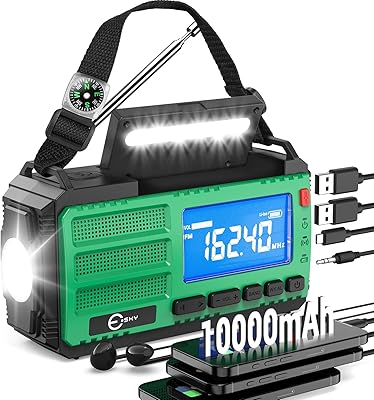
Esky 10000mAh Emergency Hand Crank Radio
73%
91%
Value for Money
84%
Radio Reception
72%
Battery Performance
47%
Hand Crank Charging
53%
Solar Panel Efficiency
More
GIDEZH H27 30000mAh Emergency Weather Radio
75%
82%
Battery Capacity
86%
NOAA Reception Quality
78%
Charging Versatility
88%
All-in-One Convenience
74%
Flashlight Performance
More
KAYINOW DF-580B Hand Crank Emergency Radio
88%
89%
Battery Performance
91%
Build Quality
87%
Portability
95%
Power Sources Flexibility
82%
Sound Quality
More
ZZMICHP 16000mAh Hand Crank Emergency Weather Radio
85%
92%
Battery Life & Power
87%
Ease of Use
68%
Portability & Size
85%
Durability & Build Quality
90%
Radio Performance
More
Mesqool Solar Radio Emergency Hand Crank 12000mAh
86%
89%
Battery Life
91%
Ease of Use
87%
Weather Reception (NOAA)
84%
Charging Efficiency (Solar/Hand Crank)
88%
Build Quality
More
KAYINUO DF-580 Bluetooth Hand Crank Emergency Radio
85%
91%
Battery Life
89%
Charging Options
88%
Durability (Waterproof Rating)
83%
Sound Quality
76%
Portability
More
Emgykit R11 Emergency Crank Radio
85%
92%
Value for Money
89%
Battery Life and Charging Options
88%
Portability and Size
94%
NOAA Weather Alerts Performance
80%
Bluetooth Connectivity
More

FAQ

No, it does not. The Rckskaya Condor 1 Emergency Hand Crank Radio requires you to manually tune to NOAA weather band channels — there is no auto-scan or automatic alert function. You will need to actively monitor the radio to receive updates, which is worth factoring in if you were hoping for a set-and-forget alert system.
The manufacturer rates the battery at 20000mAh, but that figure has not been independently tested. In practice, factors like battery age, cable quality, and the phone model being charged will affect output. Treat the capacity claim as a rough guide rather than a guaranteed number, and consider keeping the battery topped up via USB before any anticipated storm.

Yes. The Condor 1 has both a USB-A port and a USB Type-C port, so two devices can draw power simultaneously. Keep in mind that charging two devices at once will deplete the internal battery faster than charging one.

Solar charging works best in direct sunlight and is noticeably slower in overcast or low-light conditions. During an active storm — exactly when you might need it most — the panel will generate minimal charge. It is most useful for topping off the battery during calmer daylight hours between weather events, not as a primary fast-charge method.

Most users find the crank mechanism smooth and manageable, including older adults. That said, hand cranking is always a slow way to generate power — expect it to take extended cranking to produce meaningful charge for either the radio or phone outputs. Think of it as a last-resort option rather than a primary charging method.

The product description uses the term waterproof, but no specific IP rating is provided by the manufacturer. It is safer to assume the unit offers basic splash or weather resistance rather than full submersion protection. Avoid submerging it and keep it protected in heavy rain if possible.

Yes, a standard headphone jack is built in. This is particularly handy if you are in a shared shelter and do not want to disturb others, or if you need to monitor broadcasts quietly during the night.

The SOS alarm is described as loud and is activated by holding the flashlight button for three seconds. The strobe flash is designed to attract attention, though visibility in bright daylight is generally lower than at night for any strobe. It is a solid signaling tool for enclosed or low-light distress scenarios.

The compass will give you a basic directional orientation and is fine for confirming which general direction you are heading. It is not a precision instrument, so if you are doing serious backcountry navigation, a dedicated trail compass would serve you better. For emergency use — figuring out which way is north after getting disoriented — it does the job.

Based on available product information, the box includes the radio unit itself, a compass, a whistle with a hand strap, and an owner's manual. Charging cables do not appear to be explicitly listed as included, so it is worth having your own USB cables on hand to charge the internal battery before storing it in your emergency kit.