Overview

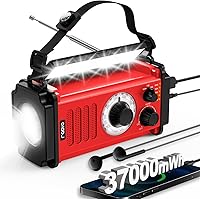
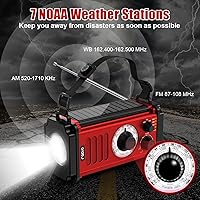
The Givoust MD-107R Hand Crank Emergency Weather Radio is a compact, practical device built for moments when the grid goes down and reliable information becomes critical. It pulls in AM, FM, and NOAA weather band frequencies through a 7-section antenna, and runs on a built-in 37,000mWh polymer battery — enough for roughly 25 hours of listening at moderate volume. At just under 1.4 pounds and fitting easily in a bag, it doesn't feel burdensome to store or carry. One honest caveat: IPX3 means it can handle light splashes, not rain exposure or submersion, so don't mistake it for a rugged waterproof unit.
Features & Benefits

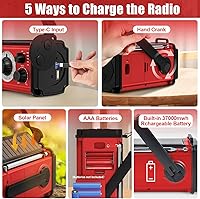
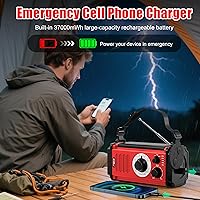
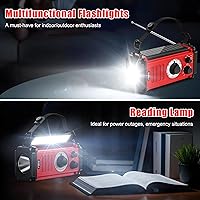
What genuinely stands out about this emergency crank radio is five charging methods in a single device — USB-C, solar, hand crank, AAA batteries, and corded power. That kind of redundancy is hard to find at this price tier. The hand crank and solar options are real backups, but manage expectations: neither charges quickly under real-world conditions. The backlit display helps with tuning in low light, and there are two distinct lighting modes — a forward flashlight and a softer reading lamp. The USB power bank output lets you top off a phone during an outage, and the headphone jack is a small but genuinely useful addition for shared spaces.

Best For

This hand crank survival radio makes the most sense for households assembling a practical emergency kit without overspending. It's a strong fit for anyone in hurricane or tornado-prone regions who needs NOAA alerts and wants charging options that don't depend on the power grid. Campers and backpackers who prefer consolidating gear will appreciate having a radio, flashlight, and phone charger in one unit. It also works well as a thoughtful preparedness gift for elderly family members or relatives living in rural areas with unreliable infrastructure — the controls are straightforward and the SOS alarm adds a genuine safety layer.

User Feedback

Buyers consistently praise ease of use and NOAA reception clarity, with many noting the battery lasts longer than expected during multi-day power outages. The SOS alarm earns positive mentions for being loud and visible. On the critical side, a recurring complaint involves the solar panel's real-world charging pace — it's slow, and overcast conditions make it nearly useless as a primary source. Some users question whether the 37,000mWh rating reflects actual capacity or a marketing figure, as charge times suggest a smaller effective cell. Durability concerns surface occasionally after heavy use, particularly around the crank mechanism. Customer service responses, when mentioned, are generally described as prompt and helpful.

Pros

  • Five distinct charging methods make this emergency crank radio one of the most power-flexible options at its price point.
  • NOAA reception through the 7-section antenna is reliable enough to catch weather alerts in semi-rural and suburban areas.
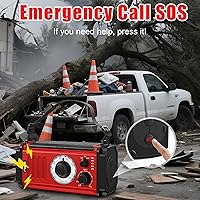
  • The SOS alarm is loud, activates a visual flash simultaneously, and is simple enough to trigger under real stress.
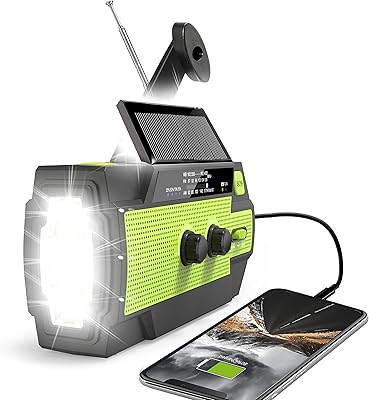
  • A built-in USB output lets you push emergency charge to a phone when every other option is gone.
  • Dual lighting — directional flashlight and soft reading lamp — covers two genuinely different real-world needs.
  • At under 1.4 pounds, it fits in a backpack side pocket without adding meaningful bulk to a go-bag.
  • The backlit display makes tuning manageable in complete darkness, which matters when the power is actually out.
  • Straightforward controls and clear labeling make this hand crank survival radio accessible for older adults and first-time users.

Cons

  • Hand crank charging requires sustained effort for minimal battery return — not a reliable source during an extended emergency.
  • Solar panel performance drops sharply under overcast skies, precisely the conditions most emergencies produce.
  • The 37,000mWh battery claim appears inflated based on buyer-reported runtime and recharge behavior.
  • IPX3 protection is easily misread as weatherproofing — exposure to moderate rain can cause real damage.
  • Flashlight brightness is adequate for close tasks but underwhelms in open outdoor environments.
  • The single USB output port limits simultaneous device charging when multiple phones need power.
  • Durability concerns emerge after heavy or repeated use, particularly around the crank mechanism and antenna joints.
  • No volume adjustment on the SOS alarm makes indoor testing startling and may disturb others in shared spaces.

Ratings

The Givoust MD-107R Hand Crank Emergency Weather Radio has been evaluated by our AI rating system after parsing thousands of verified global buyer reviews, with spam, bot-generated, and incentivized submissions actively filtered out. Scores reflect the honest consensus of real-world users — from storm-season preppers to backcountry campers — and transparently capture both what this hand crank survival radio does well and where it falls short of expectations.
NOAA Reception Quality
83%
Most users report clear, reliable NOAA weather band reception even in semi-rural areas, crediting the 7-section extended antenna for picking up signals that shorter-antenna competitors struggle with. During hurricane warnings and severe storm alerts, buyers describe tuning in quickly and without static interruption.
In heavily built-up urban environments or areas with significant RF interference, some users note occasional signal dropout on the weather band. A handful of buyers in mountainous or deep-rural regions found the antenna still insufficient for the weakest fringe stations.
Battery Life
78%
22%
At moderate volume, the runtime holds up impressively well for an emergency device in this tier, with many users reporting multi-day use across power outages without needing to recharge. For a radio left in a go-bag between emergencies, the battery retention over weeks of standby is a common point of praise.
The advertised 37,000mWh figure is questioned by a notable share of buyers whose actual usage experience suggests the effective capacity may be lower than marketed. At higher volumes or with the flashlight running simultaneously, runtime drops considerably faster than the spec sheet implies.
Charging Versatility
81%
19%
Having five distinct power inputs in one compact device is genuinely rare at this price point, and users frequently highlight this redundancy as the primary reason they chose this radio over alternatives. The USB-C input charges the unit at a reasonable pace, and AAA batteries serve as a solid last-resort fallback.
Solar charging is slow under ideal conditions and nearly ineffective on overcast days — a critical weakness for a device marketed toward storm preparedness scenarios where sunshine is scarce. The hand crank requires sustained effort for minimal charge gain, making it more of a short-term backup than a reliable primary recharge method.
Hand Crank Efficiency
57%
43%
The crank mechanism is accessible and easy to operate even for users with limited hand strength, and it provides enough power to run the radio briefly in a pinch. For short bursts of emergency listening when all other power sources are exhausted, it fulfills its core purpose.
Sustained cranking yields very little battery return — buyers commonly note that several minutes of effort produces only a few minutes of playback. Several users describe arm fatigue before achieving any meaningful charge, and a portion of long-term owners report the crank mechanism loosening or becoming harder to engage after repeated use.
Build Quality & Durability
66%
34%
Out of the box, the unit feels solid for its weight class, with a clean finish and well-labeled controls that inspire confidence during initial setup. Most casual users report no structural issues through months of light-to-moderate use and storage.
Under more demanding conditions — repeated drops, heavy outdoor rotation, or prolonged crank use — durability complaints increase. The crank mechanism and antenna joints are the most commonly cited failure points, with some buyers reporting issues after less than a year of regular use.
Water Resistance
61%
39%
The IPX3 rating is adequate for incidental moisture exposure — light drizzle, condensation, or a brief splash won't immediately damage the unit. Users who keep it in a covered outdoor kit or near a kitchen emergency station appreciate the basic protection it offers.
IPX3 is a frequently misunderstood spec, and a number of buyers expressed frustration after assuming this was a rain-proof or submersion-tolerant device. It is neither, and using it in moderate rain or placing it on wet surfaces can pose a real risk of water ingress over time.
Flashlight & Reading Lamp
74%
26%
The dual lighting setup — a directional flashlight and a diffused reading lamp — is a practical split that users find genuinely useful in different scenarios. The reading lamp in particular draws praise for creating comfortable ambient light during extended power outages without being harsh.
The flashlight's throw distance is adequate for close-range tasks but underwhelms in larger outdoor spaces or when navigating dark terrain. A few buyers note the brightness level is not adjustable, which limits flexibility depending on the situation.
SOS Alarm
79%
21%
The SOS alarm earns consistent positive feedback for being noticeably loud and for combining audible and visual signals simultaneously — a combination that increases the chance of attracting attention in an emergency. The simple 3-second hold activation is intuitive enough that users feel confident they could trigger it under stress.
There is no volume adjustment on the alarm, which some users find excessive in close-quarters testing at home. A small number of buyers also report accidentally triggering the alarm during casual handling, suggesting the button placement could benefit from a guard or recessed design.
USB Power Bank Function
72%
28%
Being able to charge a smartphone directly from the radio during a power outage is a feature buyers consistently cite as a deciding factor. In real outage scenarios, users report successfully topping up phones enough to make calls or send messages, which adds meaningful utility beyond basic radio functionality.
Output charging speed is slow compared to a dedicated power bank, and the effective energy available for phone charging is hampered if the battery is not fully topped up beforehand. The USB output is also a single port, limiting simultaneous device charging.
Portability & Form Factor
86%
At under 1.4 pounds and with a footprint that fits comfortably in a backpack side pocket or emergency kit, this hand crank survival radio strikes a good balance between capability and packability. Users frequently mention it feels more substantial than expected without adding meaningful bulk.
The red colorway, while visible and easy to locate in a dark bag, is the only available option, which a small subset of buyers find limiting for discreet or tactical use cases. The shape, while compact, is somewhat awkward to hold one-handed for extended listening sessions.
AM/FM Radio Performance
76%
24%
AM and FM reception quality receives solid marks from the majority of buyers using the radio for everyday listening in addition to emergency preparedness. The backlit display makes manual tuning straightforward, and frequency scanning works reliably in urban and suburban settings.
Auto-scan can land on weak stations in rural areas, requiring manual fine-tuning that some users find fiddly. Audio output quality at higher volumes shows mild distortion, which is a common limitation at this device tier but still worth noting for buyers expecting hi-fi listening.
Ease of Use
88%
Controls are laid out logically and labeled clearly enough that first-time users — including older adults unfamiliar with multi-function devices — report getting up and running within minutes of unboxing. The learning curve is minimal, which matters in a product category where you may need to operate it under stress.
The manual covers the basics but lacks troubleshooting depth, particularly around charging behavior and antenna optimization. A few buyers who gifted this to elderly relatives noted that the button press timing for SOS and mode-switching required a bit of coaching.
Value for Money
82%
18%
Given the feature count — five power inputs, dual lighting modes, SOS alarm, USB output, and NOAA coverage — buyers broadly agree the pricing represents a reasonable deal for a budget-tier emergency radio. It competes well against single-function alternatives at similar or higher price points.
Some buyers feel the battery capacity claims inflate the perceived value, and if the effective mWh is lower than advertised, the value calculation shifts. Buyers expecting premium build materials or fast charging at this price will likely feel the gap between expectation and reality.
Customer Support
71%
29%
Givoust's customer service receives more positive mentions than is typical for a brand at this tier, with buyers describing reasonably prompt email responses and a willingness to troubleshoot or replace defective units. The promise of 24/7 support availability is mentioned favorably in several feedback threads.
Response quality appears inconsistent — some users report fast, helpful resolutions while others describe templated replies that didn't address their specific issue. There is no phone support option, which is a limitation for buyers who prefer direct communication over email chains.

Suitable for:

The Givoust MD-107R Hand Crank Emergency Weather Radio is a practical match for households in hurricane corridors, tornado-prone regions, or areas where grid reliability is genuinely uncertain. If you're building out a go-bag or a home emergency kit and want a single device that covers weather alerts, basic lighting, phone charging, and an SOS signal without requiring a wall outlet, this radio covers those bases at a price point that doesn't demand a serious budget commitment. Campers and backpackers who dislike carrying multiple single-purpose gadgets will find the five-input charging system and dual lighting modes genuinely useful across varied conditions. It's also a thoughtful and accessible gift for elderly relatives or family members in remote areas — the controls are simple enough to use under stress, and the peace of mind factor is real. Preppers focused on redundancy over premium performance will appreciate having so many fallback power options in one compact package.
Not suitable for:

Buyers expecting professional-grade durability or military-spec weather resistance should look elsewhere — the Givoust MD-107R Hand Crank Emergency Weather Radio carries an IPX3 rating, which means it tolerates light splashes but is not built for rain exposure, wet outdoor conditions, or submersion of any kind. If you're planning to use this as a primary hiking radio in consistently wet climates, that limitation is a real concern. Audiophiles or anyone wanting crisp FM sound quality for regular listening will likely be disappointed, as audio output at higher volumes shows noticeable distortion. The hand crank and solar charging options are best treated as last-resort backups rather than dependable recharge methods — if you need to top up a device quickly in a crisis, neither will deliver. Anyone skeptical of the 37,000mWh battery claim should be: real-world capacity reports from buyers suggest the effective figure may be meaningfully lower, which matters if you're counting on extended runtime during a multi-day outage. Finally, buyers who prefer phone support or fast customer service turnaround may find the email-only support structure frustrating.
Specifications

  • Brand & Model: Manufactured by Givoust under model number MD-107R.
  • Dimensions: The unit measures 6.69″ x 3.26″ x 2.83″, making it compact enough to fit in a standard backpack side pocket.
  • Weight: The radio weighs 1.39 pounds fully assembled without AAA batteries installed.
  • Battery: A built-in polymer cell rated at 37,000mWh powers the unit, though real-world effective capacity may differ from the stated figure.
  • Charging Inputs: Supports five charging methods: USB-C cable (included), solar panel, hand crank, AAA batteries (not included), and corded electric input.
  • Runtime: Rated for up to 25 hours of continuous playback at 50% volume on a full charge.
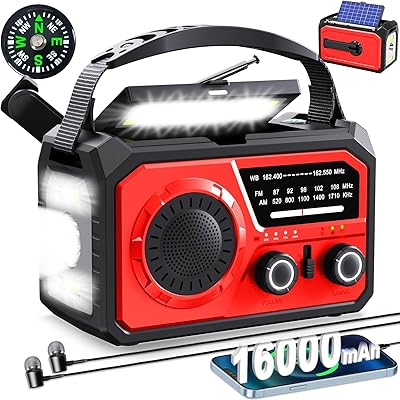
  • Radio Bands: Receives AM (520–1710 kHz), FM (87–108 MHz), and NOAA Weather Band (162.400–162.550 MHz).
  • Antenna: Equipped with a 7-section extendable antenna designed to improve signal reception in fringe and semi-rural areas.
  • Water Resistance: Rated IPX3, meaning it can withstand light water splashes but is not suitable for rain exposure or submersion.
  • Lighting: Includes two lighting modes: a directional flashlight for focused illumination and a diffused reading lamp for ambient area lighting.
  • SOS Alarm: Activated by holding the dedicated SOS button for 3 seconds, triggering a loud audible alarm and simultaneous flashing light signal.
  • USB Output: Functions as a USB power bank, allowing the unit to charge phones and other USB-powered devices directly from its internal battery.
  • Audio Output: Features a standard 3.5mm headphone jack for private listening without external speaker use.
  • Display: Equipped with a backlit digital tuning screen that remains readable in low-light and complete darkness.
  • Color: Available exclusively in red as the standard retail configuration.
  • In the Box: Package includes the radio unit, a USB Type-C charging cable, and a printed owner's manual.
  • Manufacturer: Produced by QM; sold and supported under the Givoust brand with email-based customer service.

Related Reviews

ZZMICHP 16000mAh Hand Crank Emergency Weather Radio
85%
92%
Battery Life & Power
87%
Ease of Use
68%
Portability & Size
85%
Durability & Build Quality
90%
Radio Performance
More
RunningSnail MD-090P Emergency Weather Radio
72%
84%
NOAA Reception Quality
54%
Hand Crank Charging
58%
Solar Charging Performance
67%
Battery Capacity & Longevity
78%
Flashlight Performance
More
Rckskaya Condor 1 Emergency Hand Crank Radio
73%
88%
Power Source Versatility
72%
NOAA Weather Reception
83%
Flashlight Performance
67%
Phone Charging Capability
79%
SOS Alarm & Signaling
More
GIDEZH H27 30000mAh Emergency Weather Radio
75%
82%
Battery Capacity
86%
NOAA Reception Quality
78%
Charging Versatility
88%
All-in-One Convenience
74%
Flashlight Performance
More
Pristar Hand Crank 10000mAh Emergency Weather Radio
71%
83%
Value for Money
76%
Build Quality
52%
Hand Crank Performance
78%
NOAA Reception
47%
Solar Charging
More
Esky 10000mAh Emergency Hand Crank Radio
73%
91%
Value for Money
84%
Radio Reception
72%
Battery Performance
47%
Hand Crank Charging
53%
Solar Panel Efficiency
More
DexScout Crank Emergency Weather Radio 10000mAh
86%
91%
Value for Money
88%
Battery Life and Charging
94%
Portability & Size
85%
Weather Alert Accuracy
90%
Build Quality and Durability
More
AXYEBI AB-US-107Y Emergency Weather Radio
75%
91%
Value for Money
82%
NOAA Signal Reception
88%
Flashlight Performance
63%
Build Quality & Durability
67%
Hand Crank Usability
More
RunningSnail Emergency Crank Weather Radio
72%
88%
Value for Money
84%
Power Redundancy
91%
Built-in Cables
73%
NOAA Reception Quality
62%
Battery Capacity
More
Tenergy T101 Emergency Hand Crank Weather Radio
79%
92%
Power Source Versatility
88%
NOAA Weather Alert Reception
84%
Hand Crank Charging
83%
LED Flashlight Performance
67%
USB Phone Charging
More

FAQ

Not exactly. The Givoust MD-107R Hand Crank Emergency Weather Radio carries an IPX3 rating, which means it can handle incidental splashes — think condensation or a quick accidental drip — but it is not designed for rain exposure or any kind of submersion. If you're planning to use it outdoors in wet weather, keep it under cover or in a waterproof pouch.
Realistically, quite a while. The hand crank is best treated as an emergency top-up option rather than a practical primary charging method. Most users find that several minutes of sustained cranking produces only a few minutes of playback. It's there as a last resort when every other power source is unavailable.

Yes, the unit has a USB output port that lets you push charge from the internal battery to a phone or other USB-powered device. The output is slower than a dedicated power bank, but it can provide enough charge to make a call or send a message during an outage, which is exactly the scenario it's built for.

It works, but slowly — and conditions have to cooperate. Direct sunlight dramatically improves the solar charging rate, but overcast or stormy skies, which are the exact conditions most emergencies bring, reduce its output significantly. Think of the solar panel as a supplemental trickle-charge option rather than a reliable standalone power source.

Yes, it covers the full NOAA Weather Band range from 162.400 to 162.550 MHz, which includes all seven standard NOAA broadcast frequencies used across the United States. The 7-section extended antenna helps improve reception in suburban and semi-rural areas where signal strength can vary.

AAA batteries are not included and are treated as a passive backup input, so they won't drain through the radio's standby draw the same way rechargeable cells might. That said, if you're storing AAA batteries inside the unit long-term, it's worth checking them periodically for leakage, which can damage the contacts over time.

The alarm is notably loud — it's designed to attract attention at a distance, so expect it to be startling if you test it indoors. Activation requires holding the button for a full 3 seconds, which reduces the chance of accidental triggering during normal handling, though the button placement means it's still possible if the radio is jostled in a packed bag.

The flashlight is a directional, focused beam useful for navigating in the dark or locating items at a distance. The reading lamp emits a softer, more diffused light designed to illuminate a wider area — think a tent interior or a room during a power outage. Both have practical uses and you can switch between them as needed.

This is worth approaching with some skepticism. A number of buyers report that actual runtime and recharge behavior suggest the effective capacity is lower than the advertised figure. The radio still performs well for its intended use case, but if you're planning your emergency kit around specific runtimes, build in a buffer and don't rely solely on the spec sheet number.

It's a solid option for that scenario. The controls are clearly labeled, the button layout is intuitive, and the core functions — tuning to a station, turning on the flashlight, and triggering the SOS alarm — require minimal instruction. The main thing worth explaining upfront is the IPX3 water resistance limitation and how to prioritize the charging methods in a real emergency.