Overview

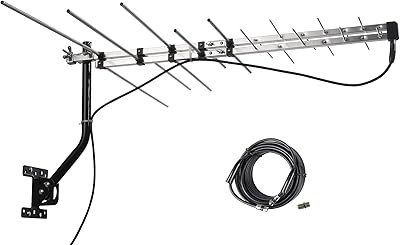
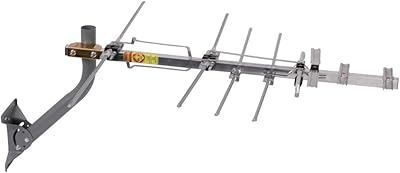
The McDuory DA-210 Outdoor HDTV Antenna is a budget-friendly amplified option built for cord-cutters who want free over-the-air HD channels without a monthly bill. It sits squarely in the entry-level outdoor antenna category, making it appealing for suburban and semi-rural households within a reasonable distance of broadcast towers. It arrives largely pre-assembled and includes a 40-foot RG6 coax cable — a genuinely useful addition that saves a separate purchase. The built-in amplifier is what separates it from passive outdoor antennas at this tier. Worth knowing upfront: no mounting pole is included, which catches some buyers off guard and means an extra trip to the hardware store.

Features & Benefits

The DA-210 covers both VHF and UHF bands, which matters because many local channels — particularly older VHF stations — get missed by cheaper UHF-only antennas. In practice, reception supports 720p, 1080i, and 1080p broadcasts, so picture quality depends entirely on what your local stations transmit, not on the antenna itself. The 75-ohm impedance is standard across modern TVs, meaning no adapters required. That included 40-foot cable is more useful than it sounds — long enough to route from rooftop to living room in most single-story homes. Setup is genuinely quick; most components come pre-attached, and the whole connection process rarely takes more than half an hour.

Best For

This outdoor antenna makes the most sense for cord-cutters living in suburban or exurban areas roughly 50 to 80 miles from broadcast towers — the honest realistic range, not the advertised maximum. If your household mainly wants local news and sports without a monthly fee, it covers that need well. Attic or rooftop mounting is still required, so factor in an installation cost if ladders are not your thing. It also works as a secondary setup — vacation cabins or a garage TV where the investment needs to stay modest. Just remember to source a mounting pole separately before you begin.

User Feedback

Across several hundred reviews, this amplified rooftop antenna holds a 4.1 out of 5 rating — respectable, but the breakdown tells a useful story. Buyers consistently praise strong channel pickup and the easy setup experience. Criticism, however, clusters around range; the 120-mile figure is a ceiling, not a typical result, with real-world performance landing closer to 50–70 miles depending on terrain. The missing mounting pole frustrates buyers who expected a complete kit. Less common but worth noting: users near towers sometimes report amplifier-induced interference, suggesting the built-in amp can work against you in strong-signal areas. A handful of reviews also flag housing durability concerns after harsh winters.

Pros

  • Covers both VHF and UHF bands, so you are less likely to miss older local VHF stations that UHF-only antennas skip.
  • A 40-foot RG6 coax cable is included, saving a separate purchase and making longer cable runs straightforward.
  • Pre-assembled design means most setups are done in under 30 minutes with no special tools.
  • The built-in amplifier provides a meaningful signal boost for homes in the 40 to 70 mile range from towers.
  • Compatible with any modern TV at standard 75-ohm impedance — no adapters or converters needed.
  • Strong user consensus on reliable local channel pickup for everyday network and news viewing.
  • At its price point, this outdoor antenna competes well against passive alternatives that cost nearly as much.
  • Works well as a secondary or vacation-property antenna where budget matters more than maximum range.

Cons

  • The 120-mile range claim is misleading; in practice, expect reliable performance closer to 50 to 70 miles.
  • No mounting pole is included, which means an extra hardware store trip before installation can begin.
  • The amplifier cannot be bypassed, causing interference issues for viewers who live very close to broadcast towers.
  • A handful of long-term owners report the plastic housing cracking or degrading after one harsh winter season.
  • Heavy tree cover, hills, or multi-story buildings can noticeably cut into the usable reception range.
  • Customer satisfaction sits at 4.1 out of 5 — solid, but trailing some competing antennas in the same category.
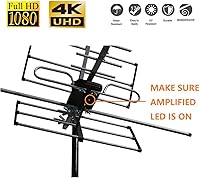
  • Amplifier power draw requires access to an outlet near the installation point, adding a minor logistical constraint.

Ratings

The McDuory DA-210 Outdoor HDTV Antenna has been scored by our AI system after analyzing verified purchase reviews from buyers worldwide, with spam, bot-submitted, and incentivized feedback actively filtered out before scoring. Each category below reflects the honest spread of real user experiences — strengths and frustrations weighted equally — so you get a transparent picture of where this amplified rooftop antenna genuinely delivers and where it falls short.

Signal Reception
72%
28%
For households sitting within 50 to 70 miles of broadcast towers, most users report picking up all major local network affiliates with a stable, clear picture. The dual VHF and UHF coverage is a real advantage, catching stations that cheaper single-band antennas miss entirely.
The advertised 120-mile range consistently overpromises in real-world conditions, particularly where hills, dense foliage, or urban structures block line-of-sight to towers. Buyers beyond 70 miles tend to experience dropouts and missing channels, which leads to visible disappointment in reviews.
Amplifier Performance
67%
33%
In fringe-signal areas — think semi-rural homes 40 to 65 miles from a city — the built-in amplifier makes a measurable difference, pulling in channels that a passive antenna would simply miss. Users in these mid-range locations credit the amplifier as the main reason reception exceeded their expectations.
For viewers who live close to towers, the amplifier introduces noise rather than clarity, causing pixelation and signal dropouts that would not exist with a passive setup. There is no way to bypass or disable the amplifier, which makes this antenna a poor fit for dense urban locations with already strong signal strength.
Ease of Installation
84%
The pre-assembled design genuinely shortens setup time — most buyers report being fully connected and scanning for channels within 30 minutes of opening the box. The included 40-foot coax cable eliminates the common frustration of realizing mid-install that your cable is too short.
The absence of a mounting pole is a recurring complaint that disrupts an otherwise smooth setup experience, requiring an extra hardware store trip before installation can even begin. Buyers who did not read the product listing carefully often feel the kit is incomplete upon unboxing.
Value for Money
78%
22%
At its price point, this outdoor antenna competes favorably against passive alternatives that offer less range and no included cable. For a secondary TV, a vacation cabin, or a first cord-cutting experiment, the cost-to-performance ratio feels fair to most buyers.
Some reviewers feel the missing mounting pole erodes the value proposition, since that omission effectively adds cost to what initially looks like a complete kit. Buyers who end up with reception only in the 40 to 50 mile range may feel they paid for range headroom they never actually had.
Build Quality
61%
39%
The antenna feels reasonably solid out of the box, and the black and silver housing looks clean enough for visible rooftop placement without standing out awkwardly. For fair-weather climates, several users report years of trouble-free outdoor use.
A consistent thread in long-term reviews points to the plastic housing cracking or becoming brittle after one severe winter, suggesting the materials are not well-suited to freeze-thaw cycling. This durability concern is significant enough that buyers in northern climates should factor in the possibility of a replacement within a year or two.
Range Accuracy
43%
57%
In ideal flat-terrain conditions with no obstructions between the antenna and nearby towers, a handful of users do report channel pickup beyond 80 miles, lending some credibility to the extended range claims under optimal circumstances.
The gap between advertised and real-world range is the single most criticized aspect across all user reviews — the 120-mile figure is widely regarded as misleading. Buyers in hilly or wooded areas report effective ranges well below 50 miles, creating frustration that directly impacts the product's credibility.
Weather Resistance
58%
42%
The antenna handles moderate rain and wind without issue for most users, and its lightweight frame means it is not prone to catching wind loads that could stress a typical J-mount bracket. Short-term outdoor durability is generally considered acceptable.
Extended exposure to freezing temperatures is where the housing shows weakness, with multiple reviewers describing cracked or warped plastic after harsh winters. The antenna does not appear to carry a weather-resistance rating, so buyers in demanding climates are essentially relying on unspecified material tolerances.
Channel Count
74%
26%
In well-served suburban markets, users regularly report 30 to 50 channels after an initial scan, covering all major network affiliates plus a range of sub-channels for news, classic TV, and local programming. The dual-band frequency coverage is a key contributor here.
Channel counts vary dramatically by location, and buyers in smaller media markets sometimes receive fewer than 15 usable channels — a reality driven by geography rather than the antenna itself, but one that still leads to disappointment when expectations are set by marketing language.
Cable Quality
76%
24%
The included 40-foot RG6 coaxial cable is a genuine highlight for most buyers, providing enough length to route from a rooftop installation down through walls or around doorframes to a typical living room TV without needing an extension.
A small number of users have reported that the included cable's connectors feel slightly loose or show wear earlier than expected, suggesting the cable quality is functional but not premium. For permanent installations, some users opt to replace it with a higher-grade aftermarket RG6 for peace of mind.
Compatibility
88%
The standard 75-ohm coax connection works out of the box with virtually every modern television, digital converter box, and signal splitter on the market — no adapters, no additional hardware, no compatibility research needed. Most buyers connect it on the first try without any issues.
Users hoping to feed multiple TVs from a single antenna need to purchase a splitter separately, and splitting the signal without an additional distribution amplifier can reduce reception quality noticeably in areas where the signal is already marginal.
Package Contents
51%
49%
The box does include the most time-consuming component — the coax cable — which many competing products at this tier leave out entirely. For buyers who already own a mounting pole from a previous antenna, the package contents feel complete enough.
The missing mounting pole is consistently flagged as a gap that feels out of place for a product marketed as a complete outdoor antenna solution. Several reviewers note that the pole omission is not disclosed prominently in the product listing, leading to frustration at the point of installation.
Setup Speed
81%
19%
Pre-assembled components mean there is very little physical assembly involved — it is largely a matter of mounting, running the cable, and connecting it to the TV. Most households can realistically complete the job in under an hour, even without prior antenna experience.
The process is straightforward only if you already have a mounting solution in place; without a pole, the entire install stalls before it starts. First-time antenna buyers are the most likely to be caught off guard by this gap.
Amplifier Noise (Close Range)
46%
54%
For the majority of users at mid-range distances from towers, the amplifier runs quietly in the background without introducing any perceptible interference, doing its job without drawing attention to itself.
Users within a few miles of broadcast towers describe the amplifier as actively harmful to their reception, introducing digital noise and dropouts that disappear when they switch to a passive antenna. The lack of any gain control or bypass switch is a meaningful design limitation for this specific buyer segment.
Long-Term Reliability
62%
38%
In temperate climates without extreme seasonal swings, a good number of buyers report consistent, trouble-free performance over one to two years of outdoor use. The electronics appear stable once installed in a protected location.
Durability over multiple winters is the main long-term risk, with the plastic housing being the most vulnerable component. Buyers who mount it in an exposed rooftop position in cold climates have the highest likelihood of needing a replacement within 18 to 24 months.

Suitable for:

The McDuory DA-210 Outdoor HDTV Antenna is a practical choice for cord-cutters living in suburban or exurban neighborhoods who are within a realistic 50 to 80 miles of their nearest broadcast towers. If your household primarily watches local news, network dramas, and live sports — the kind of programming that streams over free over-the-air signals — this antenna covers those needs without a recurring monthly cost. It suits DIY-minded buyers who are comfortable with basic rooftop or attic mounting and want a largely pre-assembled kit that gets them up and running quickly. The included 40-foot coax cable is a genuine convenience for households where the TV is not directly below the installation point. It also makes strong sense as a secondary antenna — think a detached garage, a guest room setup, or a seasonal cabin where you want reliable local channels without overspending.

Not suitable for:

The McDuory DA-210 Outdoor HDTV Antenna is not the right tool for viewers living in truly remote or rural areas expecting to pull in stations from well beyond 70 miles — the advertised 120-mile range is a best-case figure that rarely holds up in real-world conditions with hills, trees, or buildings in the path. Buyers who live very close to broadcast towers may actually find the built-in amplifier works against them, introducing signal noise and interference rather than improving reception. This antenna also falls short for anyone wanting a complete out-of-the-box installation kit, since no mounting pole is included and that omission adds an extra purchase before you can even start. Those in climates with severe winters should weigh the durability concerns raised by some long-term owners, as the housing has shown vulnerability to freezing temperatures over time. If your primary goal is pulling in distant or fringe-market stations consistently, a higher-grade directional antenna with a separate, adjustable amplifier will serve you better.

Specifications

  • Brand: Manufactured by WLT and sold under the McDuory brand name.
  • Model: The specific model designation for this outdoor antenna is the DA-210.
  • Antenna Type: Amplified outdoor HDTV antenna designed for rooftop, attic, or elevated exterior mounting.
  • Frequency Range: Receives VHF signals from 170–230 MHz and UHF signals from 470–860 MHz for broad local channel coverage.
  • Claimed Range: Maximum advertised reception range is 120 miles, though real-world performance typically falls between 50 and 70 miles depending on terrain and obstructions.
  • Resolutions: Supports free over-the-air broadcasts in 720p, 1080i, and 1080p HD formats.
  • Impedance: Standard 75-ohm impedance is compatible with the coax input on virtually all modern televisions and signal splitters.
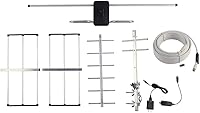
  • Included Cable: Package includes a 40-foot RG6 coaxial cable, sufficient for most single-story rooftop-to-living-room runs.
  • Amplifier: Features a built-in signal amplifier designed to boost weak over-the-air signals in fringe or mid-range reception areas.
  • Dimensions: The antenna body measures 9.45 x 3.54 x 16.93 inches, making it a compact but functional outdoor directional unit.
  • Weight: Complete unit weighs 3.63 pounds, light enough for single-person mounting on standard hardware-store mast brackets.
  • Color: Available in a black and silver finish designed to blend with most exterior rooftop and fascia environments.
  • Mounting Pole: No mounting pole is included in the package; a standard J-mount or pipe mast must be purchased separately before installation.
  • Installation: Arrives largely pre-assembled, allowing most users to complete mounting and cable connection without specialized tools.
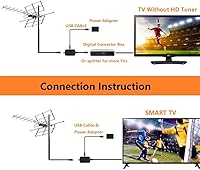
  • Connectivity: Connects to any TV or amplifier distribution hub via the included RG6 coax cable using a standard F-type connector.

Related Reviews
Antennas Direct DB8e Outdoor TV Antenna
73%
83%
Signal Reception
88%
Build Quality
86%
Weather Durability
58%
Ease of Installation
71%
Value for Money
More
RCA ANT860EV Amplified Outdoor HDTV Antenna
84%
91%
Signal Reception
88%
Ease of Installation
84%
Durability
90%
Value for Money
89%
Range
More
McDuory UHD-3968 Outdoor Yagi TV Antenna
73%
78%
Signal Reception
51%
Range Accuracy
88%
Ease of Assembly
74%
Build Quality
81%
Value for Money
More
PBD WA-2900-4G Outdoor HDTV Antenna
87%
94%
Signal Reception Quality
91%
Range Performance
88%
Ease of Installation
85%
Build Durability
89%
Weather Resistance
More
PBD HJK544 Outdoor Yagi TV Antenna
76%
83%
Signal Reception
89%
UHF Performance
61%
VHF Performance
78%
Build Quality
81%
Weather Resistance
More
ANTOP AT-415B Outdoor HDTV Antenna
74%
76%
Signal Reception Quality
88%
Ease of Installation
67%
Amplifier Performance
83%
4G LTE Filtering
72%
Value for Money
More
August DTA240 Indoor/Outdoor TV Antenna
78%
72%
Signal Reception
91%
Ease of Setup
88%
Magnetic Base Usability
67%
Build Quality
63%
Cable Length
More
Vansky VS-TX01 Indoor TV Antenna
72%
73%
Signal Reception
67%
Amplifier Performance
91%
Ease of Setup
88%
Cable Length & Flexibility
61%
Build Quality
More
RGTech Monarch 40 Indoor HDTV Antenna
68%
71%
Signal Reception Quality
93%
Ease of Setup
48%
Range Accuracy
78%
Build & Design Quality
82%
4G LTE Interference Filtering
More
One for All 14432 HDTV 1080p Antenna
85%
88%
Reception Performance
93%
Ease of Setup
85%
App Experience
79%
Signal Stability
84%
Build Quality
More

FAQ

Honestly, treat that figure as a theoretical ceiling rather than a typical result. In practice, most users get reliable reception somewhere between 50 and 70 miles from their nearest broadcast towers. Terrain, tree cover, buildings, and even weather can all chip away at that range, so if you are on the outer edge of a metro area rather than in a truly remote location, you should be fine.

Yes — one thing the box does not include is a mounting pole or mast. You will need to pick up a J-mount bracket or a short pipe mast from a hardware store before you can attach it to your roof or exterior wall. Everything else, including the 40-foot coax cable, comes in the box.

It should work fine. The antenna uses a standard 75-ohm F-type coax connection, which matches the antenna input found on virtually every TV made in the last 30 years. Just run the included cable from the antenna directly into the coax port on your TV and run a channel scan.

You can, and many people do. Attic installation protects the antenna from weather and simplifies the cable run. The trade-off is that roofing materials and insulation will reduce signal strength, so you may lose 10 to 20 miles of effective range compared to a full outdoor rooftop mount.

It might. A handful of users who live very close to towers have reported that the amplifier actually introduces noise and degrades the picture rather than improving it. If you are within five miles of your local towers, a passive antenna without amplification would likely serve you better.

The DA-210 itself has a single coax output, so out of the box it connects to one TV. If you want to feed multiple sets, you will need to add a two-way or four-way coax splitter downstream. Keep in mind that splitting the signal reduces strength, so if your reception is already marginal, adding a distribution amplifier alongside the splitter is worth considering.

It is designed for outdoor installation, but long-term durability in harsh climates is a fair concern. A small number of owners in colder regions have reported the plastic housing cracking after one or two winters. If you live somewhere with heavy freeze-thaw cycles, mounting it in a protected location like a sheltered eave or the attic is worth considering.

That depends entirely on where you live and how close you are to broadcast towers. In most suburban markets within 50 miles of a city, you can expect the major network affiliates — ABC, CBS, NBC, Fox, PBS — along with several sub-channels. Websites like antennaweb.org let you enter your address and see exactly which channels are realistically receivable in your area before you buy.

No electrician needed. The antenna arrives mostly pre-assembled, and connecting the coax cable is a simple hand-tighten operation. The physically demanding part is getting the antenna onto the roof and aiming it toward your towers — that requires a ladder and ideally a second person to help with alignment while you check the TV signal indoors.

Yes, this works with digital converter boxes. Just run the coax from the antenna into the input port of the converter box, then connect the box to your older TV using RCA or coax output. The antenna captures the digital OTA signal and the converter box handles the translation for your legacy set.