Overview

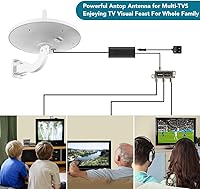
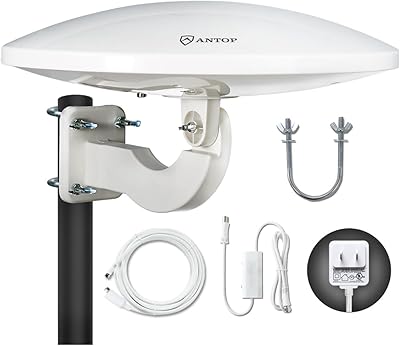
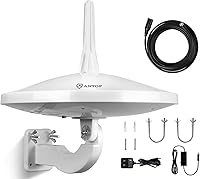
The ANTOP AT-415B Outdoor HDTV Antenna takes a different approach than most rooftop antennas — its distinctive UFO-shaped housing isn't just a design quirk, it's the physical expression of its dual omni-directional reception system. Unlike traditional directional antennas that need careful pointing toward a broadcast tower, this UFO outdoor antenna picks up signals from every horizontal and vertical angle simultaneously. That makes it a practical choice for rooftop, attic, or RV installations where you either can't determine tower direction or have towers scattered across different bearings. It ships with a 33ft coaxial cable and requires no tools to mount. Fair warning, though: how well it actually performs depends significantly on your distance from towers and what's between you and them.
Features & Benefits

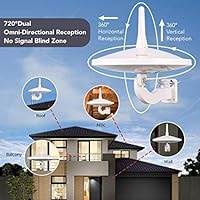
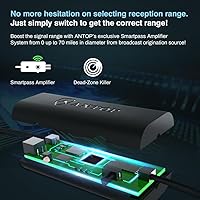
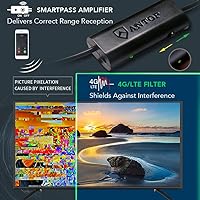
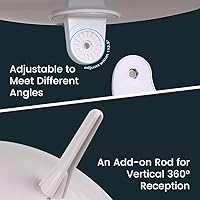
The standout feature here is 720° total coverage — 360° horizontal plus 360° vertical — which means you never have to rotate or reposition to chase a signal. The Smartpass Amplifier is what separates this from cheaper omni-directional options; it includes an adjustable switch that lets you dial between short-range and long-range sensitivity, which matters in urban areas where too much amplification can actually cause overload and cost you channels. A built-in 4G LTE filter tackles cellular interference head-on, something that frustrates a lot of passive antenna users near busy wireless networks. The hardware supports 720p, 1080i, and 1080p, and is marketed as 4K UHD ready — though receiving 4K over the air ultimately depends on what your local broadcasters are actually transmitting.

Best For

This omni-directional rooftop antenna is best suited to cord-cutters living within about 55–65 miles of broadcast towers who find aiming a directional antenna impractical — or simply don't want the hassle. RV travelers are arguably the strongest use case: pulling into a new campsite and immediately picking up local channels without climbing on the roof to re-aim is a genuine convenience. It also works well in attics when tower locations are unknown or spread across multiple directions. If you're dealing with 4G LTE interference that's been muddying your signal, the built-in filter adds real value over a basic passive antenna. Less ideal for truly rural locations beyond its rated range, where terrain and distance tend to overwhelm what any amplified antenna can compensate for.

User Feedback

With nearly 1,400 reviews and a 3.9 out of 5 rating, the ANTOP UFO antenna sits in solid but not exceptional territory. Buyers in suburban zones consistently praise the easy installation process and the channel counts they pull in right out of the box — the low-profile design earns positive mentions too. On the other side, users on the fringe of the rated range report that the Smartpass Amplifier can be temperamental and requires patient tuning before reception stabilizes. Rain-related signal drops also come up repeatedly, worth factoring in if you live in a wet climate. RV users tend to rate it higher overall, likely because they're camping closer to urban towers rather than pushing the hardware to its outer limits.

Pros

  • No aiming required — the omni-directional design captures signals from every direction simultaneously.
  • Tool-free installation with 33ft of coaxial cable included makes setup genuinely quick.
  • The Smartpass Amplifier's adjustable switch prevents signal overload in densely populated urban areas.
  • Built-in 4G LTE filtering eliminates cellular interference that plagued users with cheaper passive antennas.
  • Low-profile UFO shape mounts cleanly on rooftops, RV roofs, or in attics without bulk.
  • Weatherproof construction holds up to year-round outdoor exposure without deteriorating quickly.
  • RV users consistently report strong channel counts without repositioning at new campsites.
  • Covers both Hi-VHF and UHF bands, maximizing the number of receivable local channels.
  • Lightweight at under 5 lbs, reducing stress on mounting points and simplifying solo installs.
  • Nearly 1,400 buyer reviews provide a solid real-world performance baseline before purchasing.

Cons

  • Amplifier performance at the outer edge of the 55–65 mile range is notably inconsistent.
  • The Smartpass Amplifier requires manual fine-tuning and isn't truly plug-and-play out of the box.
  • Signal dropouts during heavy rain have been reported repeatedly by fixed rooftop users.
  • Single coaxial output means feeding multiple TVs requires extra hardware and risks signal degradation.
  • The 4K UHD marketing claim is largely irrelevant since almost no local broadcasters transmit 4K.
  • Rural buyers beyond the rated range will likely find performance disappointing regardless of amplifier settings.
  • Mid-range pricing means paying a clear premium over basic antennas, with real trade-offs to match.
  • Fringe-area buyers may need to experiment with placement height and amplifier settings across multiple sessions.

Ratings

The ANTOP AT-415B Outdoor HDTV Antenna scores below were produced by AI after systematically analyzing verified purchaser reviews from around the world, with spam, bot-generated, and incentivized feedback actively identified and removed before any scoring was applied. The results reflect a candid cross-section of real buyer experience — where this omni-directional rooftop antenna clearly earns its place, and where it falls short of expectations. Strengths and pain points carry equal weight across every category.
Signal Reception Quality
76%
24%
Buyers in suburban zones within 40–50 miles of their broadcast towers consistently report pulling in a solid range of local channels on the very first scan, often 20 or more. The omni-directional pattern earns particular praise from homeowners who discovered towers scattered in multiple directions — something no single-aim directional antenna could have handled.
Performance drops noticeably as distance pushes toward the 60–65 mile threshold, with some users reporting unstable or missing channels that flicker in and out depending on weather and time of day. Heavy rain is a recurring culprit for signal loss even within the stated range, which frustrated users who expected outdoor-rated hardware to handle precipitation without issue.
Ease of Installation
88%
The tool-free mounting system is among the most consistently praised aspects across the entire review pool — buyers regularly describe getting from unboxing to a first channel scan in under 30 minutes. The included 33ft coaxial cable covers most standard rooftop-to-TV routing distances without requiring an extra purchase on day one.
While the physical mount goes up quickly, the Smartpass Amplifier switch is rarely intuitive on first use, and some buyers needed two or three full channel rescans with different switch positions before landing on a stable configuration. The included documentation does not guide users clearly through that part of the process.
Amplifier Performance
67%
33%
When dialed in correctly for the right range mode, the Smartpass Amplifier meaningfully improves channel acquisition compared to a basic passive antenna, particularly for buyers dealing with moderate signal weakness. Urban users who switched to short-range mode to prevent overload reported noticeably cleaner, more stable reception after making the adjustment.
Performance at the outer edge of the rated range is the single most common complaint in the review pool — buyers near the 60-mile mark frequently report inconsistent results that no amount of switch adjustment fully resolves. Many new buyers also underestimate the trial-and-error involved, expecting the amplifier to self-optimize without manual input.
4G LTE Filtering
83%
Buyers who previously battled cellular interference causing pixelation or channel dropout on cheaper passive antennas report a clear improvement after switching to this antenna. The built-in filter works without any setup or user configuration, and most reviewers in congested wireless environments noticed the benefit immediately on their first channel scan.
A subset of users in markets with early 5G infrastructure report that the filter does not fully address next-generation cellular interference, which falls partially outside the filter's designed blocking range. This is a relatively niche issue today, but one worth flagging for buyers in dense urban areas where 5G deployment is already mature.
Value for Money
72%
28%
For buyers who land in the sweet spot — suburban location, moderate tower distance, existing 4G LTE interference problems — the combination of the Smartpass Amplifier and integrated filter delivers capabilities that would otherwise require purchasing multiple separate components. RV users in particular tend to feel the price is well justified given the convenience of no-aim campsite reception.
Buyers at the edge of the rated range or in rural territory often feel the premium over simpler antennas is hard to justify when real-world performance does not surpass much cheaper directional alternatives. The single output also limits multi-room use, which makes the cost difficult to spread across a larger household.
Build & Weather Resistance
79%
21%
The outdoor-rated housing holds up well across a typical range of seasonal conditions — users in climates with cold winters and hot summers report no cracking, warping, or significant fading after extended rooftop exposure. The disc shape also sheds wind load more effectively than larger flat panel alternatives.
Despite the weatherproof rating, repeated reports of signal dropout specifically during heavy rain suggest the housing protects the hardware better than it protects signal integrity in wet conditions. A number of longer-term users also flag the coaxial connector junction as a potential corrosion point after two or more years of direct outdoor exposure.
Design & Form Factor
86%
The low-profile UFO disc is one of the more visually neutral outdoor antenna designs available — rooftop buyers appreciate that it does not stand out as an eyesore from the street, and RV owners value how flat it sits without catching wind at highway speeds. The sub-5-pound weight makes solo installs genuinely manageable.
The nearly 15-inch diameter is larger than some buyers anticipate from product listings, and a handful report it being more visually prominent than expected from certain street-level viewing angles. Attic installers with tighter rafter spacing occasionally note that the disc shape is awkward to maneuver into a final mounting position.
RV & Mobile Use
84%
RV owners consistently rate the ANTOP UFO antenna higher than fixed rooftop users, and the reason is simple: the no-aim design means arriving at a new campsite and scanning for local channels without climbing onto the roof. The low-profile disc also presents minimal wind resistance at highway speeds, which full-time RVers cite as a genuine practical benefit.
The single coaxial output feels limiting inside a larger coach where multiple screens are common, requiring a powered splitter and additional cabling to serve more than one TV at a time. A small number of RV users also report that sustained road vibration eventually loosens the coaxial connection at the antenna base over time.
Range Accuracy
62%
38%
Within the 40–50 mile band, the antenna generally performs in line with its billing — buyers in that zone with open suburban terrain report reliable channel counts that match or exceed what antenna range-mapping tools predicted. The omni-directional coverage also captures towers across multiple bearings, which boosts total channel count even at mid-range distances.
The 55–65 mile range rating frequently overpromises for buyers at the upper end — reviewers living in hilly or wooded terrain at those distances report reception that is unreliable at best. The specification makes no distinction for terrain type, which has led to a pattern of disappointed buyers who trusted the number without accounting for local geography.
Channel Count
78%
22%
In suburban zones with broadcast clusters spread across multiple directions, the omni-directional design pays off clearly — buyers report picking up channels they would have missed entirely with a fixed directional antenna. Channel counts of 30 or more are commonly reported by users within a comfortable distance of their local broadcast market.
Channel counts fall meaningfully as range and terrain challenges compound, and fringe-zone users often pull in fewer channels than prediction tools suggested before purchase. Sub-channel reception from lower-power stations can be hit or miss even within the rated range, which matters for viewers who rely on specific local sub-channels for news or weather.
Cable Quality & Length
74%
26%
The 33ft coaxial cable covers the majority of standard rooftop and attic installation distances without needing a supplemental extension, which buyers consistently highlight as a practical convenience that saves an extra trip to the hardware store. The cable connects cleanly to standard F-connector inputs on modern televisions with no adapters required.
The cable quality is functional rather than premium — a handful of users report that the connectors feel soft and can strip if overtightened during installation. Buyers with longer cable runs between the rooftop mount and a basement-level TV will need to purchase additional cable separately, as 33ft is a ceiling rather than a guarantee.
Multi-TV Compatibility
48%
52%
For single-TV households, which likely represent the majority of buyers, the single output connection is a complete non-issue and the antenna performs its intended function without any supplemental hardware. The standard coaxial output works with any television, streaming tuner, or DVR without adapters.
For anyone hoping to run two or more TVs, the single output is a real structural limitation that requires a powered splitter and extra cabling — with no guarantee that signal quality survives the split cleanly, especially at longer ranges. Multi-room household buyers cite this as the most common practical disappointment after purchase.
Long-Term Reliability
71%
29%
Many buyers report the antenna functioning consistently across one to two years of outdoor rooftop use without meaningful degradation in reception quality, particularly in moderate climates with standard seasonal variation. The weatherproof housing holds its structural integrity well under routine exposure.
A recurring thread among longer-term reviewers involves the amplifier's reliability over time — some users report subtle performance issues emerging after 18–24 months of continuous use, requiring mode resets or rescans that were unnecessary when the unit was new. The coaxial junction at the antenna base is also flagged as a wear point in harsh outdoor environments.
Setup & Tuning Experience
69%
31%
The physical installation — mounting the disc, routing the cable, connecting to the TV — is genuinely quick and frustration-free for most buyers, with the tool-free design delivering on its promise. Users who have previously installed directional antennas consistently describe this as a noticeably less complicated process overall.
Tuning after mounting is where the experience becomes more involved than buyers anticipate — the Smartpass Amplifier switch requires deliberate testing across multiple channel scans, and the included documentation does not walk users through that process clearly. Buyers who expect automatic optimization are often surprised to find that peak performance requires active configuration effort.

Suitable for:

The ANTOP AT-415B Outdoor HDTV Antenna is a strong fit for cord-cutters in suburban or semi-rural areas within a realistic distance of broadcast towers who want reliable over-the-air reception without the headache of figuring out which direction to aim. Its omni-directional design is a practical win for attic installations where tower bearings are unknown, multiple towers sit in different directions, or physical rotation simply isn't feasible after mounting. RV owners are arguably the best-matched buyer group: this UFO outdoor antenna sits low on the roof, needs no re-aiming when you pull into a new campsite, and the included 33ft coaxial cable means you're not scrambling for parts on day one. If you've been fighting 4G LTE interference with a cheaper passive antenna, the built-in filter addresses that problem directly without requiring an external add-on. DIY-oriented buyers who want a clean, quick install without hiring a technician will also find the tool-free setup genuinely straightforward.
Not suitable for:

The ANTOP AT-415B Outdoor HDTV Antenna is a harder sell for buyers in genuinely rural areas where broadcast towers are sparse, far away, or blocked by terrain like hills, dense woods, or large structures. The 55–65 mile range rating sounds generous, but real-world reception at the outer edges of that window is inconsistent — user reports make clear that fringe-zone performance fluctuates in ways no spec sheet will warn you about. If you were hoping for a true plug-and-play experience, be aware that the Smartpass Amplifier's adjustable switch requires patience and trial-and-error before settling into stable operation, which can frustrate buyers expecting instant results. Anyone drawn in by the 4K UHD marketing should also set expectations carefully: that capability depends entirely on what local broadcasters are actually transmitting, and most markets still don't offer 4K over the air. Households that need to feed multiple televisions from one antenna will also run into limitations quickly, since there is only a single coaxial output and signal splitting adds cost and risk of degradation.
Specifications

  • Brand & Model: Manufactured by ANTOP Antenna Inc. under the model designation AT-415B.
  • Reception Pattern: Dual omni-directional design delivers 720° total coverage by combining 360° horizontal and 360° vertical reception planes simultaneously.
  • Frequency Bands: Receives both Hi-VHF and UHF broadcast bands, covering the full spectrum of available over-the-air HDTV channels.
  • Reception Range: Rated for a maximum reception range of 55–65 miles under favorable, unobstructed conditions.
  • Amplifier: Includes ANTOP's proprietary Smartpass Amplifier with a manual switch to toggle between short-range and long-range sensitivity modes.
  • Signal Filter: Integrated 4G LTE filter actively blocks cellular network interference to maintain a stable over-the-air signal.
  • Coaxial Cable: Ships with 33ft of coaxial cable included in the box, ready to connect directly to a TV or external tuner.
  • Impedance: Output impedance is rated at 75 Ohm, the standard for residential television coaxial connections.
  • Dimensions: The antenna unit measures 14.96 x 14.96 x 6.6 inches, forming a compact, low-profile disc-shaped housing.
  • Weight: Complete unit weighs 4.84 pounds, light enough for straightforward single-person rooftop or attic installation.
  • Output Count: Provides a single coaxial output connection, suitable for one television or one tuner at a time.
  • HDTV Support: Compatible with 720p, 1080i, and 1080p broadcast formats, and is designed to be 4K UHD ready for compatible broadcast signals.
  • Installation: Designed for tool-free DIY mounting, with a setup process that requires no additional hardware for a basic install.
  • Weather Rating: Constructed with outdoor-rated weatherproof materials suited for year-round exposure to rain, wind, and temperature variation.
  • Intended Use: Optimized for outdoor rooftop, RV rooftop, and attic mounting environments where aiming a directional antenna is impractical.

Related Reviews

Antennas Direct DB8e Outdoor TV Antenna
73%
83%
Signal Reception
88%
Build Quality
86%
Weather Durability
58%
Ease of Installation
71%
Value for Money
More
Antop AT-400BV Outdoor TV Antenna
76%
76%
Signal Range
82%
VHF Reception
69%
Amplifier Performance
84%
4G LTE Filtering
67%
Build Quality
More
RCA ANT860EV Amplified Outdoor HDTV Antenna
84%
91%
Signal Reception
88%
Ease of Installation
84%
Durability
90%
Value for Money
89%
Range
More
McDuory DA-210 Outdoor HDTV Antenna
67%
72%
Signal Reception
67%
Amplifier Performance
84%
Ease of Installation
78%
Value for Money
61%
Build Quality
More
PBD WA-2900-4G Outdoor HDTV Antenna
87%
94%
Signal Reception Quality
91%
Range Performance
88%
Ease of Installation
85%
Build Durability
89%
Weather Resistance
More
Antop AT-414BG Omni-Directional Outdoor TV Antenna
85%
90%
Reception Quality
88%
Ease of Installation
86%
Durability in Outdoor Conditions
92%
Value for Money
87%
Signal Range
More
PBD HJK544 Outdoor Yagi TV Antenna
76%
83%
Signal Reception
89%
UHF Performance
61%
VHF Performance
78%
Build Quality
81%
Weather Resistance
More
August DTA240 Indoor/Outdoor TV Antenna
78%
72%
Signal Reception
91%
Ease of Setup
88%
Magnetic Base Usability
67%
Build Quality
63%
Cable Length
More
RGTech Monarch 40 Indoor HDTV Antenna
68%
71%
Signal Reception Quality
93%
Ease of Setup
48%
Range Accuracy
78%
Build & Design Quality
82%
4G LTE Interference Filtering
More
One for All 14432 HDTV 1080p Antenna
85%
88%
Reception Performance
93%
Ease of Setup
85%
App Experience
79%
Signal Stability
84%
Build Quality
More

FAQ

No, and that is really the core reason most people pick this over a standard directional antenna. The omni-directional design receives signals from all horizontal and vertical directions at once, so once it is mounted, you do not need to adjust it again. Whether your broadcast towers are north, south, or scattered in completely different directions, the antenna handles all of them without any manual repositioning.

It is a reasonable estimate under ideal conditions, but treat it as a best-case ceiling rather than a guarantee. Real-world reception depends heavily on terrain, tree cover, building obstructions, and the actual transmission strength of your local stations. If you are 40 miles from towers with clear sightlines, you will likely do well. If you are 60 miles out with hills or dense foliage between you and the towers, results will be less predictable.

The switch toggles between two sensitivity modes: short-range reduces amplifier gain to prevent signal overload if you are close to towers, while long-range boosts gain to pull in weaker signals from farther away. Using the wrong mode for your situation can actually hurt reception rather than help it, so it requires a bit of trial and error. The practical approach is to start a channel scan on each mode and compare which one pulls in more stable channels for your specific location.

The antenna has only one coaxial output, so you would need a separate coaxial splitter to feed multiple TVs. Keep in mind that splitting a signal introduces loss, which can weaken reception — particularly if you are already near the edge of your broadcast range. A powered splitter helps offset that loss, but it adds cost and one more piece of hardware to manage.

Honestly, it is a stretch. The ANTOP AT-415B Outdoor HDTV Antenna is rated for 55–65 miles, and beyond that the amplifier's ability to compensate for weak signals starts to fall short, especially when terrain and distance combine against you. If you are in genuinely rural territory well outside that range, a high-gain directional antenna aimed directly at your nearest tower cluster is likely to serve you more reliably than any omni-directional antenna can.
The hardware can technically pass a 4K signal, but whether you actually see 4K content depends entirely on what your local broadcast stations are transmitting — and most markets currently do not offer 4K over the air at all. For the vast majority of buyers today, the 4K claim will not translate into a meaningful real-world difference, though it does mean the antenna should not be a bottleneck if over-the-air 4K becomes more widely available in the future.

Most RV owners find it one of the simpler antenna installs available. The disc profile is low and unobtrusive, the mounting system requires no tools, and the included 33ft coaxial cable gives enough length to route it inside without needing to buy additional cable right away. A tip often shared by RV owners in reviews: mount it in the most unobstructed spot on the roof and position it as high as your setup allows for the best channel results at each new campsite.

Some users do report signal dropouts during heavy downpours, and this UFO outdoor antenna is not immune to that phenomenon — it is a known limitation of over-the-air reception in general. Light rain typically causes no noticeable problem, but severe storms can bring temporary interruptions. If you live somewhere with frequent heavy rainfall, it is worth factoring that into your expectations before buying.

Yes, the Smartpass Amplifier requires power to operate, typically delivered through a power inserter that connects inline with your coaxial cable and plugs into a standard wall outlet. This is completely standard for amplified outdoor antennas and should not be a surprise, but it does mean you need to plan your cable routing to reach a nearby outlet — something worth thinking through before you finalize your mounting location.

For a straightforward rooftop or attic install, most buyers report being up and running within 20–30 minutes. The tool-free mounting system genuinely speeds things up, and the included cable covers the most common routing distances without any extra purchases. The part that takes the most time is usually dialing in the Smartpass Amplifier switch setting and running a channel scan two or three times to make sure you are pulling in everything available in your area.

Where to Buy