Overview

The RCA ANT860EV Amplified Outdoor Antenna is one of those products that does not try to reinvent the wheel, and that is part of its appeal. RCA built it, but it is manufactured under Voxx Accessories Corporation, which has been making antenna hardware for years. The idea behind this outdoor antenna is simple: cut the cable bill and pull in the networks you actually watch using a free, over-the-air signal. It has been on the market since mid-2021, so it is not some untested newcomer. Price-wise, it sits in the mid-range bracket for amplified, long-range antennas, which tells you it is aimed at buyers who want more than a bargain-bin unit but are not chasing a flagship-tier rig.
Features & Benefits

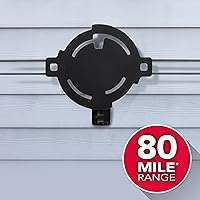
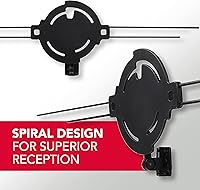
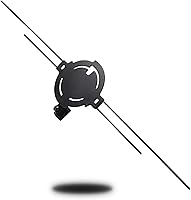
Where this amplified HD antenna earns its price tag is in the amplifier and the spiral element design working together. The built-in amplifier is meant to grab signals that would otherwise get lost between you and the broadcast tower, while the spiral layout helps it pick up signals from multiple directions instead of just one. RCA rates it for up to an 80-mile range, though that number assumes open, unobstructed terrain rather than hills, trees, or a city skyline in the way. It tunes in both UHF and VHF, including the low-VHF channels that some cheaper antennas simply skip over. When the broadcast is available in 4K, 8K, or 1080p, the antenna passes that signal through cleanly. The housing is also built to handle outdoor weather year-round without falling apart.

Best For

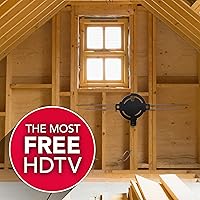
This outdoor antenna makes the most sense for households in suburban or semi-rural areas that sit a fair distance from broadcast towers but still want reliable reception. Cord-cutters who miss free access to local news, sports, and the major networks are the obvious audience here, especially if a monthly streaming bill is starting to feel like cable all over again. It also works well as a backup plan: when a storm knocks out cable or satellite service, having an over-the-air signal already wired up means you are not sitting in silence. Homes with usable attic space get an easy, discreet install without worrying about brackets or weatherproofing. And for anyone running a mix of free channels and a streaming box, it slots neatly into that hybrid setup.

User Feedback

Actual owner experiences paint a fair picture rather than a glowing one. The most common theme is that the 80-mile range is best treated as a ceiling, not a promise; trees, hills, and nearby buildings can cut that distance down noticeably. Several buyers mention that getting it positioned and aimed correctly took a bit of trial and error, including some climbing back up to the attic or roof to adjust angle. Opinions are split on how much real difference the built-in amplifier makes, with some swearing it rescued weak channels and others noticing little change. Long-term durability outdoors, especially through harsh winters or strong wind, comes up often in feedback too. And how many channels you actually get depends heavily on what is broadcasting in your specific market, not a fixed number.

Pros

  • Works in two mounting locations, so attic or outdoor installs are both options
  • Built-in amplifier helps grab weaker signals that basic antennas often miss
  • Spiral design pulls in signals from multiple directions, not just one
  • Picks up both UHF and VHF, including low-VHF channels many antennas skip
  • Passes through 4K, 8K, and 1080p broadcasts when your local stations offer them
  • No monthly fees or subscriptions once it is installed and tuned in
  • Acts as a dependable backup source when cable or satellite service drops during storms
  • Construction is built to handle outdoor weather exposure across multiple seasons
  • Pairs naturally with a streaming device for a hybrid free-and-paid channel lineup

Cons

  • Real-world range often falls noticeably short of the advertised 80-mile rating
  • Getting the angle and position right can take several rounds of trial and error
  • Hills, trees, and tall buildings can meaningfully cut down reception quality
  • Amplifier performance gets mixed reviews, with some buyers seeing little real improvement
  • Channel count varies a lot depending on your specific local broadcast market
  • Long-term durability against harsh wind and weather is a recurring concern among owners
  • Attic installs may still need adjustment if initial reception turns out weak
  • Buyers wanting an instant, no-fuss setup may find the tuning process tedious

Ratings

These scores for the RCA ANT860EV Amplified Outdoor Antenna were generated by AI after analyzing a large pool of verified buyer reviews from across different markets, with spam, bot activity, and incentivized feedback filtered out before scoring. The goal is to give you an honest read on where this antenna genuinely performs well and where real owners have run into friction. Both the strong points and the recurring complaints are reflected here, not just the highlights.
Signal Range & Distance Performance
71%
29%
Owners in fairly open suburbs report pulling in stations from well over 40 to 50 miles out, which covers most regional network affiliates without any cable bill attached. For many households, that is more than enough to replace a basic cable package.
The advertised 80-mile ceiling rarely shows up in practice once hills, trees, or nearby buildings enter the picture. Several reviewers in valley or wooded locations report results far closer to 25 or 30 miles, which can be a letdown if range was the main selling point.
Amplifier Performance
76%
24%
For households sitting at the edge of a station's broadcast radius, the built-in amplifier has reportedly turned a choppy, unwatchable signal into something stable enough for daily news and primetime viewing. That kind of rescue effect shows up often in stronger-signal regions.
In areas where the signal is already weak to begin with, some owners say the amplifier boosts noise right alongside the actual broadcast, leading to little real improvement. The benefit appears inconsistent depending on how far you are from the nearest tower.
Multi-Directional Reception
81%
19%
The spiral element layout lets it grab stations broadcasting from more than one direction without needing constant repositioning, which is handy for households whose local network towers are scattered rather than clustered together.
It is still not a true omnidirectional solution, so households with towers spread across opposite sides of the compass sometimes find one direction noticeably stronger than the other and end up compromising on overall channel count.
UHF/VHF Band Coverage
85%
Covering both UHF and low-VHF means it picks up older network affiliates that some newer antennas quietly drop, which matters in regions where a major channel still broadcasts on a low-VHF frequency.
A handful of owners in markets with weak low-VHF broadcasts still report dropouts on those specific channels, since low-VHF signals are inherently harder to capture cleanly regardless of the antenna design.
4K/8K/1080p Signal Pass-Through
89%
When local stations actually broadcast in 4K or full 1080p, this antenna passes that signal through without any visible compression or quality loss, giving cord-cutters a genuinely sharp picture on compatible TVs.
The catch is that very few broadcast markets currently send out true 4K or 8K signals, so most owners end up watching standard HD regardless of the antenna's technical capability.
Build Quality & Weather Resistance
69%
31%
The housing has held up through ordinary rain, wind, and temperature swings for outdoor installs, with many owners reporting no visible wear after a full season mounted outside.
A subset of long-term owners describe the housing or mounting hardware loosening after repeated exposure to severe storms or high-wind conditions, suggesting durability can vary depending on climate and exact mounting setup.
Installation & Setup Ease
58%
42%
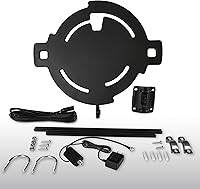
Once positioned correctly, the actual mechanical setup is simple, requiring just a mount, a coax run, and a channel scan, with no extra hardware or app pairing involved.
Getting to that point often takes multiple rounds of climbing back into the attic or up to the roof to adjust the angle, since first-time aiming rarely lands on the strongest signal immediately.
Mounting Versatility (Attic or Outdoor)
87%
Having both attic and outdoor mounting as legitimate options gives buyers real flexibility, especially renters or homeowners who would rather avoid drilling into roofing or siding.
Attic installs can lose some signal strength compared to a clear outdoor mount, since roofing material and attic clutter sit between the antenna and the broadcast towers.
Value for Money
83%
Compared to ongoing cable or satellite bills, this antenna pays for itself within a few months for households that get solid reception, with zero recurring fees afterward.
Buyers in genuinely fringe reception areas may feel the price is harder to justify if they end up with fewer usable channels than expected after testing it out.
Channel Count Reliability
66%
34%
Households in mid-sized broadcast markets frequently report landing 25 to 40 watchable channels, covering all the major networks plus several local affiliates and subchannels.
In smaller or more remote markets, total channel count can drop sharply, and a few owners mention ending up with fewer stations than they anticipated based on the antenna's 100-channel capacity rating.
Cable & Connector Compatibility
92%
The 75 Ohm impedance matches standard RG6 coax cable that most homes already have running to their TVs, so there is no need for adapters or specialty cabling.
Households still running older or non-standard coax setups may need a quick cable swap first, though this is a minor, one-time inconvenience rather than an ongoing issue.
Long-Term Outdoor Durability
64%
36%
Many owners report stable performance well past the one-year mark with no noticeable signal degradation, even through multiple seasons of outdoor exposure.
A recurring thread in longer-term feedback involves connector corrosion or mount fatigue after a few years outdoors, which suggests periodic inspection is worth doing rather than a fully set-and-forget approach.
Compact Design for Attic Use
84%
Its slim profile tucks into tighter attic spaces more easily than bulkier traditional outdoor antennas, which matters for homes without a lot of spare attic clearance.
The narrow shape does mean careful initial placement matters more, since there is less surface area to work with when trying to maximize directional reception inside a cramped attic.

Suitable for:

The RCA ANT860EV Amplified Outdoor Antenna is a smart pick for anyone in a suburban or semi-rural area who is far enough from broadcast towers to need real amplification, not just a basic indoor unit. It suits cord-cutters who want their local news, sports, and major network shows without paying a monthly fee for the privilege. Homeowners with a usable attic will appreciate having a mounting option that skips outdoor brackets and weatherproofing altogether. It also makes sense as a backup line for households that already stream but want something reliable when storms knock out cable or satellite. Buyers who do not mind a little setup work to dial in the best signal will get the most out of it.
Not suitable for:

This outdoor antenna is not a great match for buyers who expect a flawless, plug-and-play experience right out of the box, since aiming and positioning often take some patience. Anyone living in a dense urban core or deep in a valley surrounded by hills should be cautious, because the rated range assumes open, unobstructed terrain that rarely matches real-world geography. Renters without attic or roof access, or without permission to mount outdoor hardware, will struggle to use it as intended. Buyers expecting the built-in amplifier to single-handedly fix a genuinely weak signal area may end up disappointed. If you want guaranteed channel counts before you buy, the RCA ANT860EV Amplified Outdoor Antenna is not the right fit, since actual reception depends entirely on your local broadcast market.
Specifications

  • Brand: This antenna is manufactured under the RCA brand name.
  • Model Number: The official model number for this unit is ANT860EV.
  • Manufacturer: Production and distribution are handled by Voxx Accessories Corporation.
  • Color: The antenna housing comes in a black finish.
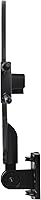
  • Mounting Options: It can be installed either inside an attic space or mounted outdoors.
  • Maximum Range: RCA rates the antenna for a maximum reception range of up to 80 miles under open, unobstructed conditions.
  • Impedance: The antenna operates at a standard impedance of 75 Ohm, matching common coaxial TV cabling.
  • Channel Capacity: It is rated to receive up to 100 over-the-air channels depending on local broadcast availability.
  • Reception Bands: The antenna receives both UHF and VHF frequencies, including low-VHF channels.
  • Signal Resolution: It supports the pass-through of 4K, 8K, and 1080p HDTV broadcast signals when those signals are available locally.
  • Amplifier: A built-in signal amplifier is included to help strengthen weaker incoming broadcast signals.
  • Antenna Design: The unit uses a spiral element design intended to aid multi-directional signal pickup.
  • Item Weight: The antenna weighs approximately 3.67 pounds.
  • Product Dimensions: Its measured dimensions are approximately 113 x 1 x 1 inches.
  • Ongoing Fees: There is no monthly fee or subscription required to receive channels once the antenna is installed.

Related Reviews
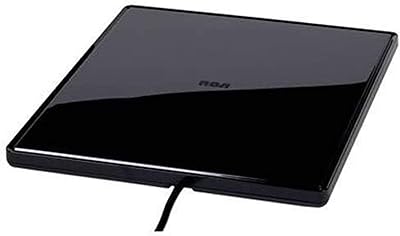
RCA ANT1360E Indoor HDTV Antenna
75%
76%
Signal Reception
91%
Ease of Setup
63%
Amplifier Performance
78%
Channel Count
71%
Build Quality
More
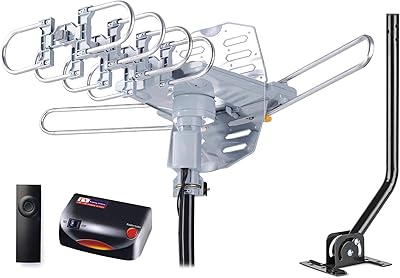
PBD WA-2608 Motorized Outdoor TV Antenna
74%
82%
Signal Reception Quality
78%
Motorized Rotation
84%
Installation Experience
74%
Dual TV Output
71%
Build Quality & Durability
More
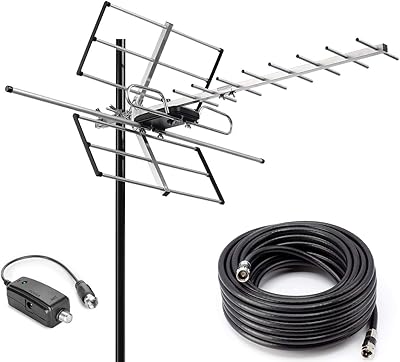
PBD HJK544 Outdoor Yagi TV Antenna
76%
83%
Signal Reception
89%
UHF Performance
61%
VHF Performance
78%
Build Quality
81%
Weather Resistance
More
DTB TECH V086-V087 Outdoor TV Antenna
74%
74%
Signal Reception
88%
Ease of Setup
43%
Advertised vs. Real Range
67%
Amplifier Performance
81%
Build Quality
More
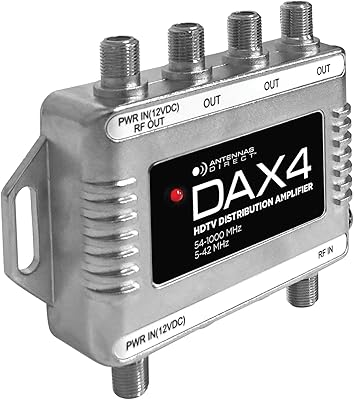
Antennas Direct DAX4 4-Output Distribution Amplifier
79%
83%
Signal Performance
88%
Build Quality
91%
Ease of Installation
79%
Value for Money
86%
ATSC 3.0 Compatibility
More
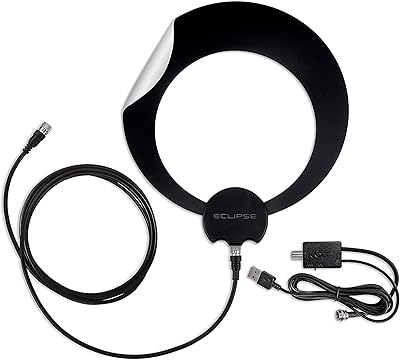
Antennas Direct ClearStream Eclipse Indoor TV Antenna
77%
74%
Signal Reception
67%
Amplifier Performance
93%
Design & Profile
91%
Ease of Setup
62%
Cable Length
More
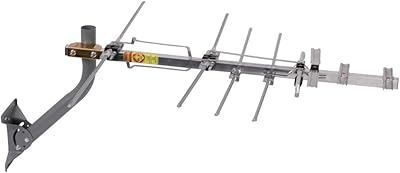
Antennas Direct DB8e Outdoor TV Antenna
73%
83%
Signal Reception
88%
Build Quality
86%
Weather Durability
58%
Ease of Installation
71%
Value for Money
More
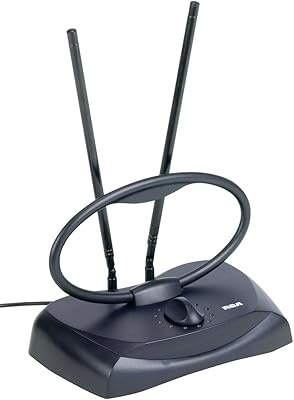
RCA ANT121Z Indoor TV Antenna
71%
78%
Signal Reception (VHF)
41%
Signal Reception (UHF)
94%
Ease of Setup
57%
Build Quality
72%
Value for Money
More
RCA ANT751E Outdoor Yagi TV Antenna
75%
88%
Signal Reception
67%
Range Accuracy
83%
Build Quality
74%
Installation Experience
86%
VHF Performance
More
iGENJUN ANT-CS8218 Amplified Indoor Outdoor TV Antenna
72%
73%
Signal Reception Quality
67%
Amplifier Performance
88%
Ease of Installation
48%
Range Accuracy vs. Claimed Specs
71%
Build Quality & Materials
More

FAQ

Treat the 80-mile figure as a best-case number rather than a guarantee. That range assumes flat, open terrain with nothing blocking the signal path. In practice, hills, trees, and buildings between you and the broadcast tower will shrink that distance, sometimes significantly.

Either works, and it really comes down to your situation. An attic install is easier to set up and keeps the hardware protected from weather, while a rooftop or exterior mount can sometimes grab a slightly stronger signal since there is less material in the way. If your attic gets decent reception during testing, it is usually the more convenient choice.

It is built with outdoor exposure in mind, so it is designed to handle typical weather conditions throughout the year. That said, some owners do report wanting to keep an eye on the mounting hardware after particularly harsh storms or high winds, just to make sure everything is still secure.

Yes, direction matters quite a bit. Even though this antenna is designed for multi-directional reception, pointing it generally toward your nearest broadcast towers will almost always give you better results. It is worth doing a channel scan, adjusting the angle slightly, and rescanning until you land on the strongest signal.

Not necessarily. The amplifier helps boost weaker signals so they are more usable, but it cannot create a signal that simply is not reaching your location. Feedback on how noticeable the amplifier's improvement is tends to vary from one household to another.

That depends almost entirely on what stations are broadcasting in your specific area. The antenna is capable of tuning in up to 100 channels, but your real-world count will be set by your local market, not by the antenna itself.

It is capable of passing through 4K, 8K, and 1080p signals when local stations actually broadcast in those formats. Most over-the-air channels today still broadcast in standard HD, so the resolution you see will depend on what your local stations are sending out.

No, there are no subscription fees or monthly charges involved. Once it is mounted and tuned in, you are simply receiving free over-the-air broadcasts.

It matters because it needs to match the coaxial cable and connectors you are using to run the signal to your TV. Standard RG6 coax cable, which most households already use, is built for this same 75 Ohm standard, so compatibility is generally not an issue.

It is manageable, but plan on spending some time getting it positioned correctly. Most first-time installs involve mounting it, running a channel scan, then making small adjustments to the angle until reception improves. It is not overly technical, just a bit of patience-required trial and error.