Overview

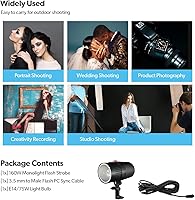
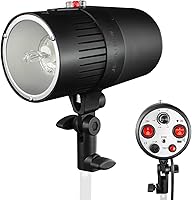
The LimoStudio AGG1756 160W Monolight Strobe has been quietly earning its place in home studios since 2015 — a decade-long run that says something real about its staying power. This is not a professional workhorse; it's an honest, entry-level studio flash built for hobbyists and beginners who want to step beyond natural light without spending a fortune. What makes it practical for newcomers is the included 75W halogen modeling light, which lets you actually see how shadows and highlights fall before you fire a single shot. Build quality reflects the price point — plastic-forward construction with functional controls — but the performance it delivers for basic portrait and still-life work is more than respectable.
Features & Benefits

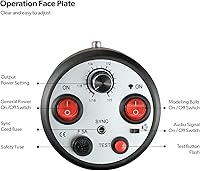
The power output dial runs from 1/16 all the way to full 160W, giving you meaningful control over exposure without touching your camera settings — a range that proves genuinely useful when shooting at different distances or swapping between subjects. Recycle time sits between 0.2 and 1.5 seconds depending on power level, fast enough that you won't be staring at a green LED waiting between shots during a portrait session. The built-in slave sensor is a quiet highlight: it picks up another flash and fires in sync automatically, so you don't need a separate radio transmitter to get started. A universal mount accepts most softboxes and umbrellas, and the 1/250s sync speed works cleanly with DSLRs and mirrorless cameras alike.

Best For

This studio flash unit makes the most sense for first-time studio photographers who need a structured light source they can genuinely learn from. If you've been relying on speedlights and want to understand how to shape light with modifiers, this is a low-risk way to make that transition. It also works well as a secondary fill light if you already own a stronger main strobe — the slave sensor handles triggering automatically, keeping the setup simple. Product photographers shooting flat-lays or small still-life arrangements will appreciate the adjustable output for dialing in even, controlled results. Workshop instructors and college photography programs looking for affordable, practical units students can handle freely will find it a sensible choice.

User Feedback

Across nearly 200 ratings, the LimoStudio strobe holds a solid 4-star average — for a budget unit, that reflects real-world usefulness rather than inflated expectations. Buyers consistently praise how approachable the initial setup is and how reliably the slave sensor fires without additional gear. Where things get more critical is heat: the halogen modeling bulb runs noticeably warm during longer sessions, and there's no cooling fan to offset that. A subset of reviewers has flagged concerns about flash tube lifespan under heavy, repeated use, and a handful note color temperature inconsistency when mixing it with other lights. Worth noting — but most of these points track with what budget flashes across the board tend to produce, not specific defects.

Pros

  • Built-in slave sensor fires reliably without a separate radio transmitter, making initial setup genuinely approachable.
  • Power output adjusts from 1/16 to full 160W, giving you real exposure control at different shooting distances.
  • The included 75W halogen modeling light helps beginners visualize light placement and shadow fall before shooting.
  • Recycle time between 0.2 and 1.5 seconds keeps portrait and product sessions moving without frustrating delays.
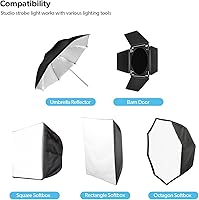
  • Universal modifier mount means most third-party softboxes and umbrellas attach without additional adapters.
  • Dual LED indicators take the guesswork out of knowing when the unit is powered and ready to fire.
  • Weighing just 2.35 pounds, this monolight strobe is easy enough to reposition frequently during a shoot.
  • The 1/250s sync speed works cleanly with the majority of DSLR and mirrorless camera bodies.
  • A consistent seller since 2015 with nearly 200 ratings, this studio flash unit has a meaningful track record for its class.
  • Functions well as an affordable secondary fill or background light alongside a stronger main strobe.

Cons

  • The halogen modeling bulb gets noticeably hot with no cooling fan, making extended sessions in small spaces uncomfortable.
  • Color temperature can shift compared to other strobes in a mixed setup, adding unwanted correction work in post.
  • Flash tube lifespan concerns appear in a subset of long-term reviews, raising questions about durability under heavy repeated use.
  • Plastic construction feels noticeably budget-tier and lacks the sturdiness expected for demanding location shoots.
  • A dedicated wireless trigger transmitter is sold separately, adding to costs if optical slave mode does not suit your workflow.
  • At 160W maximum output, the power ceiling feels limiting when trying to overpower strong ambient light in larger spaces.
  • Output precision can be inconsistent at the lower dial settings, which may frustrate photographers doing exacting product work.
  • No carrying case or protective padding is included, leaving safe transport between locations entirely up to the buyer.

Ratings

Our AI-generated scores for the LimoStudio AGG1756 160W Monolight Strobe are produced by systematically analyzing verified buyer reviews from global markets, with automated filters actively removing incentivized, bot-generated, and duplicate submissions to ensure the data reflects real-world ownership experiences. Each category score is calibrated to surface both what users genuinely appreciate and the frustrations that appear repeatedly across independent feedback — nothing is smoothed over or inflated. The result is an honest, data-grounded view of where this studio flash unit earns its place and where it runs up against its limitations.
Value for Money
84%
For beginners setting up their first home studio, the price-to-output ratio is genuinely hard to beat in this category. Getting a self-contained flash unit, a modeling light, and a working slave sensor in one package — without needing to invest in a full trigger system — represents real savings for someone just learning the craft.
The value equation weakens if you need it as a long-term workhorse. Replacement flash tubes and eventual component wear can erode the initial savings over time, and photographers who outgrow its 160W ceiling relatively quickly may feel they would have been better served investing more upfront.
Build Quality
58%
42%
The plastic construction is functional and holds together adequately under careful, stationary home studio use. For a beginner who sets the unit up on a stand, keeps it in one location, and handles it with basic care, the build does what it needs to do without feeling like it is about to fail.
Anyone transporting this unit between locations or handling it frequently will notice how lightweight the casing feels in a less reassuring way. The controls and housing lack the tactile solidity of mid-range or professional monolights, and no protective case is included to absorb bumps during storage or transit.
Flash Output & Power Control
77%
23%
The 1/16 to full output dial gives users a real, usable range for adjusting exposure across different shooting distances and setups. Beginners learning the relationship between flash power, aperture, and subject distance will find this dial a practical teaching tool — turning it down for close product work and up for larger portrait setups.
At 160W maximum, the output ceiling is modest by studio standards. Photographers working in rooms with strong ambient light or trying to fill a larger space will hit the power limit sooner than expected, and consistency at the lower dial positions has been flagged as slightly imprecise by more experienced users.
Ease of Setup
88%
Out-of-the-box setup is about as simple as studio flash gets: mount it on a stand, screw in the modeling bulb, plug it in, and the red LED confirms it is live. Buyers consistently report being up and shooting within minutes of opening the box, which matters enormously for beginners who want to spend time learning lighting, not troubleshooting equipment.
The included instruction sheet is minimal, which leaves complete beginners with real questions about optimal power settings and trigger configuration. First-time users wanting a fully wireless setup will need to research radio trigger options independently, as no guidance on that workflow is provided in the packaging.
Slave Trigger Reliability
82%
18%
The built-in optical slave is one of the most consistently praised aspects across buyer feedback — it picks up a triggering flash reliably and fires in sync without the need to purchase additional equipment to get started. For beginners pairing this with a camera-mounted speedlight, the slave mode typically just works, making multi-light setups accessible without extra complexity.
Optical slave performance depends on line-of-sight and ambient light conditions. In bright environments or rooms with strong overhead lighting, the sensor can occasionally misfire or fail to trigger consistently. Users who need rock-solid, interference-free sync in variable lighting conditions will eventually require a radio transmitter, sold separately.
Modeling Light
71%
29%
The included 75W halogen modeling light is a genuine asset for anyone learning how studio lighting works. Having a continuous light source that shows exactly where shadows fall and how light wraps around a subject — before firing a single flash shot — is a teaching tool that many beginners underestimate until they actually use it.
The halogen bulb produces real, noticeable heat with no cooling fan to offset it during extended sessions. In a compact home studio or tight shooting space that heat accumulates quickly. The bulb also has a warmer color cast than the flash itself, so the preview is an approximation of the final result rather than an exact match.
Recycle Speed
79%
21%
At lower power settings, the 0.2-second recycle time is fast enough to shoot at a comfortable, deliberate pace without stalling a portrait or product session. The green ready indicator removes any guesswork, clearly signaling when the unit has recharged and the next shot can be taken without risking a misfired or underexposed frame.
At full power, the 1.5-second recycle time is serviceable but noticeable — especially for photographers coming from speedlights who are used to quicker turnaround. Any scenario requiring rapid successive shots will expose this limitation, though it is worth noting this unit was never designed for that type of high-frequency shooting workflow.
Heat Management
43%
57%
For brief, well-spaced portrait sessions where the modeling light does not run continuously for extended periods, heat buildup stays within manageable limits. Photographers who turn the modeling light off between shots or work in a well-ventilated room will experience fewer issues than those shooting back-to-back in tight, enclosed spaces.
The absence of a cooling fan is the most frequently recurring complaint among users who shoot for longer stretches. The halogen modeling bulb generates significant passive heat, and with no active dissipation mechanism, the unit needs deliberate rest periods during prolonged sessions — a genuine workflow disruption that reviewers flag consistently across independent feedback.
Modifier Compatibility
83%
The universal mount opens access to a wide ecosystem of affordable third-party light modifiers without requiring brand-specific adapters. Beginners who pick up a basic softbox or umbrella kit will generally find it attaches cleanly and holds securely, removing one potential source of frustration when experimenting with light shaping for the first time.
Fit quality can vary depending on the modifier brand and construction quality. Some cheaper third-party accessories sit slightly loose on the mount, which can cause them to shift during a session. Users attaching larger or heavier modifiers should also verify their light stand can support the combined weight safely before committing to a setup.
Color Temperature
52%
48%
For single-light setups — a straightforward portrait against a backdrop or a simple product shot with one light source — color temperature performance is functional and produces correctable results without demanding significant post-processing work. Most beginners shooting in this configuration will not notice or be materially affected by any temperature variation between shots.
In multi-light setups or when paired with other strobes, color temperature inconsistency becomes more apparent and harder to ignore in editing. Some users report a visible warm or cool shift that requires per-image color correction, and photographers who need precise, matched output across multiple units should not rely on this monolight strobe to deliver that level of consistency.
Flash Tube Longevity
54%
46%
For users who shoot at moderate power settings and keep sessions at a reasonable length, the flash tube tends to perform without incident during the early months of casual home studio use. Hobbyists running occasional portrait or product sessions — rather than daily high-volume shoots — are unlikely to encounter tube failure quickly.
A meaningful portion of long-term reviewers has reported flash tube failure earlier than expected, particularly among users who fire consistently at or near full power. Replacement tubes are available but add to the total cost of ownership over time, and high-frequency shooters should treat eventual tube replacement as a near-certainty rather than a remote possibility.
LED Indicator Clarity
86%
The dual LED system — red for power-on and green for flash-ready — gives users an unambiguous status read during a session without any guesswork about whether the unit has recycled. For beginners still building a shooting rhythm who need clear feedback between shots, these indicators reduce uncertainty and help establish a more consistent, confident workflow.
The indicators are functional but basic. In very bright environments or when the unit is angled away from the photographer, the LEDs can be harder to read at a glance from across the room. There is also no audible ready signal, which users who position the unit behind or beside them would likely find useful.
Portability & Weight
81%
19%
At 2.35 pounds, this studio flash unit is genuinely lightweight for a monolight, making repositioning between shots quick and physically easy during a session. Photographers who frequently move the unit between key light, fill, and background positions will appreciate not having to counterbalance a heavy head on their stand each time they reconfigure.
Portability as a location or travel flash is fundamentally limited by the AC power requirement. With no battery option, the unit is anchored to wherever a wall outlet is available, keeping it studio-bound. No carrying case or padding is included, so transporting it safely between spaces requires sourcing appropriate protection independently.
Sync Speed
78%
22%
The 1/250s maximum sync speed aligns cleanly with the native flash sync ceiling of most popular DSLR and mirrorless camera bodies, meaning the majority of users will not encounter sync-related banding issues during normal controlled studio shooting. For indoor work where shutter speed is not being used to compete with ambient light, the sync ceiling rarely becomes a constraint.
Photographers who rely on high-speed sync to shoot at faster shutter speeds — common when blending flash with ambient light or shooting wide-open outdoors — will find this unit does not support that feature. It is a standard limitation at this price tier, but it is worth confirming upfront if HSS is a regular part of your workflow.
Beginner Friendliness
87%
This monolight strobe was clearly designed with the beginner experience in mind, and it shows. The physical power dial, visible LED status indicators, and straightforward plug-and-shoot operation give newcomers a tangible, hands-on way to learn how flash output affects an exposure — something genuinely harder to internalize through menus and digital readouts.
The included documentation is sparse, leaving complete beginners to work out optimal power settings, modifier pairings, and trigger configuration largely through trial and error or external online resources. Users with no prior flash photography experience may spend meaningful time troubleshooting questions that a more thorough setup guide would have answered upfront.

Suitable for:

The LimoStudio AGG1756 160W Monolight Strobe is a natural fit for anyone building a first home photography studio on a tight budget and wanting to move beyond available light or speedlights. Photography students will find the adjustable power dial and included modeling light genuinely educational — the modeling light, which stays on continuously, teaches you how light and shadow behave across a subject before you ever press the shutter. The built-in slave sensor means you can fire this unit in sync with another flash without buying a radio trigger upfront, which keeps the cost of entry low. Content creators who shoot product flat-lays, small still-life setups, or simple headshots will get consistent, repeatable results without investing in a full professional kit. It also slots in well as a secondary fill or background light alongside a more capable main strobe, since the slave triggering handles sync automatically. Workshop instructors and photography educators will appreciate having units that students can use freely, knowing replacement costs remain manageable if something goes wrong.
Not suitable for:

The LimoStudio AGG1756 160W Monolight Strobe is not the right choice for photographers operating in commercial or professional contexts where color accuracy, output consistency, and long-term durability are non-negotiable. If you are lighting a multi-strobe setup for editorial or product advertising work, the color temperature variation some users report between this unit and other lights will create visible inconsistencies that cost real time in post-processing. The halogen modeling bulb produces genuine heat, and without a cooling fan, extended continuous shooting in a small or poorly ventilated space becomes a comfort and equipment-longevity concern. Photographers who shoot in high volume — multiple client sessions per week — may find the flash tube shows wear sooner than more expensive, purpose-built professional monolights. Anyone who needs a fully wireless setup right out of the box should note that a radio trigger transmitter is sold separately; the built-in optical slave requires another flash to set it off. At 160W maximum output, this studio flash unit also lacks the power headroom needed to compete with strong ambient light in bright or large-scale environments.
Specifications

  • Flash Power: This unit delivers a maximum flash output of 160W, providing sufficient light for portrait and product photography in small to medium home studio spaces.
  • Power Range: The power output dial adjusts continuously from 1/16 to full, allowing exposure control without the need to change camera settings between shots.
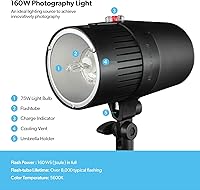
  • Modeling Light: A 120V, 75W halogen modeling bulb is included and remains lit continuously to help photographers assess light direction, shadow fall, and coverage before firing.
  • Input Voltage: Requires an AC power source between 110V and 130V at 60Hz, compatible with standard North American household wall outlets.
  • Recycle Time: Flash recycle time ranges from 0.2 seconds at low power settings to 1.5 seconds at full output, keeping most portrait and product sessions flowing at a practical pace.
  • Sync Speed: Supports flash synchronization at shutter speeds up to 1/250s, matching the native sync ceiling of most DSLR and mirrorless camera bodies.
  • Slave Sensor: A built-in photo-cell slave sensor detects light from a nearby flash source and triggers the unit automatically, enabling wireless triggering without a dedicated radio transmitter.
  • Test Button: A dedicated test-fire button on the flash body allows manual triggering to verify output and check modifier positioning independently of the camera.
  • Mount Type: The flash head features a universal mount ring compatible with standard tripod light stands and most third-party light modifiers including softboxes, umbrellas, and reflectors.
  • Flash Tube: The unit uses a circular flash tube design housed within the monolight body, providing even light distribution into attached reflectors and modifiers.
  • LED Indicators: A red LED confirms active AC power connection, and a green LED illuminates when the capacitor has fully charged and the unit is ready to fire.
  • Cooling System: This unit relies on passive heat dissipation through the flash body casing and does not include an active cooling fan.
  • Dimensions: The flash body measures 10.2 x 5.7 x 7.9 inches, a compact footprint suited to home studio setups with limited floor or stand space.
  • Weight: At 2.35 pounds, the unit is lightweight enough to mount and reposition easily on a standard light stand without counterbalancing concerns.
  • Package Contents: Box includes one flash body, one 120V 75W halogen modeling bulb, and one instruction sheet; light stand, modifiers, and wireless trigger are not included.

Related Reviews

DAMGOO T160HS Stereo Amplifier Board
79%
91%
Value for Money
88%
Ease of Setup
74%
Audio Quality
52%
Power Output Accuracy
78%
Build Quality
More
Westcott FJ400 400Ws AC/DC Strobe Monolight
83%
88%
Build Quality
93%
Color Consistency
79%
Battery Performance
86%
TTL Accuracy
91%
High-Speed Sync
More
Flashpoint XPLOR 600 PRO TTL Strobe Monolight
81%
88%
Output Power & Consistency
91%
High-Speed Sync Performance
76%
TTL Accuracy
79%
Battery Life (Real-World)
84%
Build Quality & Durability
More
Godox AD300 Pro Outdoor Flash Strobe
82%
93%
Light Output & Power
89%
Portability & Form Factor
84%
TTL Accuracy
91%
HSS Performance
88%
Recycle Time & Stamina
More
MAC Strobe Cream Pinklite 50ml Illuminating Cream
77%
88%
Glow Payoff
91%
Texture & Absorption
47%
Shade Inclusivity
62%
Wear Longevity
86%
Versatility
More
Godox AD600BM II Outdoor Flash Strobe
84%
93%
Flash Output & Power
88%
Recycle Time
79%
Battery Life
91%
Build Quality
66%
Portability & Weight
More
SIGMA Beauty Strobing Fan Brush - F42
85%
94%
Application Precision
88%
Skin Sensitivity & Hypoallergenic Quality
91%
Ergonomics & Handle Comfort
89%
Versatility with Product Types
80%
Ease of Use
More
NEEWER Q4 400Ws Outdoor Flash Strobe
81%
91%
Output Power & Performance
88%
Battery Life
86%
Recycle Speed
83%
TTL Accuracy
87%
High Speed Sync (HSS)
More
NEEWER S101-400W Studio Monolight
76%
88%
Light Output Consistency
79%
Build Quality
61%
Recycling Speed
84%
Modeling Lamp Usability
93%
Bowens Mount Compatibility
More
Westcott FJ200 Round Head Strobe
82%
93%
Light Quality & Color Consistency
88%
Build Quality & Durability
91%
Recycle Time & Shooting Speed
82%
Battery Life & Charge Capacity
89%
High-Speed Sync & Flash Capabilities
More

FAQ

Not necessarily. This studio flash unit has a built-in optical slave sensor that fires automatically when it detects light from another flash nearby — so if you already have a camera-mounted speedlight or a second strobe, you can use that to trigger it without buying anything extra. If you want to fire it as a standalone unit directly from your camera with no other light source present, you would need a sync cable or a separate radio transmitter, both of which are sold separately.

Most third-party softboxes, umbrellas, and reflectors with a universal monolight speed ring will attach without issue. The mount follows a widely used standard, so many commonly available modifier kits are compatible. If you are purchasing a modifier specifically to pair with this unit, look for products labeled as universal monolight or studio flash compatible to be safe.

The 75W halogen bulb runs noticeably warm, especially during longer continuous sessions. It is not dangerous under normal use, but in a small enclosed shooting space you will feel the heat accumulate over time. For short portrait or learning sessions it is perfectly manageable. Avoid touching the bulb directly, and give the unit a few minutes to cool before moving or packing it away.

Yes, with the right connection method. The LimoStudio AGG1756 160W Monolight Strobe is not a hot-shoe flash — it is a studio monolight, so it does not mount directly onto your camera body. The most common approach is to attach a small radio or optical trigger to your camera's hot shoe and set this unit to optical slave mode so it fires in sync. Camera bodies with a PC sync port can also connect via a standard sync cable. Either way, pairing it with Canon, Nikon, Sony, or most other brands is straightforward once you understand how studio flash triggering works.
Yes, that is actually one of the smarter ways to use this monolight strobe. Set one unit as your main light triggered by your camera, and put the second on optical slave mode — the built-in sensor will detect the first flash and fire automatically. Many beginners use this exact approach to build a simple key-and-fill portrait setup at home without needing a complex multi-channel trigger system.

The biggest practical differences are modifier compatibility and the continuous modeling light. Speedlights are compact and great for on-location shooting, but they are not designed to accept large modifiers like softboxes or strip lights the way a studio monolight is. This studio flash unit also has a modeling light that stays on between shots, making it far easier to see how your light is shaping the subject before you commit to a frame — something a speedlight simply cannot offer. Output control is also more intuitive here, adjusted with a physical dial rather than buried menu options.

The box contains the flash body, one 75W halogen modeling bulb, and an instruction sheet — nothing else. No light stand, modifier, or wireless trigger is included. You will need to pick up a compatible tripod-style light stand separately, which is widely available and generally very affordable.

Lifespan depends heavily on how often you use it and at what power level. Firing at full power repeatedly puts more stress on the tube than working at moderate settings. For casual home studio use — a session or two per month — most users get reasonable service life. That said, a portion of longer-term reviewers has reported tube failure under heavy, high-frequency use, so if you plan to shoot large volumes regularly, factor that into your expectations before committing.

This unit is designed strictly for indoor AC-powered use. It requires a standard wall outlet and has no battery option, so outdoor use would require a generator or power inverter. It is also not weather-resistant in any way, meaning humidity, wind-blown dust, or moisture exposure all pose a real risk of damage. For reliable, safe performance, keep it in a dry indoor environment.

For small to medium product setups — tabletop arrangements, flat-lays, packaged goods, or small objects — this monolight strobe handles the job well. The adjustable output dial lets you fine-tune light intensity to suit your product and shooting distance, and the modeling light helps you position and shape the light before you shoot. Where it shows its limits is in color temperature consistency when paired with other strobes, and in raw output for larger spaces, but for straightforward home product photography it delivers solid, repeatable results.