Overview

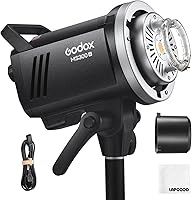
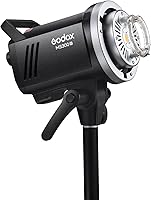
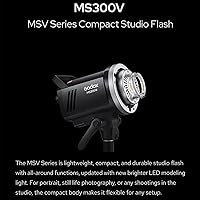
The Godox MS300-V 300W Studio Monolight is Godox's refined take on one of its own bestsellers, built for working photographers who shoot portraits, headshots, or small commercial work and want reliable, predictable flash power without overspending. This studio monolight sits firmly in the entry-to-mid tier — it won't replace a Profoto setup, and it doesn't try to. What it offers instead is a compact, capable body with a Bowens mount, meaning virtually every softbox, beauty dish, or reflector you already own attaches without an adapter. For photographers building a home studio or managing a small space, that kind of broad compatibility matters more than most specs on the sheet.
Features & Benefits

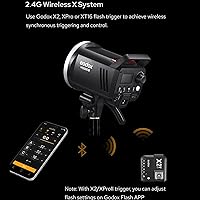
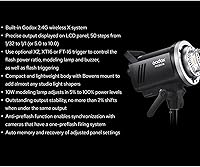
The most meaningful upgrade over the original MS300 is the switch to a 10W LED modeling lamp, which runs cooler than the old incandescent design and lets you dial brightness from a subtle glow to full output — useful when you're checking shadow fall or catchlight position before you shoot. Recycle speed is genuinely quick at lower power settings, so this Godox flash keeps up during fast-paced portrait sessions without breaking your rhythm. The built-in wireless X system integrates cleanly with compatible Godox triggers for remote power control and lamp toggling — though note those triggers are sold separately. Fifty discrete power steps give you enough fine control for consistent, repeatable exposures across a full shoot.

Best For

This studio monolight makes the most sense for solo photographers running portrait or product sessions out of a home or small commercial space. If you've been relying on speedlights and keep running into inconsistent exposures or frustrating recycle delays, the MS300-V is a meaningful and affordable step up. It's also a natural fit for existing Godox users who already own X-series triggers and want to add a reliable strobe without reconfiguring their workflow. That said, be clear-eyed about what it isn't: there's no TTL support, and high-volume commercial shooters demanding sustained full-power output for hours at a stretch will likely outgrow it and should budget accordingly for something more robust.

User Feedback

Across hundreds of reviews, build quality consistently surprises buyers in a good way — the body feels more substantial than the price suggests, and those upgrading from the original MS300 single out the LED modeling lamp as a genuine improvement. Recycle speed at mid-range power draws strong praise from photographers shooting client sessions where waiting between frames costs time and energy. The most repeated criticism is fan noise at full power during extended use; it's rarely disruptive, but noticeable in very quiet environments. A handful of buyers were frustrated to discover that wireless triggering needs a separately purchased trigger. At 4.5 stars from a broad user base, the trade-offs are real but minor, and most shooters consider them easy compromises.

Pros

  • Exceptional value for the performance level — hard to find comparable output and features at this price.
  • The Bowens mount means your existing modifier collection works immediately, no adapters needed.
  • The upgraded LED modeling lamp runs cooler and is far more useful for previewing light than the older incandescent design.
  • Built-in Godox wireless X receiver integrates cleanly with X-series triggers for full remote control.
  • Fifty power steps give you precise, repeatable exposure control across a full shooting session.
  • Compact and lightweight enough to reposition quickly in tight studio spaces without a second pair of hands.
  • Setup is genuinely beginner-friendly — most users are shooting within minutes of unboxing.
  • Output consistency at mid-range power is strong, keeping skin tones and exposures predictable across long sessions.
  • Recycle speed at moderate power settings keeps up well with a brisk portrait shooting pace.
  • Compatible with every major camera brand, so switching systems does not require replacing your flash.

Cons

  • No TTL support — every power adjustment is manual, which limits usefulness in fast-changing shooting situations.
  • No trigger included in the box; wireless control requires a separately purchased Godox X-system trigger.
  • Fan noise becomes noticeably loud at higher power settings, making it disruptive for video work with live audio.
  • Requires a mains power outlet — completely unsuitable for location or outdoor shoots without a generator.
  • Long-term reliability beyond heavy use is not well-documented; durability over several years remains an open question.
  • Output fluctuations have been noted at sustained full power during extended high-intensity sessions.
  • The included documentation is thin — beginners relying solely on the printed manual may hit setup confusion.
  • Only compatible with Godox X-system wireless triggers; other brand trigger systems will not work with the built-in receiver.
  • Lowest power settings may not go dim enough for photographers who regularly work in bright mixed-light environments.
  • Some users report minor physical looseness in the mount connection when using particularly heavy light modifiers.

Ratings

The Godox MS300-V 300W Studio Monolight has been scored below using an AI-driven analysis of verified global buyer reviews, with spam, incentivized feedback, and bot activity actively filtered out before scoring. Each category reflects what real photographers — from home-studio hobbyists to working portrait pros — consistently reported across hundreds of documented experiences. Both the strengths that keep buyers recommending it and the friction points that give others pause are transparently represented in every score.
Value for Money
93%
Buyers repeatedly describe this as one of the most capable studio flashes available at its price point, especially when factoring in the Bowens mount compatibility and built-in wireless system. Photographers who previously paid significantly more for comparable performance were notably impressed by what they received.
A small segment of reviewers noted that once you factor in the cost of a separately purchased trigger, the overall investment climbs higher than the unit price implies. For buyers on the tightest budgets, that hidden add-on cost felt like a gap in the advertised value.
Build Quality
81%
19%
Most users express genuine surprise at how solid the body feels relative to the price. The casing holds up well through regular studio moves and the occasional bump, and the mount connection feels secure even with heavier modifiers attached.
A recurring observation is that certain plastic components — particularly the control dial area — feel slightly less refined than the overall unit suggests. Long-term durability beyond two or three years of heavy use remains a question mark based on available feedback.
Flash Consistency & Output Stability
88%
Photographers running multi-hour portrait or product sessions report very little variation in exposure from one shot to the next when working at mid-range power. That consistency is genuinely valuable when you are color-grading batches of images and need your baseline exposure to hold steady.
At the upper end of full power, a small number of users noticed occasional slight output fluctuations over prolonged high-intensity use. This is rarely a dealbreaker, but it is worth knowing if you shoot extensively at maximum power for long stretches.
Recycle Speed
86%
At mid-range power settings — which is where most portrait and headshot photographers actually work — the recycle time is fast enough to keep up with a moderately brisk shooting pace without interrupting creative flow. Buyers coming from older or cheaper units are consistently pleased with how quickly it resets.
At or near full power, recycle times stretch noticeably and some photographers found themselves waiting longer than expected between frames during fast-paced editorial-style sessions. It is a physics limitation of the power storage design, not a defect, but it shapes what this flash is realistically suited for.
Modeling Lamp Quality
84%
The upgrade to an LED modeling lamp is one of the most praised improvements over the previous model. It runs much cooler during extended shoots, and the ability to adjust brightness across a wide range makes it genuinely useful for previewing light placement and catchlight positioning before committing to a shot.
A handful of users noted the modeling lamp, while much improved, is not bright enough to fully substitute for dedicated constant-light setups in video work. It is a preview and positioning tool first — treating it as a primary video light will leave some users underwhelmed.
Wireless Control Integration
77%
23%
For photographers already inside the Godox ecosystem with an X-series trigger on their camera, the wireless integration works reliably and covers remote power adjustment and lamp control without requiring physical access to the flash head. It is a clean, practical system that removes a lot of unnecessary interruptions during a shoot.
The built-in receiver only plays nicely within the Godox X wireless family. Buyers who own triggers from other systems were frustrated to discover incompatibility, and the fact that no trigger is included in the box caught a meaningful number of first-time buyers off guard.
Ease of Setup
89%
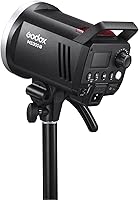
First-time monolight users consistently describe the setup experience as intuitive. Controls are clearly laid out, the display is easy to read, and getting from unboxing to first test shot takes very little time even without consulting the manual. This matters especially for photographers making the jump from speedlights.
The manual bundled with the unit has been criticized for being thin on detail, particularly regarding wireless setup steps. Users relying purely on the included documentation rather than online resources or video tutorials tended to hit small friction points during initial configuration.
Portability & Size
82%
18%
Weighing just over a kilogram and with a relatively short tube length, this Godox flash is easier to transport and position than many competing units in the same power class. Photographers working in tight home studios or carrying gear to client locations appreciate not dealing with bulky, unwieldy equipment.
It is still a mains-powered monolight requiring an AC outlet, so location flexibility is inherently limited compared to battery-powered alternatives. For outdoor or on-location shoots away from power sources, this is a hard stop regardless of the compact body.
Power Range & Control Precision
83%
Fifty discrete power steps between minimum and full output give photographers meaningful creative control over exposure without relying solely on modifier swaps or camera adjustments. Portrait and product photographers particularly valued the ability to make small, incremental changes and get repeatable results across a full session.
A small number of experienced studio photographers felt that even with fifty steps, the lower-end power settings do not reach quite as dim as they would prefer for certain high-key or mixed-light scenarios. It is a niche concern but relevant if you frequently work at the extremes.
Modifier Compatibility (Bowens Mount)
91%
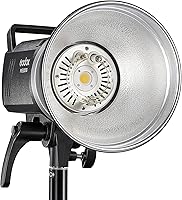
The Bowens mount is one of the most widely supported flash mount standards available, and buyers with existing softboxes, grids, beauty dishes, and reflectors could attach their entire modifier collections without purchasing additional adapters. This is a practical, real-world advantage that significantly extends the value of the unit.
While the mount standard itself is universally praised, a few users noted that the physical mount connection felt slightly less tight than on premium-tier units, and with very heavy modifiers there was occasional minor wobble that needed to be checked before shooting.
Fan Noise
58%
42%
At lower and mid-range power settings, the cooling fan is quiet enough that most photographers working alone or in a standard studio environment barely notice it. For the majority of typical portrait sessions, it simply is not a meaningful distraction.
At higher power levels, the fan becomes noticeably louder — enough that several users specifically mentioned it as disruptive during video work with live audio recording, or in very quiet client-facing environments. It is the most consistently raised complaint across the full review pool.
Color Accuracy & Flash Consistency
79%
21%
Users report that skin tones render naturally and that the daylight-balanced output produces clean results without significant color casts when shooting at standard studio white balance settings. For portrait and headshot work, the color rendering is more than adequate.
Precise color temperature consistency across power levels has not been extensively documented by buyers, and a few users working in more technically demanding commercial contexts noted subtle color shifts when comparing shots taken at very different power settings — something that matters more in product photography than in portraits.
Long-Term Durability
69%
31%
A solid portion of reviewers who have owned the unit for over a year report no performance degradation or hardware issues under regular use in a small studio environment. For photographers with moderate shooting volumes, the build appears to hold up reliably.
There is a notable absence of long-term feedback from high-volume users, and the handful of reliability concerns that do appear in the review pool tend to cluster around the flash tube and electrical components after extended heavy use. It is not a systemic problem, but the durability picture beyond the two-year mark is genuinely unclear.
TTL & Advanced Trigger Support
41%
59%
For manual studio shooters who have never relied on TTL and work with fixed setups, the absence of automated exposure metering is not a loss — and those users report no frustration whatsoever with how the flash performs in a controlled environment.
This flash has no TTL capability at all, which is a hard limitation for photographers who shoot dynamic or run-and-gun portrait work where lighting conditions change quickly. Buyers who did not check this detail before purchasing expressed clear disappointment, making it one of the most important factors to clarify upfront.

Suitable for:

The Godox MS300-V 300W Studio Monolight is a well-matched choice for photographers who shoot portraits, headshots, or small product work in a dedicated home studio or modest commercial space. If you have been relying on speedlights and keep wrestling with inconsistent exposures or slow recycle times, this is a meaningful and affordable step toward repeatable, professional-grade results. Photographers already invested in the Godox ecosystem — particularly those with an X-series trigger already on their camera — will find the wireless integration works smoothly right out of the box without any additional configuration headaches. The Bowens mount is a genuine practical advantage: if you have already built up a collection of softboxes, beauty dishes, or grids, almost all of it will attach directly without adapters. Solo shooters managing a single or dual-light setup in a small space will find the compact body easy to reposition quickly between setups.
Not suitable for:

The Godox MS300-V 300W Studio Monolight is not the right tool for photographers who depend on TTL — there is no automatic exposure metering here, and if your work involves rapidly changing lighting conditions where manual adjustments between shots simply are not practical, this flash will slow you down. High-volume commercial shooters running back-to-back client sessions at sustained full power will likely find the recycle limitations and fan noise more disruptive than occasional studio users would. It is also not a location flash in any meaningful sense — it requires a mains power outlet, which rules it out for outdoor natural-light-complement work or any shoot away from reliable AC power. Photographers who shoot video with live audio will find the cooling fan intrusive at higher power settings. And anyone hoping to trigger it wirelessly using non-Godox equipment should know upfront that the built-in receiver is X-system specific — plus, no trigger is included in the box, so budget for that separately before your first shoot.
Specifications

  • Flash Power: Rated at 300W with a guide number of 58, suitable for illuminating subjects in small-to-medium studio spaces.
  • Power Range: Output is adjustable across 50 discrete steps from 1/32 to full power, enabling precise and repeatable exposure control.
  • Recycle Time: Recycle time ranges from 0.1 seconds at minimum power to 1.8 seconds at full power, depending on the selected output level.
  • Modeling Lamp: Equipped with a 10W LED modeling lamp with adjustable brightness from 5% to 100%, replacing the incandescent lamp used in the original MS300.
  • Mount Type: Uses the Bowens mount standard, providing broad compatibility with a wide range of third-party light modifiers including softboxes, beauty dishes, and grids.
  • Wireless System: Features a built-in Godox 2.4G Wireless X receiver for remote power adjustment, modeling lamp control, and flash triggering via compatible X-system triggers.
  • Sync Speed: Supports camera sync speeds between 1/800s and 1/2000s depending on the connected camera body.
  • Flash Tube Length: The flash tube with lamp cover measures 28.3cm in total length, contributing to the unit's compact footprint.
  • Dimensions: Physical body measures 13.39 x 7.52 x 8.98 inches, designed to fit comfortably in small studio setups without occupying excessive floor space.
  • Weight: Net weight is approximately 1.3kg, making it manageable for solo repositioning during a shoot without requiring a second person.
  • Power Supply: Operates on AC 110–120V at 60Hz, designed for standard North American mains power outlets only.
  • Camera Compatibility: Compatible with Canon, Nikon, Sony, Fujifilm, Olympus, Panasonic, and Pentax camera systems when used with an appropriate Godox X-system trigger.
  • Color Rendering: Produces daylight-balanced flash output consistent with standard studio color temperature expectations for portrait and product photography.
  • Trigger Included: No wireless trigger is included in the box; a separately purchased Godox X-series trigger such as the X3 or XT16 is required for wireless operation.
  • Flash Type: Manual studio monolight with no TTL (through-the-lens) automatic exposure metering capability.
  • Cooling System: Active fan cooling is used to manage heat during extended sessions, with fan noise increasing at higher power output levels.
  • Model Number: Official model designation is MS300V, representing the upgraded version of the earlier Godox MS300.
  • Manufacturer: Designed and produced by Godox, a China-based lighting manufacturer with broad distribution across the global photography accessories market.

Related Reviews

Godox AD600Pro TTL Studio Flash
88%
94%
Performance
89%
Build Quality
85%
Ease of Use
75%
Portability
92%
Battery Life
More
GODOX AD100Pro Pocket Studio Flash Light
86%
93%
Portability
89%
Performance
85%
Battery Life
91%
Recycling Time
88%
Ease of Use
More
Calibrite ColorChecker Studio
87%
93%
Calibration Accuracy
85%
Ease of Use
74%
Software Experience
91%
Device Compatibility
88%
Portability & Size
More
Godox V850III Flash
Godox V850III Flash
85%
88%
Performance
92%
Battery Life
86%
Ease of Use
84%
Build Quality
89%
Speed and Recycle Time
More
Godox AD200 Pro
Godox AD200 Pro
86%
93%
Output Power & Consistency
91%
Portability & Form Factor
78%
Battery Life & Charging
89%
HSS & Sync Performance
88%
Wireless Ecosystem Integration
More
Beats Studio Buds
Beats Studio Buds
85%
87%
Sound Quality
92%
Active Noise Cancelling (ANC)
85%
Battery Life
88%
Comfort & Fit
90%
Bluetooth Stability & Range
More
Microsoft LifeCam Studio
84%
92%
Video Quality
89%
Microphone Quality
90%
Ease of Setup
88%
Compatibility
85%
Build Quality
More
AKG K361 Studio Headphones
85%
91%
Sound Quality
84%
Comfort & Fit
90%
Noise Isolation
88%
Build Quality
86%
Portability
More
Godox MF12 Macro Flash
87%
88%
Performance
90%
Ease of Use
85%
Battery Life
80%
Flash Power
92%
Wireless Control
More
Godox TT350F Flash for Fujifilm
88%
94%
Portability & Size
90%
Ease of Use
84%
Battery Life
87%
Build Quality
88%
Performance in Low Light
More

FAQ

No trigger is included — this is probably the most important thing to know before ordering. To use the wireless control features, you will need to purchase a compatible Godox X-system trigger separately, such as the X3, XT16, or FT16. Budget for that additional cost upfront so it does not catch you off guard when the box arrives.

Yes, the MS300-V works with Canon cameras, along with Nikon, Sony, Fujifilm, Olympus, Panasonic, and Pentax systems. The key is pairing it with the correct Godox X-system trigger designed for your specific camera mount — the flash itself is trigger-agnostic as long as you stay within the Godox X wireless family.

The headline upgrade in the Godox MS300-V 300W Studio Monolight is the switch from an incandescent modeling lamp to a 10W LED. That change means the lamp runs cooler during long sessions, lasts significantly longer, and gives you adjustable brightness across a much wider range than the older design. The core flash performance is similar, but the LED modeling lamp is a meaningful practical improvement for everyday studio use.
Almost certainly yes. This flash uses a Bowens mount, which is one of the most widely adopted standards in studio lighting. The vast majority of softboxes, beauty dishes, reflectors, and grids sold today either include a Bowens fitting or are available with one. If you already own modifiers for another Bowens-mount flash, they will attach directly with no adapter needed.

At mid-range power settings — where most portrait photographers spend the majority of their time — the fan is quiet enough to be a non-issue. It becomes noticeably louder when you push toward full power for extended periods. If you are recording live audio simultaneously, such as during video work, the fan noise at higher output levels is worth considering before committing to this unit.

For most home studio scenarios — headshots, portraits, small product photography — it is genuinely sufficient. The guide number of 58 means it has solid reach for a subject within a few meters, especially when paired with a reflective modifier. Where it starts to feel limited is in larger spaces, at great shooting distances, or when working with heavily diffused light that eats into available output.

No, it does not support TTL or high-speed sync. This is a manual-only studio monolight, meaning every power adjustment is dialed in by hand. For controlled studio work with a fixed setup, that is rarely a limitation — but if TTL or HSS is important to your workflow, you will need to look at a different product category entirely.

At lower and mid-range power settings, the recycle time is quick enough to keep up with a reasonably brisk shooting pace — typically well under a second. At or near full power, the wait stretches to close to two seconds. For most portrait sessions this is not a problem, but photographers who like to shoot rapid consecutive frames at maximum output may find it occasionally interrupts their rhythm.

Only if you have access to a mains power outlet or a portable AC generator. This is a traditional mains-powered monolight — it plugs into a standard wall socket and has no battery option. For outdoor shoots away from power sources, a battery-powered strobe would be a better fit.

Unfortunately, the built-in receiver is specific to the Godox 2.4G Wireless X system, so non-Godox triggers will not communicate with it wirelessly for power control or modeling lamp functions. You can still use a non-Godox trigger to fire the flash via the sync port for basic triggering, but remote power control requires a Godox X-compatible trigger. If you are deeply invested in another system, this is worth factoring into your decision.