Overview

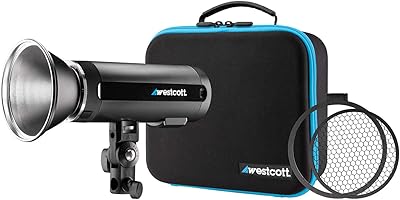
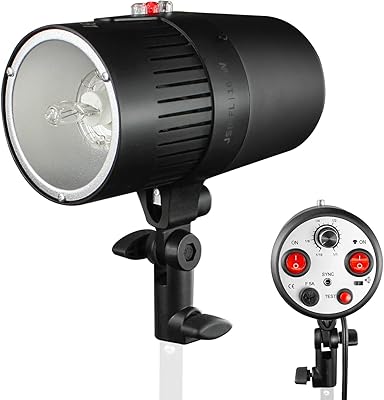
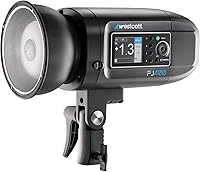
The Westcott FJ400 400Ws AC/DC Strobe Monolight sits in an interesting spot in the lighting market — powerful enough for serious professional work, yet practical enough to carry to a rooftop shoot or a remote location without hunting for a power outlet. The AC/DC dual-power design is what really distinguishes this strobe from plug-dependent competitors; run it tethered on AC in the studio or switch to the removable LiPo battery the moment you step outside. Its Bowens S-Type mount means most photographers can slot it into an existing modifier ecosystem without buying new gear. With a 4.7-star rating from a focused group of working photographers, expectations should be set clearly: this is a capable professional-grade tool, not a beginner's first flash.
Features & Benefits

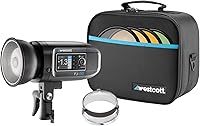
At 400Ws with a recycle time that can drop as low as 0.05 seconds, this strobe keeps up with demanding shoots that would expose the weaknesses of slower alternatives. The removable LiPo battery delivers 480+ full-power flashes per charge, which comfortably covers most outdoor sessions without touching an AC source. When shooting in bright midday sun, High-Speed Sync to 1/8000s lets you hold a wide aperture without clipping highlights — and Freeze Sync to 1/19000s freezes motion that most lights simply can't handle. Color temperature holds at 5500K across the full power range, which genuinely reduces corrective work in post. The included 20W LED modeling lamp, diffusion dome, magnetic reflector, and CCT gel set round out a remarkably complete kit.

Best For

The FJ400 is most at home with portrait and commercial photographers who regularly move between controlled studio work and unpredictable location shoots. If you already own Bowens-compatible modifiers — softboxes, beauty dishes, grids — the S-Type mount makes adopting this AC/DC monolight essentially painless. It supports TTL triggering across Canon, Sony, Nikon, Fuji, Olympus, and Panasonic Lumix systems, so switching camera brands doesn't mean rebuilding your lighting setup from scratch. Photographers shooting in direct sunlight who rely on high-speed sync to keep apertures wide will find this strobe genuinely capable. Hybrid shooters working at up to 20fps in continuous capture mode also benefit — a feature most units at this price tier skip entirely.

User Feedback

Photographers who own the FJ400 consistently highlight build quality and color consistency as genuine strengths — and looking at real-world feedback, both hold up under repeated heavy use. TTL performance across supported systems earns strong marks as well. Where opinions get more nuanced is battery longevity over time; a few users report noticeable capacity degradation after extended ownership, which is worth factoring in if you shoot at high volume. The wireless trigger pairing process also has a learning curve that occasionally frustrates first-time users. Against Godox at a similar price point, most reviewers find this strobe competitive but acknowledge the Westcott ecosystem is more limited. Positive notes on USB firmware updates suggest the unit is actively supported — a genuine advantage for long-term reliability.

Pros

  • Dual AC/DC power lets you shoot in a studio or on location without carrying separate equipment.
  • Recycle time as fast as 0.05 seconds keeps up with fast-paced editorial and event shooting.
  • Color temperature stays locked at 5500K across the full power range, cutting down post-processing correction work.
  • High-Speed Sync to 1/8000s gives you real control over ambient light without adding ND filters.
  • Bowens S-Type mount opens up a wide range of compatible modifiers from multiple manufacturers.
  • The included accessories — dome, magnetic reflector, gel set, and travel case — add genuine immediate value.
  • USB firmware upgrades mean the unit can receive improvements after purchase, extending its useful lifespan.
  • 480+ full-power flashes per charge handles most full-day outdoor sessions without interruption.
  • TTL support across Canon, Sony, Nikon, Fuji, Olympus, and Panasonic Lumix covers virtually every major camera system.
  • Freeze Sync to 1/19000s enables motion-stopping shots that most competing units at this price cannot match.

Cons

  • The Westcott wireless trigger ecosystem is more limited than Godox in terms of third-party compatibility options.
  • Battery capacity can degrade noticeably over time with heavy high-volume use.
  • Pairing the wireless trigger for the first time has a learning curve that is not well-documented in the manual.
  • At 5.29 pounds, this AC/DC monolight is not the lightest option for photographers who travel with carry-on only.
  • The Westcott modifier and accessory lineup is smaller than what Profoto or Godox users have access to.
  • No built-in trigger receiver means you must purchase the FJ-X2m or FJ80 separately for wireless operation.
  • LCD menu navigation requires some time investment before it feels intuitive under fast-changing shoot conditions.
  • Replacement battery packs add a recurring cost that should be budgeted for by high-frequency shooters.

Ratings

The Westcott FJ400 400Ws AC/DC Strobe Monolight scores below were generated by AI after analyzing verified global buyer reviews, with spam, bot-submitted, and incentivized feedback actively filtered out. The ratings reflect a balanced synthesis of what real photographers praised and where they ran into genuine frustrations — no cherry-picking. Both the standout strengths and the honest pain points are factored into every score.
Build Quality
88%
Photographers consistently describe the housing as solid and well-assembled, with no flex or rattle even after repeated transport in and out of location bags. The tilter bracket and mount feel secure under heavier modifiers, which matters when you're setting up quickly on uneven ground.
A small number of users noted that the plastic housing shows scuff marks after moderate field use, and the battery latch mechanism feels slightly less premium than the rest of the unit. It's durable, but not quite at the tactile level of Profoto hardware.
Color Consistency
93%
This is arguably the FJ400's strongest suit — the 5500K color temperature holds remarkably steady from full power down to minimum output, which means skin tones stay consistent across a long portrait session without corrective gels or heavy grading in post. Working photographers who batch-edit large shoots notice this immediately.
A handful of reviewers shooting in very cold outdoor temperatures reported a very slight warm shift, suggesting the tight tolerance spec is most reliable under moderate ambient conditions. It's a minor edge case rather than a systematic flaw.
Battery Performance
79%
21%
The removable LiPo delivers a genuine 480-plus full-power flashes in real-world use, which comfortably covers most outdoor portrait or commercial sessions without hunting for an outlet. Being able to carry a spare battery and swap it in the field is a practical advantage most competing units don't offer.
Several owners reported noticeable capacity degradation after 18 to 24 months of frequent use, meaning the battery holds fewer flashes than it did when new. Replacement packs are an added recurring cost that budget-focused buyers should factor into the total ownership picture.
TTL Accuracy
86%
Across Canon, Sony, and Nikon systems in particular, TTL metering performs consistently and responds predictably to subject distance changes — a real plus for run-and-gun portrait work where manually dialing power between shots isn't realistic. Most reviewers describe the TTL as reliable enough to trust without a lot of exposure bracketing.
A portion of Fuji and Olympus users flagged occasional TTL inconsistency in high-contrast scenes, suggesting the system is most dialed-in for the major Canon and Sony ecosystems. It's workable on other systems, but may require more manual intervention.
High-Speed Sync
91%
HSS up to 1/8000s performs cleanly without significant light fall-off across the frame, which is not always the case with competing battery strobes at this price. Outdoor portrait photographers using wide apertures in direct sun find this feature genuinely reliable rather than just technically present.
At higher HSS shutter speeds, effective power output drops as expected — some users shooting at 1/4000s and above found they needed to push the strobe closer or open up an additional stop, which limits working distance in tight locations.
Recycle Speed
84%
At reduced power settings, the sub-0.1-second recycle time keeps up with fast editorial and lifestyle shooting without the photographer waiting for a ready signal. For photographers shooting at 10 to 12fps bursts at moderate power, the FJ400 holds its own impressively well.
At or near full power, the 0.9-second recycle is competitive but not class-leading — the Godox AD400 Pro edges it slightly in sustained high-power burst situations. This rarely matters for portrait work but can be a factor in high-volume event shooting.
Wireless Reliability
77%
23%
Once the 2.4GHz wireless system is properly configured across groups and channels, triggering is consistent and dropout-free across reasonable working distances — most photographers report rock-solid performance in typical studio and outdoor environments.
The initial pairing and group setup process is poorly documented and trips up a meaningful number of first-time users. Compared to the Godox X system, which many photographers already know, the Westcott trigger ecosystem has a steeper onboarding curve and less community troubleshooting support online.
Portability
81%
19%
At 5.29 pounds with the battery installed, this AC/DC monolight strikes a reasonable balance between power and portability — experienced location photographers describe it as genuinely carry-friendly on a good light stand or roller bag.
It is noticeably heavier than pure battery-powered speedlights and some competing compact monolights, and a few carry-on-only travelers found it pushed the limits of their airline gear allowance when packed with modifiers and a trigger.
Modeling Lamp
74%
26%
The 20W LED modeling lamp at 5600K gives a useful, daylight-balanced preview of shadow placement and light shape in controlled studio environments, and its brightness is proportional to flash power output which makes pre-visualization more accurate.
In brighter ambient conditions — near windows or in outdoor shade — the modeling lamp is largely washed out and impractical as a preview tool. Several users wished for a higher-output option, especially when working with large modifiers that diffuse and soften the lamp's effect.
Included Accessories
82%
18%
The out-of-the-box kit is genuinely useful rather than token — the magnetic reflector, CCT gel set, diffusion dome, and travel case can all be put to work on a real shoot immediately without supplemental purchases. The magnetic attachment system for gels and the reflector is well-designed and fast to use.
The included 5.5″ reflector is functional but small for many portraiture applications, and photographers who need a larger bare-bulb spread will want to invest in a proper modifier fairly quickly. The travel case is protective but adds bulk when packing for air travel.
Firmware & Longevity
83%
USB firmware upgradeability is a legitimately useful feature that several long-term owners praised after updates improved TTL accuracy and added minor functionality post-purchase. It signals that Westcott treats the FJ400 as an evolving platform rather than a static product.
Firmware update instructions are not prominently communicated, and a subset of users discovered the upgrade path only after searching forums rather than through official documentation. Westcott's update cadence is also slower than some competitors.
Value for Money
78%
22%
For photographers who need genuine AC/DC flexibility in a single unit, the price-to-capability ratio is strong — buying a separate plug-in studio strobe and a battery-powered location flash would cost significantly more and require managing two systems. The included accessories amplify the value further.
Godox offers comparable power and HSS capability at a lower price point with a larger trigger ecosystem, making the value proposition less obvious for photographers who prioritize ecosystem breadth over Westcott-specific features. Buyers comparing carefully will feel the pressure at checkout.
Ease of Setup
76%
24%
Physical setup — mounting the head, attaching modifiers via the Bowens mount, and positioning — is straightforward and follows conventions that any working photographer will recognize immediately. The LCD color display and intuitive menu make power adjustments quick once the system is learned.
First-time setup of the wireless system and TTL channel configuration adds friction, particularly for photographers coming from simpler manual strobe systems. The manual is sparse in critical areas, and several buyers resorted to third-party video tutorials to get fully operational.
Heat Management
85%
In standard portrait and commercial shooting scenarios, the strobe's onboard thermal monitoring keeps everything running without interruption, and photographers report no unexpected shutdowns during full-day sessions at moderate power levels.
During sustained high-frequency burst shooting at or near full power, a few high-volume users reported the unit entering a brief protective throttle state. It's a sensible safety mechanism, but it can interrupt workflow in demanding consecutive-shot scenarios.

Suitable for:

The Westcott FJ400 400Ws AC/DC Strobe Monolight was clearly designed with the working photographer in mind — someone who needs consistent, powerful output whether they're shooting a corporate headshot in a studio on Monday or a lifestyle campaign outdoors on Friday. The dual AC/DC power system is the core reason to choose this strobe over plug-only alternatives; you're not forced to rent a generator or find an outlet on location. Photographers who already own Bowens-compatible light modifiers will slot this unit directly into their existing setup without friction. The high-speed sync capability up to 1/8000s is a practical asset for anyone shooting portraits in open shade or direct sun while wanting control over depth of field. Hybrid and high-volume shooters will also appreciate the 20fps continuous capture support and the 480+ full-power flashes per charge, which comfortably outlasts most full-day location sessions.
Not suitable for:

If you're just getting into photography and buying your first off-camera flash, the Westcott FJ400 400Ws AC/DC Strobe Monolight is more tool than you realistically need at this stage — the wireless trigger system, group configurations, and TTL calibration all carry a learning curve that can frustrate newcomers. Budget-conscious buyers who are primarily studio-only shooters may find that a simpler plug-in monolight delivers similar output at a lower cost, since the battery system adds price that only pays off on location. Photographers heavily invested in a non-Bowens modifier ecosystem may face compatibility headaches unless they purchase additional adapters. The Westcott-branded trigger system is also a more closed ecosystem compared to Godox, which has broader third-party support, so if cross-brand trigger flexibility matters to you, that's worth researching carefully before committing. Finally, buyers expecting the battery pack to hold its original capacity over several years of heavy use should factor in long-term battery replacement costs.

Specifications

  • Power Output: The strobe delivers 400 watt-seconds of flash power, adjustable across a 9 f-stop energy range for fine exposure control.
  • Power Source: Operates on both AC mains power and a removable DC LiPo battery, allowing full flexibility between studio and location use.
  • Battery: The included removable battery pack is a 14.8V 4400mAh 65Wh lithium polymer unit that supports trickle charging when connected to AC.
  • Battery Life: On a full charge, the battery delivers 480 or more full-power flashes, with a rated runtime of approximately 2.5 hours.
  • Recycle Time: Recycle time ranges from 0.05 seconds at reduced power to 0.9 seconds at full power, enabling fast consecutive shots.
  • Color Temperature: Flash color temperature is rated at 5500K with a tight tolerance of plus or minus 150K maintained across the entire power range.
  • Modeling Lamp: A 20-watt LED modeling lamp running at 5600K provides accurate, daylight-balanced preview light for shaping and positioning.
  • Sync Speed: Supports High-Speed Sync up to 1/8000s and Freeze Sync up to 1/19000s for motion-stopping and bright-ambient-light control.
  • Continuous Capture: The strobe supports continuous capture shooting at up to 20 frames per second for burst-mode and action photography workflows.
  • Wireless System: Built-in 2.4GHz wireless receiver supports 6 groups and 16 channels, compatible with the Westcott FJ-X2m trigger and FJ80 Speedlight.
  • Mount Type: Uses the industry-standard Bowens S-Type bayonet mounting system, providing broad compatibility with third-party light modifiers.
  • Trigger Modes: Supports Manual mode, TTL (Through-The-Lens) auto exposure, Rear Curtain Sync, High-Speed Sync, and Group Exposure Compensation.
  • Dimensions: The unit measures 12.95 x 11.55 x 7.15 inches, sized for practical transport and use on standard light stands.
  • Weight: The strobe body weighs 5.29 pounds, making it manageable for location work while still housing a full-power LiPo battery.
  • Compatibility: TTL and HSS triggering functions are supported across Canon, Sony, Nikon, Fuji, Olympus, and Panasonic Lumix camera systems.
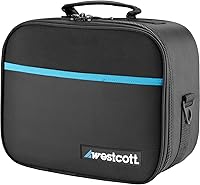
  • Included Accessories: In the box: a diffusion dome, 5.5″ magnetic reflector, magnetic CCT gel set, USB firmware cable, Rapid Box Switch insert, and travel case.
  • Firmware: Firmware is upgradeable via USB, allowing the manufacturer to release performance improvements and new feature support after purchase.
  • Color Temperature Range: Voltage is rated at 14.8V from the battery pack, ensuring stable power delivery and consistent color output across flash cycles.

Related Reviews
MYSWEETY 600W AC to DC Converter
84%
88%
Performance & Power Output
85%
Ease of Use
81%
Cooling System Efficiency
90%
Safety Features
83%
Build Quality & Durability
More
SDRGEEK 12V 600W AC to DC Converter
85%
88%
Power Performance
91%
Cooling Efficiency
75%
Ease of Installation
86%
Build Quality
94%
Safety Features
More
Westcott FJ200 Round Head Strobe
82%
93%
Light Quality & Color Consistency
88%
Build Quality & Durability
91%
Recycle Time & Shooting Speed
82%
Battery Life & Charge Capacity
89%
High-Speed Sync & Flash Capabilities
More
BOSYTRO 12V 600W AC to DC Converter
86%
88%
Performance Under Load
91%
Cooling System Efficiency
85%
Ease of Setup
90%
Build Quality & Durability
70%
Noise Level
More
NEEWER Q4 400Ws Outdoor Flash Strobe
81%
91%
Output Power & Performance
88%
Battery Life
86%
Recycle Speed
83%
TTL Accuracy
87%
High Speed Sync (HSS)
More
SDRGEEK 1000W 12V AC to DC Converter
76%
74%
Output Stability
81%
Build Quality
78%
Cooling Performance
83%
Ease of Connection
77%
Value for Money
More
Tebrol 3500W Inverter 12V DC to 110V AC
85%
88%
Performance
91%
Ease of Setup
94%
Safety Features
92%
Power Output
60%
Fan Noise
More
Anbull 600W 12V DC Power Supply Converter
81%
83%
Output Stability
78%
Build Quality
71%
Cooling & Fan Noise
91%
Ease of Setup
93%
Power Switch Convenience
More
LVYUAN 200W Power Inverter 12V DC to 110V AC
87%
92%
Portability & Size
89%
Charging Performance
86%
Build Quality
94%
Noise Level
75%
Cooling & Thermals
More
LimoStudio AGG1756 160W Photo Monolight Flash Strobe Light
81%
87%
Value for Money
91%
Recharge Speed
85%
Build Quality
88%
Ease of Setup
84%
Light Consistency
More

FAQ

Yes, the FJ400 runs on AC power alone when plugged in — the battery is not required for studio use. You can leave the battery out entirely or keep it installed, since it trickle-charges while connected to AC. Many studio photographers just leave it plugged in and treat the battery as an on-location bonus.

A trigger is not included in the box. The strobe has a built-in 2.4GHz wireless receiver, but you need either the Westcott FJ-X2m Universal Wireless Trigger or the Westcott FJ80 Speedlight to fire it wirelessly from your camera. It's a real additional cost to factor in if you don't already own one.

If your modifiers use a standard Bowens S-Type bayonet mount, they will attach directly with no adapter needed. This is one of the more practical strengths of the FJ400 — it fits a very wide range of third-party modifiers from brands like Godox, Glow, Elinchrom (with adapter), and many others.

Both units are competitive in TTL accuracy across most shooting conditions. The Westcott FJ400 400Ws AC/DC Strobe Monolight tends to get favorable marks for color consistency and build quality, while the Godox AD400 Pro benefits from a larger and more established trigger ecosystem with broader third-party support. If you already shoot in a Godox wireless system, switching takes more effort; if you're starting fresh, either is a solid choice.

Yes, Sony is one of the supported systems for both TTL and HSS functionality, so you can sync up to 1/8000s using a compatible Westcott FJ trigger on your hot shoe. Just make sure you have the appropriate trigger for your system, as TTL communication is brand-specific.

A full recharge from a depleted battery typically takes around 2 to 2.5 hours. When the strobe is plugged into AC power, the battery trickle-charges simultaneously, which is useful for topping it off between location jobs without a dedicated charging session.

Yes, the LiPo battery pack is removable and sold separately as a replacement. This is worth knowing upfront — if you shoot at high volume, battery capacity will eventually drop, and being able to swap in a fresh pack extends the usable life of the strobe significantly rather than forcing a full unit replacement.

Freeze Sync is a mode that pushes the effective flash duration to an extremely short 1/19000s, which is short enough to freeze fast motion like water splashes, fabric movement, or athletes mid-jump with no motion blur from the subject. It's separate from shutter speed-based HSS — it works by shortening the actual light pulse rather than using a scanning sync technique.

The 20W LED modeling lamp is genuinely useful for reading shadows and previewing light shape before shooting, though it is not bright enough to compete with continuous lights in a high-ambient environment. For studio work with controlled ambient light, it does exactly what a modeling lamp should do — it gives you an honest preview of where your light is falling.

Yes, the unit includes onboard self-monitoring safety features that protect against overheating during sustained high-frequency use. If you're pushing it at full power in rapid burst mode for extended periods, the system monitors temperature and can throttle performance before any damage occurs. For normal portrait or commercial sessions, most photographers will never trigger these limits.