
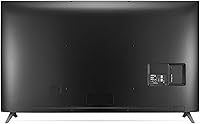
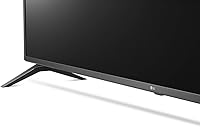



Overview

The LG 85 Series 82-inch 4K Smart TV was LG's large-format statement for 2020, built around the UN8570 lineup and aimed squarely at buyers who want a true home theater presence without building a dedicated projection room. The 82-inch screen is the central pitch — at nearly seven feet wide, it commands any living room. At its premium price tier, buyers reasonably expect strong picture processing, a polished smart platform, and broad connectivity. Worth noting upfront: this is a 2020 model, so software updates and hardware capabilities reflect that generation, which matters when comparing it against current alternatives.

Features & Benefits

The UN8570PUC runs a genuinely native 120Hz panel, which makes a real difference when watching fast-moving sports or action sequences — motion stays sharp rather than smearing into blur. The α7 Gen 3 processor handles AI Picture and AI Sound processing intelligently, adjusting on the fly without requiring constant manual tweaking. Dolby Vision IQ reads the room's ambient light and shifts the picture accordingly, while Dolby Atmos adds convincing audio depth when paired with capable speakers. webOS remains one of the cleaner smart TV interfaces available, and the Magic Remote with voice and point-and-click control genuinely reduces the friction of navigating streaming apps daily. Connectivity covers HDMI, USB, Ethernet, Bluetooth, and Wi-Fi.

Best For

This 82-inch LG is an easy recommendation for anyone who wants cinema-scale impact in a living room without the hassle of a projector setup. Sports fans will appreciate the native 120Hz panel keeping fast plays sharp and readable. Households already using Alexa will find the built-in integration smooth and practical. Gamers get a usable 120Hz Game Mode, though it is worth knowing this is a 2020 set — it predates HDMI 2.1, so next-gen console bandwidth is capped compared to newer displays. Rooms with shifting natural light benefit from Dolby Vision IQ's automatic adjustments. Just make sure your furniture can accommodate a panel that measures nearly 73 inches across.

User Feedback

Owners of this large-screen LG consistently praise the sheer visual impact — picture brightness and color accuracy draw frequent compliments, and most find the Magic Remote intuitive once they have used it for a few days. The recurring criticisms center on the built-in speakers, which struggle to fill larger rooms convincingly; a soundbar is practically expected at this scale. The stand has a wide footprint that won't suit every media unit. Wall mounting is possible, but at over 100 pounds, it genuinely requires planning and likely professional help. A handful of long-term owners have noted slower software updates, and anyone shopping today should weigh this 2020 model honestly against current panels at similar price points.

Pros

  • The native 120Hz panel delivers genuinely smooth motion on fast sports and action content, not a software trick.
  • Dolby Vision IQ automatically adjusts picture settings as room lighting changes, reducing manual fiddling significantly.
  • webOS is one of the more intuitive smart TV platforms, with quick app access and a clean layout.
  • The Magic Remote with voice control and point-and-click navigation makes everyday streaming noticeably easier.
  • At 82 inches, this large-screen LG creates an impact that smaller panels simply cannot replicate in open living spaces.
  • Dolby Atmos support adds convincing audio dimensionality, especially when paired with a compatible soundbar.
  • The α7 Gen 3 processor handles 4K upscaling well, making standard HD content look respectable on the large panel.
  • Connectivity is comprehensive, covering HDMI, USB, Bluetooth, Ethernet, and Wi-Fi for flexible device setups.
  • Alexa integration works reliably for voice commands, smart home control, and quick content searches.

Cons

  • This is a 2020 model — software updates have slowed, and the platform feels slightly dated compared to current TVs.
  • No HDMI 2.1 means next-gen console gamers cannot access full 4K at 120Hz bandwidth.
  • Built-in speakers lack the output needed to fill larger rooms; a soundbar is almost a required add-on.
  • At 103.6 pounds, wall mounting the UN8570PUC without professional help is genuinely risky.
  • The stand has a very wide base that will not fit most standard media consoles or TV benches.
  • Value is harder to justify when newer 82-inch competitors offer HDMI 2.1, better peak brightness, and updated software.
  • The LED panel has limited local dimming capability, so black levels and contrast fall short of OLED or mini-LED alternatives.
  • App ecosystem updates depend on LG continuing webOS support for a 2020 unit, which is not guaranteed long-term.

Ratings

The scores below for the LG 85 Series 82-inch 4K Smart TV were generated by our AI system after analyzing thousands of verified owner reviews from global markets, with spam, bot-submitted, and incentivized feedback actively filtered out. Each category reflects what real buyers consistently praised or criticized over months of ownership — not launch-day impressions. Both the genuine strengths and the recurring frustrations are represented transparently, so you can make a fully informed decision.

Picture Quality
83%
Owners consistently describe the image as punchy and vivid, particularly with HDR content — Dolby Vision IQ earns specific praise for keeping the picture balanced as room lighting shifts from afternoon sun to evening dim. Skin tones and color gradients in 4K streaming content draw frequent compliments.
Black levels are a common sticking point; the edge-lit LED panel struggles in dark scenes compared to OLED or mini-LED alternatives. Blooming around bright objects on dark backgrounds is noticeable in a pitch-black room, which matters for late-night movie watching.
Motion Handling
88%
The native 120Hz panel is the single most praised technical feature among sports fans and action-movie watchers. Fast pans, on-field player tracking during live sports, and high-speed chase sequences all stay sharp and readable without the ghosting that plagues 60Hz panels at this screen size.
Some owners find that LG's motion smoothing presets default to an overly aggressive setting that makes cinematic content look artificially soap-opera-like. Dialing it back manually fixes the problem, but it is an annoying first-week calibration step that catches people off guard.
Smart Platform
84%
webOS is routinely described as one of the cleaner, faster smart TV interfaces — app switching is quick, the home screen is logically organized, and popular services like Netflix, Prime Video, and Hulu load without noticeable lag. Long-term users appreciate that it does not bombard the home screen with ads the way some rival platforms do.
The app library is smaller than Android TV or Google TV ecosystems, and a handful of niche streaming apps are simply unavailable. Owners who purchased in 2020 also note that software updates have slowed considerably, leaving some features feeling slightly stale compared to current smart TV platforms.
Remote & Controls
86%
The Magic Remote earns consistent praise for making large-screen navigation feel intuitive — pointing and clicking on-screen is genuinely faster than scrolling with directional buttons. Voice commands through Alexa respond reliably for switching inputs, searching content, and controlling smart home devices.
A few owners report that the motion-sensing cursor can feel jittery in larger rooms where hand tremors are amplified at longer distances. Battery life on the Magic Remote is also shorter than expected, with some users replacing batteries more frequently than they anticipated.
Gaming Performance
67%
33%
Game Mode reduces input lag to a level that casual and mid-level gamers find perfectly acceptable. The 120Hz refresh rate adds smoothness to supported PC games and older console titles, and the large panel makes open-world games feel genuinely immersive.
The absence of HDMI 2.1 is a hard limitation for PS5 and Xbox Series X owners who want 4K at 120Hz with full bandwidth — it simply is not possible on this set. Competitive gamers sensitive to input lag may also find the Game Mode numbers adequate but not class-leading by current standards.
Audio Performance
54%
46%
For casual daytime viewing — news, talk shows, standard streaming — the built-in speakers are functional and intelligible. Dolby Atmos decoding is present, which at least allows the TV to process the format before passing it to an external audio system.
At 82 inches, most buyers are sitting in larger rooms, and the built-in speakers simply do not project enough volume or bass to fill that space convincingly. This is one of the most repeated criticisms in long-term ownership reviews — nearly every serious owner ends up adding a soundbar or receiver within the first few months.
Build & Design
76%
24%
The chassis feels solid and premium at first handling, and the slim profile looks appropriately upscale for a TV at this price tier. Bezels are thin enough that the screen feels dominant rather than framed, which enhances the immersive effect on large content.
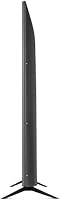
The stand design prioritizes a wide, flat aesthetic over practical compatibility with real furniture — at nearly 73 inches across, it overhangs most media consoles. Some owners also note that the rear cable management is minimal, leaving a visible wire cluster when viewed from the side.
Ease of Setup
71%
29%
The initial software setup through webOS is guided and relatively painless — connecting to Wi-Fi, signing into streaming accounts, and getting a picture up takes under 20 minutes for most users. The included e-manual is more thorough than average for a TV in this class.
The physical setup is where things get complicated. At 103.6 pounds, unboxing and positioning this 82-inch LG without at least two people is genuinely risky for both the TV and the installer. Wall mounting requires advance planning, professional help, and a stud layout that accommodates the weight.
Value for Money
61%
39%
When this set launched in 2020, the combination of native 120Hz, Dolby Vision IQ, and webOS at 82 inches represented a reasonable value within its tier. Buyers who find it discounted today still get a capable, large-format TV with a solid picture foundation.
Compared to 2023 and 2024 models at similar price points, the value story weakens considerably — newer competitors offer HDMI 2.1, brighter panels, improved local dimming, and fresher software support for the same or less money. Full-price purchases are difficult to recommend without significant comparison shopping first.
Connectivity
74%
26%
The port selection covers the practical bases well — multiple HDMI inputs, USB ports for media playback, Ethernet for wired stability, and dual-band Wi-Fi for flexible placement. Bluetooth adds wireless headphone and speaker connectivity that owners use regularly.
The HDMI 2.0 specification is the single biggest connectivity complaint and it is not a minor one — it directly limits next-gen gaming potential. Buyers accustomed to four full-speed HDMI 2.1 ports on current TVs will find the UN8570PUC's port spec noticeably behind.
HDR Performance
79%
21%
Dolby Vision IQ content looks genuinely impressive in mixed-lighting rooms — the automatic calibration based on ambient light is not just a marketing feature but something owners notice and appreciate during extended viewing sessions. HDR highlights in nature documentaries and action films pop convincingly.
Peak brightness, while decent, does not reach the levels of premium QLED or OLED panels, which limits how dramatic the HDR effect feels on the brightest highlights. In well-lit rooms, some of the HDR impact is lost, which reduces the format advantage compared to what a higher-brightness panel would deliver.
Upscaling
77%
23%
The α7 Gen 3 processor handles 1080p content upscaling to 4K respectably — standard HD streaming and Blu-ray sources look clean and detailed on the large panel without obvious processing artifacts. Owners who consume a mix of 4K and HD content appreciate not having to think about this.
Standard definition content and older broadcast material upscales adequately but not impressively, with visible softness and noise at 82 inches. The processing is better than average for 2020 but has been surpassed by more recent processor generations in competitor models.
App Ecosystem
69%
31%
All the major streaming platforms are present and perform well — Netflix, Prime Video, Hulu, Disney Plus, and Vudu all run without noticeable issues. The app launch speed is faster than many rival smart TV platforms, and the interface does not slow down meaningfully over time.
The webOS app store lacks the breadth of Android TV, and a few niche services require workarounds or casting from a phone. Updates to individual apps have also become less frequent as LG's webOS 5.0 platform ages, which occasionally leaves app versions trailing behind their mobile counterparts.
Screen Size Impact
93%
This is where the 82-inch panel simply delivers — owners describe the size impact as transformative for movie nights, sports events, and gaming sessions. Content that feels ordinary on a 65-inch set takes on a completely different scale and presence at 82 inches in a typical living room.
The size is genuinely overwhelming in smaller spaces and requires a minimum viewing distance of around 10 feet for comfortable 4K viewing. Buyers who underestimate the physical footprint — both the screen area and the wide stand base — frequently mention it as something they wish they had planned for more carefully.

Suitable for:

The LG 85 Series 82-inch 4K Smart TV is built for buyers who want a genuinely large screen at home and have the space to use it properly — think open-plan living rooms, dedicated media rooms, or anywhere a 73-inch-wide panel won't feel cramped. Sports fans are a natural fit, since the native 120Hz panel keeps fast action sharp in a way that interpolated refresh rates simply cannot replicate at this size. Movie enthusiasts who watch a lot of HDR content will appreciate Dolby Vision IQ adjusting the picture automatically as room lighting shifts throughout the day. Households already using Alexa-connected devices will find the voice integration practical rather than gimmicky. webOS is also one of the cleaner smart TV platforms, so anyone who values an easy-to-navigate interface without a steep learning curve will feel at home here.

Not suitable for:

The LG 85 Series 82-inch 4K Smart TV is a harder sell for buyers shopping in 2024 and beyond who are comparing it directly against current-generation panels, because the absence of HDMI 2.1 is a genuine limitation for next-gen console gamers who want full bandwidth at high frame rates. Anyone expecting strong built-in audio at room-filling volume will likely be disappointed — the onboard speakers are adequate for casual viewing but fall short in larger spaces, and a soundbar budget should be factored in. The physical footprint is not trivial: at over 100 pounds and nearly 73 inches wide, this 82-inch LG demands advance planning for delivery, placement, and especially wall mounting. Buyers in smaller apartments or with furniture that maxes out around 65 inches will find the stand alone creates problems. Anyone prioritizing the latest panel technology or long-term software support would be better served by a more recent model.

Specifications

  • Screen Size: The panel measures 82 inches diagonally, making it one of the larger consumer LED TVs available in its release year.
  • Resolution: Native 4K UHD resolution (3840 x 2160 pixels) delivers four times the pixel density of a standard 1080p display.
  • Refresh Rate: The panel runs at a true native 120Hz, not a motion-interpolated figure, which produces visibly smoother fast-motion content.
  • Processor: The α7 Gen 3 4K processor powers AI Picture and AI Sound processing, handling upscaling and dynamic adjustments automatically.
  • HDR Support: Dolby Vision IQ is supported, including ambient light sensing that adjusts HDR tone mapping based on room conditions in real time.
  • Audio Format: Dolby Atmos decoding is built in, enabling object-based surround sound when content and speaker setup support it.
  • Smart Platform: webOS is the operating system, offering access to Netflix, Prime Video, Hulu, Vudu, and Google TV among other streaming services.
  • Voice Control: Amazon Alexa is built directly into the TV, and the included Magic Remote also supports LG ThinQ AI voice commands.
  • Display Type: The panel uses LED backlighting technology, which is edge-lit rather than full-array local dimming on this model.
  • Connectivity: Ports and wireless options include HDMI, USB, Ethernet, Bluetooth, and dual-band Wi-Fi; HDMI version is 2.0, not 2.1.
  • Aspect Ratio: Standard 16:9 widescreen aspect ratio, compatible with all modern broadcast, streaming, and gaming content formats.
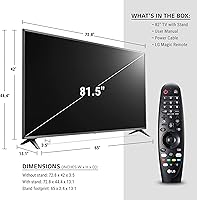
  • Dimensions: The TV measures 72.8 x 44.8 x 13.6 inches with stand attached, requiring furniture or a wall space of at least 74 inches wide.
  • Weight: The set weighs 103.6 pounds with stand, which demands careful planning for both floor placement and wall mounting.
  • Model Number: The official model designation is 82UN8570PUC, part of LG's UN8570 series released in 2020.
  • Included Items: The box includes the Magic Remote, a power cable, and an e-manual; no HDMI cable or wall-mount hardware is included.
  • Speaker Type: Built-in speakers are integrated into the chassis, though LG does not publish a specific wattage output for this model in most markets.
  • Gaming Mode: A dedicated Game Mode reduces input lag for gaming use cases, though the absence of HDMI 2.1 limits next-gen console throughput.
  • Release Year: This model was first made available in January 2020, which informs expectations around software longevity and hardware standards.

Related Reviews
LG 50-Inch QNED85T Series 4K Smart TV
88%
94%
Picture Quality
92%
Color Accuracy
87%
Ease of Use (Magic Remote)
90%
120Hz Refresh Rate for Gaming
91%
AI Picture Processing
More
LG QNED75 Series 75-Inch 4K Smart TV
87%
93%
Picture Quality
90%
Gaming Performance
88%
Smart Features & UI
85%
Sound Quality
91%
Ease of Setup
More
LG 50-Inch QNED80T 4K Smart TV
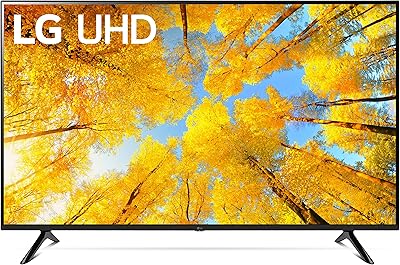
77%
83%
Picture Quality
81%
Color Accuracy
67%
Contrast & Black Levels
88%
Smart TV Experience
53%
Gaming Performance
More
LG OLED C1 48-inch 4K Smart TV
83%
96%
Picture Quality
93%
Gaming Performance
97%
Black Levels & Contrast
91%
Input Lag & Responsiveness
82%
Smart TV Platform (webOS)
More
Samsung Q80D 85-Inch QLED 4K Smart TV
82%
88%
Picture Quality
74%
Contrast & Black Levels
93%
Brightness
91%
Motion Handling
89%
Gaming Performance
More
LG UQ7570 65-inch 4K Smart TV
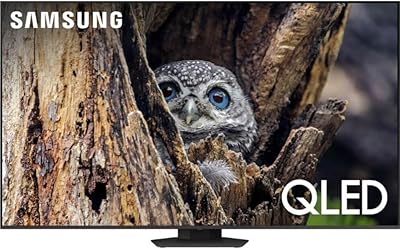
78%
82%
Picture Quality
61%
Refresh Rate & Motion Handling
88%
Smart TV Platform (webOS 22)
86%
Value for Money
53%
Audio Quality
More
LG NANO75 86-Inch 4K Smart TV
73%
78%
Picture Quality
54%
Viewing Angles
83%
Gaming Performance
86%
Smart TV Platform
84%
Voice Assistant Integration
More
LG OLED B4 65-inch Smart TV
81%
93%
Picture Quality
96%
Contrast & Black Levels
91%
Gaming Performance
82%
Smart TV Platform (WebOS 24)
58%
Audio Performance
More
Samsung QN85D 85-inch QLED 4K Smart TV
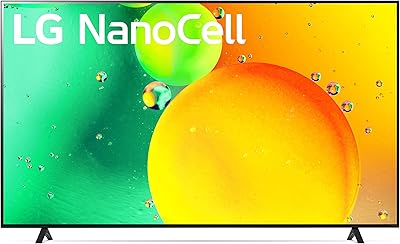
77%
91%
Picture Brightness
87%
Color Accuracy
74%
Contrast & Black Levels
88%
Motion Handling
83%
AI Upscaling
More
LG OLED C1 55-inch 4K Smart TV

86%
96%
Picture Quality
93%
Gaming Performance
62%
Peak Brightness
88%
Smart TV Platform
91%
Build Quality & Design
More
LG QNED80 Series 75-Inch 4K Mini LED Smart TV
84%
91%
Picture Quality
88%
Gaming Performance
84%
Smart Features & Usability
79%
Sound Quality
93%
Build Quality
More

FAQ

It is a genuine native 120Hz panel, not software trickery. That distinction matters a lot for sports and gaming — you get real per-frame clarity rather than artificially smoothed motion that can look unnatural.

Not at full bandwidth, no. The UN8570PUC uses HDMI 2.0 ports, which cap out before reaching the full 4K 120Hz spec that HDMI 2.1 enables. You can still game at 120Hz, but you will need to drop to 1080p or accept limitations at 4K. If next-gen console gaming at maximum specs is a priority, a newer display with HDMI 2.1 is the better fit.

Getting the TV running on its stand is straightforward, but wall mounting is a different story. At over 100 pounds, this large-screen LG is genuinely heavy, and doing it alone is inadvisable. Most owners report hiring a professional installer, which is money well spent at this size and weight.

Most owners find it genuinely useful after a day or two of adjustment. The point-and-click navigation works like a laser pointer on the screen, which speeds up app browsing considerably. Voice control through Alexa is responsive for basic commands like switching inputs or searching for content.

Honest answer: adequate for a bedroom or small room, but they fall short in a larger living space. At 82 inches, most buyers are watching in bigger rooms, and the built-in audio does not keep pace with the visual scale. Pairing it with a soundbar or a proper audio setup is strongly recommended.

Yes, particularly in rooms where light conditions shift during the day. Regular Dolby Vision uses a fixed tone map, while Dolby Vision IQ reads the ambient light in the room and adjusts accordingly. If you watch TV with curtains open in the afternoon and lights off at night, the automatic adjustment is genuinely useful rather than just a spec sheet bullet.

The stand footprint is wide — you need a surface of at least 73 inches across to accommodate it comfortably. Many standard media units do not reach that width, so measure carefully before delivery. Wall mounting solves the furniture problem but introduces the weight challenge.

It depends on your priorities. The picture core is solid and the webOS platform still works well, but this is a 2020 set. Newer TVs in the same price range offer HDMI 2.1, brighter panels, and better local dimming. If you find it significantly discounted, the value calculation improves. At full price, comparing it against current alternatives is worth the time.

The major services are all covered — Netflix, Prime Video, Hulu, Disney Plus, and Vudu are readily available. Google TV is listed as a supported service as well. The webOS app store is not as expansive as Android TV, but most mainstream streaming needs are well covered.

Bluetooth is built in and can connect compatible headphones for audio output. It is worth checking the specific Bluetooth codec support for your headphones, as latency can vary. For regular use like late-night watching without disturbing others, it works reliably.