Overview

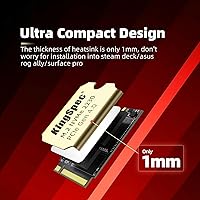
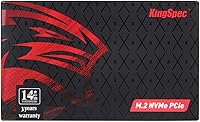
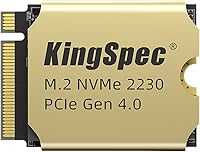
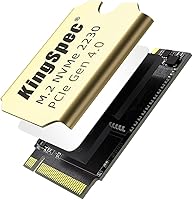
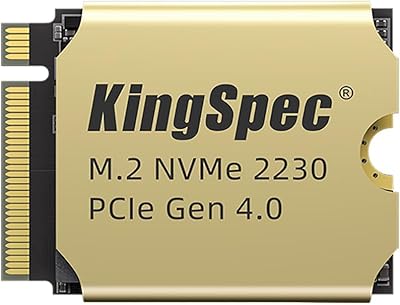
The KingSpec XF-2230 1TB M.2 2230 SSD arrived in late 2023 as KingSpec's push into the handheld gaming storage market — a space where the compact 2230 form factor is essentially non-negotiable. KingSpec isn't a household name the way Samsung or Western Digital are, but this 2230 SSD makes a credible case on paper. It runs on a PCIe Gen 4x4 interface and ships with a factory-fitted copper heatsink already attached — something you don't always see at this price tier. For anyone who's cracked open a Steam Deck or ROG Ally, knowing the drive arrives thermally ready is a small but genuinely welcome detail.
Features & Benefits

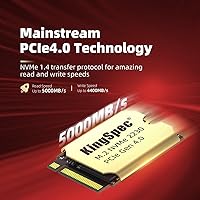
At 5000MB/s read and 4200MB/s write, this KingSpec Gen 4 drive operates in a completely different league from the stock SATA SSDs most handhelds ship with. In practice, that means noticeably snappier load screens in demanding titles — not just a spec-sheet win. The integrated copper heatsink is the headline differentiator; KingSpec claims 15% better thermal efficiency over paste-only drives, which matters in a tight chassis where sustained throttling can quietly kill performance. Backing that up are solid endurance figures: 2400TB TBW and a 2 million hour MTBF rating. LDPC error correction and TRIM support round out a feature set that punches above its market position.

Best For

The XF-2230 is squarely aimed at anyone upgrading storage inside a Steam Deck or ROG Ally — devices that physically only accept the shorter 2230 module. It fits equally well in mini PCs and compact ultrabooks where a standard 2280 drive simply won't seat. Linux users get a welcome nod too, with confirmed compatibility across RHEL, CentOS, and Ubuntu, which isn't always documented this clearly by budget-oriented brands. This drive makes the most sense for buyers who want genuine Gen 4 throughput without stretching to premium pricing. If your device takes a 2230 and you game heavily on it, this 2230 SSD is a focused, practical choice.

User Feedback

With a 4.6-star average across 123 ratings, early reception for the XF-2230 is positive — though that sample size is modest enough that one bad batch could shift the picture noticeably. Buyers frequently mention smooth Steam Deck installation and real-world speeds that align with advertised figures. The copper heatsink draws genuine praise for keeping temperatures manageable during longer sessions, lending some credibility to KingSpec's thermal claims. On the downside, a handful of users flag occasional drive recognition delays or compatibility edge cases, and some question whether a lesser-known brand's long-term support will hold up against established rivals. Cautiously optimistic overall, but worth monitoring as ratings accumulate.

Pros

  • Gen 4 PCIe speeds hit close to advertised figures in real-world Steam Deck benchmarks reported by early buyers.
  • The factory-fitted copper heatsink is a genuine differentiator — no fiddling with thermal pads before installation.
  • 1TB of storage gives handheld gamers enough room for a large modern library without constant juggling.
  • Backward compatibility with PCIe 3.0 slots adds flexibility if you ever migrate the drive to an older device.
  • Documented Linux support across major distros is a practical bonus for Steam Deck users running desktop mode.
  • The 2400TB TBW endurance rating is respectable for a mid-range drive and suggests reasonable longevity.
  • A 3-year warranty provides a meaningful safety net for a brand that hasn't yet built deep consumer trust.
  • Installation in the Steam Deck is straightforward, with most buyers reporting no driver or recognition issues out of the box.
  • LDPC error correction adds a quiet layer of data protection that matters over years of daily use.
  • TRIM support helps maintain consistent write performance over time rather than degrading as the drive fills up.

Cons

  • KingSpec's brand reputation is thin compared to Samsung or WD, making long-term reliability harder to predict confidently.
  • With only 123 ratings collected so far, it is too early to rule out quality consistency issues across production batches.
  • A small number of users report intermittent drive recognition delays, which can be frustrating during initial setup.
  • The 15% thermal improvement claim is manufacturer-stated and not yet widely corroborated by independent thermal testing.
  • Buyers migrating existing OS installations report mixed results with cloning software, requiring extra troubleshooting in some cases.
  • After-sales support may feel limited compared to tier-one brands that offer robust online resources and return processes.
  • Write speeds trail some competing Gen 4 drives in the same price range when tested under sustained sequential workloads.
  • The 2230 form factor, while ideal for handhelds, limits resale or repurposing options if you upgrade your primary device.

Ratings

Our AI-driven scoring for the KingSpec XF-2230 1TB M.2 2230 SSD was built by analyzing verified global buyer reviews, actively filtering out incentivized, bot-generated, and low-credibility submissions to surface what real users actually experienced. The scores below reflect both the genuine strengths that make this 2230 SSD stand out in its niche and the friction points that temper an otherwise solid reception. Nothing has been smoothed over — if buyers ran into issues, those show up in the numbers.
Read/Write Performance
88%
Buyers upgrading from SATA or stock eMMC storage consistently report a dramatic improvement in game load times on the Steam Deck and ROG Ally. Sequential reads close to the 5000MB/s ceiling translate into noticeably snappier OS boot times and faster level transitions in open-world titles.
Sustained write speeds can dip below rated figures during prolonged sequential writes, which a minority of users noticed when transferring large game libraries in bulk. The gap between peak and sustained performance is not unique to this drive, but it is worth flagging for anyone moving hundreds of gigabytes at once.
Thermal Management
81%
19%
The factory-fitted copper heatsink is the feature buyers mention most positively, particularly those who game for two or more hours continuously. Several Steam Deck owners noted their device no longer throttled during demanding sessions after swapping to this 2230 SSD, lending real-world credibility to KingSpec's thermal claims.
A subset of reviewers found it difficult to independently verify the claimed 15% thermal improvement without dedicated monitoring tools, leaving some uncertainty around whether the heatsink is delivering its full theoretical benefit. In extremely compact chassis with limited airflow, temperatures still climb under heavy sustained workloads.
Installation Experience
84%
The vast majority of Steam Deck and ROG Ally owners report a clean, hassle-free physical installation, with the drive seating correctly on the first attempt. The pre-attached heatsink does not add awkward bulk, and the drive is recognized immediately by SteamOS without any driver hunting.
A recurring issue for a smaller group of buyers involves drive cloning — some SSD cloning tools do not complete the process reliably on the first attempt, requiring a retry or a different software approach. Drive recognition delays at initial boot were also flagged by a handful of users, though these appeared isolated rather than systemic.
Value for Money
79%
21%
For buyers who specifically need the 2230 form factor with Gen 4 speeds, this KingSpec Gen 4 drive hits a price point that significantly undercuts Samsung and WD Black equivalents without giving up much measurable performance in handheld gaming scenarios. Most buyers feel the copper heatsink inclusion justifies the cost premium over basic 2230 drives.
Buyers who compared pricing across a broader market noted that the value case weakens if you are not constrained to the 2230 form factor — a 2280 Gen 4 drive at a similar or lower price often delivers better-validated performance and brand assurance. The value story is niche-dependent, not universal.
Brand Trust & Reputation
63%
37%
KingSpec has been operating in the storage space since 2007 and offers a 3-year warranty, which provides more confidence than many no-name alternatives flooding the 2230 market. Early adopters who dealt with the brand's support channel report reasonably prompt responses.
KingSpec simply does not carry the community trust or long-term reliability dataset that Samsung, WD, or Crucial have accumulated over decades. Buyers who have never encountered the brand feel understandably hesitant, and the relatively small review pool makes it harder to assess how the drives hold up after the first year of heavy use.
Endurance & Longevity
76%
24%
The 2400TB TBW rating is strong for a mid-range 1TB drive and suggests the NAND and controller combination is specced for years of heavy daily gaming. LDPC error correction running in the background adds a meaningful layer of protection for data integrity over the drive's lifespan.
Because the XF-2230 launched in late 2023, there is no meaningful long-term endurance data from real-world users yet — the TBW figure is manufacturer-stated, not field-validated. Buyers who plan to keep their handheld for four or five years will need to revisit reviews in 12 to 18 months to assess real aging patterns.
Compatibility Range
83%
Explicit Linux support across RHEL, CentOS, and Ubuntu is a practical differentiator that benefits Steam Deck users running desktop mode and developers who use their handhelds as lightweight Linux machines. PCIe 3.0 backward compatibility also future-proofs the drive if it gets migrated to an older device.
Compatibility is inherently limited by the 2230 form factor itself — buyers with standard 2280 slots who do not have a bracket adapter cannot use this drive at all. A small number of users with older mini PCs also reported M-key slot conflicts that required additional troubleshooting before the drive was recognized.
Build Quality & Finish
77%
23%
The drive feels solid and well-assembled for its price tier, with the copper heatsink adhered cleanly and flush without obvious alignment issues. Buyers who inspected the drive closely before installation noted the PCB quality looks comparable to mid-range drives from more established brands.
A small number of buyers noticed minor cosmetic inconsistencies in the heatsink adhesion on their units, which did not affect function but raised quality control questions. The overall fit and finish, while acceptable, does not carry the premium tactile confidence of a Samsung or Seagate drive.
Software & Driver Support
71%
29%
No proprietary drivers are required — the drive works natively with Windows and Linux kernel NVMe drivers, which keeps setup simple and avoids software compatibility headaches. TRIM is supported out of the box on all major OS environments without any configuration.
KingSpec does not offer a dedicated SSD management utility the way Samsung (Magician) or WD (Dashboard) do, meaning users cannot easily monitor drive health, run diagnostics, or update firmware from a polished first-party tool. For users who like to keep a close eye on drive health metrics, third-party tools like CrystalDiskInfo are the only option.
Packaging & Unboxing
68%
32%
The drive arrives with minimal but adequate protective packaging, and the heatsink being pre-installed means there is one less step and one less component to handle during unboxing. Buyers generally report the drive arriving undamaged and correctly labeled.
The packaging is purely functional — there is no installation guide, no screwdriver, and no anti-static pouch included, which can frustrate first-time SSD upgraders who expected at least basic accessories. Compared to retail boxed drives from Samsung or WD, the presentation feels noticeably sparse.
Random Read/Write (IOPS)
74%
26%
Random read performance is strong enough that day-to-day OS responsiveness and application launching feel fluid on handheld devices, which is what most gaming-focused buyers care about in actual use rather than synthetic benchmarks.
Buyers who ran 4K random write benchmarks noted the XF-2230 trails some competing Gen 4 drives at this capacity point, particularly under queue depths typical of OS-level workloads. For pure gaming use this rarely surfaces as a problem, but it is a consideration for anyone also using the drive for lighter creative or productivity tasks.
Warranty & After-Sales Support
72%
28%
A 3-year warranty is the standard expectation for this product category, and KingSpec does meet it. Users who contacted support with compatibility questions reported receiving responses within a reasonable timeframe, which is more than can be said for some competitors at this price tier.
The warranty process itself is not as streamlined as what Samsung or Crucial offer — there is no self-service RMA portal, and buyers outside major markets have reported uncertainty about how returns or replacements are handled logistically. The support infrastructure feels proportional to a smaller brand's resources.
Gaming Load Time Impact
86%
Steam Deck users switching from the stock drive — whether a slow eMMC chip or an older SATA SSD — report that AAA game load screens are cut down noticeably, with some titles loading in roughly half the previous time. Open-world games with frequent streaming assets benefit most visibly from the higher read bandwidth.
The real-world gaming performance advantage over other Gen 4 2230 drives is marginal once you are already in the NVMe Gen 4 tier — buyers upgrading from another Gen 4 drive will not see a meaningful difference and should not expect a dramatic improvement.

Suitable for:

The KingSpec XF-2230 1TB M.2 2230 SSD is purpose-built for anyone upgrading storage inside a Steam Deck, ASUS ROG Ally, or similar handheld gaming device where the short 2230 form factor is a hard physical requirement, not a preference. If you've been living with the stock 64GB or 256GB drive that came with your handheld, the jump to 1TB of Gen 4 NVMe storage is genuinely transformative — more games installed locally, faster load times, and less time staring at progress bars. Mini PC builders and compact ultrabook upgraders will also find this 2230 SSD a natural fit, especially when a full-length 2280 module simply won't clear the chassis. Linux users who've been burned by vague compatibility claims from other brands will appreciate that KingSpec explicitly lists RHEL, CentOS, and Ubuntu support. Budget-conscious enthusiasts who want real Gen 4 throughput without spending flagship prices on a Samsung or WD Black have a practical option here.
Not suitable for:

The KingSpec XF-2230 1TB M.2 2230 SSD is not the right call for buyers who prioritize brand pedigree and long-established support ecosystems above all else — KingSpec simply doesn't carry the same track record or community confidence as Samsung, WD, or Crucial. If your motherboard or laptop has a standard 2280 slot and no form factor constraint, there are faster, better-validated Gen 4 drives available at comparable or only slightly higher prices, making this drive's key advantage irrelevant. Power users running sustained workloads like large video exports, database operations, or continuous file transfers should look for a drive with a more proven thermal solution and a longer history of real-world endurance data. The 123-rating sample size is also too small to confidently rule out batch-level quality variance, so risk-averse buyers may want to wait for the rating pool to grow. Anyone expecting the kind of after-sales support infrastructure that comes with a tier-one brand will likely find KingSpec's customer service experience more limited.

Specifications

  • Capacity: This drive offers 1TB of usable NVMe storage, providing ample space for a large library of installed games or applications.
  • Form Factor: The M.2 2230 module measures 1.18 x 0.87 x 0.08 inches, making it physically compatible with short-slot devices that cannot accept a standard 2280 drive.
  • Interface: It uses a PCIe 4.0 x4 (NVMe) interface, operating at Gen 4 bandwidth while remaining backward compatible with PCIe 3.0 slots.
  • Sequential Read: Maximum sequential read speed is rated at 5000MB/s under optimal conditions.
  • Sequential Write: Maximum sequential write speed is rated at 4200MB/s, suitable for fast file transfers and game installations.
  • NAND Type: Storage cells use 3D NAND flash technology, which stacks memory layers vertically to improve density and endurance over planar NAND.
  • Error Correction: LDPC (Low-Density Parity-Check) error correction is built in to detect and fix data errors during read and write operations.
  • Endurance (TBW): The drive is rated for 2400TB of total bytes written, indicating a strong endurance ceiling for sustained daily use.
  • Reliability (MTBF): Mean time between failures is specified at 2 million hours, which is a standard reliability benchmark for enterprise-class and premium consumer SSDs.
  • Heatsink: A 1mm copper heatsink is factory-fitted to the drive, designed to dissipate heat without adding significant bulk inside compact chassis.
  • Weight: The drive weighs 0.704 ounces including the pre-attached heatsink, adding negligible mass to portable devices.
  • OS Support: Compatible operating systems include Windows 7, Windows 10, Windows 11, and Linux distributions including RHEL, CentOS, and Ubuntu.
  • Device Compatibility: Confirmed compatible with Steam Deck, ASUS ROG Ally, compact ultrabooks, and mini PCs that accept an M.2 2230 slot.
  • TRIM Support: TRIM is supported natively, allowing the operating system to actively maintain write efficiency and prevent performance degradation over time.
  • Warranty: KingSpec provides a 3-year limited manufacturer warranty covering defects, backed by a direct customer support contact channel.
  • Model Series: This drive belongs to KingSpec's XF-2230 series, with the specific model designated XF-2230 1TB in official documentation.
  • Availability Date: The drive was first made available for purchase in December 2023, making it a relatively recent addition to the M.2 2230 Gen 4 market.

Related Reviews
KingSpec XF-2230 2TB M.2 SSD
80%
83%
Sequential Performance
91%
Value for Money
96%
Form Factor Fit
88%
Installation Ease
86%
Gaming Load Times
More
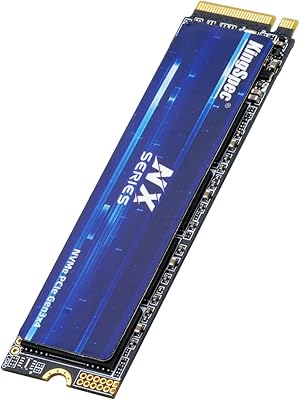
KingSpec NX 1TB M.2 2230 NVMe SSD
74%
88%
Read Performance
63%
Write Performance
94%
Form Factor Fit
86%
Installation Experience
89%
Value for Money
More
KingSpec XG7000 1TB M.2 2242 SSD
88%
94%
Performance
96%
Read Speed
89%
Build Quality
90%
Reliability
85%
Compatibility
More
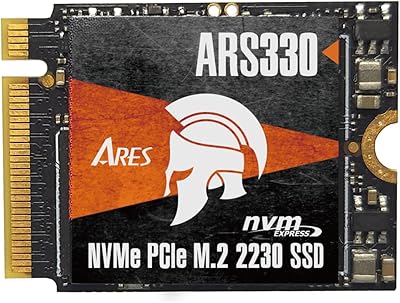
DATO ARS330 1TB M.2 2230 NVMe SSD
81%
83%
Sequential Read Speed
71%
Sustained Write Performance
88%
Thermal Management
91%
Form Factor Compatibility
86%
Value for Money
More
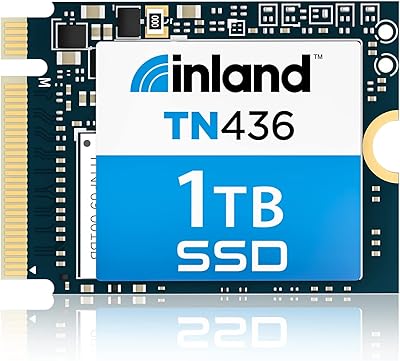
Inland TN436 1TB M.2 2230 NVMe SSD
84%
96%
Form Factor Fit
88%
Read/Write Performance
67%
Thermal Management
93%
Installation Experience
84%
Value for Money
More
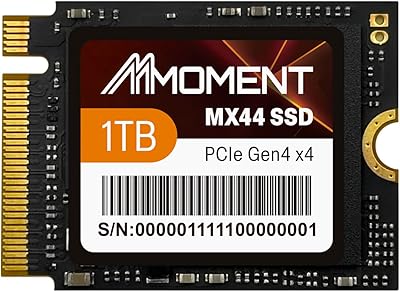
MMOMENT MX44 1TB M.2 2230 NVMe SSD
86%
92%
Performance
89%
Value for Money
95%
Ease of Installation
85%
Build Quality
87%
Durability (Dust/Water/Shock Resistance)
More
KingSpec X400 512GB Gen4 NVMe SSD
75%
88%
Sequential Read Speed
61%
Sustained Write Performance
91%
Value for Money
73%
PS5 Compatibility
77%
Thermal Management
More
KingSpec NN900S 1TB M.2 NVMe SSD
73%
83%
Read & Write Performance
88%
Value for Money
79%
Build & Form Factor
54%
NAND Flash Transparency
91%
Installation & Compatibility
More
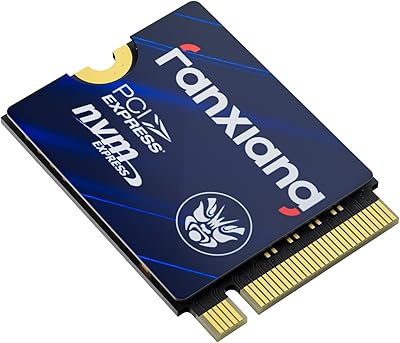
fanxiang S630 1TB M.2 2230 NVMe SSD
80%
88%
Read Speed Performance
74%
Write Speed Performance
81%
Device Compatibility
79%
Thermal Management
93%
Installation Experience
More
KingSpec NT 1TB M.2 2280 SATA SSD
76%
88%
Value for Money
76%
Sequential Performance
52%
Compatibility Clarity
91%
Installation Experience
87%
Everyday Reliability
More

FAQ

Yes, the 2230 form factor is exactly what the Steam Deck requires, and the pre-attached copper heatsink is thin enough (1mm) that it does not interfere with reassembly. No modification to the heatsink or the drive is needed before installation.

The drive ships unformatted, so SteamOS will handle partitioning during the recovery image installation process. If you are cloning an existing drive instead, tools like Clonezilla work well, though a small number of users have reported needing to retry the clone process once before it completes cleanly.

Yes, the ROG Ally uses an M.2 2230 slot, and this drive is explicitly listed as compatible. The installation process is similar to the Steam Deck — just make sure to power down the device fully and ground yourself before swapping the drive.

It depends on the slot length your device supports. Many laptops and desktops have M.2 2280 slots, which are longer and will physically hold a 2230 drive only if there is a mounting point or adapter bracket at the shorter position. Some motherboards support both lengths natively, so check your manual before purchasing.

KingSpec claims a 15% thermal improvement over paste-only drives, and early buyer feedback is generally positive about temperatures staying manageable during extended gaming sessions. That said, independent thermal testing data is still limited given how recently this drive launched, so treat the exact percentage as a manufacturer estimate rather than a verified benchmark.

KingSpec has been making storage products since 2007 and sells across global markets, so they are not a fly-by-night operation. That said, they do not carry the same brand recognition or long-term reliability data as Samsung or Western Digital. The 3-year warranty and the current user rating of 4.6 stars are reasonable confidence signals, but the sample size of reviews is still relatively small.

KingSpec offers a 3-year limited manufacturer warranty and provides a direct support contact channel. In practice, warranty support from smaller storage brands can vary in responsiveness, so it is worth keeping your purchase receipt and documenting any issues with benchmark screenshots or error logs if something goes wrong.

NVMe SSDs like this one are supported natively by the Linux kernel, so no additional drivers are required on modern distributions. KingSpec explicitly lists compatibility with Ubuntu, CentOS, and RHEL, which covers the most common Linux environments Steam Deck users and developers are likely to run.

On paper, peak sequential speeds are similar, and both are Gen 4 drives. Samsung's 980 Pro carries stronger brand trust, more extensive real-world endurance data, and a larger support ecosystem. The XF-2230 is the more budget-accessible option, but if you want the maximum confidence in long-term reliability and you can stretch the budget, Samsung or WD Black are safer bets. This KingSpec Gen 4 drive makes more sense when price-to-performance in the 2230 format is the primary concern.

No, PCIe 4.0 drives are fully backward compatible with Gen 3 slots. The drive will simply operate at Gen 3 speeds (roughly up to 3500MB/s read) rather than its full Gen 4 rated speeds. For a device like the Steam Deck, which itself caps NVMe bandwidth, this distinction matters very little in day-to-day use.