Overview

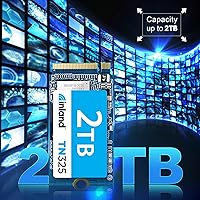
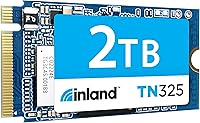
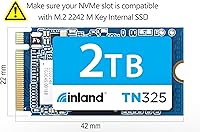
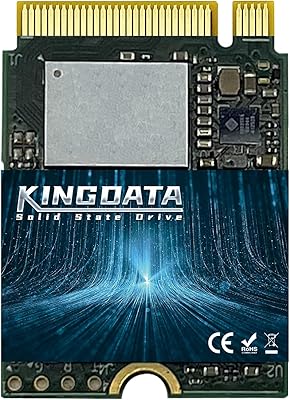
The Inland TN325 2TB M.2 2242 NVMe SSD exists to solve a very specific problem: you need serious storage capacity, but your device only accepts a 42mm-long drive. Most NVMe drives ship in the longer 2280 form factor and simply won't physically fit in handhelds like the Lenovo Legion Go, certain ultrabooks, or compact mini-PCs. Inland, Micro Center's in-house storage label, has built a reputation by targeting exactly these overlooked niches. This 2242 NVMe drive also backs itself with a 6-year warranty — unusually generous at this tier — though the DRAM-less architecture is a real trade-off worth understanding before you buy.
Features & Benefits

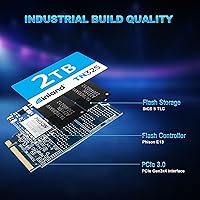
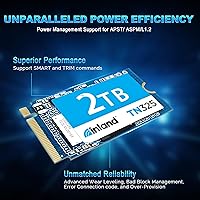
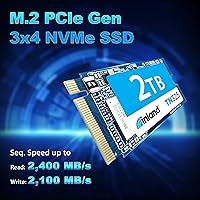
Running on a PCIe Gen 3x4 interface, the Inland TN325 reaches sequential reads up to 2,400 MB/s and writes up to 2,100 MB/s — solid throughput, though Gen 4 drives push noticeably higher if your system supports it. For everyday workloads, the random performance of 250K read and 400K write IOPS handles gaming and multitasking without issue. The 1,600 TBW endurance rating is genuinely high for 3D TLC NAND at this capacity, giving this compact SSD a long usable lifespan under normal conditions. Power management support for APST, ASPM, and L1.2 also helps limit battery consumption on portable devices where every watt matters.

Best For

This 2242 NVMe drive is the most practical choice for Lenovo Legion Go owners who want to expand storage — that handheld only exposes a 2242 slot, leaving most drives on the market incompatible by default. It also suits ultrabook users with a secondary 2242 slot sitting unused, or anyone replacing a slow factory drive in a compact mini-PC or tablet. The 2TB capacity in this form factor is genuinely rare, which is much of the draw. Skip it, though, for NAS use, professional video editing rigs, or any workflow that sustains heavy write loads around the clock — the DRAM-less design is not built for that.

User Feedback

Across 850 ratings, the Inland TN325 holds a 4.6-star average — a strong result for a niche product that buyers often purchase out of sheer necessity. Legion Go compatibility comes up repeatedly in reviews, with users reporting clean installs and no driver complications. The 2TB capacity in a hard-to-find size earns consistent praise. On the downside, a handful of buyers flag thermal throttling during prolonged transfers in tightly enclosed builds, which is worth considering if airflow around the slot is limited. Encouragingly, users who bought near launch in mid-2023 report no failures after more than a year of use, which adds credibility to the long warranty coverage.

Pros

  • Fills a genuine market gap — 2TB in the 2242 form factor is extremely hard to find from any brand.
  • Legion Go compatibility is confirmed by real buyers, not just the product listing.
  • Sequential speeds hold up well in everyday tasks like loading games and transferring files.
  • A 1,600 TBW endurance rating is genuinely high for 3D TLC NAND at this capacity.
  • The 6-year warranty provides meaningful long-term coverage that most drives in this tier do not offer.
  • Low-power management features help preserve battery life on handheld and portable devices.
  • Installation is consistently described as straightforward, with no driver headaches on Windows, Mac, or Linux.
  • Drive health tools — S.M.A.R.T., TRIM, and Wear-Leveling — are all included and functioning as expected.
  • Early buyers report reliable operation well past the one-year mark with no failures surfaced.

Cons

  • No DRAM cache means sustained large sequential writes slow down more noticeably than on cached alternatives.
  • Gen 3 interface is a ceiling — systems capable of PCIe Gen 4 will never see those speeds with this drive.
  • Thermal throttling has been reported in builds where the 2242 slot sits in a poorly ventilated enclosure.
  • The form-factor premium means you are paying above typical NVMe pricing for the same raw capacity.
  • Availability outside Micro Center can be inconsistent, making restocks unpredictable for some buyers.
  • Random read IOPS of 250K trails behind DRAM-equipped competitors in heavily multithreaded workloads.
  • Not suited for RAID arrays or NAS enclosures that depend on consistent sustained write performance.

Ratings

Our AI rating engine analyzed verified global buyer reviews for the Inland TN325 2TB M.2 2242 NVMe SSD, actively filtering out incentivized, duplicate, and bot-generated feedback to surface what real users actually experience. Scores reflect both the genuine strengths and the honest pain points of this drive, weighted by how frequently each factor came up across hundreds of long-term user reports. Nothing is smoothed over — if a category has a real weakness, the score and commentary reflect it directly.

Form Factor Fit
96%
The 2242 length is the entire reason most buyers choose this drive, and it delivers exactly what it promises. Legion Go owners, ultrabook users with secondary 2242 slots, and mini-PC builders all report clean physical installs with no fitment issues whatsoever.
The form factor is a strength for the right buyer, but it also means the drive offers no value to the majority of users who have standard 2280 slots — this is a purpose-specific product and should be treated as one.
Sequential Read Speed
83%
Real-world read performance holds up well for gaming loads, OS-installed app launches, and media access on handheld devices. Users moving large game installs around frequently note that the speeds feel consistent rather than erratic in day-to-day use.
Gen 4 NVMe drives at similar price points can reach more than twice these sequential read figures, so buyers who eventually upgrade to a Gen 4-capable platform will feel the ceiling. Within Gen 3, though, this is not an outlier.
Sequential Write Speed
78%
22%
For typical handheld gaming session saves, game installs, and routine file writes, the write performance is more than adequate and users rarely notice any lag or stutter during normal operation.
Sustained large sequential writes — think cloning a full drive or transferring a 100GB-plus video project — can slow noticeably once the SLC write cache fills, a known characteristic of DRAM-less 3D TLC designs at this density.
Endurance & Longevity
91%
The 1,600 TBW rating is a standout figure for a consumer TLC drive at 2TB, and buyers who purchased at launch in mid-2023 report zero failures after more than a year of active use. The wear-leveling and bad block management features appear to be doing their job.
TBW ratings are manufacturer estimates and real-world degradation depends heavily on workload patterns. High-write professional environments should still look at enterprise-class drives regardless of this rating.
Installation Experience
93%
Reviewers across Windows, macOS, and Linux consistently describe installation as painless — no drivers to hunt down, no firmware tools required out of the box. The drive shows up immediately in disk management after seating it in the slot.
A small number of users in very compact enclosures noted difficulty physically accessing the slot itself, though that is a chassis design issue rather than anything attributable to the drive.
DRAM-less Performance Impact
67%
33%
For the vast majority of use cases this drive is actually sold for — gaming storage expansion, handheld PC secondary drives, ultrabook file storage — the absence of dedicated DRAM cache is essentially invisible in daily use. Random IOPS performance handles mixed workloads without complaint.
Heavy multitasking with large simultaneous file operations, or sustained write loads from backup software running in parallel with active gaming, can expose the HMB-reliant architecture. It is a real limitation for power users even if casual buyers never hit it.
Thermal Management
71%
29%
Under typical mixed-use loads in well-ventilated builds, temperatures stay within a manageable range and throttling is not a common complaint among the majority of reviewers using it in laptops or handhelds.
A notable subset of buyers in tightly enclosed mini-PC cases or devices with poor airflow around the M.2 slot do report throttling during prolonged sequential transfers. Adding an M.2 heatsink is the recommended workaround, but physical clearance does not always allow for one.
Warranty Coverage
94%
A 6-year warranty is genuinely rare at this market tier and it is one of the most frequently cited reasons buyers choose this drive over alternatives when multiple 2242 options exist. It signals manufacturer confidence in the endurance rating.
Warranty claims must go through Inland directly, and as a Micro Center house brand, regional buyers outside the US may find the process less straightforward than dealing with a global brand's support infrastructure.
Value for Money
79%
21%
Within the narrow pool of 2TB 2242 NVMe drives, this compact SSD is competitively positioned and buyers acknowledge they are paying a form-factor premium rather than a brand premium. For devices where no alternative physically fits, the value calculus is clear.
Buyers with flexible slot options who compare it against 2280 drives at equivalent capacity will find the per-gigabyte cost meaningfully higher. The value proposition only holds up when the 2242 constraint is non-negotiable.
Random Read Performance
74%
26%
At 250K random read IOPS, the drive handles the typical access patterns of installed games, background OS processes, and application launches without producing noticeable stutter or delay in real handheld and laptop use.
DRAM-equipped competitors at a similar capacity tier can push 500K to 700K random read IOPS, a gap that becomes measurable under database-style or heavily parallelized workloads. For gaming and general storage, this rarely surfaces.
Power Efficiency
88%
APST, ASPM, and L1.2 support are all active and users in battery-sensitive devices like the Legion Go report that the drive does not appear to be a meaningful contributor to battery drain compared to the display and GPU.
Power efficiency benefits only fully materialize if the host device and firmware actually enable the relevant low-power states — a small number of older laptop models may not negotiate L1.2 correctly, which limits the idle power savings.
OS & Platform Compatibility
92%
No platform-specific quirks have been reported across Windows, macOS, or Linux. The standardized NVMe protocol means the drive is recognized and functional without any user intervention beyond formatting after installation.
Verified compatibility reports are overwhelmingly Windows-centric given the Legion Go use case; macOS and Linux install reports exist but are less numerous, so edge-case firmware interactions on those platforms are less thoroughly documented in the review pool.
Long-Term Reliability
87%
Given that the SKU launched in June 2023, there is now a meaningful cohort of buyers with 12-plus months of active use, and failure reports in that group are essentially absent from the review record. The endurance figures appear to be holding up under real-world conditions.
The drive is still relatively young by storage reliability standards and multi-year NAND degradation data is not yet available. Buyers planning decade-long deployments should factor that uncertainty into their decision alongside the warranty coverage.

Suitable for:

The Inland TN325 2TB M.2 2242 NVMe SSD is the right call for anyone whose device physically demands a 2242-length drive and who refuses to settle for low-capacity options. Lenovo Legion Go owners are the most obvious fit — that handheld gaming PC only exposes a 2242 slot, which immediately rules out the vast majority of NVMe drives on the market. Beyond handheld gaming, ultrabook users with a secondary 2242 slot and mini-PC builders replacing a slow factory drive will find this compact SSD covers both the capacity and the physical constraints in one shot. The 2TB ceiling is rare in this form factor, making it a practical choice for anyone managing a large game library, media collection, or mixed-use storage on a portable machine. If battery life matters to you, the low-power management features are a genuine bonus rather than a checkbox spec.
Not suitable for:

Buyers who have a standard 2280-compatible slot and are simply shopping for the best value-per-gigabyte NVMe drive should look elsewhere, because the Inland TN325 2TB M.2 2242 NVMe SSD commands a premium tied entirely to its rare form factor rather than raw performance. Gen 4 NVMe drives operate at roughly double the sequential speeds, so if your system supports PCIe Gen 4 and throughput actually matters for your workflow, this drive will leave performance on the table. The DRAM-less architecture, while fine for gaming and everyday storage, can slow noticeably during sustained large-file transfers — making it a poor fit for video editors, backup servers, or anyone routinely moving hundreds of gigabytes at a time. NAS enclosures and always-on workstation builds are also a mismatch, since those environments push write cycles far harder than what a consumer-grade TLC drive is optimized to handle long-term.
Specifications

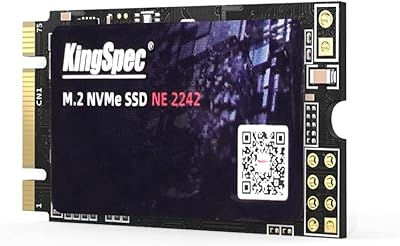
  • Form Factor: This drive uses the M.2 2242 format, measuring 22mm wide by 42mm long by 3.5mm tall — shorter than the common 2280 length that most NVMe drives use.
  • Interface: It connects via PCIe Gen 3x4 using an M Key connector, which is compatible with any M.2 slot supporting NVMe over PCIe Gen 3 or Gen 4.
  • Capacity: Total usable storage is 2TB (formatted from 2000GB raw NAND), making it one of the highest-capacity options available in the 2242 form factor.
  • Sequential Read: Rated sequential read speed reaches up to 2,400 MB/s under optimal conditions on a PCIe Gen 3x4 interface.
  • Sequential Write: Rated sequential write speed reaches up to 2,100 MB/s, competitive for a Gen 3 DRAM-less drive at this capacity tier.
  • Random IOPS: The drive is rated for up to 250K random read IOPS and 400K random write IOPS, which covers typical mixed workloads including gaming and general-purpose file access.
  • NAND Type: Storage cells use 3D TLC (Triple-Level Cell) NAND, a widely deployed technology that balances density, cost, and write endurance at consumer scale.
  • Endurance: Total endurance is rated at 1,600 TBW (Terabytes Written), which is unusually high for a consumer 3D TLC drive at the 2TB capacity level.
  • Cache: This drive is DRAM-less, relying on host memory buffer (HMB) instead of dedicated onboard DRAM cache for address mapping.
  • Power Management: Supports APST, ASPM, and L1.2 low-power states, allowing the drive to reduce power draw during idle periods on compatible portable and battery-powered systems.
  • Drive Health: Includes support for S.M.A.R.T. monitoring, TRIM command, Bad Block Management, and Wear-Leveling technology for ongoing drive health and longevity management.
  • Warranty: Covered by a 6-year limited warranty from Inland, which is longer than the 3- to 5-year coverage typical of competing consumer NVMe drives at this tier.
  • OS Support: Compatible with Windows, macOS, and Linux operating systems without requiring additional drivers beyond standard NVMe support built into each platform.
  • Compatible Devices: Designed for desktops, laptops, ultrabooks, tablets, and handheld gaming consoles that provide a PCIe NVMe M.2 2242 slot.
  • Weight: The drive weighs 0.774 ounces, adding negligible mass to any portable device during installation.
  • Package Dimensions: Retail packaging measures approximately 5.2 inches by 3.86 inches by 0.47 inches, housing the bare drive and basic documentation.
  • Brand & Series: Manufactured by Inland under the TN325 series designation; Inland is the proprietary storage label sold through Micro Center retail and online channels.
  • Availability Date: This SKU was first made available in June 2023, meaning early adopters have accumulated over a year of real-world usage data as of mid-2024.

Related Reviews
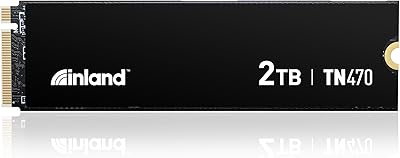
Inland TN470 2TB Gen4 NVMe M.2 SSD
82%
93%
Sequential Speed
91%
Value for Money
62%
Thermal Performance
96%
Installation Ease
78%
Random I/O Performance
More
SanDisk 2TB SSD Plus M.2 NVMe SSD
86%
89%
Performance
92%
Ease of Installation
88%
Reliability
91%
Value for Money
90%
Capacity
More
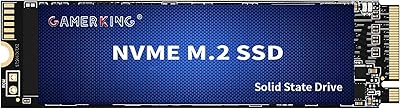
GAMERKING 2TB M.2 NVMe Internal SSD
75%
78%
Read/Write Performance
82%
Value for Money
91%
Installation Experience
67%
Thermal Management
63%
Long-Term Reliability
More
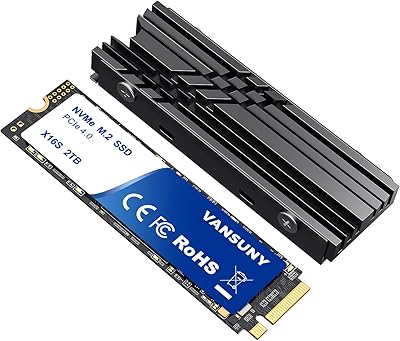
Vansuny 2TB NVMe M.2 Internal SSD
78%
88%
Value for Money
79%
Read/Write Speed
91%
PS5 Compatibility
74%
Thermal Management
93%
Installation Experience
More
SanDisk Extreme M.2 NVMe 2TB SSD
79%
91%
Read Speed Performance
63%
Sustained Write Performance
94%
Installation Ease
83%
Value for Money
88%
Compatibility & Versatility
More
Inland QN446 2TB M.2 2230 NVMe SSD
82%
88%
Sequential Read Speed
61%
Sustained Write Performance
97%
Form Factor Compatibility
74%
Random I/O Performance
83%
Thermal Management
More
WD_BLACK SN850P 2TB NVMe SSD
86%
93%
Read Speed Performance
96%
PS5 Compatibility & Licensing
94%
Installation Experience
88%
Heatsink Quality & Thermal Management
71%
Value for Money
More
ORICO IG740PRO 2TB NVMe SSD
83%
93%
Read & Write Speed
91%
Endurance & Longevity
84%
Thermal Management
88%
Data Security & Protection
92%
PS5 Compatibility & Installation
More
ORICO J10-2242 256GB NVMe M.2 SSD
78%
83%
Read Speed Performance
61%
Write Speed & Sustained Performance
78%
Thermal Management
88%
Value for Money
81%
Build Quality & Packaging
More
INLAND TN320 1TB NVMe M.2 SSD
77%
91%
Value for Money
88%
Sequential Read Speed
64%
Sustained Write Performance
93%
Installation Ease
94%
Warranty & Support
More

FAQ

Yes, and that is one of the most common reasons people buy it. The Legion Go exposes a 2242 slot for secondary storage expansion, and this compact SSD fits it correctly. Multiple verified buyers have confirmed a clean installation with no physical or firmware issues.

The numbers refer to the physical dimensions of the drive — 22mm wide and either 42mm or 80mm long. A 2280 drive is nearly twice as long as a 2242, so it will not fit in a slot designed for the shorter length. Most consumer NVMe drives are 2280, which is exactly why finding a 2TB option in 2242 is genuinely difficult.

For most people, no. Gaming, browsing, streaming, and general file storage all fall well within what a DRAM-less NVMe handles without issue. Where you might notice it is during sustained transfers of very large files — think moving a 200GB folder — where speeds can dip as the SLC cache fills. For typical handheld gaming or laptop use, it is not a meaningful limitation.

PCIe Gen 4 drives can hit sequential reads above 7,000 MB/s, roughly three times what this drive offers. That said, your device needs a Gen 4-compatible slot to benefit from those speeds, and many 2242 slots are Gen 3 only. If your machine has a Gen 4 slot and supports 2242 drives, it is worth checking if a Gen 4 option exists — but the real-world gap narrows substantially for gaming and mixed storage workloads.

Just a small Phillips-head screwdriver to remove the M.2 slot cover on your device. No drivers are needed — Windows, macOS, and Linux all recognize NVMe drives natively. After installation, you will need to initialize and format the new partition through your OS disk management utility before using it.

Inland is Micro Center's house storage label and has been producing SSDs and HDDs for several years with a generally solid track record among enthusiast buyers. The 6-year warranty on this drive is a strong signal of the manufacturer's confidence in the product. User reviews dating back to launch in 2023 have not surfaced widespread failure patterns.

Technically yes, provided your device is configured to boot from the 2242 slot and that slot supports NVMe boot. In practice, many devices that use the 2242 slot treat it as secondary storage only, with the primary boot drive occupying a separate 2280 or soldered slot. Check your device's documentation before planning a boot install.

It can be in very enclosed spaces with poor airflow around the M.2 slot. A small number of reviewers have flagged it during prolonged large transfers. For gaming sessions and normal mixed workloads it does not appear to be a common complaint. If you are installing it in a tight mini-PC chassis, adding a small M.2 heatsink — if the slot clearance allows it — is a reasonable precaution.

All three are supported. NVMe is a standardized protocol, so macOS and Linux both handle this 2242 drive the same way they would any other NVMe SSD. No platform-specific firmware or driver is required.

TBW stands for Terabytes Written, and it represents the total volume of data the manufacturer rates the drive to handle before wear becomes a concern. At 1,600 TBW, even a user writing 50GB per day every day would take nearly 90 years to hit that ceiling under those conditions — for virtually all consumer workloads, the drive will outlast its useful life for other reasons long before endurance becomes a factor.