Overview

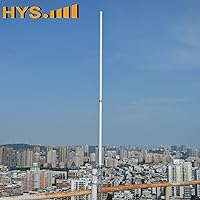
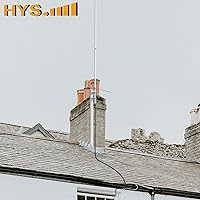
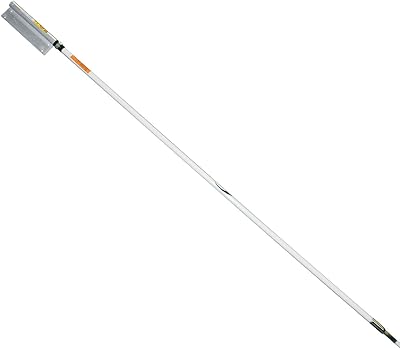
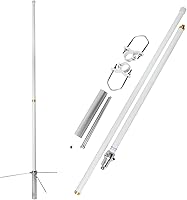
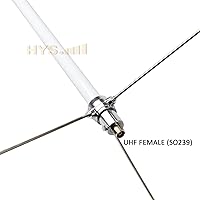
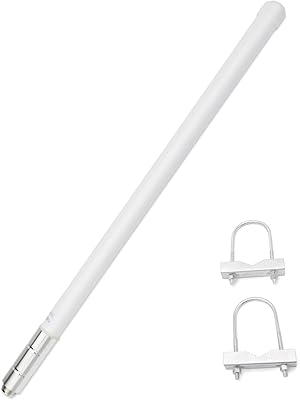
The HYS 144/430MHz Dual-Band Base Station Antenna is a fixed-installation fiberglass antenna built for amateur radio operators who want solid VHF and UHF coverage without fussing with tuners or analyzers. Standing 5.7 feet tall in two sections, it ships pre-tuned and ready to connect straight to your coax. The white fiberglass radome gives it a clean, unobtrusive look whether it ends up on a rooftop, a backyard mast, or mounted to a utility pole. With an SO-239 connector as standard, it slots right into most ham radio setups without adapters. It sits in the mid-to-upper range for this antenna category, reflected in its overall build approach.
Features & Benefits

The gain figures are worth putting in context. On VHF, you're looking at around 4.5dBi — the listing mentions 4.7dBi elsewhere, a minor discrepancy that likely reflects measurement methodology rather than anything concerning. Either way, it's a meaningful improvement over a basic dipole. On UHF, 7.2dBi of gain is the real headline here, noticeably extending your reach on 70cm, particularly for hitting repeaters at distance. The antenna handles up to 200 watts input, which covers virtually any home station transceiver. Stainless steel radials and a weatherproof housing make it a sensible choice for long-term outdoor exposure, and built-in lightning protection via direct ground is a welcome inclusion for any permanent install.

Best For

This VHF/UHF fiberglass antenna is a natural fit for licensed operators building a permanent home station on 2m and 70cm. If you've been relying on a mag-mount or a mobile whip and want noticeably better range without learning how to tune an antenna, this is a straightforward upgrade. It also works well for rooftop or mast mounting where weather exposure is a real concern. That said, it won't serve anyone needing HF bands, and it's clearly not a portable option. Think of it as a set-and-forget solution for VHF/UHF simplex and repeater use at a fixed location.

User Feedback

The review pool for this dual-band base antenna is still relatively small — around 60 ratings — so patterns should be taken as directional rather than definitive. On balance, buyers seem genuinely pleased. Build quality gets consistent praise, especially given what you're paying. Several users confirmed SWR readings came in close to spec on both bands right out of the box, which is exactly what you want from a pre-tuned design. On the downside, a handful of people felt the included mounting hardware was functional but not particularly robust, and a few noted the packaging could do a better job protecting the antenna during transit.

Pros

  • Pre-tuned out of the box — no antenna analyzer or tuning skills required to get on the air fast.
  • The 7.2dBi gain on UHF is a real-world upgrade for reaching distant repeaters on 70cm.
  • Handles up to 200 watts, making it compatible with virtually any home station transceiver.
  • Weatherproof fiberglass construction holds up to rain, UV exposure, and temperature swings over time.
  • SO-239 connector means no adapters needed for the vast majority of ham radio coax setups.
  • Built-in direct ground lightning protection is a meaningful safety feature for any permanent outdoor install.
  • Stainless steel radials resist corrosion, which matters when the antenna is exposed to the elements year-round.
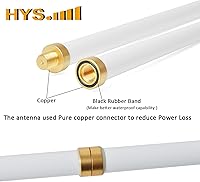
  • Two-section design makes shipping and initial assembly manageable without special tools.
  • Omnidirectional 360-degree coverage means you never have to rotate or aim the antenna.
  • Multiple buyers confirmed SWR readings landed close to advertised specs right out of the package.

Cons

  • The included U-bolt mounting hardware is adequate but feels undersized for heavy-duty or high-wind installations.
  • Packaging has drawn complaints from some buyers who received the antenna with minor shipping damage.
  • The gain figure listed in the title differs slightly from the one in the product body, which can create confusion before purchase.
  • At 5.7 feet tall, this antenna is not a subtle installation — it will be visible on any rooftop or mast.
  • No coaxial cable is included, so you need to factor in additional cable cost and length for your specific setup.
  • The review base is still relatively small, making it harder to gauge long-term durability with confidence.
  • Dual-band coverage is limited to 2m and 70cm; operators wanting broader frequency range will need a different solution.
  • Assembly instructions could be clearer — a few users found the two-section connection less intuitive than expected.

Ratings

Our AI-generated scores for the HYS 144/430MHz Dual-Band Base Station Antenna were produced by analyzing verified buyer reviews from multiple global sources, with spam, bot-generated, and incentivized feedback actively filtered out. The ratings reflect a balanced picture — genuine strengths are recognized, but real frustrations from actual users are weighted equally and transparently reflected in every score. Whether this antenna fits your shack or falls short of your expectations, the scorecard below gives you an honest, data-driven starting point.
RF Performance
83%
Most buyers setting up a home base station report a clear, tangible improvement over a mobile whip or mag-mount antenna, particularly on 70cm UHF where the gain advantage is most pronounced. Hitting distant repeaters that were previously marginal becomes noticeably more reliable, and simplex contacts feel more consistent at the edges of range.
A handful of users found that real-world VHF performance did not quite match their expectations based on the advertised gain figures, which can vary slightly between the listing title and body text. In RF-noisy urban environments, the improvement over a decent mobile antenna can feel less dramatic than anticipated.
Build Quality
78%
22%
The fiberglass radome feels solid and purposeful — not the thin, brittle housing you sometimes see on budget antennas. Stainless steel radials add a level of corrosion resistance that buyers living in wet or coastal climates specifically called out as reassuring after months of outdoor exposure.
Some users felt the overall construction, while adequate, did not quite justify the price when compared side-by-side with competing brands at a similar level. A few noted minor cosmetic imperfections on arrival that, while not affecting function, suggested inconsistent quality control at the factory.
Ease of Setup
88%
For operators who dread spending an afternoon with an antenna analyzer, the pre-tuned design is a genuine convenience. The two-section assembly threads together quickly, and the SO-239 connector means most people can go from opening the box to being on the air in under 30 minutes without any specialized tools.
The included assembly instructions are thin and lack detail, which left a few less experienced buyers second-guessing whether they had properly seated the two sections. Nothing technically difficult, but a clearer setup guide would remove unnecessary uncertainty for newcomers to base station antennas.
Weatherproofing
81%
19%
After extended outdoor exposure — including rain, snow, and direct summer sun — the fiberglass housing holds up without cracking or fading badly, based on feedback from users who have had the antenna installed for a year or more. The stainless steel radials show no meaningful corrosion in most reported climates.
The connector junction between the antenna and your coax is not inherently weatherproofed by the antenna itself, meaning you need to apply self-amalgamating tape or a similar sealant yourself. A few users skipped this step and reported early connector degradation, which is user error but worth flagging.
Mounting Hardware
62%
38%
The included stainless steel U-bolts get the job done for standard mast diameters, and for a straightforward rooftop or backyard pole installation they are completely serviceable. Buyers in calm weather environments reported no issues with the hardware holding the antenna securely over extended periods.
In higher-wind locations or for heavy-duty installations, the included U-bolts feel undersized and a step below what the antenna's overall weight and wind load probably warrant. Several buyers proactively replaced the hardware with heavier-gauge clamps, which suggests the included hardware is the weakest physical component in the package.
SWR & Tuning Accuracy
79%
21%
A meaningful portion of buyers who bothered to check SWR after installation reported readings comfortably below 1.5 on both bands, confirming the pre-tuning claim holds up in practice for most standard installations. On UHF in particular, the antenna tends to come in very close to the published specification.
A smaller but vocal group of users measured VHF SWR slightly higher than expected, though still within workable range for most transceivers. Because the antenna is not tunable, if your specific installation environment pushes SWR higher, your only option is to adjust coax length or accept the reading as-is.
Gain on VHF (2m)
72%
28%
On the 2-meter band, this dual-band base antenna delivers a real improvement over a quarter-wave ground plane or a basic mobile whip, making it a worthwhile upgrade for operators who use 144MHz as their primary band. Local net check-ins and simplex contacts benefit from the tighter vertical beam and higher gain.
The VHF gain figure has minor inconsistencies across the product listing — 4.5dBi in some places, 4.7dBi in others — which, while practically insignificant, erodes some confidence in the specification accuracy. Users expecting a dramatic range extension on VHF may find the improvement more incremental than transformative.
Gain on UHF (70cm)
86%
The 7.2dBi UHF gain is where this VHF/UHF fiberglass antenna clearly earns its place. Buyers consistently noted that distant 70cm repeaters they could barely key up with a handheld or mobile antenna became solidly accessible after installation, which is exactly the use-case scenario the gain figure promises.
To fully exploit the UHF gain advantage, coax cable quality becomes important — and that cost is not included. Users who ran cheap or excessively long RG-58 runs found the cable loss partially offset the gain benefit, which is a system-level consideration but one the product does not explicitly warn buyers about.
Compatibility
91%
The SO-239 connector is effectively the universal standard for HF and VHF/UHF ham radio equipment, meaning almost every transceiver, tuner, or feed line terminated with a PL-259 plug connects directly with no adapters. This removes a surprisingly common frustration that cheaper antennas with non-standard connectors create for new buyers.
Operators whose shack uses N-type connectors — more common in professional or microwave-focused setups — will need an adapter, which introduces a minor impedance and mechanical consideration. This is a niche issue for most ham radio users but worth noting for anyone already invested in N-type infrastructure.
Value for Money
69%
31%
For buyers stepping up from a mag-mount or handheld antenna to their first proper outdoor base station antenna, the performance-to-price ratio feels fair. The weatherproof build, copper radiating element, and included mounting hardware mean you are not buying a bare antenna and sourcing everything else separately.
At its price point, this VHF/UHF fiberglass antenna sits in a competitive bracket where several established brands offer comparable or slightly better-documented performance. Buyers who have used premium Japanese or American-made antennas in the same frequency range may find the value proposition less compelling.
Packaging & Delivery Condition
58%
42%
Most buyers received the antenna intact and ready to assemble without issue. The box dimensions are appropriate for the disassembled antenna sections, and the fiberglass construction offers some inherent resistance to minor impacts during transit.
A recurring complaint in user reviews is that packaging protection is minimal — thin foam or cardboard padding rather than purpose-designed foam inserts. A non-trivial number of buyers reported cosmetic scuffs or minor damage on arrival, and a few noted the connector arrived with slight deformation that required minor correction before use.
Longevity & Durability
74%
26%
Buyers who have had the HYS base station antenna installed for 12 months or more generally report it still performing within spec, with no cracking or delamination of the fiberglass housing and no corrosion on the stainless steel radials. Fiberglass as a construction material has a well-established track record in outdoor antenna applications.
Long-term durability data is limited given the moderate review volume and the antenna's relatively recent market availability. The connector area and mounting clamps are the components most likely to show wear first, particularly in environments with significant temperature cycling or salt air exposure.
Lightning Protection
77%
23%
Having direct ground lightning protection built into the antenna design is a legitimate selling point for permanent outdoor installations, and it provides a meaningful layer of protection beyond what operators would get with no grounding strategy at all. For rooftop installations especially, this feature can matter.
Direct ground protection is a passive safety measure, not a guarantee against lightning damage to connected equipment — a point the product does not make explicit. Buyers in high-lightning-frequency areas should still invest in a dedicated RF lightning arrestor at the entry point to their shack for full protection.
Omnidirectional Coverage
84%
The 360-degree horizontal pattern means you never have to think about antenna orientation once it is mounted, which is a real practical advantage for home operators who want to work in all directions — whether that is hitting a repeater to the north or talking simplex with a contact to the south simultaneously.
The vertical beam width is relatively narrow (30 degrees on VHF, 19 degrees on UHF), which is typical for higher-gain antennas but means the antenna is optimized for terrestrial near-horizon communication. Operators interested in satellite work or high-elevation contacts will find this pattern geometry a poor fit.

Suitable for:

The HYS 144/430MHz Dual-Band Base Station Antenna is a strong match for licensed amateur radio operators who are ready to move beyond temporary or mobile antenna solutions and set up a proper fixed station at home. If you spend regular time on 2-meter and 70-centimeter frequencies — whether for local simplex contacts, hitting repeaters, or participating in nets — the jump in gain over a mag-mount or rubber duck is genuinely noticeable, especially on UHF. It's also a practical pick for anyone who doesn't want to mess with tuning: connect your coax, check your SWR once for peace of mind, and get on the air. Operators in areas with harsh weather, or those planning a rooftop or outdoor mast installation, will appreciate the weatherproof fiberglass construction and stainless steel hardware. The 200-watt power handling means it won't be the limiting factor if you're running a mid-range or higher-powered transceiver.
Not suitable for:

The HYS 144/430MHz Dual-Band Base Station Antenna is simply the wrong tool if your operating interests extend to HF bands — it covers only VHF and UHF, full stop. Operators looking for a portable or field-deployable option should also look elsewhere; at 5.7 feet and requiring pole or mast mounting, this is a permanent-installation antenna by design. If you're working with very tight mounting spaces or need a low-profile setup that won't draw attention, the size and white fiberglass profile may be a drawback. The included U-bolt hardware is functional for most standard mast diameters, but if you're mounting in a demanding or high-wind environment, you may want to budget for heavier-duty mounting accessories. Finally, buyers who need an antenna backed by thousands of verified reviews before committing should be aware that the user feedback pool here is still relatively modest, so there's less community data to draw from compared to more established models.
Specifications

  • Frequency Range: Covers 144MHz VHF (136–159MHz) and 430MHz UHF (415–445MHz), making it compatible with the 2-meter and 70-centimeter amateur radio bands.
  • Gain: Rated at 4.5dBi on VHF and 7.2dBi on UHF, providing a noticeable signal improvement over a standard dipole on both bands.
  • Max Power: Accepts up to 200 watts of input power, which comfortably accommodates most home station transceivers.
  • Connector Type: Fitted with an SO-239 (UHF female) connector, the standard interface found on the majority of ham radio equipment and PL-259-terminated coax cables.
  • Impedance: Nominal impedance is 50 ohms, matching the standard output impedance of virtually all amateur radio transceivers.
  • VSWR: Specified VSWR is under 1.5 across both supported frequency ranges, indicating efficient power transfer with minimal reflected energy.
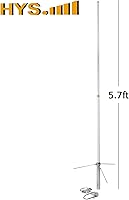
  • Antenna Length: Stands 5.7 feet (1.75 meters) tall in its assembled two-section configuration.
  • Weight: Complete antenna assembly weighs approximately 1.0 kg (2.73 lbs), which is manageable for standard mast and pole mounting.
  • Polarization: Vertically polarized, which is the standard orientation for VHF and UHF terrestrial amateur radio communication.
  • Beam Width: Provides 360-degree omnidirectional horizontal coverage, with vertical beam widths of 30 degrees on VHF and 19 degrees on UHF.
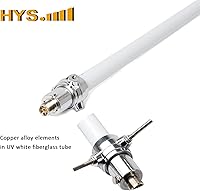
  • Radome Material: Outer housing is constructed from white fiberglass, offering impact resistance and protection against UV exposure, rain, and temperature extremes.
  • Radiating Element: The radiating element is made from copper, which provides reliable conductivity and resistance to oxidation over time.
  • Radial Hardware: Stainless steel radials are included as part of the antenna assembly, contributing to corrosion resistance in outdoor environments.
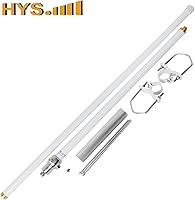
  • Mounting Hardware: Ships with two stainless steel U-bolt clamps for attachment to a mast or vertical pole, along with the necessary nuts and washers.
  • Lightning Protection: Incorporates direct ground lightning protection, an important safety feature for any antenna installed permanently outdoors.
  • Construction: Built as a two-section assembly that screws together, simplifying shipping and making initial installation more manageable without specialized tools.
  • Mounting Hardware Material: Supplementary mounting components such as brackets are made from aluminum alloy, keeping the overall hardware weight low.
  • Package Dimensions: Ships in a box measuring approximately 35.5 x 3.6 x 2.2 inches to accommodate the disassembled antenna sections safely.

Related Reviews
Diamond X50A Dual-Band VHF/UHF Base Antenna
78%
88%
RF Performance
91%
Out-of-Box SWR
84%
Build Quality
79%
Weather Durability
76%
Ease of Assembly
More
Diamond Antenna X30A Dual-Band Base Antenna
80%
91%
Signal Performance
88%
Build Quality
86%
Weatherproofing
84%
Ease of Installation
89%
SWR Consistency
More
Tram 1477 Dual-Band VHF/UHF Base Antenna
79%
91%
Ease of Setup
78%
RF Performance
83%
Build Quality
86%
Value for Money
67%
Connector Quality
More
Tram 1480 Dual-Band Fiberglass Base Antenna
76%
88%
Signal Performance
83%
Build Quality
86%
Weather Resistance
91%
Ease of Installation
89%
Connector Compatibility
More
HYS TC-YG08UV Dual-Band Yagi Antenna
70%
83%
Signal Gain Performance
76%
Build Quality
81%
Weather Resistance
84%
Ease of Assembly
61%
Aiming & Directional Usability
More
UAYESOK UA-CB6200 20ft CB Base Station Antenna
74%
83%
Signal Performance
78%
SWR & Tuning
74%
Build Quality
86%
Ease of Installation
81%
Weather Resilience
More
UAYESOK Dual Band Fiberglass Radio Antenna 17-inch SO239 Connector
88%
89%
Signal Performance
93%
Durability & Weather Resistance
88%
Ease of Installation
90%
Build Quality
85%
Portability
More
Solarcon IMAX-2000 Vertical Base Station Antenna
77%
88%
Signal Performance
83%
Build Quality
79%
Ease of Assembly
63%
SWR Tuning
86%
Durability & Longevity
More
Linksys EA2700 Dual-Band Router
82%
84%
Wireless Performance
78%
Signal Coverage
88%
Setup & Installation
90%
Wired Connectivity
81%
Reliability
More
Yealink W70B Phone Base Station
84%
91%
Call Quality
70%
Ease of Setup
88%
Voice Clarity
87%
Reliability
92%
Security Features
More

FAQ

It is genuinely pre-tuned and ready to use once assembled and connected. Most buyers who check SWR after installation report readings well within acceptable range on both bands without any adjustment. That said, running a quick SWR check with your radio or an analyzer after mounting is always a good habit, just to confirm nothing shifted during shipping.

The two included U-bolt clamps are designed to fit standard mast diameters, typically in the range of 1 to 2 inches. If your mounting pole is significantly outside that range, you may need to source alternative or supplementary hardware. The included clamps are functional but not heavy-duty, so consider upgrading the mounting hardware if you are in a high-wind location.

Technically you can connect it indoors, but you will lose a significant portion of its outdoor performance benefit. Fiberglass base antennas like this are optimized for open-air, unobstructed installation. If indoor mounting is your only option, a smaller or purpose-built indoor antenna may serve you better.

It will work with any radio that has an SO-239 compatible output and operates on 144MHz or 430MHz — including handhelds if you use an appropriate adapter cable. Keep in mind the antenna is designed for fixed installation, so it pairs most naturally with a base station transceiver connected via a proper coaxial run.

No coax cable is included in the package. For runs up to about 50 feet, RG-8X or LMR-240 are solid choices that balance cost and low loss. For longer runs, consider LMR-400 to minimize signal loss, especially on UHF where cable loss becomes more significant.

The fiberglass radome and stainless steel radials handle weather exposure well in most conditions, including snow, rain, and moderate salt air. Fiberglass is inherently resistant to UV degradation and does not corrode. For coastal installations with heavy salt spray, periodically inspect the connector and mounting hardware, as those areas are more vulnerable to corrosion over time.

Yes, it works fine for APRS and other 2-meter digital modes. The antenna does not care what mode your radio is transmitting — as long as you are within the 144MHz band, it will perform as expected. The omnidirectional pattern is actually ideal for APRS, where you want to receive and transmit in all directions equally.

Not really. The listing mentions 4.5dBi in some places and 4.7dBi in others for VHF, which is a very minor discrepancy that likely reflects rounding or different measurement conditions. In practical terms, that difference is essentially imperceptible on the air. The UHF gain figure of 7.2dBi appears consistently and is the more impactful number for most users anyway.

The antenna is designed exclusively for vertical polarization and vertical mounting. Mounting it horizontally would put it out of phase with the vast majority of VHF and UHF stations you would want to communicate with, resulting in a significant signal penalty. Stick to vertical installation for standard terrestrial amateur radio use.

Assembly is straightforward — the two sections thread together, and the mounting hardware attaches with basic hand tools like a wrench or adjustable spanner. Most people can have it fully assembled and mounted within 20 to 30 minutes. A few users have noted that the assembly instructions could be more detailed, so take your time with the section connection to make sure it is properly seated and weatherproofed if needed.