Overview

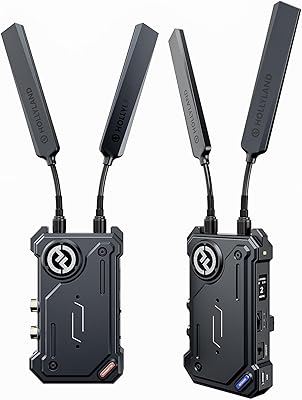
The Hollyland Pyro H Wireless HDMI Video Transmitter marks a clear step up from Hollyland's Mars lineup, built specifically for professional crews who need reliable multi-user monitoring across a full set. The base kit ships with one transmitter and one receiver, but the real draw is expandability — you can run up to four receivers simultaneously, changing how a director, DIT, and script supervisor all work together. It operates across dual-band 2.4GHz and 5GHz frequencies with automatic channel selection at startup, which matters a lot in congested RF environments. A UVC streaming option is also tucked in for those who occasionally need a direct computer feed. Launched in early 2024, it quickly climbed to a top ranking in its category.
Features & Benefits

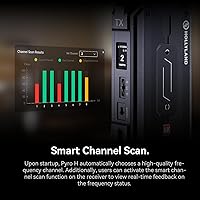
The range on this wireless HDMI transmitter is genuinely useful on large sets — not just a spec to brag about. At roughly 400 meters, a director can walk the full length of a location without losing the feed. Pair that with 60ms latency and you get real-time feedback that is actually usable for calling action. Video quality tops out at 4K, though it is capped at 30fps — worth flagging for any shooter running 4K60 on their camera. The HDMI loopout keeps a field monitor live on the rig while the signal goes out wirelessly. Smart Channel Scan handles frequency selection automatically at startup, and the flexible power options — NPF battery, DC, or USB-C — mean it slots into most existing rigs without fuss.

Best For

The Pyro H is a natural fit for narrative film productions where multiple crew members — the director, script supervisor, and DIT — all need a live feed at once. ENG and EFP crews working unpredictable environments will appreciate the automatic channel management that keeps things stable when the RF landscape shifts. Event videographers covering large venues, like conference halls or wedding spaces, get genuine freedom from the cable that usually tethers a monitor to the camera. Live streamers who want a clean HDMI path straight into a computer will find the UVC support a tidy bonus. Teams already inside the Hollyland Pyro ecosystem also benefit from full cross-compatibility across the product line.

User Feedback

Owners consistently praise range and signal stability in open and semi-open environments, with many noting that latency holds up well during actual takes rather than just in controlled tests. Build quality earns solid marks too — the cold shoe mount feels sturdy rather than an afterthought. That said, a handful of users in dense urban locations report occasional interference, which suggests antenna placement deserves real attention in challenging RF conditions. The Hollyview app is well-liked for its simplicity, though some users find it lacks depth once they need finer control on set. Most buyers consider the base 1TX+1RX kit a reasonable starting point, while noting that crews needing three or four simultaneous feeds will need to budget for additional receiver units separately.

Pros

  • Supports up to four simultaneous receivers, giving every key crew member an independent live feed.
  • Automatic dual-band channel scanning cuts setup time significantly on busy, RF-crowded sets.
  • The HDMI loopout keeps a physical monitor live on the rig while the wireless signal goes out simultaneously.
  • Signal holds reliably across large locations, giving directors genuine freedom to move without losing the feed.
  • Flexible power options — NPF battery, DC, and USB-C — slot into most existing rig configurations without extra hardware.
  • UVC support provides a clean plug-and-play signal path into a computer, no capture card required.
  • Cold shoe mount feels secure on professional rigs and holds up well under daily production use.
  • Cross-compatible with the broader Pyro ecosystem, making it a practical investment for teams expanding their Hollyland setup.
  • Low latency is usable for real-time directing, not just passable under test conditions.

Cons

  • 4K transmission is capped at 30fps, which is a meaningful limitation for high-frame-rate production workflows.
  • Base kit includes only one receiver — adding enough units to use the multi-receiver capability adds up quickly.
  • Antenna placement requires more attention than a plug-and-play system ideally should, especially in challenging environments.
  • The Hollyview app lacks depth for advanced users and feels behind the hardware in terms of capability.
  • No native SDI connectivity means cinema and broadcast cameras require an additional converter in the signal chain.
  • Signal range can drop noticeably in dense urban or high-interference environments compared to open-location performance.
  • Documentation in the box is minimal and leaves intermediate setup questions unanswered without external research.
  • Units are not weather-sealed, limiting use in rain or dusty outdoor conditions without added protection.

Ratings

The Hollyland Pyro H Wireless HDMI Video Transmitter earns strong marks across professional filming and broadcast workflows, based on AI analysis of verified global buyer reviews with spam, bot-generated, and incentivized feedback actively filtered out. Scores reflect the full picture — where this transmission kit genuinely delivers for working crews, and where real-world users have run into friction. Both the strengths and the honest pain points are weighted into every category below.

Transmission Range
91%
On larger shooting locations — think warehouse interiors, outdoor event grounds, or multi-floor production spaces — users consistently report that the signal holds cleanly across distances that would break lesser systems. The range gives directors and DITs real freedom to roam without babysitting the feed.
A small number of users shooting in dense urban environments or RF-heavy broadcast venues note the effective range drops noticeably. In those conditions, the real-world distance can fall short of the maximum spec, so teams should test placement before committing to a critical shoot.
Signal Stability
87%
The automatic dual-band channel selection at startup is one of the features crew members appreciate most in practice. On busy sets where multiple wireless systems compete for spectrum, the Pyro H tends to find a clean channel quickly without manual intervention, which keeps setup moving.
Occasional dropouts are reported when the transmitter and receiver lose line of sight for extended periods, particularly around concrete structures or metal staging. A few users emphasize that antenna orientation makes a bigger difference than expected and requires some trial and error on unfamiliar locations.
Latency Performance
89%
At 60ms, the delay is low enough that directors calling action from a monitor feed do not feel disconnected from what the camera operator is actually doing. Users across narrative film and live event work note this is one area where the Pyro H holds up under real production pressure, not just benchmark conditions.
For scripted drama where a director is watching lip sync or subtle physical performance, some users feel even 60ms is perceptible under close scrutiny. It is not a dealbreaker for most workflows, but it is worth knowing for anyone coming from a wired monitoring setup with zero delay.
Video Quality
84%
The transmitted image holds up well in practice, with users noting clean color representation and no visible compression artifacts during normal monitoring use. The HDMI loopout is particularly valued on camera rigs where a physical monitor also needs to stay live while the signal goes out wirelessly.
The 4K cap at 30fps is the most cited limitation among buyers shooting 4K60 or higher on their cameras. For high-frame-rate productions, the wireless feed becomes a downgraded reference rather than a true mirror of the camera output, which some users find frustrating at this price level.
Multi-Receiver Expandability
88%
The ability to run up to four receivers simultaneously is the feature that most clearly separates this kit from simpler one-to-one wireless systems. Film crews where the director, script supervisor, and DIT all need independent feeds find this genuinely changes how monitoring gets organized on set.
The base kit only includes one receiver, and the cost of adding two or three more units stacks up quickly. Some buyers felt the product positioning undersells how much additional investment is needed to actually realize the multi-receiver capability that makes the system compelling.
Setup & Ease of Use
82%
18%
Power on and the system handles channel scanning automatically — there is no menu-diving required before a shot. Crew members new to the Hollyland ecosystem generally report getting a stable link within a couple of minutes, which is the kind of low-friction startup that matters when time is tight on set.
A handful of users note the initial antenna setup is less intuitive than expected, with some confusion about optimal positioning for their rig configuration. The quick guide included in the box covers the basics but leaves some advanced configuration questions unanswered without turning to online resources.
Build Quality
79%
21%
The units feel solid and purposefully built for production environments rather than consumer use. The cold shoe mount in particular draws positive comments — it sits firmly on camera rigs and does not develop the looseness over time that plagues cheaper accessory mounts.
A few users handling the units daily on longer productions mention some scuffing and surface wear appearing faster than expected given the price tier. The units are not ruggedized for rain or dust, which limits their use in genuinely harsh outdoor conditions without additional protection.
Power Flexibility
86%
Support for NPF batteries, DC power, and USB-C charging means the Pyro H integrates cleanly into most existing power setups on professional rigs. Users running V-mount or NPF battery systems appreciate not needing a separate power strategy just for the transmitter.
USB-C at 5V/2A works in a pinch but drains portable battery packs faster than some users expect during extended monitoring sessions. A couple of buyers also note that not all third-party NPF batteries perform identically, with some shorter-capacity units giving less runtime than anticipated.
Hollyview App
71%
29%
The companion app is stable for basic monitoring tasks and connects without much hassle on both iOS and Android. For crews who want a quick phone-based feed check without setting up an additional receiver, it covers the need reasonably well.
Users who dig deeper into the app find it short on advanced controls and customization. Feedback consistently points to a gap between what the hardware can do and what the app currently exposes — firmware and app updates have helped somewhat, but it still feels like a work in progress relative to the hardware's capability.
UVC Live Streaming
74%
26%
Plug the receiver into a laptop via USB and it registers as a video input device without any driver installation — a genuinely useful shortcut for content creators or journalists who need to get a clean camera signal into streaming software quickly. It removes the need for a dedicated capture card in lighter setups.
This feature is best treated as a convenient secondary capability rather than a primary workflow. Users expecting broadcast-grade streaming performance from the UVC output note it has limitations in resolution and throughput compared to dedicated capture hardware at a similar investment level.
Compatibility
83%
Works with a wide range of cameras, monitors, and other HDMI-equipped devices without configuration headaches. Users coming from the broader Hollyland Pyro ecosystem also benefit from cross-compatibility with other Pyro series units, which matters for teams building out a shared gear pool.
HDMI-only connectivity means there is no SDI option for broadcast and cinema cameras that use professional video outputs natively. For crews working with higher-end cinema bodies, an HDMI adapter or converter is required, which adds a potential point of failure in the signal chain.
Value for Money
76%
24%
At its price point, the Pyro H delivers a feature set that competes directly with more expensive options from established broadcast accessory brands. Users who need the multi-receiver capability and smart channel management feel the cost is justified when weighed against comparable alternatives.
For buyers who only need a point-to-point wireless HDMI link with no plans to expand, the price feels high relative to simpler systems that handle basic monitoring just as well. The value proposition is strongest for multi-person crews — single-operator shooters may find it harder to justify.
Antenna Performance
72%
28%
The five included cylindrical antennas provide reasonable signal performance straight out of the box, and users report that thoughtful placement consistently improves stability. The rotatable design allows for adjustment once mounted on a rig or stand.
The antennas are a recurring discussion point in user feedback — many experienced wireless users upgrade to third-party options after finding the included antennas sub-optimal in challenging RF environments. Placement sensitivity is higher than some buyers anticipated, requiring more attention than a plug-and-play system ideally should.
Portability & Form Factor
81%
19%
The units are compact enough to sit cleanly on a camera handle or articulating arm without throwing off rig balance. Crews running lightweight documentary or ENG setups specifically call out the size as a practical advantage over bulkier wireless monitoring systems.
The dimensions, while reasonable, mean the Pyro H is not truly pocketable when antennas are attached. For run-and-gun shooters who want to stow equipment rapidly between setups, the antenna profile adds some bulk that requires a dedicated pouch or case compartment.
Documentation & Support
64%
36%
Hollyland provides firmware updates and has an active user community online, which means common setup questions are generally answerable through forums and video tutorials. The one-year manufacturer warranty provides reasonable coverage for a professional-tier accessory.
The included quick guide is genuinely minimal, and several users mention needing to search for answers to intermediate-level setup questions that should be covered in the box. Official support response times receive mixed reviews, with some users reporting slower resolution than expected for a product at this tier.

Suitable for:

The Hollyland Pyro H Wireless HDMI Video Transmitter is built for working crews where more than one person needs to see the camera feed at the same time. Narrative film productions are the clearest fit — directors, script supervisors, and DITs can each run an independent receiver without routing cables across a set. ENG and EFP teams will also find it holds up well in unpredictable RF environments, thanks to automatic dual-band channel selection that adapts without manual adjustments between setups. Event videographers covering large venues like concert halls or conference spaces get genuine freedom from the cable that would otherwise tether a monitor to the camera. Live streamers and hybrid content creators who occasionally need a clean signal path into a laptop will appreciate the UVC support as a no-fuss addition. Teams already building out a Hollyland Pyro ecosystem get cross-compatibility benefits that make this transmission kit a logical central piece of a shared gear pool.

Not suitable for:

The Hollyland Pyro H Wireless HDMI Video Transmitter is not the right call for every shooter, and being clear about that saves real money. Single-operator run-and-gun videographers who only ever need one monitor feed will likely find the price hard to justify against simpler point-to-point systems that handle basic monitoring just as reliably. Shooters working with cinema cameras that output natively via SDI will need to add a converter into the chain, which introduces both cost and an extra failure point. Anyone shooting 4K at high frame rates should know the wireless feed tops out at 4K30 — it becomes a downgraded reference rather than a true mirror of the camera output, which matters for precision review on set. Crews operating regularly in extremely dense urban RF environments may encounter more signal management than expected, and the included antennas may need to be upgraded to get consistent results. Finally, buyers expecting a fully polished companion app experience will find the Hollyview app functional but limited compared to what the hardware itself is capable of.

Specifications

  • Video Resolution: Supports HDMI input and output up to 3840x2160 at 24, 25, or 30fps, with 1080p operation available up to 60fps.
  • Transmission Range: Rated for a maximum line-of-sight range of up to 1,300ft (approximately 400 meters) under optimal conditions.
  • Latency: Operates at an end-to-end latency of 60ms, suitable for real-time monitoring and on-set direction.
  • Frequency Bands: Transmits across both 2.4GHz and 5GHz bands simultaneously, with Smart Channel Scan selecting the cleanest available frequency at startup.
  • Max Receivers: A single transmitter can pair with up to 4 receivers concurrently for multi-crew monitoring setups.
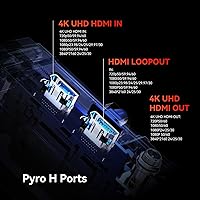
  • HDMI Connectivity: Each unit includes HDMI In, HDMI Out, and HDMI Loopout ports, allowing a camera and a field monitor to remain connected simultaneously.
  • Video Encoding: Uses H.264 video encoding for the wireless transmission signal.
  • Audio Support: Transmits stereo audio in a 2.0 channel configuration alongside the video signal.
  • UVC Streaming: The receiver supports USB Video Class (UVC) output, enabling plug-and-play video input to a computer without a dedicated capture card.
  • Power Options: Compatible with DC power input, Sony NPF-series batteries, and 5V/2A USB-C charging for flexible rig integration.
  • App Compatibility: Pairs with the Hollyview app, available for both iOS and Android devices, for wireless feed monitoring and basic remote adjustments.
  • Kit Contents: Each kit includes one transmitter, one receiver, five dual-band cylindrical antennas, one rotatable cold shoe mount, one USB-C OTG adapter, and a quick-start guide.
  • Dimensions: Each unit measures 8.27 x 5.71 x 2.44 inches including antenna mounts.
  • Connectivity Type: Interfaces exclusively via HDMI; no native SDI input or output is available on either unit.
  • Ecosystem Compatibility: Cross-compatible with other devices in the Hollyland Pyro series, but not backward-compatible with the Mars M1 Enhanced lineup.
  • Warranty: Covered by a one-year manufacturer warranty provided directly by Hollyland.
  • Power Draw (USB-C): USB-C charging operates at 5V/2A; higher-draw power sources are not required but DC and NPF options are recommended for extended sessions.
  • Release Date: First made available for purchase in April 2024.

Related Reviews

PWAYTEK DT257W-H Wireless HDMI Extender
70%
88%
Ease of Setup
54%
Wireless Range — Indoors
78%
Wireless Range — Outdoors
71%
Video Quality — Output
57%
Latency & Sync
More
Hollyland Cosmo C1 Wireless Video Transmission System
79%
91%
Signal Stability
88%
Latency Performance
67%
Real-World Range
83%
UVC Streaming Usability
61%
SDI Loopout Functionality
More
DxInvb Wireless HDMI Transmitter and Receiver Kit
75%
91%
Ease of Setup
58%
Device Compatibility
74%
Wireless Range & Stability
69%
Video Quality
83%
Build Quality & Portability
More
Vrriis WL009 Wireless HDMI Transmitter Receiver Kit
75%
74%
Wireless Range Performance
71%
Signal Stability
82%
Video Quality
67%
Latency
89%
Ease of Setup
More
Kihoplly DT269W-H Wireless HDMI Transmitter and Receiver
77%
93%
Ease of Setup
74%
Signal Stability
71%
Video Output Quality
68%
Wireless Range
67%
Latency Performance
More
BRAIDOL G03 Wireless HDMI Transmitter and Receiver
83%
88%
Value for Money
92%
Performance with 1080p
75%
4K Streaming Performance
96%
Ease of Setup
70%
Signal Stability
More
WELUSOPU 1TX+2RX Wireless HDMI Extender Kit
74%
88%
Ease of Setup
74%
Wireless Range
67%
Video Output Quality
79%
Multi-Receiver Sync
81%
Latency Performance
More
EDUP EH-WD9905 Wireless HDMI Transmitter and Receiver
75%
91%
Ease of Setup
78%
Wireless Range (Open Space)
47%
Through-Wall Signal Penetration
83%
Video Quality at 1080p
69%
Latency
More
Lemorele G500 Wireless HDMI Transmitter and Receiver
79%
91%
Ease of Setup
86%
Battery Life
74%
Wireless Range
83%
Video & Audio Quality
78%
Multi-Presenter Switching
More
IOGEAR GWHD11
IOGEAR GWHD11
75%
72%
Signal Stability
84%
Video Quality
61%
Wireless Range
91%
Setup & Ease of Use
83%
Audio Performance
More

FAQ

The box includes one transmitter, one receiver, five antennas, a cold shoe mount, a USB-C OTG adapter, and a quick-start guide — enough to get a basic one-to-one wireless feed running immediately. If you need to send a signal to multiple crew members at once, you will need to purchase additional receivers separately, as only one is included.

Not directly. The Pyro H is HDMI-only on both the transmitter and receiver, so if your camera outputs SDI natively, you would need an SDI-to-HDMI converter in the chain before connecting. That adds a small amount of cost and one more connection point to manage on set.

When you power on the system, it scans the available spectrum across both 2.4GHz and 5GHz and selects whichever channel has the least interference at that moment. You do not need to manually configure frequencies before a shot — the system handles it. On the receiver side, you can also view real-time feedback on channel status if you want to monitor what the system has selected.

It does transmit a genuine 4K signal, but only up to 30fps. If your camera is set to 4K60 or higher, the wireless feed will not match that frame rate — it will top out at 30fps regardless. For most monitoring purposes that is fine, but if you are using the wireless feed for precise high-frame-rate review on set, that limitation is worth knowing upfront.

The Hollyland Pyro H Wireless HDMI Video Transmitter supports up to four receivers simultaneously, but the base kit only ships with one. To run three or four feeds at once, you would need to purchase the additional receiver units separately. The expandability is real — you just have to budget for the extra hardware.
The units are not weather-sealed or rated for rain, dust, or humidity exposure. In dry outdoor conditions they perform well, but for wet or particularly dusty environments you would need to take protective measures — a rain cover or case. Treat them as professional indoor and controlled outdoor gear rather than fully ruggedized field equipment.

For basic tasks — checking the live feed on a phone, basic monitoring — the app works reliably and connects without much hassle. Where it falls short is in advanced control and customization; experienced users often find it does not expose the full range of what the hardware can do. Think of it as a useful convenience feature rather than a fully developed remote control system.

Dense RF environments are where the dual-band Smart Channel Scan earns its keep, but they are also where you are most likely to encounter occasional instability. The system handles interference better than most single-band alternatives, but antenna placement makes a real difference in these conditions. Testing your setup before a critical shoot in a challenging location is strongly recommended.

Yes, in a basic sense — plug the receiver into your laptop via the included USB-C OTG adapter and it registers as a video input device in most streaming software without drivers. It is a genuinely handy shortcut for quick setups. That said, it is not a replacement for a dedicated capture card if you need the highest possible quality or reliability for a professional live broadcast.

The Pyro series is designed to go further, support more receivers simultaneously, and operate more stably in complex RF environments than the Mars lineup. The key practical differences are the multi-receiver capability, the longer transmission range, and the cross-compatibility within the Pyro ecosystem — none of which the Mars series offers at the same level. If you are a solo shooter who only ever needed one monitor feed, the Mars series may still be sufficient; the Pyro H starts to make sense once a crew is involved.

Where to Buy