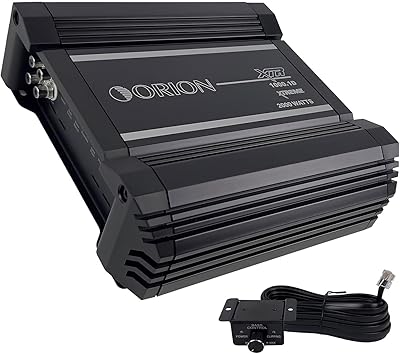
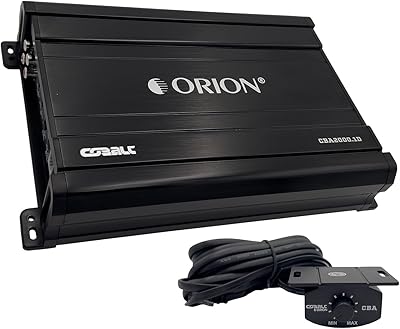
Overview

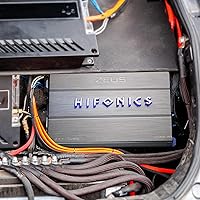
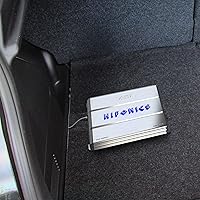
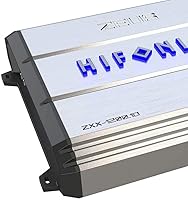
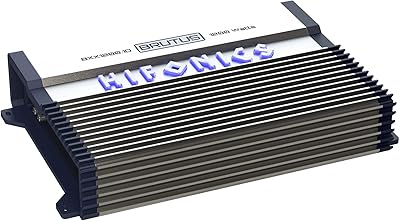
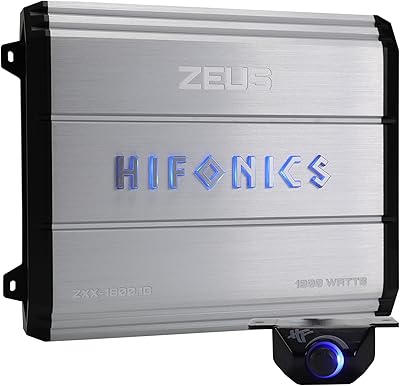
The Hifonics ZXX-1200.1D Monoblock Car Amplifier sits in Hifonics' Zeus ZXX series — a mid-range monoblock lineup built for drivers who take their bass seriously but aren't chasing trophies at competition events. It runs a Class D topology, which means it converts power efficiently and stays cooler during extended listening sessions compared to older Class AB designs. The single-channel configuration makes the purpose clear: this is dedicated subwoofer amplification, full stop. At 12.6 x 2.4 x 10 inches with a clean silver finish, the chassis is compact enough to fit most trunk builds without dominating the space. Honest value is the story here — not flagship performance, but a solid, capable amp at a mid-range price point.
Features & Benefits

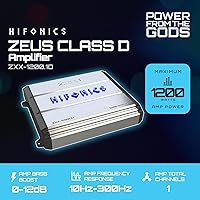
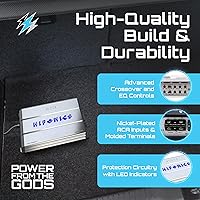
The Class D design is the Zeus ZXX amp's most practical advantage — it draws less current and generates significantly less heat than traditional amplifier classes, which translates to reliable output during long commutes or road trips. Variable low-pass crossover controls let you dial in the exact frequency cutoff to suit your subwoofer and box type, whether that's a sealed or ported enclosure. The included bass knob remote is a small feature that makes a real difference; you can adjust sub levels on the fly without contorting yourself into the trunk. Nickel-plated RCA inputs and hex screw terminals round out a build that handles temperature swings and the occasional rough road without complaint.

Best For

This Class D subwoofer amp is a natural fit for daily driver builds — the kind of setup where you want meaningful bass improvement over stock audio but don't need competition-level output. It works especially well paired with a single 8-inch to 12-inch sub in a sealed or ported box, and the intuitive gain and crossover controls make it approachable for first-time installers. If trunk space is tight, the compact footprint is a genuine advantage. It's also a logical next step for anyone currently running their subwoofer off the head unit's internal power — a dedicated amp channel like this makes a night-and-day difference in both volume and control.

User Feedback

The Zeus ZXX amp holds a 4.4-star rating across a solid volume of reviews, and the overall picture is positive, though not without nuance. Buyers consistently highlight the straightforward installation experience — most report getting everything wired and tuned within a couple of hours, even without prior amp install experience. The responsive bass knob gets frequent mentions as a practical daily-use feature. On the flip side, it's worth knowing that the 1200W figure is a peak rating; real-world RMS output is lower, and a handful of buyers feel the listing could be clearer about that distinction. A small number also mention fitment being tighter than expected in cramped trunk layouts. Long-term reliability feedback, however, trends positive.

Pros

  • Class D design runs efficiently and stays noticeably cooler during long drives compared to older amp classes.
  • Variable low-pass crossover lets you fine-tune bass output to match your specific subwoofer and box combination.
  • The included bass knob remote is a practical, well-built addition that most buyers use daily.
  • Nickel-plated RCA inputs help preserve signal quality from the head unit all the way through the circuit.
  • Hex screw terminals are sturdy and corrosion-resistant — a detail that matters in trunk environments.
  • Installation is genuinely approachable for first-timers; most report a clean setup within a couple of hours.
  • The compact 12.6 x 2.4 x 10-inch footprint fits trunk builds where larger amps simply won't.
  • Long-term reliability reports from buyers are encouraging, with many running the Zeus ZXX amp a year or more without issues.
  • At its price tier, the overall output quality for daily listening far outperforms any head-unit-driven sub setup.
  • Universal vehicle compatibility means fitment concerns are minimal across most car and truck platforms.

Cons

  • The 1200W rating is peak power; actual continuous RMS output is considerably lower and not prominently disclosed.
  • Buyers matching this amp to a subwoofer's RMS spec may find the real-world headroom tighter than expected.
  • A subset of users found the chassis still challenging to position in very cramped or irregularly shaped trunks.
  • Build quality reflects the mid-range price point — the chassis feels solid but lacks the premium feel of higher-end amps.
  • No multi-channel capability; anyone planning to expand their system later will need an additional amp.
  • Advanced protection features are limited compared to more expensive Class D competitors in the market.
  • The wattage marketing can create unrealistic expectations for buyers who don't know to look past peak ratings.
  • Gain-setting without an oscilloscope or multimeter is easy to get wrong, which can lead to distortion at higher volumes.

Ratings

The Hifonics ZXX-1200.1D Monoblock Car Amplifier scores here reflect a rigorous AI-driven analysis of verified global buyer reviews, with spam, bot activity, and incentivized feedback actively filtered out before any scoring was applied. The result is an honest, balanced picture of where this Class D subwoofer amp genuinely delivers and where real buyers have run into friction. Both the strengths that keep customers satisfied and the recurring pain points that generate negative feedback are transparently represented in every category below.
Value for Money
88%
Most buyers feel they got significantly more amplifier than the price tag suggests, particularly those stepping up from a head-unit-powered subwoofer for the first time. The combination of Class D efficiency, included bass remote, and variable crossover in this price bracket is hard to match from competing brands.
A portion of buyers who assumed the peak wattage figure was continuous RMS felt the value proposition eroded once they understood the actual sustained output. Managing that expectation gap upfront would solidify this score considerably.
Bass Output Quality
83%
For daily commuting and casual listening, the Zeus ZXX amp delivers tight, clean bass that makes a genuine and immediate difference compared to stock audio. Buyers running it with a 10-inch or 12-inch sub in a sealed box consistently describe the low-end response as punchy and well-controlled.
Listeners who pushed the amp harder at higher volumes occasionally noted that the bass lost some definition and started to sound less precise — a limitation more tied to the mid-range power ceiling than any specific circuit flaw, but noticeable for critical listeners.
Ease of Installation
91%
This is consistently one of the most praised aspects across buyer feedback — first-time installers routinely describe completing the full wiring and setup within a couple of hours without professional help. The labeled terminals, logical layout, and included bass knob wiring all reduce the guesswork that usually trips up beginners.
A small but recurring group of buyers found the gain and crossover knobs physically close together on the chassis, making fine adjustments slightly fiddly, especially in tight trunk environments where visibility is limited.
Thermal Management
86%
Class D topology gives this Hifonics monoblock a real-world thermal advantage over older amp classes — buyers who run it during long highway drives or in warm climates report consistent output without thermal shutoff cutting their music mid-session.
A minority of buyers who installed the amp in poorly ventilated spaces — directly against carpet or inside enclosed under-seat cavities — did experience occasional heat-related shutoffs, suggesting the chassis relies on ambient airflow more than aggressive onboard cooling.
Build Quality
74%
26%
The hex screw terminals feel sturdy and hold wire connections firmly without loosening over time, which buyers running the amp through hot summers and cold winters have particularly appreciated. The silver chassis has a clean, professional appearance that fits well in a visible trunk install.
Beyond the terminals, the overall chassis feel is firmly mid-range — some buyers noted the casing feels slightly lightweight compared to higher-priced competitors, and a few reported cosmetic finish inconsistencies out of the box that, while not affecting performance, did affect first impressions.
Signal Clarity
81%
19%
The low-noise preamp circuitry with nickel-plated RCA inputs does meaningful work here — buyers connecting the amp to mid-range head units consistently report a clean, hiss-free signal, even at moderate gain settings. The absence of background noise at idle is a frequently mentioned positive.
Buyers using budget-tier head units with weak preamp output, or those who set the gain aggressively without proper calibration, occasionally reported a faint hiss or mild distortion at the top of the volume range — an issue more about system matching than the amp itself.
Crossover Flexibility
79%
21%
The variable low-pass crossover gives installers a practical tuning range that works across most common subwoofer and enclosure combinations, letting buyers dial in the frequency cutoff without needing an external processor for basic setups.
Experienced installers noted that the crossover range, while adequate for everyday builds, lacks the precision sweep and additional subsonic filter options that more advanced or competition-oriented amplifiers offer at higher price points.
Bass Knob Remote
89%
The included wired bass remote is one of the most talked-about practical features in buyer feedback — drivers love being able to cut sub output at a traffic stop or crank it up on the highway without ever touching the amp in the trunk. The rotary feel is smooth and the control range is wide enough to be genuinely useful.
The supplied cable length works for most sedans and small SUVs, but buyers in larger vehicles or those with complex routing paths through the cabin occasionally found it just barely long enough, requiring careful planning during installation.
Long-Term Reliability
82%
18%
A meaningful number of reviewers specifically mentioned coming back months or over a year later to report the amp was still performing exactly as it did on day one — an encouraging signal for a mid-range unit used in the demanding thermal cycle of a car trunk.
There is a smaller cluster of buyers who reported failure within the first few months, typically linked to either installation errors or pairing the amp with a mismatched subwoofer load — making proper setup critical to long-term durability outcomes.
Wattage Transparency
58%
42%
Buyers who did their research before purchasing and understood the peak-versus-RMS distinction were largely satisfied with the actual sustained output relative to their expectations. For informed shoppers, the real power delivery is a reasonable match for a mid-range daily driver setup.
This is one of the most consistent friction points across negative reviews — the 1200W peak marketing creates expectations that the actual continuous RMS output cannot meet, and buyers who matched subwoofers based on the peak figure often felt the amp underperformed. More transparent power labeling would improve buyer trust meaningfully.
Physical Fitment
76%
24%
At 12.6 x 2.4 x 10 inches, the Zeus ZXX amp fits comfortably in the majority of trunk builds, including many compact cars, which is not a given for amplifiers in this power class. Buyers with moderate trunk space consistently found mounting positions without difficulty.
A recurring minority of buyers — particularly those with compact sedans that have shallow or irregularly shaped trunk floors — found the dimensions just large enough to cause fitment headaches, especially when a subwoofer enclosure was already claiming most of the available floor space.
Compatibility
87%
The universal vehicle designation holds up well in practice — buyers across a wide range of makes and models, from hatchbacks to full-size trucks, report clean integration with their existing electrical systems and no unusual compatibility issues with standard 12V setups.
Buyers with factory-installed Bose, Harman, or other premium OEM audio systems sometimes needed additional signal processing equipment such as a line output converter or DSP to get a clean input signal, adding cost and complexity that was not immediately obvious at purchase.
Packaging & Unboxing
72%
28%
The amp arrives securely packed in the majority of cases, and most buyers report the unit and included accessories arriving intact without shipping damage — a basic but important benchmark for a product with exposed terminals and a rigid chassis.
A few buyers noted that the included documentation is minimal and the quick-start guidance for gain setting and crossover adjustment is too sparse for true beginners, leaving newcomers to rely on YouTube tutorials for what should be covered in the box.

Suitable for:

The Hifonics ZXX-1200.1D Monoblock Car Amplifier is a strong match for everyday drivers who want a meaningful bass upgrade without committing to a high-end audio budget. It's particularly well-suited to first-time amp installers — the controls are intuitive, the wiring layout is logical, and you don't need a shop full of tools to get it running cleanly. If you're pairing it with a single 8-inch to 12-inch subwoofer in a sealed or ported box, the variable low-pass crossover gives you enough flexibility to tune the output to your enclosure without guesswork. The compact chassis is a real advantage for builds where trunk real estate is limited, and the included bass knob remote means you can adjust your sub level from the driver's seat instead of crawling into the boot every time. Buyers stepping up from a head-unit-powered subwoofer will notice the difference immediately — a dedicated amplifier channel just hits differently.
Not suitable for:

The Hifonics ZXX-1200.1D Monoblock Car Amplifier is not the right tool for listeners chasing competition-level SPL output or who need sustained high-power performance across multiple subwoofers. The 1200W figure is a peak rating, and buyers who need to plan a system around verified RMS continuous power will want to research the actual RMS spec carefully before purchasing — the gap between peak and RMS matters when matching an amp to a subwoofer's continuous power handling. Audiophiles who prioritize premium build quality, advanced protection circuitry, or multi-channel flexibility should look further up the price ladder. If your install space is extremely tight — think a cramped sedan trunk with no room to maneuver — a minority of users have flagged that the physical footprint, while compact for its class, can still be a challenge. And if you're running two subwoofers or a full multi-driver setup, a single-channel monoblock simply isn't the right architecture for the job.
Specifications

  • Amplifier Type: Single-channel Class D monoblock design, optimized exclusively for subwoofer amplification in automotive applications.
  • Peak Power: Rated at 1200W maximum peak output at 14.4V DC; continuous RMS power is lower and should be verified against your subwoofer's RMS handling spec.
  • Channels: Single channel (1-channel monoblock), with no multi-channel capability.
  • Supply Voltage: Operates at a maximum supply voltage of 14.4V DC, compatible with standard 12V automotive electrical systems.
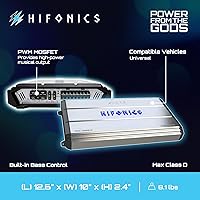
  • Dimensions: The chassis measures 12.6 x 2.4 x 10 inches, providing a relatively compact footprint suited to trunk installations.
  • Mounting Type: Through-hole mounting design, allowing the unit to be secured directly to a mounting surface using standard hardware.
  • Signal Inputs: Nickel-plated RCA inputs are included to minimize corrosion and reduce signal degradation between the head unit and amplifier stage.
  • Terminals: Hex screw power and speaker terminals are constructed to resist corrosion and impact, suitable for environments with temperature variation.
  • Crossover: Variable low-pass crossover filter is built in, allowing the installer to set the frequency cutoff to match the subwoofer and enclosure type.
  • Bass Remote: A wired bass knob remote is included in the box, enabling driver-seat adjustment of subwoofer output level without accessing the amplifier directly.
  • Preamp Circuit: Low-noise preamplifier circuitry is integrated to preserve signal integrity when receiving a low-voltage signal from the source unit.
  • Finish: The unit features a silver-finish chassis with a clean, utilitarian appearance typical of the Zeus ZXX series.
  • Series: Part of the Hifonics Zeus ZXX mid-range monoblock lineup, positioned between entry-level and competition-grade amplifier tiers.
  • Vehicle Fit: Listed as universally compatible, meaning it is not designed for a specific vehicle make or model and can be installed in most passenger cars and trucks.
  • Model Number: The official model identifier is ZXX-1200.1D, which corresponds to the Zeus ZXX series 1-channel monoblock variant.
  • Brand: Manufactured and sold by Hifonics, a brand with a long history in the consumer car audio amplifier market.

Related Reviews
Hifonics Zeus ZXX 1800 Watt Monoblock Car Audio Amplifier
86%
88%
Performance
90%
Build Quality
85%
Ease of Installation
89%
Heat Management
84%
Sound Clarity
More
Hifonics BXX1200.1D Mono Car Subwoofer Amplifier
79%
88%
Power Output Accuracy
91%
Thermal Management
86%
1-Ohm Stability
79%
Ease of Installation
74%
Build Quality
More
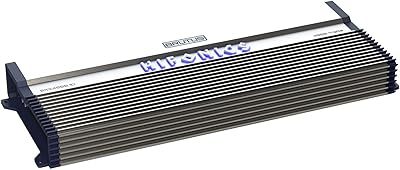
Hifonics ZD-1950.1D Mono Car Amplifier
76%
78%
Power Output
61%
Heat Management
86%
Ease of Installation
74%
Build Quality
79%
Value for Money
More
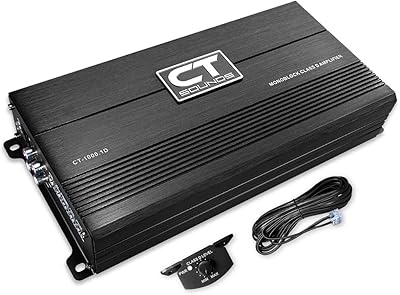
Hifonics BXX4000.1D Brutus 4000W RMS Mono Car Amplifier
86%
94%
Power Output
93%
Bass Performance
88%
Build Quality
86%
Ease of Installation
72%
Thermal Performance
More
CT Sounds CT-2000.1D Monoblock Amplifier
77%
88%
Value for Money
74%
Power Output
71%
Build Quality
69%
Thermal Management
86%
Ease of Installation
More
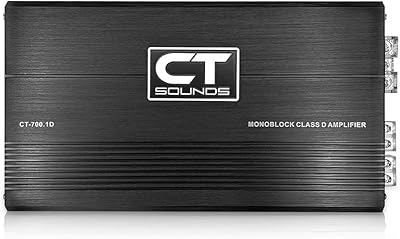
CT Sounds CT-1000.1D Monoblock Car Amplifier
77%
88%
Value for Money
79%
Power Output
84%
Thermal Management
72%
Build Quality
71%
Installation Ease
More
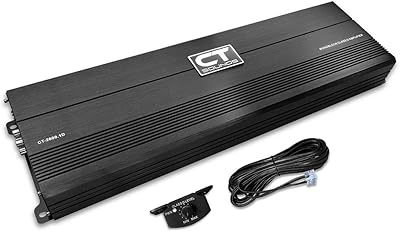
CT Sounds CT-700.1D Monoblock Amplifier
80%
91%
Value for Money
88%
Bass Output
86%
Thermal Performance
87%
Ease of Installation
74%
Build Quality
More
Orion XTR1000.1D Monoblock Class D Car Amplifier
79%
83%
Power Output Accuracy
88%
Bass Performance
61%
Thermal Management
79%
Build Quality
86%
Ease of Installation
More
Planet Audio AC4000.1D Monoblock Car Amplifier
77%
88%
Value for Money
79%
Power Output
82%
Thermal Management
67%
Build Quality
63%
Installation Experience
More
Orion CBA2000.1D Monoblock Car Amplifier
72%
83%
Value for Money
78%
Bass Output
41%
Power Accuracy
62%
Thermal Management
59%
Build Quality
More

FAQ

For an amp in this power class, a 4-gauge power and ground wire is the standard recommendation and will handle the current draw without voltage drop issues. Make sure to run the power wire through a fuse holder close to the battery — 60A to 80A is a reasonable fuse rating for this application. Using undersized wire is one of the most common installation mistakes and can cause the amp to clip or shut down under load.

That 1200W figure is the peak or maximum rating, not the continuous RMS output. RMS is the number that actually matters when matching an amp to a subwoofer, because it reflects sustained power delivery rather than a momentary spike. Before purchasing, verify the actual RMS spec from Hifonics directly and compare it against your subwoofer's RMS power handling to make sure they're in the same ballpark.

Technically you could connect a full-range speaker to a monoblock, but it's not what this amp is designed for. The built-in low-pass crossover is meant to roll off higher frequencies and send only bass to the output — running full-range speakers through it would result in a muffled, bass-heavy sound. For door speakers or tweeters, you'd want a dedicated multi-channel amp instead.

The easiest method without test equipment is to set your head unit to about 75 to 80 percent of its maximum volume, play a bass-heavy track, and slowly turn the gain up on the amp until you hear the bass start to distort, then back it off slightly. If you want to be precise, using a multimeter or a basic oscilloscope to match the amp's input sensitivity to your head unit's output voltage is a better long-term approach and protects your subwoofer from clipping damage.

Yes, it can work with a factory head unit as long as the head unit has preamp RCA outputs. If your factory radio doesn't have RCA outputs, you'll need a line output converter (LOC) to step the speaker-level signal down to a preamp-level signal before it hits the amp's RCA inputs. This is a very common setup and an LOC is an inexpensive addition to the install.

A single 8-inch to 12-inch subwoofer is the sweet spot for the Zeus ZXX amp in terms of output and control. Impedance-wise, check the amp's RMS power ratings at both 2-ohm and 4-ohm loads and match that to your subwoofer's wiring configuration — most single-sub installs run at 4 ohms, though dual voice coil subs wired in parallel can bring the load down to 2 ohms for more output.

Class D amplifiers run significantly cooler than Class A or Class AB designs, and the general consensus from long-term owners is that thermal shutoff is not a common problem with this unit under normal conditions. That said, make sure the amp has adequate airflow around it — don't mount it flat against carpet or inside a sealed compartment with no ventilation. A few inches of clearance on all sides goes a long way.

The bass knob remote plugs directly into a dedicated port on the amp and typically comes with enough cable length for most installs. Routing it to the front of the cabin does require feeding the cable through the interior, which takes some patience, but it's a straightforward job. Once in place, buyers consistently find it responsive and smooth — it's one of the more positively received aspects of the overall package.

This is already a monoblock — it has a single output channel by design, so bridging as you would with a stereo amp doesn't apply here. If you want to run two subwoofers, you can wire them both to this amp's single channel, but you'll need to make sure the combined impedance load stays within the amp's rated range. Running two 4-ohm subs in parallel, for example, would drop the load to 2 ohms, so confirm the amp's 2-ohm stability before doing that.

At 12.6 x 2.4 x 10 inches, this Class D subwoofer amp is on the compact side for its power class, and most buyers find it manageable in standard trunk setups. However, a small number of users with very cramped trunks — particularly in compact sedans where the spare tire well takes up most of the usable floor space — have found positioning tricky. Measuring your available mounting area before ordering is always a smart move.