Overview

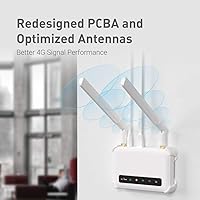
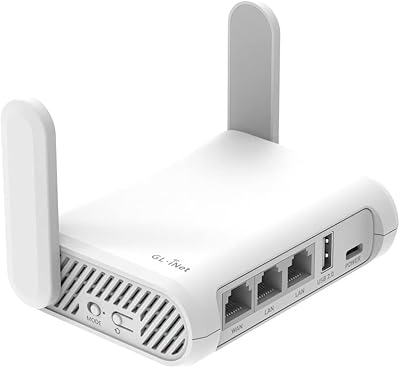
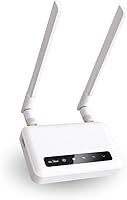
The GL.iNet Spitz GL-X750V2 4G LTE Router is a compact cellular router built for mobile users, RV travelers, and remote workers who need dependable internet without a fixed broadband connection. The V2 is not just a cosmetic refresh — GL.iNet redesigned the circuit board and improved the antenna layout specifically to strengthen performance in rural and fringe-coverage areas. It carries AT&T IoT certification and works with T-Mobile, which gives it genuine carrier credibility rather than just claimed compatibility. Weighing under 90 grams, it travels easily. Expect real-world speeds of 15–20 Mbps under typical LTE conditions — perfectly workable for video calls and remote tasks, though not a replacement for fiber.
Features & Benefits

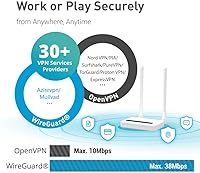
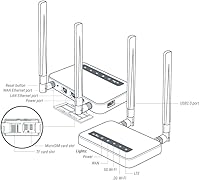
The Spitz V2 runs on a Quectel CAT4 LTE modem and distributes that signal across dual-band Wi-Fi — 2.4GHz for range and 5GHz for speed — making it flexible for both older and newer devices. Both OpenVPN and WireGuard come pre-installed, so you can route every connected device through a VPN without adjusting individual settings. Casual users will appreciate the clean GL.iNet admin panel; technically inclined users can dig into OpenWrt to install packages, write scripts, or build automation workflows. The microSD slot handles up to 128GB, and the two detachable SMA antennas can be swapped for higher-gain models when you need to pull in a weaker signal.

Best For

This LTE router was clearly designed with specific use cases in mind, not general home networking. It is a natural fit for RV and van-life travelers who want to stop depending on unreliable campground Wi-Fi, and equally useful for field technicians or workers in areas where wired broadband simply is not an option. Anyone who wants network-level VPN coverage — meaning every device on the network is automatically protected — will find real value here. IoT developers get an open-source, programmable gateway for sensor prototyping. It also works well as a failover backup connection for home or small office setups when the primary internet drops unexpectedly.

User Feedback

Across several hundred reviews, the GL-X750V2 holds a steady 4-star average, and the feedback patterns are fairly predictable. Buyers consistently praise the straightforward initial setup through the GL.iNet web interface and the reliable AT&T connectivity, with VPN integration earning particular appreciation from privacy-focused users. On the downside, the 100Mbps Ethernet ceiling frustrates buyers who expected gigabit wired speeds, and the absence of a built-in battery is a genuine limitation compared to some competing travel routers. A portion of T-Mobile users mention needing to manually configure APN settings and band locking to get stable performance. OpenWrt customization excites tinkerers but can feel like a steep learning curve for less technical owners.

Pros

  • AT&T IoT certification means tested, dependable connectivity — not just claimed compatibility.
  • Both WireGuard and OpenVPN come pre-installed, covering every device on the network automatically.
  • The V2 redesign meaningfully improves rural signal pickup compared to the original Spitz.
  • Weighing under 90 grams, the GL-X750V2 packs easily without adding bulk to a travel setup.
  • Detachable SMA antennas can be swapped for higher-gain models when signal conditions are poor.
  • OpenWrt unlocks serious customization for developers, including scripting and package installation.
  • MicroSD slot supports up to 128GB, useful for IoT data logging without cloud dependency.
  • The GL.iNet admin panel makes initial setup accessible even for users without a networking background.
  • Dual-band Wi-Fi handles multiple connected devices simultaneously without noticeable congestion.
  • Works as a reliable failover backup when a primary home or office broadband connection drops.

Cons

  • Both Ethernet ports cap at 100Mbps — a genuine limitation for high-bandwidth wired use cases.
  • No built-in battery means the router cannot operate independently without an external power source.
  • T-Mobile band locking is inconsistent and often requires manual APN configuration to resolve.
  • The CAT4 modem standard limits maximum throughput, making it unsuitable as a primary connection for demanding workflows.
  • Onboard flash storage is only 16MB, which restricts how many OpenWrt packages can be installed natively.
  • Plastic casing has no dust or moisture resistance rating, a real gap for outdoor and vehicle deployments.
  • Advanced troubleshooting quickly pushes users into the OpenWrt backend, which has a steep learning curve.
  • Restricted to North America — the modem is locked out of several countries entirely.
  • Real-world speeds vary significantly by carrier and location, with no guarantee of consistent performance.
  • Community forums often fill the gap that thin official documentation leaves, which is frustrating for non-technical users.

Ratings

The GL.iNet Spitz GL-X750V2 4G LTE Router has been scored by our AI system after processing hundreds of verified global buyer reviews, with spam, bot activity, and incentivized feedback actively filtered out. The ratings below reflect where this cellular router genuinely excels and where real users have run into frustration — no sugar-coating on either side.
LTE Connectivity & Signal Reliability
83%
The V2 antenna redesign makes a noticeable difference in rural and semi-remote areas where the original Spitz struggled. AT&T users in particular report stable connections during long RV trips through patchy coverage zones, with the router holding onto a usable signal where phones would drop to one bar.
T-Mobile performance is more hit-or-miss. Several users report that the router does not always lock onto the optimal band automatically, requiring manual APN configuration to get consistent speeds — something a non-technical buyer may not know how to do.
Wi-Fi Performance
74%
26%
Dual-band output works well for the typical use case: a handful of devices streaming, video calling, or browsing simultaneously. The 5GHz band handles closer devices cleanly, and range across a mid-size RV or small office space is generally adequate without signal dead zones.
This is a cellular-grade Wi-Fi router, not a home mesh replacement. Users expecting strong throughput across a large space or through thick walls will find the coverage limiting. The underlying CAT4 LTE ceiling also means Wi-Fi speed is only as good as the cellular signal feeding it.
VPN Integration
91%
Having both OpenVPN and WireGuard baked into the firmware is a genuine differentiator. Users working remotely from hotels, RV parks, or offshore sites consistently praise how straightforward it is to connect to a VPN service and have every device on the network covered automatically — no per-device setup needed.
WireGuard configuration still requires some technical comfort, and users relying on less common VPN providers occasionally run into compatibility gaps despite the claimed 30-plus provider support. Beginners sometimes need to consult community forums to get their specific VPN working correctly.
Setup & Ease of Use
78%
22%
The GL.iNet admin panel is one of the cleaner router interfaces available at this price point. Most users — even those with limited networking experience — report getting the router online and distributing Wi-Fi within 15 to 20 minutes of unboxing, which is a reasonable bar for a device with this level of functionality.
The easy setup experience ends fairly quickly if anything goes wrong or if you want to do anything beyond the basics. T-Mobile band locking, custom DNS, and VPN troubleshooting all push users toward the OpenWrt backend, which is a significantly steeper environment to navigate.
OpenWrt Customization
88%
For developers, network tinkerers, and IoT builders, OpenWrt pre-installed on a certified LTE router is a compelling combination. The software package repository is broad, and users have built everything from automated failover scripts to custom IoT data pipelines on top of this hardware.
For buyers who just want a plug-and-play cellular router, OpenWrt is mostly irrelevant — and its presence can add confusion when troubleshooting. The firmware is powerful but not forgiving; an incorrect configuration can take the device offline in ways that require a factory reset to fix.
Ethernet Port Performance
54%
46%
Two Ethernet ports give the GL-X750V2 more flexibility than single-port competitors, allowing it to serve as both a WAN input and a direct wired connection simultaneously. For low-bandwidth wired tasks like connecting a desktop or a network printer, the ports work reliably.
The 100Mbps cap on both ports is a real limitation that frustrates buyers who anticipated gigabit wired speeds. Anyone transferring large files over Ethernet or running wired connections for video production will feel the ceiling immediately. It is one of the clearest hardware compromises on the device.
Build Quality & Portability
81%
19%
At under 90 grams and with a compact footprint, the Spitz V2 is genuinely portable in a way that many LTE routers are not. The casing feels solid enough for travel use, and the detachable SMA antennas fold down to reduce the chance of breakage in a bag or storage compartment.
The plastic enclosure does not inspire premium confidence, and there is no IP rating for dust or moisture resistance — a notable omission for a device marketed toward outdoor and vehicle-based use. A few users mention the antenna connectors feeling slightly loose after extended use.
Battery & Power Flexibility
41%
59%
The included power adapter and standard USB power input mean the router can run off a USB power bank in a pinch, which some RV and van-life users appreciate as a workaround for mobile power setups when 12V adapters are available.
There is no built-in battery, which is a straightforward disadvantage compared to rivals like the GL-E750 Mudi. Buyers who need a router that operates independently for hours without a power source will need to factor in an external battery, adding cost and complexity to the setup.
Carrier Compatibility & Certification
79%
21%
AT&T IoT certification is more than a marketing badge — it means the device has been tested to AT&T standards and is eligible for official AT&T IoT data plans. For businesses deploying this in field equipment or remote monitoring setups, that certification matters for support and contract eligibility.
Coverage is limited to North America, and the modem is locked out of several countries entirely due to hardware restrictions. Buyers outside the US looking for a globally compatible LTE router will need to look elsewhere, and even within North America, performance outside AT&T and T-Mobile networks is untested.
Storage & Expandability
76%
24%
The microSD slot supporting up to 128GB is a useful addition for IoT use cases where local data logging matters — think sensors pushing readings to a card rather than requiring constant cloud connectivity. The USB 2.0 port also allows connection of a flash drive or modem dongle for additional flexibility.
The onboard flash storage is minimal at 16MB, which constrains how many OpenWrt packages can be installed natively without relying on external storage. Users who want to run multiple custom applications simultaneously will hit this ceiling faster than expected.
Real-World Speed Performance
69%
31%
In locations with strong AT&T LTE coverage, the GL-X750V2 delivers consistent throughput that handles video conferencing, cloud file access, and standard web use without interruption. Users in rural areas often find it outperforms expectations given the signal conditions they are working with.
Speeds are fundamentally capped by the CAT4 modem standard, which maxes out well below what CAT6 or 5G devices can achieve. In congested urban areas or during peak hours, real-world performance can dip noticeably below the 15 to 20 Mbps typical range, making it less reliable as a primary connection for demanding workflows.
Value for Money
77%
23%
For a device that combines certified LTE connectivity, dual-band Wi-Fi, built-in VPN support, and an open-source firmware platform, the price point sits in a reasonable range. Buyers who need all of those features together would pay significantly more assembling separate solutions.
The value calculation changes depending on the buyer. For someone who only needs basic cellular Wi-Fi sharing, cheaper alternatives exist. The GL-X750V2 earns its price through its feature depth, but buyers who will not use VPN routing, OpenWrt, or IoT features are essentially paying for capabilities they will ignore.
Documentation & Support
66%
34%
GL.iNet maintains an active community forum and a reasonably detailed online documentation library. For OpenWrt-related questions especially, community threads often surface practical fixes faster than official support channels, and the brand has a reputation for engaging with technical users.
The included printed manual is thin and does not cover intermediate or advanced configuration scenarios. New users troubleshooting T-Mobile band issues or VPN misconfigurations often have to piece together answers from multiple forum threads, which can be time-consuming and frustrating without prior networking knowledge.
Antenna Upgrade Potential
82%
18%
The detachable SMA connectors mean buyers in weak signal areas are not stuck with factory antenna performance. Upgrading to a directional or higher-gain external antenna is straightforward and well-documented, and several users in fringe coverage areas report meaningful signal improvements after swapping antennas.
The base antennas that ship with the unit are adequate but not exceptional. Users in strong-signal urban environments will not notice any need to upgrade, but those in the marginal-coverage scenarios this router is specifically marketed for may find themselves spending extra to get the performance the product implies out of the box.

Suitable for:

The GL.iNet Spitz GL-X750V2 4G LTE Router was built for a specific kind of buyer, and if you fall into that category, it is a genuinely strong pick. RV travelers and van-lifers who have grown tired of unreliable campground Wi-Fi will find it particularly practical — it converts an AT&T or T-Mobile SIM into shared Wi-Fi for multiple devices without any complicated setup. Remote workers stationed in rural areas, on job sites, or offshore where fixed broadband is simply not an option will also get real mileage out of it, especially given its AT&T IoT certification which signals tested, reliable connectivity rather than just claimed compatibility. Privacy-focused users who want every device on their network routed through a VPN automatically — rather than configuring each phone, laptop, and tablet individually — will appreciate the pre-installed WireGuard and OpenVPN support. IoT developers and network tinkerers get the added benefit of OpenWrt, which turns this compact router into a programmable gateway capable of running custom scripts, automated workflows, and sensor-data pipelines. It also makes a practical emergency backup for home or small-office setups when a primary broadband connection goes down.

Not suitable for:

The GL.iNet Spitz GL-X750V2 4G LTE Router has clear limitations that will frustrate certain buyers, and it is worth being direct about them. If you need fast wired Ethernet speeds for tasks like large file transfers, network-attached storage, or video production workflows, the 100Mbps port ceiling will be a persistent source of disappointment — this is a hard hardware constraint, not something firmware updates can fix. Buyers comparing this against travel routers with built-in batteries should know the Spitz V2 has no internal power source, meaning it needs a wall outlet or external battery pack to function, which adds both cost and inconvenience in mobile scenarios. T-Mobile users in particular should go in with tempered expectations — inconsistent band locking means some users need to manually configure APN settings to get stable performance, and that requires a degree of networking knowledge the average buyer may not have. Anyone looking for a straightforward plug-and-play experience with no technical involvement beyond initial setup may eventually feel out of their depth if anything goes wrong. This is also a North America-only device, so international travelers or buyers outside the US will need to look elsewhere.

Specifications

  • Modem Module: Uses the Quectel EC25-AFFA CAT4 LTE modem, which supports download speeds up to 150 Mbps and upload speeds up to 50 Mbps under ideal conditions.
  • Carrier Support: Officially compatible with AT&T (IoT certified) and T-Mobile in North America; not supported in Russia, Belarus, Cuba, Iran, North Korea, Syria, or the Crimean Peninsula.
  • Wi-Fi Bands: Dual-band Wi-Fi covers 2.4GHz at up to 300 Mbps and 5GHz at up to 433 Mbps, conforming to the 802.11ac standard.
  • Processor: Powered by a Qualcomm QCA9531 SoC running at 650MHz, which handles routing, VPN encryption, and OpenWrt tasks concurrently.
  • Memory: Equipped with 128MB of DDR2 RAM and 16MB of NOR Flash storage for the operating system and installed packages.
  • Storage Expansion: A microSD card slot supports cards up to 128GB, suitable for extended data logging, IoT payloads, or additional OpenWrt package storage.
  • SIM Card Type: Accepts a standard Micro SIM card; nano SIM users will need a physical adapter, which is not included in the box.
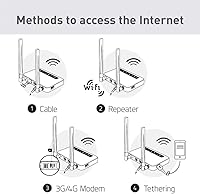
  • Ethernet Ports: Two 10/100Mbps Fast Ethernet ports allow simultaneous WAN input and direct wired device connection, though neither port supports gigabit speeds.
  • Antennas: Two detachable external SMA antennas are included; the standard connectors allow replacement with higher-gain third-party antennas for weak-signal environments.
  • USB Port: One USB 2.0 port supports peripheral connections such as flash drives or compatible USB modems for additional connectivity options.
  • Firmware: Ships with OpenWrt/LEDE pre-installed, providing access to a large open-source software repository and full root-level customization.
  • VPN Support: OpenVPN and WireGuard are pre-installed and compatible with more than 30 commercial VPN providers, enabling network-wide privacy routing out of the box.
  • Dimensions: The unit measures 115 x 74 x 22mm, making it compact enough to fit in a jacket pocket or small travel pouch.
  • Weight: The router weighs 86g without packaging, one of the lighter options in the portable LTE router category.
  • Power Source: Powered via the included US-plug AC adapter; there is no internal battery, so a wall outlet or external USB power bank is required for operation.
  • IPv6 Support: Full IPv6 support is included, ensuring compatibility with modern carrier networks and future-proofed network configurations.
  • EAP Support: Extensible Authentication Protocol (EAP) is supported, enabling enterprise-grade Wi-Fi authentication for corporate or security-sensitive deployments.
  • Warranty: GL.iNet provides a 2-year manufacturer warranty covering hardware defects under normal use conditions.
  • Box Contents: The package includes the router, a US-plug power adapter, one Ethernet cable, and a printed user manual.
  • Regional Restriction: This device is designed exclusively for North American use and is not authorized or configured for cellular operation in several sanctioned or restricted countries.

Related Reviews
GL.iNet GL-XE300 Puli 4G LTE IoT Gateway
77%
88%
4G LTE Connectivity & Failover
91%
OpenWrt Flexibility & Customization
84%
VPN Performance & Setup
76%
Battery Life & Portability
58%
Wi-Fi Speed & Coverage
More
GL.iNet GL-X3000 Spitz AX
82%
88%
Cellular Signal Performance
91%
Dual-SIM & Failover Reliability
84%
Wi-Fi 6 Local Network Speed
82%
VPN Performance
86%
Setup & Initial Configuration
More
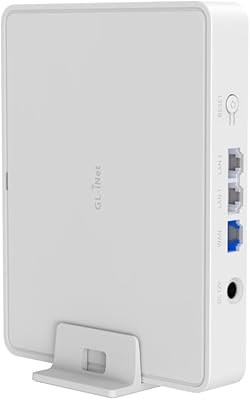
GL.iNet GL-X300B (Collie) 4G LTE VPN Industrial Wireless Gateway
85%
92%
Value for Money
88%
Connectivity Reliability
85%
Ease of Setup
90%
Build Quality
91%
Performance in Harsh Environments
More
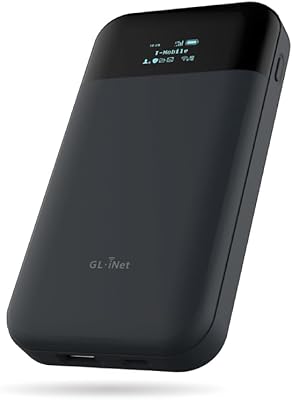
GL.iNet GL-E750V2 4G LTE Mobile Hotspot
74%
88%
VPN Performance
84%
Build Quality
51%
Setup & Ease of Use
63%
Battery Life
72%
LTE Connectivity
More
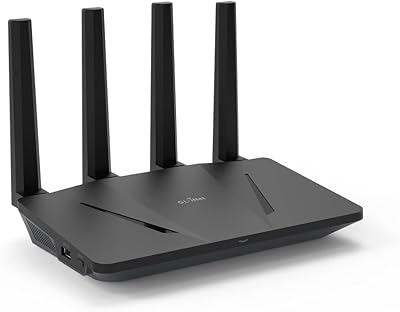
GL.iNet GL-AX1800 Flint WiFi 6 Router
79%
93%
VPN Performance
91%
Firmware Flexibility
74%
Wireless Speed & Range
58%
Ease of Setup
89%
Wired Connectivity
More
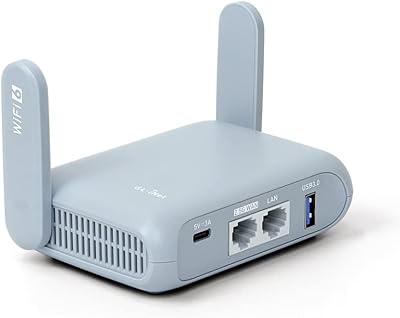
GL.iNet GL-A1300 Slate Plus Travel Router
78%
83%
VPN Performance
88%
Ease of Setup
91%
Portability & Form Factor
76%
Wireless Speed & Range
79%
Build Quality
More
GL.iNet GL-B3000 Marble WiFi 6 Router
86%
88%
Performance
91%
Setup & Installation
85%
Security Features
80%
Parental Controls
94%
Design & Aesthetics
More
GL.iNet GL-MT3000 Beryl AX
81%
91%
VPN Performance
93%
Portability & Form Factor
88%
Security Features
67%
Ease of Initial Setup
82%
Wi-Fi Speed & Range
More
GL.iNet GL-SFT1200 Opal
80%
88%
Ease of Setup
84%
VPN Performance
93%
Portability & Form Factor
67%
Wi-Fi Range & Coverage
79%
Build Quality
More
GL.iNet GL-BE3600 Slate 7
84%
91%
Touchscreen Interface
78%
VPN Performance
93%
Portability & Form Factor
74%
Setup & Ease of Use
82%
Wi-Fi Speed & Range
More

FAQ

It is specifically designed and tested for AT&T and T-Mobile in North America. While some MVNOs that run on those networks may work, there is no official support for them, and you may need to configure APN settings manually. Using a carrier outside those two networks is genuinely hit-or-miss, and GL.iNet does not guarantee compatibility.

In real-world conditions, most users see somewhere between 15 and 20 Mbps on a solid AT&T or T-Mobile signal. That is more than enough for video calls, remote desktop sessions, and standard streaming. Do not expect the theoretical CAT4 ceiling of 150 Mbps — that figure assumes perfect lab conditions that almost never exist in the field.

Basic setup is straightforward — insert a SIM, plug in power, connect to the Wi-Fi network, and follow the GL.iNet web panel prompts. Most users are up and running in under 20 minutes. The complexity only comes in if you want to configure a VPN, change bands manually, or dig into OpenWrt, which are optional steps that casual users can skip entirely.

Yes, and it works well for that purpose. You can connect the Spitz V2 to your existing home network and set it to act as a failover when the primary connection drops. Some users keep an active SIM in it specifically for this scenario, so there is no scramble to configure it during an outage.

The GL.iNet admin panel has a dedicated VPN section where you can paste in your provider credentials and enable either OpenVPN or WireGuard with a few clicks. Once the VPN is active at the router level, every device connected to that Wi-Fi network is automatically routed through it without any per-device configuration. WireGuard is noticeably faster than OpenVPN on this hardware, so that is the better choice if your VPN provider supports it.

Yes, both antennas use standard SMA connectors, which means you can swap them for higher-gain or directional antennas available from third-party suppliers. This is actually one of the more practical upgrades for users in fringe coverage areas, and the GL.iNet community has documented several antenna setups that noticeably improve rural performance.

It does not have a built-in battery. It needs constant power from either the included AC adapter or an external USB power bank. If you are comparing this to something like the GL-E750 Mudi, which has a 7000mAh internal battery, that is a meaningful difference to factor in for purely mobile or off-grid use.

T-Mobile connectivity issues on this router are a common topic in user forums, and the most effective fix is usually manual APN configuration combined with band locking. Navigate to the modem settings in the admin panel and manually specify the APN for T-Mobile, then try locking the router to Band 12 or Band 71, which carry T-Mobile signal over longer distances. If you are not comfortable editing these settings, the GL.iNet community forums have step-by-step guides specifically for T-Mobile users.

OpenWrt is a Linux-based open-source firmware that gives you deep control over how the router behaves — think custom scripts, automated tasks, additional software packages, and network rules that a typical consumer router would never allow. For most users, you will never need to touch it. It lives in the background while the standard GL.iNet interface handles everything. If you are a developer or network tinkerer, it is a significant bonus.

It can handle a handful of concurrent users reasonably well — a couple of people streaming standard or HD video, or doing video calls simultaneously, is within its comfort zone given a decent LTE signal. Where it starts to struggle is with five or more heavy users, or if someone on the network is doing something bandwidth-intensive like large file downloads, since the CAT4 modem caps the total available throughput for the whole network.

Where to Buy