Overview

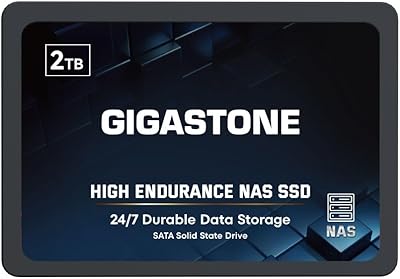
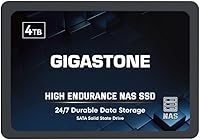
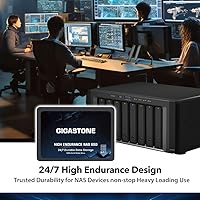
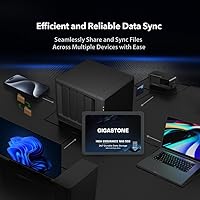
The Gigastone 4TB NAS Internal SATA SSD is built from the ground up for always-on storage duty — not a desktop drive quietly rebranded for NAS use. Gigastone has been developing dedicated NAS storage long enough to understand what separates a drive that survives years of continuous operation from one that struggles through the first summer of 24/7 uptime. At 4TB, this high-endurance storage drive sits in a practical sweet spot for home office setups and small business NAS builds that need real density without buying enterprise hardware. The 2.5-inch SATA III form factor drops straight into virtually any Synology, QNAP, or Asustor bay. Just be clear going in: this drive competes on durability and reliability, not benchmark bragging rights.

Features & Benefits

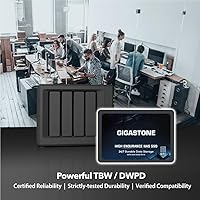
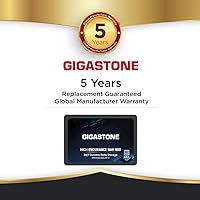
The underlying 3D NAND Flash pairs with an SLC cache layer that handles burst writes efficiently — when multiple users hit the NAS simultaneously or a large transfer kicks off, the cache absorbs the load before it reaches the slower base cells, which also extends the drive's overall write lifespan. Power Loss Protection is genuinely important here; if your NAS loses power mid-write, this drive has circuitry to flush in-flight data safely rather than leaving you with corrupted files. ECC memory works quietly in the background, catching bit errors before they become real problems. Read speeds top out at 530 MB/s, which covers multi-user media streaming and collaborative file access on a local network comfortably. A 5-year replacement warranty and lifetime technical support back the whole package.

Best For

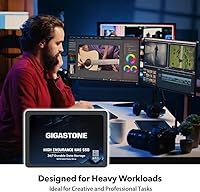
This NAS SSD is a natural fit for anyone running a Synology, QNAP, or Asustor enclosure as a home media server, shared creative storage pool, or small business backup hub. Video editors pulling 4K or 8K footage from a centralized NAS will appreciate the consistent throughput; the same goes for photographers sharing large RAW files across multiple workstations on a local network. It's also a smart choice for RAID 1 mirror setups where you want drives specifically validated for NAS RAID behavior rather than hoping a generic desktop SSD handles the pressure. Anyone swapping spinning hard drives out of a quiet home office NAS will notice the difference in noise and power draw immediately. One clear boundary: this drive is not rated for enterprise server or SAN environments, and Gigastone is upfront about that.

User Feedback

With a 4.3-star average across roughly 270 reviews, the Gigastone 4TB drive earns mostly positive marks from real NAS users. The most consistent praise centers on how smoothly it integrates into Synology and QNAP bays, plus the noticeably silent operation compared to a spinning HDD. Long-term owners running RAID configurations report steady performance without the reliability surprises that sometimes surface with repurposed desktop SSDs in always-on environments. On the critical side, some buyers question the value against competing NAS SSDs at comparable price points, and a small number mention write speed dips during sustained large transfers — a known SLC cache behavior once the cache fills. Gigastone's support response, however, draws consistent praise, which matters when the five-year warranty is part of the value equation.

Pros

  • Engineered specifically for 24/7 NAS operation, not a repurposed desktop drive pushed beyond its design limits.
  • Power Loss Protection preserves data integrity if the NAS loses power unexpectedly mid-write.
  • ECC memory quietly prevents bit-level errors from accumulating into real data corruption over years of continuous use.
  • Drops straight into Synology, QNAP, and Asustor enclosures with minimal setup friction and broad verified compatibility.
  • SLC caching handles burst workloads effectively, keeping multi-user access responsive without hammering the base NAND.
  • Silent operation is a tangible improvement over spinning HDDs, especially in quiet home or office environments.
  • The 5-year replacement warranty paired with lifetime technical support is an unusually generous safety net for this category.
  • At 4TB, the Gigastone 4TB drive delivers real density for photo archives, video vaults, and layered backup pools.
  • Long-term owners running RAID configurations consistently report stable, reliable performance without unexpected failures.
  • Dust, shock, and water resistance offer a practical buffer for NAS units stored in garages or utility spaces.

Cons

  • SATA III interface caps maximum throughput, making this a weaker option if your NAS enclosure supports NVMe drives.
  • Sustained write speeds can drop noticeably once the SLC cache fills during very large or prolonged transfer sessions.
  • Pricing reflects the endurance engineering rather than raw storage economics, so cost-focused buyers may find better value elsewhere.
  • Not validated for enterprise server or SAN environments, which is a hard boundary for certain business deployments.
  • Some users report limited drive health monitoring visibility compared to more established NAS SSD competitors.
  • Thermal performance under heavy, sustained workloads in poorly ventilated enclosures has drawn occasional concern in user reviews.
  • Gigastone carries less brand recognition than WD Red or Seagate IronWolf, which may give cautious buyers pause.
  • The ruggedness features add little practical value for a stationary internal drive that never leaves its enclosure.

Ratings

Scoring for the Gigastone 4TB NAS Internal SATA SSD was generated by AI after systematically analyzing hundreds of verified buyer reviews worldwide, with automated filters applied to remove spam, bot-generated ratings, and incentivized feedback before any category score was calculated. The resulting scorecard spans 14 performance categories and reflects honest user sentiment — including both the areas where this NAS SSD earns genuine trust and the trade-offs that real buyers have consistently flagged. Strengths and limitations are weighted equally so you can make a confident, well-rounded purchasing decision.

Endurance & Reliability
88%
Buyers running continuous backup jobs and always-on Plex servers consistently report that this NAS SSD holds up without the early failures some have experienced with desktop drives repurposed for NAS duty. Long-term owners using it in RAID arrays describe stable, predictable performance even after extended operational periods — exactly what 24/7 NAS workloads demand.
A small subset of reviews flags early-unit failures, though these appear isolated rather than systemic. Without prominently published TBW (terabytes written) figures, it is harder for buyers to benchmark its rated endurance ceiling against competing NAS SSDs that openly disclose this data.
NAS Compatibility
91%
Integration with Synology, QNAP, and Asustor enclosures is repeatedly described as friction-free — the drive shows up immediately in the NAS management interface without custom configuration. Creative teams sharing media storage across multiple workstations report that multi-device access works without dropouts, recognition delays, or enclosure-specific quirks.
Verified compatibility is limited to the brands Gigastone has explicitly tested, leaving buyers with less common NAS enclosures without a formal guarantee. The drive is also explicitly excluded from enterprise server and SAN environments, which firmly narrows its audience for business-critical rack deployments.
Data Integrity Protection
87%
The combination of Power Loss Protection and ECC memory is a meaningful differentiator for buyers who have previously lost data from unprotected drives during power outages. Users running unattended overnight RAID builds and scheduled backup jobs particularly value the assurance that a sudden power cut will not leave their filesystem in a corrupted state.
While Power Loss Protection and ECC are strong defenses, they do not replace a proper tiered backup strategy or protect against all failure modes. Some technically minded buyers also note that without published MTTF figures, it is difficult to quantitatively compare the reliability ceiling against competitors who provide this data.
Write Performance
68%
32%
For mixed workloads — incremental backups, periodic syncs, and regular file uploads from multiple devices throughout the day — the SLC cache keeps write speeds feeling responsive and consistent. Photographers uploading batches of RAW files or teams syncing project folders across a local network will rarely push the cache to saturation in normal use.
Sustained large sequential writes — copying a multi-hundred-gigabyte archive or running a full RAID rebuild — will exhaust the SLC cache and trigger a visible drop to base NAND write rates. Buyers running intensive data migration pipelines or large overnight transfers should evaluate whether this cache behavior fits their specific workload pattern before committing.
Value for Money
63%
37%
For buyers who need a NAS-validated drive with Power Loss Protection, ECC memory, a genuine 5-year warranty, and lifetime technical support, the all-in package does justify part of the price premium over generic desktop SSDs repurposed for NAS use. The five-year replacement guarantee alone provides meaningful financial assurance across the drive's operational lifespan.
At its price point, buyers comparing cost-per-terabyte will find competing NAS SSDs from more established brands at similar or lower prices with better-documented endurance specifications. For strictly budget-driven purchasing decisions — especially in multi-drive NAS builds where per-unit cost compounds — the value proposition is genuinely harder to defend.
Read Performance
74%
26%
For the actual workloads most home and SMB NAS owners run — streaming 4K video to a few concurrent devices, pulling large photo libraries, or serving files across a gigabit local network — the 530 MB/s read ceiling covers real-world demand without issue. Most users will never approach the interface limit during typical daily operation.
The SATA III interface imposes a hard throughput ceiling that NVMe-based NAS SSDs have already surpassed, and benchmark-focused buyers will find this drive firmly mid-range in sequential read comparisons. Those planning to run multi-stream 8K editing directly off the NAS may begin to feel the SATA III constraint under sustained peak load.
Setup & Integration
89%
Drop it in, power on, and the NAS detects it — that is the experience the majority of buyers describe across Synology and QNAP installations. Even first-time NAS builders without prior SSD experience report a smooth process, and the standard 2.5-inch SATA form factor means no adapters, brackets, or enclosure modifications are required.
Buyers using NAS enclosures outside the verified compatibility list are proceeding without a formal guarantee, as Gigastone's testing does not extend to every brand on the market. A small number of users report drive detection delays in specific NAS firmware versions, though these cases are typically resolved through standard troubleshooting steps.
Noise & Vibration
94%
Switching from a spinning NAS hard drive to this high-endurance storage drive produces an immediate, tangible difference in a home office environment — the NAS transitions from a constant mechanical hum to near-silence. Multi-bay enclosures also benefit from the complete absence of rotational vibration, which can otherwise compound across multiple spinning drives sharing a chassis.
Silent operation is a broadly expected baseline of any SSD rather than a unique selling point of this specific drive. Buyers already running a quiet NAS environment with other SSD-class alternatives will not notice a meaningful improvement, making this a parity feature rather than a genuine differentiator in a like-for-like comparison.
Thermal Management
72%
28%
Under typical mixed NAS workloads — multi-user file sharing, media streaming, and incremental backups — the drive operates within normal temperature ranges and maintains consistent performance in adequately ventilated enclosures. Most home and small office users do not report thermal throttling as a real-world issue during everyday NAS operation.
In poorly ventilated NAS bays or units stored in warm environments during summer months, a subset of users notes elevated temperatures under sustained heavy loads. Specific operating temperature ceilings are not prominently published in the product materials, making it harder for buyers to model worst-case thermal headroom for demanding deployment scenarios.
Warranty & Support
86%
A five-year replacement warranty combined with lifetime free technical support is a genuinely strong commitment for a storage drive in this category, well above the two or three-year standard common among competitors. Buyers who have contacted Gigastone's support team frequently describe the process as accessible and responsive — which matters when troubleshooting a NAS issue outside business hours.
As a smaller brand, Gigastone's support infrastructure may not match the geographic reach or turnaround speed of WD or Seagate's established service networks. A handful of reviews mention longer response times during peak periods, and international buyers occasionally report extended replacement shipping windows compared to locally stocked alternatives.
Build Quality
83%
The drive feels solid and well-assembled, and the dust, shock, and water resistance ratings provide a practical buffer for NAS units stored in garages, workshops, or utility rooms where a controlled server environment is not realistic. Buyers familiar with multiple NAS SSDs rate the physical construction as consistent with competing drives in this price tier.
The ruggedness features, while present, are secondary characteristics for a stationary internal drive that almost never leaves its bay once installed. Buyers specifically seeking ruggedized storage for field use or mobile applications will find purpose-built options better suited to that scenario than a drive designed primarily around always-on NAS operation.
RAID Validation
85%
Unlike desktop SSDs forced into NAS RAID duty, the Gigastone 4TB drive is specifically tested and validated for NAS RAID configurations, giving buyers building RAID 1 or RAID 5 arrays a meaningful assurance. Long-term RAID owners report consistent drive behavior without the unexpected array dropouts that can occur when a NAS detects a non-validated drive as unresponsive.
Gigastone does not publish detailed RAID-specific endurance data, making it harder to estimate drive lifespan under intensive RAID rebuild cycles compared to competitors who provide TBW ratings segmented by workload type. Buyers assembling high-availability business RAID systems may want that level of documented specification before making a final commitment.
Power Efficiency
81%
19%
Replacing spinning hard drives with this NAS SSD meaningfully reduces total enclosure power draw, which accumulates over continuous 24/7 operation — both in electricity costs and in reduced heat output inside the NAS chassis. Home users running their NAS as a low-power always-on server notice a perceptible improvement in ambient heat and overall system temperature.
While SSDs broadly consume less power than HDDs, the specific wattage figures for this drive are not prominently published, making direct quantitative comparison against competing NAS SSDs difficult. Buyers optimizing a high-drive-count NAS build for minimum power consumption may want confirmed idle and active wattage data before finalizing their component choices.
Capacity Value
77%
23%
At 4TB, the drive occupies a practical sweet spot for home media libraries, photo archives, and shared project storage that would otherwise require multiple smaller drives or a costlier high-capacity alternative. Single-drive deployments at this capacity simplify NAS management and reduce the number of bays occupied, which matters in smaller two-bay or four-bay enclosures.
The 4TB tier carries a price premium over the 1TB and 2TB options, and buyers constructing multi-drive NAS arrays may find the per-unit cost strains the overall build budget compared to pairing smaller SSDs or high-capacity spinning drives. Those requiring 8TB or beyond in a single drive will need to look at HDDs or enterprise-class SSD alternatives.

Suitable for:

The Gigastone 4TB NAS Internal SATA SSD is purpose-built for home office and small business users who run their NAS around the clock and genuinely need storage engineered for that workload rather than a desktop drive pushed past its limits. If you manage a Synology, QNAP, or Asustor enclosure as a personal cloud, RAID backup array, or shared media server, the 4TB capacity and NAS-validated design make this a practical, no-guesswork fit without overbuying enterprise hardware. Creative professionals — video editors centralizing 4K or 8K footage on a shared NAS, or photographers distributing large RAW files across multiple workstations — will find the sustained read performance and endurance-focused architecture well matched to their daily demands. It is also a smart upgrade path for anyone still running spinning hard drives in a NAS bay, since the switch delivers meaningfully quieter operation, lower power draw, and a reduced mechanical failure risk. Users building or expanding a NAS RAID array will further benefit from the fact that this drive has been specifically validated for NAS RAID configurations, rather than relying on a generic consumer SSD never designed for that kind of coordinated, sustained multi-drive load.

Not suitable for:

If you need storage for an enterprise server rack, a SAN environment, or any deployment that requires server-grade certification, the Gigastone 4TB NAS Internal SATA SSD falls outside its validated use case — Gigastone is explicit about this, and buyers in those environments should look elsewhere rather than assume it will hold up. Speed-focused buyers comparing this against NVMe-based NAS drives also need to recalibrate expectations: the SATA III interface has a hard throughput ceiling, and if your enclosure and workflow demand NVMe-level performance, this drive will consistently underwhelm. Anyone planning to run extremely large and uninterrupted sequential write sessions should know that sustained write speeds can fall once the SLC cache saturates — a common architectural trade-off in this NAND design, but one worth understanding before purchase. Finally, if raw cost-per-terabyte is the sole buying criterion, it is worth comparing the pricing of this high-endurance storage drive carefully against competing options at the same capacity, since the premium reflects durability engineering that not every buyer actually needs.

Specifications

  • Capacity: Offers 4TB of storage, providing meaningful density for home office NAS builds, shared media archives, and multi-drive RAID arrays.
  • Form Factor: Standard 2.5-inch drive measuring 7mm in height, fitting the vast majority of NAS enclosure drive bays without an adapter.
  • Interface: Connects via SATA III at up to 6 Gb/s and is backward compatible with SATA II bays at reduced throughput.
  • Read Speed: Sequential read performance reaches up to 530 MB/s, sufficient for multi-user media streaming and collaborative file access over a local network.
  • NAND Type: Built on 3D NAND Flash, which stacks memory cells vertically to improve storage density and overall endurance compared to planar NAND.
  • Cache Type: Uses an SLC (Single-Level Cell) cache layer to absorb burst writes quickly and reduce wear on the underlying base NAND cells.
  • Error Correction: ECC (Error Correcting Code) memory actively detects and corrects bit-level errors in real time, preventing silent data corruption during prolonged continuous use.
  • Power Protection: On-board Power Loss Protection circuitry detects sudden power drops and flushes in-flight data to non-volatile storage before the drive loses power entirely.
  • Operation Rating: Rated for 24/7 continuous operation, with thermal and endurance engineering specifically tuned for the always-on demands of NAS deployments.
  • Drive Weight: Weighs approximately 1.41 ounces, consistent with a standard 2.5-inch SSD that contains no spinning mechanical assembly.
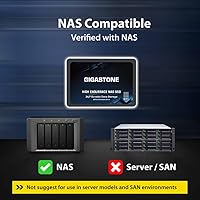
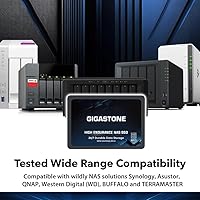
  • Compatibility: Verified for use with Synology, QNAP, and Asustor NAS enclosures and also supports NVR, RAID array, and personal cloud configurations.
  • Warranty: Covered by a 5-year replacement warranty protecting against hardware defects and premature failure under normal operating conditions.
  • Tech Support: Gigastone provides lifetime free technical support, meaning assistance is available for setup and troubleshooting even after the warranty period expires.
  • Durability: Rated as dust resistant, shock resistant, and waterproof, offering basic incidental protection for NAS units stored outside a controlled environment.
  • Excluded Use: Not validated or recommended by Gigastone for enterprise server models or SAN (Storage Area Network) environments.

Related Reviews
Gigastone 1TB NAS SSD
80%
83%
Value for Money
78%
NAS Compatibility
86%
Read Performance
61%
Write Endurance
79%
24/7 Reliability
More
fanxiang S101 4TB Internal SSD
77%
91%
Value for Money
82%
Read Speed Performance
71%
Write Speed & Cache Behavior
67%
Long-term Reliability
93%
Ease of Installation
More
Verbatim Vi550 4TB 2.5″ Internal SSD
77%
88%
Value for Money
93%
Storage Capacity
74%
Sequential Read Speed
62%
Sustained Write Performance
91%
Installation & Setup
More
Gigastone 2TB NAS Internal SSD
83%
91%
NAS Compatibility
83%
Endurance & 24/7 Operation
78%
Value for Money
93%
Installation Experience
86%
Read Performance
More
ORICO S500PRO 4TB SATA SSD
86%
91%
Performance
88%
Build Quality
90%
Value for Money
89%
Installation Ease
75%
Reliability Under Load
More
Crucial BX500 4TB SATA SSD
82%
91%
Value for Money
74%
Read/Write Performance
93%
Installation & Compatibility
67%
Endurance & Longevity
83%
Build Quality & Form Factor
More
RAOYI 1TB 2.5″ SATA III Internal SSD
73%
88%
Value for Money
76%
Read/Write Performance
92%
Installation Ease
89%
Compatibility
61%
Brand Reliability
More
Nextorage NEM-PAB 4TB M.2 NVMe SSD
84%
91%
Installation Experience
84%
Real-World Load Times
88%
Thermal Management
67%
Value for Money
89%
Build Quality
More
Transcend SSD230S 4TB SATA III SSD
88%
88%
Performance
92%
Value for Money
90%
Reliability
85%
Compatibility
91%
Ease of Installation
More
RAOYI 2TB PCIe Gen4 M.2 NVMe SSD
77%
91%
Value for Money
84%
Read Speed Performance
73%
Write Speed Performance
93%
PS5 Compatibility
88%
Ease of Installation
More

FAQ

Yes, this NAS SSD is designed for straightforward compatibility with Synology enclosures. You slot it into an available drive bay, power up the NAS, and the system detects and configures it automatically through DSM. No special drivers or firmware changes are typically needed to get started.

It depends on what matters most to you. The Gigastone 4TB drive costs more per terabyte than a mechanical NAS hard drive, but you gain completely silent operation, no vibration affecting neighboring drives in a multi-bay enclosure, lower power draw, and a drive purpose-engineered for sustained 24/7 read-write cycles. For a quiet home office or a creative professional who values reliability and silence, the trade-off is often reasonable.

Yes, this high-endurance storage drive is specifically validated for NAS RAID configurations, including RAID 1. It is actually one of the most common use cases buyers report, and long-term owners running RAID 1 mirrors consistently describe stable, predictable performance over extended periods.

Power Loss Protection handles this scenario. The drive carries dedicated capacitor-backed circuitry that detects a power drop and flushes any data sitting in volatile cache buffers to permanent storage before the drive fully loses power. It does not guarantee zero risk in every possible failure scenario, but it dramatically reduces the chance of filesystem corruption or file loss compared to drives that lack this protection.

For typical home and small office workloads — backing up photos, syncing documents, streaming video files — the SLC cache handles everything smoothly and you will never notice a speed change. The scenario where it becomes relevant is during very large, uninterrupted sequential writes: once the cache fills, write speeds step down to the base NAND rate, which is slower. For most mixed NAS workloads, that threshold is rarely reached in practice.

It will physically fit and function in a SATA II bay, though the connection will run at SATA II speeds rather than the full SATA III rate. In practical NAS use, this rarely matters because the network connection itself — Gigabit Ethernet in most home setups — is usually the real bottleneck, not the drive interface.

It provides a sensible safety margin against incidental dust buildup and minor moisture exposure, which is genuinely useful in a garage or workshop where temperature swings and airborne particles are part of life. Just keep expectations realistic: this is a stationary internal drive, and the ratings are not a license to expose it to sustained moisture or heavy environmental abuse. Think of it as a helpful buffer rather than a core selling feature.

Yes, the 2.5-inch SATA III form factor is physically compatible with most laptops and desktops that have a SATA bay. It will work fine as general storage. That said, you would be paying for endurance features — Power Loss Protection, ECC, 24/7 thermal design — that a standard personal computer environment does not need or fully utilize, so it is not the most cost-efficient choice for that use case.

Based on buyer feedback, the warranty process is described as reasonably straightforward, with Gigastone responding to claims and providing replacements without excessive friction. The five-year replacement warranty is the primary recourse for hardware failures, and the separate lifetime technical support line covers configuration and troubleshooting questions well beyond that window. As a smaller brand, the support operation may not have the scale of WD or Seagate, but reviewers generally rate the responsiveness positively.

All three are purpose-built NAS SSDs sharing similar core credentials: ECC, Power Loss Protection, and 24/7 operation ratings. The practical differences tend to come down to brand heritage, specific TBW (terabytes written) endurance ratings, and pricing at a given capacity tier. WD and Seagate carry longer track records in the storage industry, which gives some buyers added confidence. This NAS SSD competes by pairing comparable endurance engineering with a generous five-year warranty and lifetime support, making it a credible alternative if those terms matter more to you than brand legacy.

Where to Buy