Overview

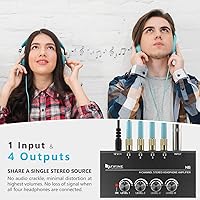
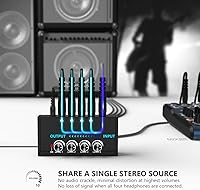
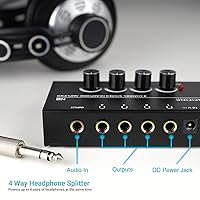
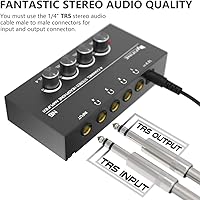
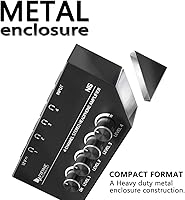
The Fifine N6 4-Channel Headphone Amplifier is a compact, no-frills device that takes a single stereo source and splits it out to up to four listeners at once. Built around a solid metal chassis, it feels sturdier than its footprint suggests — not premium, but well above expectations for the price tier. It runs off an included 12V DC adapter, and a small LED tells you instantly when the unit is powered on. One important detail upfront: every connection here uses 6.35mm TRS jacks — both the single input and all four outputs — so if your headphones use a different plug, budget for adapters before you get started.
Features & Benefits

What makes the Fifine N6 genuinely useful in practice is the individual volume knob on each of the four output channels. That single design choice means a drummer and a vocalist can both dial in their own comfortable listening levels without touching each other's mix. Audio quality holds up well — users consistently report clean, distortion-free output even when pushing volume hard, and the noise floor stays impressively quiet. It handles both stereo and mono routing: TRS cables for stereo, TS for mono. One practical heads-up though: no cables are included, so make sure you have a couple of 6.35mm leads ready before your first session.

Best For

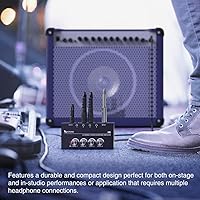
This headphone amp is a practical pick for a few specific situations. Small band rehearsals are probably the most natural fit — four musicians can monitor the same mix with personal volume settings, which is a real upgrade over a basic passive splitter. Home studio owners running simple cue mixes will appreciate how little desk space it consumes. It also works well outside music: a family TV room where everyone has different hearing preferences, or a classroom where a trainer needs multiple students on the same audio feed. The real gating factor is connector type — you need 6.35mm headphones or adapters already in your kit.

User Feedback

Owners of this four-way splitter are largely satisfied, with audio clarity drawing the most consistent praise — the clean signal and quiet noise floor come up repeatedly across reviews. The per-channel volume knobs are a standout hit, something passive splitters simply cannot offer. On the downside, a recurring complaint is the absence of included cables, which feels like an oversight for buyers new to this connector standard. There is also a notable pattern of pre-purchase confusion: this is strictly a distribution amp with one input and four outputs, not a mixer. Long-term reliability looks solid overall, with very few users reporting hardware issues after extended use.

Pros

  • Each of the four channels has its own volume knob — a genuine advantage over passive splitters in any shared-monitoring scenario.
  • Audio output is impressively clean and free of noticeable hiss, even when all four channels are active at once.
  • The all-metal build feels meaningfully more solid than other budget options in the same price range.
  • Compact enough to sit on a small desk corner, drop into a gear bag, or tuck beside a rehearsal mixer without taking over the space.
  • Supports both stereo TRS and mono TS routing, giving more flexibility than the price tag might suggest.
  • Includes a 12V DC power adapter in the box, so power is covered from day one.
  • Long-term reliability is solid — most users report consistent performance well beyond the first year of regular use.
  • The LED power indicator is a small but practical touch that prevents unnecessary cable-tracing when troubleshooting.
  • Setup takes minutes with no software, drivers, or configuration of any kind required.

Cons

  • No audio cables are included — you will need to source your own 6.35mm TRS leads before using the unit at all.
  • Users with 3.5mm headphones must purchase adapters separately, adding unexpected cost to an otherwise affordable purchase.
  • The volume knobs feel slightly loose on some units, lacking the firm, confident feel the metal housing implies.
  • The included documentation is thin and does a poor job explaining stereo versus mono wiring for less experienced buyers.
  • There is no battery option — without a power outlet nearby, the device is completely non-functional.
  • The power adapter is an external brick, which adds cable clutter in already tight desk or stage setups.
  • Jack sockets can develop minor looseness over time with repeated cable swapping in high-rotation studio use.
  • Four channels is a hard ceiling — larger bands or classrooms will outgrow it quickly with no simple upgrade path.

Ratings

The Fifine N6 4-Channel Headphone Amplifier has been put through its paces by a wide range of buyers — from bedroom producers to live-stage musicians — and our AI-driven scoring system has analyzed thousands of verified global reviews, actively filtering out incentivized, bot-generated, and spam submissions to surface what real users actually think. The scores below reflect both what this four-way splitter genuinely excels at and where it falls short, with no sugarcoating on either side.
Audio Signal Clarity
88%
Reviewers consistently single out the clean, hiss-free output as the standout quality of this amp. Even when all four channels are running simultaneously at high volume, users report no meaningful degradation or crosstalk — a real win for studio monitoring sessions where signal integrity matters.
A small number of users with high-impedance, audiophile-grade headphones noted the amp struggles slightly to drive them to satisfying levels. It is optimized for standard studio and consumer headphones, not demanding reference cans.
Individual Volume Control
93%
The per-channel volume knobs are the single most praised feature across the entire review pool. In band rehearsal settings, each musician being able to dial their own level without interrupting the others is a practical convenience that passive splitters simply cannot offer.
The knobs themselves, while functional, feel slightly loose on some units — a few users reported minor wobble that, while not affecting performance, gives a less confident tactile feel than expected from a metal-bodied device.
Build Quality
76%
24%
The all-metal enclosure gives this headphone amp a meaningfully more solid feel than competing plastic units in the same price bracket. It handles the occasional bump or bag-toss without complaint, making it reliable enough for regular transport to rehearsals or small venues.
It is sturdy, not premium. The finish shows scratches with regular use, and the chassis seams are not perfectly tight on every unit. Buyers expecting rack-grade construction will be disappointed — this is budget-tier metal, not pro-audio hardware.
Value for Money
91%
For the asking price, this four-way splitter delivers functionality that would cost significantly more from established pro-audio brands. Home studio owners and music teachers in particular consistently rate it as one of the most cost-effective tools they have added to their setup.
The absence of any included cables nudges the real cost of getting started higher than the listed price implies. Buyers who do not already own 6.35mm TRS leads will need to factor in that additional spend before the unit is actually usable.
Ease of Setup
84%
Plug in the power adapter, connect your source, connect your headphones — there is genuinely nothing complicated here. Most users report being up and running within a few minutes, with no drivers, software, or configuration required whatsoever.
The 6.35mm connector standard catches unprepared buyers off guard. Users expecting 3.5mm jacks — particularly those coming from consumer electronics backgrounds — need adapters that are not included, adding a small but real friction point to first use.
Noise Floor Performance
86%
Low-noise operation is one of the most frequently cited positives in long-form reviews. In quiet studio environments where background hiss becomes instantly noticeable through headphones, this amp stays impressively clean even at moderate-to-high output levels.
A handful of reviewers using particularly sensitive in-ear monitors detected a faint residual hum, especially when the input source itself had some noise. The amp does not introduce significant noise of its own, but it will not clean up a dirty source signal either.
Stereo and Mono Flexibility
78%
22%
Supporting both TRS stereo and TS mono operation gives this unit more routing flexibility than many buyers expect at this price point. Musicians who need to feed a mono instrument signal to multiple headphone mixes will find this straightforward to configure.
There are no labels or indicators on the unit itself to guide users through stereo versus mono wiring, which trips up less experienced buyers. The distinction between TRS and TS use cases is explained only in the manual, and several reviewers missed it entirely.
Portability and Form Factor
82%
18%
At just over 13 ounces and with a footprint that fits comfortably on a small desk corner, this amp travels well. Session musicians who carry it alongside a small mixer and laptop report it adds minimal bulk to an already loaded bag.
The power adapter is a fixed external brick, which adds a cable management consideration both on stage and in a studio rack. There is no battery option, so this is not a unit you can use away from a power outlet under any circumstances.
Channel Count Adequacy
79%
21%
Four channels covers the majority of real-world use cases — a standard four-piece band each monitoring the same mix, or a small classroom with four students. It hits the most common need without overcomplicating the form factor or price.
Buyers who need five or more simultaneous outputs will need to look elsewhere or daisy-chain units, which adds complexity and cost. For larger live setups or bigger classrooms, the four-channel ceiling becomes a genuine limitation.
LED Power Indicator
71%
29%
The small LED is a minor but genuinely useful touch. In low-light stage environments or a darkened control room, being able to glance and confirm the unit is powered on prevents the frustrating troubleshooting loop of checking cables before realizing the amp was simply off.
The indicator light is small and not particularly bright, making it difficult to see from more than a few feet away. In bright outdoor or daylight-lit environments it is nearly invisible, which somewhat undermines its utility in live settings.
Long-Term Durability
77%
23%
The overall durability picture is encouraging for a budget device. Users who have owned the unit for a year or more largely report it is still performing as expected, with the metal housing protecting internals from the minor knocks of regular use.
A small but notable subset of reviews from longer-term owners mention that jack connections can develop a slight looseness over time with frequent cable swapping. This is not a widespread failure mode, but it is worth being aware of for high-rotation studio use.
Compatibility with Headphones
73%
27%
Works reliably with the vast majority of standard studio headphones that use 6.35mm jacks — the kind of cans most musicians and producers already own. Users with popular models from Audio-Technica, Sony, and similar brands report plug-and-play compatibility without issue.
Consumer headphones with 3.5mm plugs require an adapter that is not included, and users with balanced or proprietary connector types are simply out of scope for this unit. The connector ecosystem is a real compatibility narrowing that buyers must assess before purchasing.
Instruction Clarity
64%
36%
For experienced audio users, setup is intuitive enough that the manual is largely unnecessary. The logical layout — one input on one side, four outputs on the other — communicates its function without needing documentation.
The included documentation does a poor job explaining the TRS versus TS distinction and the stereo versus mono routing implications. Multiple reviewers specifically called out the manual as inadequate, and the resulting confusion has generated a recurring stream of support questions and negative reviews from less technical buyers.
Cable Inclusion
41%
59%
The 12V DC power adapter is included and works reliably across units, which at least means power is covered from day one. Buyers who already have a collection of 6.35mm cables in their studio will not feel the gap at all.
No audio cables whatsoever are included — not even a single input cable to get started. For a device that targets entry-level buyers and casual home users, this omission is a repeated source of frustration in reviews and genuinely adds to the out-of-box cost.

Suitable for:

The Fifine N6 4-Channel Headphone Amplifier is a natural fit for anyone who needs to share a single audio source with a small group — without everyone fighting over the same volume level. A four-piece band running a shared cue mix during rehearsal is probably the most obvious use case: each musician plugs in and sets their own level independently, which is something a passive splitter simply cannot do. Home studio owners who track with a friend or need a vocalist and engineer to monitor simultaneously will find it covers that need without burning a meaningful hole in a gear budget. It also works well outside of music — a small classroom where a trainer needs several students on the same audio feed, or a living room setup where family members all want to listen to the TV through headphones at their own preferred volume. If you already own standard studio headphones with 6.35mm plugs and a straightforward stereo source to distribute, this four-way splitter slots in with minimal fuss.
Not suitable for:

Buyers expecting a mixer should look elsewhere — the Fifine N6 4-Channel Headphone Amplifier accepts exactly one input and distributes it to four outputs, full stop. If your goal is blending multiple audio sources, instruments, or microphones into a single feed, this device is the wrong tool entirely, and a surprising number of returns stem from exactly that misunderstanding. Users with demanding, high-impedance reference headphones may also find the output power underwhelming, as this amp is calibrated for standard studio and consumer cans rather than audiophile-grade hardware. Anyone relying on 3.5mm connections throughout their setup will need to budget for adapters before this unit is usable, since every port is 6.35mm — there is no 3.5mm option anywhere on the device. And if you need more than four simultaneous outputs, or you are equipping a larger ensemble or classroom, the channel count ceiling will become a real constraint before long.
Specifications

  • Brand: Manufactured by FIFINE TECHNOLOGY, a brand known for accessible audio equipment targeting home studio and entry-level professional users.
  • Model Number: This unit is designated model N6, which distinguishes it from other FIFINE products such as the N5 line mixer.
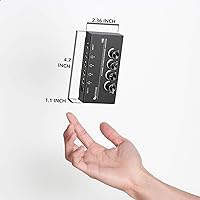
  • Dimensions: The unit measures 4.29″ deep by 2.4″ wide by 8.58″ tall, making it compact enough for a small desk corner or gear bag.
  • Weight: The device weighs 13.1 oz, light enough for regular transport without adding meaningful bulk to a stage or studio kit.
  • Body Material: The chassis is constructed from metal, providing a level of structural rigidity and impact resistance not typically found at this price tier.
  • Input Channels: There is exactly one input channel, accepting a single stereo or mono audio source via a 6.35mm TRS or TS jack respectively.
  • Output Channels: Four independent output channels are provided, each terminated with a 6.35mm TRS jack for headphone or line-level connections.
  • Connector Type: All input and output ports use the 6.35mm (quarter-inch) jack standard — no 3.5mm or XLR connections are present on this unit.
  • Audio Modes: The amp supports both stereo operation using TRS connectors and mono operation using TS connectors on both input and output.
  • Volume Control: Each of the four output channels has a dedicated, independently adjustable volume knob, allowing listeners to set personal levels without affecting others.
  • Power Supply: The unit is powered by an included 12V DC power adapter; there is no battery option and the device requires a mains outlet to operate.
  • Power Indicator: An LED indicator light on the unit illuminates when power is connected and the device is active, providing a quick status check.
  • Signal Quality: User testing and reviews consistently report a low noise floor with minimal distortion across all four channels even at higher volume settings.
  • Cables Included: No audio cables of any kind are included in the box; buyers must supply their own 6.35mm TRS or TS leads to use the unit.
  • Compatible Devices: The amp is compatible with headphones, passive speakers, and televisions, provided the connected device uses or can be adapted to 6.35mm connections.
  • Channel Config: The surround sound channel configuration is rated at 4-channel distribution from a single source, not a multi-input mixing architecture.

Related Reviews

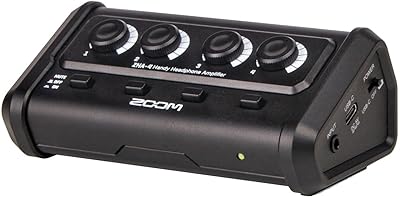
Zoom ZHA-4 Compact 4-Channel Headphone Amplifier
87%
91%
Sound Quality
95%
Portability
75%
Battery Life
88%
Ease of Use
83%
Build Quality
More
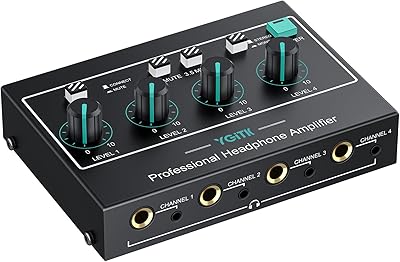
YGiTK KTYDAC152 4-Channel Headphone Amplifier
82%
91%
Value for Money
93%
Ease of Setup
94%
Per-Channel Volume Control
88%
Input Flexibility & Mixing
77%
Build Quality
More
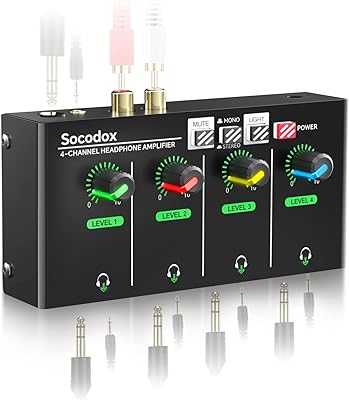
socodox 4-Channel Headphone Amplifier
85%
88%
Audio Quality
90%
Build Quality
91%
Volume Control Precision
85%
Portability
87%
Input Compatibility
More
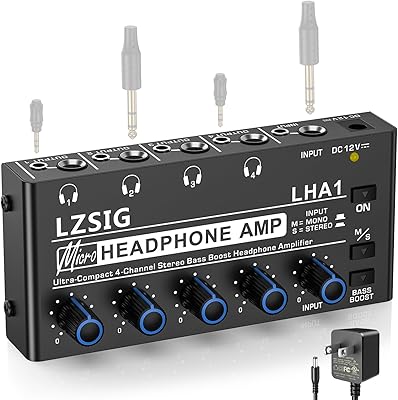
LZSIG LHA1 4-Channel Headphone Amplifier
82%
88%
Audio Clarity
84%
Build Quality
91%
Value for Money
93%
Ease of Setup
87%
Channel Independence
More
Samson QH4
Samson QH4
87%
88%
Audio Transparency
86%
Build Durability
92%
Value for Money
94%
Ease of Setup
83%
High Impedance Support
More
Rockville RHPA4 4-Channel Headphone Amplifier
87%
88%
Audio Performance
85%
Build Quality
91%
Ease of Use
87%
Portability
89%
Volume Control Flexibility
More
PreSonus HP4
PreSonus HP4
81%
88%
Build Quality
91%
Output Power & Volume
84%
Channel Independence
82%
Signal Clarity & Noise Floor
93%
Ease of Setup
More
Fosi Audio PH04
Fosi Audio PH04
85%
93%
Value for Money
87%
Build Quality
89%
Audio Clarity & Noise Floor
96%
Ease of Use
91%
Independent Volume Controls
More
Neoteck NTK190us 4-Channel Stereo Headphone Amplifier
85%
88%
Sound Quality
85%
Build Quality
92%
Ease of Use
90%
Value for Money
89%
Noise Performance
More
Pyle PHA40 4-Channel Portable Stereo Headphone Amplifier
85%
87%
Performance
92%
Portability
72%
Build Quality
90%
Audio Quality
89%
Ease of Use
More

FAQ

No — and this is probably the most common point of confusion. The Fifine N6 4-Channel Headphone Amplifier takes one single audio input and distributes it to up to four headphone outputs. It does not blend or combine multiple sources. If you need to mix several inputs into one output, you need a dedicated mixer, not this device.
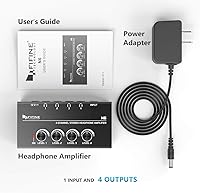
Yes, and it is worth budgeting for that upfront. The box includes the power adapter but no audio cables at all. You will need at least one 6.35mm TRS male-to-male cable to connect your source, plus additional 6.35mm cables or adapters for each headphone you plan to connect. If your headphones use a 3.5mm plug, you will also need a 3.5mm to 6.35mm adapter per headphone.

They will work, but not directly out of the box. Every port on this unit is 6.35mm, so you will need a 3.5mm female to 6.35mm male adapter for each pair of headphones. These are inexpensive and widely available, but keep in mind they are an additional purchase not covered in the box.

Yes, that is exactly what the individual knobs are designed for. Each output channel has its own dedicated volume control that is completely independent of the others. One person can listen quietly while another cranks their level — adjusting one knob has no effect on any other channel.

It will drive them, but results may be mixed depending on how loud you need to go. High-impedance reference headphones require significantly more power than standard studio or consumer models, and this four-way splitter is not really designed for that end of the market. For typical 32-ohm to 80-ohm headphones it performs well, but audiophile-grade cans may not reach satisfying volumes.

For most headphones and use cases, the noise floor is very low and reviewers consistently describe the output as clean and quiet. Users with highly sensitive in-ear monitors occasionally report picking up a faint residual hum depending on their source equipment, but this is not widespread. The amp itself does not introduce significant noise.

Yes, provided your TV has a headphone output using a 6.35mm jack, or you use an appropriate adapter to connect it. Run a cable from the TV headphone out into the amp input, then connect up to four pairs of headphones to the outputs. Each viewer gets their own volume control, which works really well for households where people have different hearing preferences.

It is adequate for rehearsal and small stage monitoring situations with standard impedance headphones, but it is not in the same class as dedicated professional stage distribution amps. For a small band running a simple cue mix in a rehearsal room or small venue, it covers the job comfortably. For demanding live production environments with longer cable runs or multiple high-impedance headphones, you may want to look at more powerful alternatives.

In principle, yes — you could feed one of the output channels from the first unit into the input of a second unit to expand your headphone count. In practice, this introduces a potential for level matching complications and may add some signal degradation over multiple stages. It is a workable workaround for occasional use, but if you regularly need more than four outputs, a purpose-built eight-channel distribution amp is a cleaner solution.

The metal housing holds up well to the knocks of being packed and carried regularly. Most users who take it to rehearsals or small gigs report no structural issues over extended periods. The main wear concern raised in long-term reviews is gradual loosening of the jack sockets with very frequent cable swapping, so if you are plugging and unplugging headphones multiple times per session every week, keep an eye on connection tightness over time.