Overview

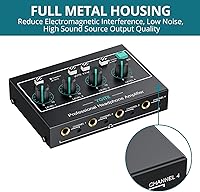
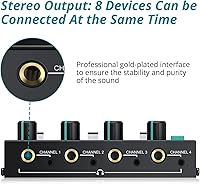
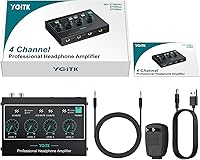
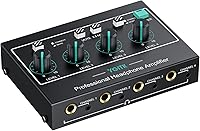
The YGiTK KTYDAC152 4-Channel Headphone Amplifier is a compact, no-frills unit built for situations where more than one person needs to hear the same source without fighting over a single jack. It measures just 4×1.3×2.5 inches, and the metal enclosure gives it a reassuring solidity you wouldn't necessarily expect at this price point. Each of the four channels delivers both a 1/4″ and a 1/8″ output simultaneously, meaning up to eight headphones can be connected at once. It ships ready to use, with a power adapter, RCA cable, and 3.5mm cable already in the box — no hunting for accessories before you can get started.
Features & Benefits

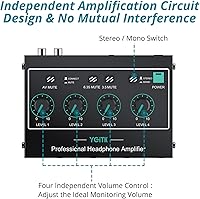
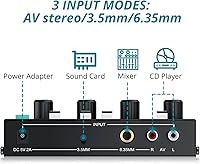
What makes this 4-channel splitter genuinely useful isn't just the headphone count — it's how much control you get over the signal. Three separate inputs (RCA, 1/8″, and 1/4″) can all run at once, and each has its own mute switch on the front panel, which effectively gives you a rudimentary source mixer without buying extra gear. Every output channel has an independent volume knob, so if one listener wants it quiet and another needs it loud, nobody has to compromise. A mono/stereo toggle collapses the stereo field with one press — a small but genuinely practical touch for mono compatibility checks — and a dedicated power switch means the unit isn't drawing power when you don't need it.

Best For

This headphone amp is a natural fit for a handful of specific scenarios. Band rehearsals are the obvious one — plug in a backing track and let each musician dial in their own level without anyone shouting across the room. Home studio sessions where a producer and client need to listen side by side work just as well. Teachers sharing audio with a small group, podcasters doing quick headphone checks across different models, and anyone who just needs a no-hassle distribution box will all find it hits the mark. It isn't built for critical audiophile listening, but for practical shared monitoring on a budget, it covers the essentials reliably.

User Feedback

Across its 411 ratings, the YGiTK amp holds a 4.5-star average, and the reviews tell a fairly consistent story. The per-channel volume knobs come up repeatedly as the feature buyers value most — it sounds obvious until you've shared headphones with someone whose preferred listening level is dramatically different from yours. Build quality earns solid marks given the price, and setup is essentially plug-and-play with no drivers required. That said, a noticeable portion of users flag a mild background hiss at higher volume settings, which is worth knowing if your environment is particularly quiet. A few also wished the input labels on the unit itself were easier to read at a glance.

Pros

  • Each output channel accepts both 1/4″ and 1/8″ headphones simultaneously — no adapters needed.
  • Individual volume knobs per channel let every listener set their own preferred level independently.
  • Three separate inputs with mute switches give this 4-channel splitter basic source-mixing capability.
  • Plug-and-play setup means no drivers, no configuration, and no wasted time before a session.
  • The metal enclosure feels noticeably more solid than competing plastic units at this price.
  • Supports up to 8 headphones at once, which covers most small-group monitoring scenarios comfortably.
  • A dedicated power switch prevents unnecessary heat buildup and reduces wear during idle periods.
  • The mono/stereo toggle is a genuinely useful addition for mono compatibility checks and accessibility needs.
  • Included RCA and 3.5mm cables mean most users can connect their source and start immediately.
  • An 18-month warranty offers reasonable peace of mind for a budget-tier audio accessory.

Cons

  • Mild background hiss becomes noticeable at higher volumes, especially with sensitive in-ear monitors.
  • Input labels on the physical unit are small and low-contrast, making them hard to read in dim conditions.
  • No per-input level trims, so balancing two sources with different output volumes requires upstream gain staging.
  • Knobs and jacks feel utilitarian and some users report knob wobble developing after prolonged regular use.
  • The power adapter cable is short, which can limit placement flexibility on a crowded desk or stage setup.
  • With all 8 outputs loaded simultaneously, drive noticeably thins out on lower-impedance headphones.
  • The mono/stereo switch has no tactile click or indicator light, making accidental mode changes easy to miss.
  • Included cables are functional but short and thin — most users will replace them fairly quickly.

Ratings

The scores below were generated by AI after analyzing verified buyer reviews for the YGiTK KTYDAC152 4-Channel Headphone Amplifier from multiple global sources, with spam, bot-submitted, and incentivized feedback actively filtered out. The result is an honest, balanced picture of where this 4-channel splitter genuinely delivers and where it falls short. Both the strengths that keep buyers satisfied and the friction points that surface repeatedly in real-world use are reflected transparently in each category.
Value for Money
91%
For the asking price, buyers consistently report getting more functionality than expected — three inputs, mute switches, and per-channel volume control in a single small unit. Reviewers who compared it to pricier alternatives often noted it covered 80 percent of their practical needs for a fraction of the cost.
A small number of buyers felt the hiss issue and the lack of clear input labeling held it back from feeling like a truly complete package at any price. If you need studio-grade silence, the value calculation shifts noticeably.
Ease of Setup
93%
The plug-and-play experience is one of the most consistently praised aspects across reviews. Users in rehearsal spaces and classrooms especially appreciated that there are no drivers, no pairing procedures, and no configuration menus — just cables and power.
A few users noted the input labeling on the physical unit is small and easy to misread in dim lighting, which added a small amount of initial confusion. It is a minor issue, but in live settings it can slow things down.
Per-Channel Volume Control
94%
This is the feature buyers mention most often, and for good reason. When a drummer and a vocalist are sharing the same backing track feed, being able to let each person set their own listening level independently removes a constant source of friction during rehearsals.
The knobs themselves are functional but not precision instruments — at very low signal levels, some users noticed slight channel imbalance before the knob reaches a usable range. Not a dealbreaker, but worth knowing for critical monitoring work.
Input Flexibility & Mixing
88%
Having three simultaneous inputs — RCA, 1/8″, and 1/4″ — with individual mute switches gives this headphone amp a basic mixing capability that goes well beyond a simple splitter. Podcasters switching between a laptop and a phone source found this particularly useful without needing a separate mixer.
The mixing functionality is rudimentary at best; there are no level trims per input, so balancing two sources with different output volumes requires careful gain staging upstream. Users expecting anything close to a real mixer will find the limitations quickly.
Build Quality
77%
23%
The metal enclosure stands out at this price point and contributes to a noticeably solid feel when the unit is sitting on a desk or music stand. Several reviewers specifically mentioned it did not feel like a cheap plastic box, which influenced their purchase confidence.
While the chassis is metal, the knobs and jacks feel more utilitarian on close inspection. A couple of long-term users reported knob wobble developing after months of regular use, suggesting the internals do not quite match the exterior's first impression.
Audio Signal Quality
68%
32%
For casual shared listening — monitoring a backing track, reviewing a podcast edit, watching a training video as a group — the signal quality is clean enough that most users never raised a concern. At moderate volumes, the output is clear and well-balanced.
The background hiss reported by a noticeable subset of buyers is the main caveat here. It becomes more apparent at higher volume settings or with sensitive in-ear monitors, which makes this a less comfortable choice for quiet studio environments or late-night headphone sessions.
Output Capacity
89%
Supporting up to 8 headphones across four channels — two jacks per channel — is a genuine advantage when you have a mixed bag of headphones in the room. Bands with a mix of studio headphones and consumer earbuds can plug everything in without needing adapters.
With all 8 outputs loaded, some users noted a slight reduction in drive, particularly with lower-impedance headphones that demand more current. It handles a typical four-person rehearsal comfortably, but maxing out the outputs is where headroom gets thin.
Mono/Stereo Toggle
82%
18%
The mono/stereo switch is a small but thoughtful addition. Audio engineers doing quick mono compatibility checks and educators working with hearing-impaired students both flagged it as a feature they actively use rather than ignore.
The switch itself has no tactile click confirmation, so it is easy to accidentally bump it and not immediately notice the stereo field has collapsed. A small LED indicator for the current mode would have made it considerably more reliable in practice.
Portability & Footprint
86%
At under 3 ounces and barely 4 inches wide, this headphone amp tucks into a gig bag side pocket or a classroom supply drawer without any fuss. Musicians who move between rehearsal spaces appreciated not having to dedicate a permanent spot to it.
The attached power cable is not particularly long, which can limit placement flexibility on a crowded desk or near a stage. A longer cable or a detachable option would have made the portability story even stronger.
Input Labeling & Usability
61%
39%
Once a user is familiar with the layout, daily operation is intuitive enough — the controls are logically grouped and the front panel does not feel cluttered for what the unit offers.
Multiple reviewers called out that the silkscreened input labels are too small and low-contrast to read comfortably, especially under stage lighting or in dim home studio setups. For a unit designed around multi-source routing, clearer labeling should have been a priority.
Included Accessories
83%
Including both an RCA cable and a 3.5mm audio cable in the box means most users can connect their primary audio source immediately without a separate accessories order. That kind of readiness matters when you are setting up quickly before a session.
The included cables are functional but short, and the RCA cable in particular drew comments about feeling thin. Most buyers ended up replacing them with longer or better-shielded alternatives fairly quickly.
Power Management
84%
The dedicated power switch is a small quality-of-life detail that adds up over time. Users who leave gear set up permanently appreciated not having to unplug the adapter every time, and it reduces unnecessary heat buildup during idle periods.
The unit runs off a 5V adapter rather than USB power, which is slightly less convenient for users who are already running USB hubs for other gear. It is a minor inconvenience, but worth noting for tidy cable management.
Warranty & Support
74%
26%
An 18-month warranty on a budget-tier product signals a reasonable level of manufacturer confidence. A handful of buyers who needed to contact support reported getting responses without excessive delays.
Customer service experiences were not uniformly positive — some international buyers reported slower resolution times, and the warranty process is not as streamlined as it would be with a larger brand. For the price, it is acceptable, but not a safety net to rely on heavily.

Suitable for:

The YGiTK KTYDAC152 4-Channel Headphone Amplifier is a practical choice for anyone who regularly needs to share audio with a small group without spending serious money on professional distribution gear. Band members running through a rehearsal with a shared backing track will immediately appreciate the independent volume knob on each channel — no compromising on levels just because someone else is plugged in. Home recording setups where a producer and a client need to monitor the same mix simultaneously are another strong fit, especially since the unit handles both 1/4″ studio headphones and 1/8″ consumer earbuds on the same channel at the same time. Teachers, trainers, and presenters who need a quick, no-fuss way to distribute audio to a small audience will find the plug-and-play setup refreshingly simple. Podcasters and content creators doing headphone checks across different models will also get genuine utility from the three independent inputs and per-input mute switches, which allow quick source switching without unplugging anything.
Not suitable for:

The YGiTK KTYDAC152 4-Channel Headphone Amplifier is not the right tool for buyers who need studio-grade signal transparency or dead-silent noise floors. The background hiss that surfaces at higher volume settings is a real issue if you are working with sensitive in-ear monitors or recording in a quiet environment where any added noise is immediately noticeable. Audiophiles or professional engineers who would be running critical listening sessions through this unit should look further up the price ladder — the performance simply does not match that standard, and expecting it to would be unfair to both the buyer and the product. The basic input labeling and the somewhat utilitarian feel of the knobs and jacks also make it a poor match for permanent installation in a professional studio rack where durability and precision matter over months of heavy daily use. If you need more than four output channels, or if you require per-input level trims to properly balance sources with different output volumes, this headphone amp will hit its ceiling quickly.

Specifications

  • Brand: Manufactured and sold by YGiTK under model number KTYDAC152.
  • Dimensions: The unit measures 4×1.3×2.5 inches, making it compact enough to sit on a small desk or fit in a gig bag pocket.
  • Weight: The amplifier weighs 2.88 ounces, keeping it lightweight for portable use.
  • Enclosure Material: The outer chassis is constructed from metal, providing more structural rigidity than typical plastic units at this price tier.
  • Output Channels: Four independent output channels are provided, each equipped with one 1/4″ TRS jack and one 1/8″ TRS jack for simultaneous use.
  • Total Headphone Jacks: A total of 8 headphone output jacks are available across all four channels, supporting up to 8 headphones at once.
  • Input Sources: Three independent audio inputs are included: one RCA stereo jack, one 1/8″ mini jack, and one 1/4″ TRS jack.
  • Input Mute Switches: Each of the three input sources has a dedicated mute switch on the front panel for real-time signal routing control.
  • Volume Control: Each of the four output channels has its own independent analog volume knob for personalized listener level adjustment.
  • Mono/Stereo Switch: A dedicated Mono/Stereo toggle button allows the user to switch the output between full stereo and collapsed mono modes.
  • Power Switch: An independent power on/off switch is built into the unit to conserve energy and reduce component wear during idle periods.
  • Power Supply: The unit is powered by an included 5V AC power adapter and does not support USB bus power.
  • Signal Compatibility: Compatible audio sources include CD players, guitars, keyboards, audio mixers, and sound cards.
  • Included Accessories: The package includes a 5V AC power adapter, one RCA audio cable, one 3.5mm audio cable, and a printed user manual.
  • Warranty: YGiTK provides an 18-month limited warranty covering manufacturing defects from the date of purchase.
  • Date Available: This model was first listed for sale on December 17, 2021.

Related Reviews
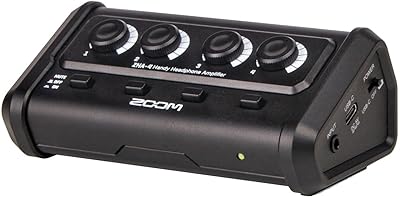
Zoom ZHA-4 Compact 4-Channel Headphone Amplifier
87%
91%
Sound Quality
95%
Portability
75%
Battery Life
88%
Ease of Use
83%
Build Quality
More
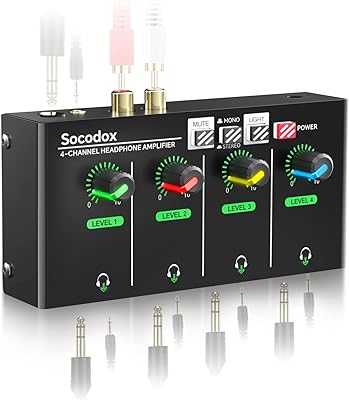
socodox 4-Channel Headphone Amplifier
85%
88%
Audio Quality
90%
Build Quality
91%
Volume Control Precision
85%
Portability
87%
Input Compatibility
More
LZSIG LHA1 4-Channel Headphone Amplifier
82%
88%
Audio Clarity
84%
Build Quality
91%
Value for Money
93%
Ease of Setup
87%
Channel Independence
More
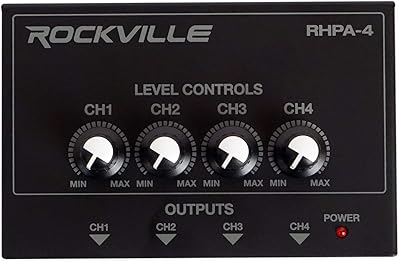
Rockville RHPA4 4-Channel Headphone Amplifier
87%
88%
Audio Performance
85%
Build Quality
91%
Ease of Use
87%
Portability
89%
Volume Control Flexibility
More
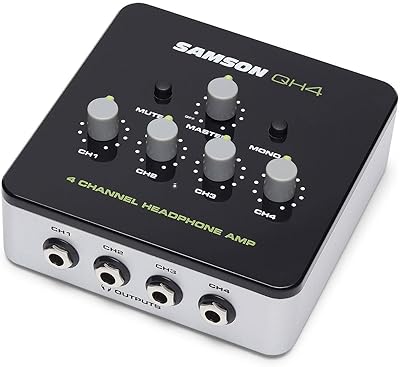
Samson QH4
Samson QH4
87%
88%
Audio Transparency
86%
Build Durability
92%
Value for Money
94%
Ease of Setup
83%
High Impedance Support
More
Fosi Audio PH04
Fosi Audio PH04
85%
93%
Value for Money
87%
Build Quality
89%
Audio Clarity & Noise Floor
96%
Ease of Use
91%
Independent Volume Controls
More
PreSonus HP4
PreSonus HP4
81%
88%
Build Quality
91%
Output Power & Volume
84%
Channel Independence
82%
Signal Clarity & Noise Floor
93%
Ease of Setup
More
Neoteck NTK190us 4-Channel Stereo Headphone Amplifier
85%
88%
Sound Quality
85%
Build Quality
92%
Ease of Use
90%
Value for Money
89%
Noise Performance
More
Pyle PHA40 4-Channel Portable Stereo Headphone Amplifier
85%
87%
Performance
92%
Portability
72%
Build Quality
90%
Audio Quality
89%
Ease of Use
More
Recoil DI550.4 4-Channel Car Audio Amplifier
85%
88%
Sound Quality
91%
Power Output
72%
Ease of Installation
85%
Cooling Efficiency
90%
Customizability of Controls
More

FAQ

Yes, each of the four output channels has both a 1/4″ and a 1/8″ jack, and both jacks on a single channel are active simultaneously. So if you have a full group of listeners with a mix of studio headphones and standard earbuds, you can have all 8 connected at once without any adapters.

Not at all. This headphone amp is entirely analog and plug-and-play. You connect your source to one of the inputs, plug in your headphones, and power it on. There is nothing to install on a computer or mobile device.

Yes, and this is one of the more practical features of this unit. All three inputs — RCA, 1/8″, and 1/4″ — can be connected simultaneously, and each has its own mute switch. Muting and un-muting different inputs lets you effectively switch or blend sources without unplugging any cables.

Some buyers have reported a mild background hiss, particularly noticeable at higher volume settings or when using sensitive in-ear monitors. At moderate listening levels with standard over-ear headphones, most users do not find it distracting. If you plan to use this in a very quiet studio environment with high-sensitivity IEMs, it is worth considering before purchasing.

It collapses the stereo signal into mono across all outputs when toggled to the Mono position. This is useful if you are checking whether a mix sounds balanced in mono, or if you have a listener who benefits from hearing the same signal in both ears rather than a split stereo field.

Yes, the 1/4″ TRS input is compatible with instruments like guitars and keyboards. Keep in mind that this is a headphone distribution amplifier and not a preamplifier, so the signal level coming from a passive instrument may be lower than ideal — pairing it with an audio interface or mixer upstream typically gives better results.

Each of the four output channels has its own dedicated knob, completely independent of the others. If one person wants the volume at 30 percent and the person next to them wants it at 70 percent, both can set their own level without affecting anyone else. It is the feature users mention most in reviews, and for good reason.

It is better described as a practical tool for home studios, rehearsal spaces, and classrooms rather than a professional-grade piece of gear. The signal quality is solid for everyday monitoring and group listening, but the noise floor and build tolerances do not place it in the same category as dedicated studio-grade headphone amplifiers from brands like Behringer or Furman.

There is no issue with leaving channels unused. The unused channels simply produce no output, and the active channels behave normally. You can also leave unused inputs unconnected without any effect on the inputs you are using.

The included 5V AC adapter cable is functional but relatively short, which can limit placement options on a crowded desk. If you need more reach, any quality 5V DC power supply with the correct barrel connector size will work as a replacement — just make sure the polarity and voltage match what is printed on the unit.