Overview

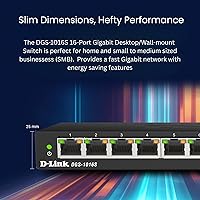
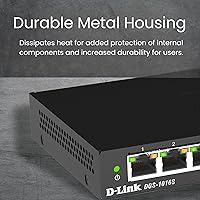
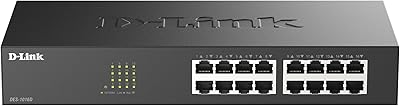
The D-Link DGS-1016S 16-Port Gigabit Ethernet Switch is one of those rare networking products that does exactly what it promises without asking much in return. D-Link has been a trusted name in affordable networking gear for decades, and this 16-port Gigabit switch fits squarely in that tradition. It's unmanaged by design — you plug it in, connect your devices, and it simply works. No login portal, no CLI, no configuration headaches. The slim metal chassis is a genuine differentiator at this price point; most budget switches feel plasticky and hollow. Available since late 2020, it has quietly built a loyal user base and a consistently strong sales rank that speaks to its staying power.
Features & Benefits

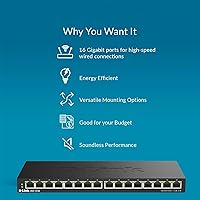
All 16 ports run at full Gigabit speeds — 1000 Mbps per connection — so transferring large files between a NAS and multiple workstations won't bottleneck anyone. The fanless passive cooling is more useful than it might sound: there's no hum, no whir, nothing. You can place this D-Link unmanaged switch on a bookshelf next to your TV and genuinely forget it's there. Hardware-level QoS quietly prioritizes traffic from IP cameras or VoIP phones over less time-sensitive activity, without any manual setup. IEEE 802.3az compliance means the switch automatically trims power draw on idle ports — a small but real efficiency gain that adds up. The physical footprint is a compact 11″ x 4.3″ x 1″, fitting almost anywhere.

Best For

This 16-port Gigabit switch is a natural upgrade for anyone who keeps running out of ports on a smaller unit. Home labs running a NAS alongside several workstations and smart devices will fill those connections quickly. It also works well in home theater setups where you want every TV, streaming box, and game console hardwired rather than competing over Wi-Fi. Small offices, creative studios, and classrooms without dedicated IT staff will appreciate the zero-configuration approach — nobody needs to know what a VLAN is to keep it running. One honest caveat: if you need Power over Ethernet, VLAN segmentation, or a web management interface, look elsewhere. This switch is built for simplicity, and that's precisely its strength.

User Feedback

With over 2,100 ratings averaging 4.6 stars, the DGS-1016S has earned real-world trust across a wide range of use cases. Buyers running home surveillance arrays, NAS setups, and small office networks consistently highlight long-term reliability and the reassuringly solid metal build as standout qualities. Quiet operation gets praised repeatedly, especially by users who placed it in living rooms or recording spaces. On the critical side, a few recurring complaints are worth noting: the included power adapter has a short cable that limits placement flexibility, and there are no per-port link-speed indicators to quickly spot a 100 Mbps weak link in your chain. Some reviewers also flag the lack of mounting hardware. Against comparable TP-Link units, most buyers consider the DGS-1016S the better-built option.

Pros

  • All-metal chassis feels noticeably more solid than plastic competitors at the same price point.
  • Completely silent operation makes it practical for living rooms, bedrooms, and recording spaces.
  • All 16 ports deliver consistent full Gigabit speeds — no bandwidth sharing or port throttling.
  • Zero configuration required means non-technical users are up and running in minutes.
  • The slim one-inch profile fits in places a standard switch simply cannot.
  • Hardware QoS quietly protects VoIP and camera feeds during periods of heavy network activity.
  • Auto power reduction on idle ports lowers energy draw without any user input.
  • D-Link backs it with a 5-year limited warranty, which is longer than most competitors offer.
  • Consistent real-world reliability reported by buyers running it 24/7 for two or more years.
  • Strong value proposition compared to similarly specced units from TP-Link or Netgear.

Cons

  • The included power adapter cable is short enough to limit placement options in many setups.
  • No per-port link-speed indicators make it impossible to spot a 100 Mbps bottleneck at a glance.
  • No PoE support means every connected device needs a separate power source.
  • Zero management interface leaves no way to diagnose intermittent port issues or monitor traffic.
  • No rack-mount hardware included, requiring extra cost and effort for clean rack installations.
  • The chassis surface shows fingerprints and can attract dust in open-shelf environments.
  • No SFP uplink port rules out fiber connections or long-distance daisy-chaining between switches.
  • No VLAN or network segmentation support, which is a hard stop for multi-tenant or security-conscious setups.

Ratings

The D-Link DGS-1016S 16-Port Gigabit Ethernet Switch scores below were generated by AI after analyzing thousands of verified global buyer reviews, with spam, incentivized, and bot-flagged submissions actively filtered out. Ratings reflect the honest consensus of real users — home lab builders, small office managers, and AV installers alike — and transparently capture both where this D-Link unmanaged switch earns genuine praise and where it leaves buyers wanting more.
Build Quality
88%
The all-metal chassis consistently surprises buyers who expect plastic at this price tier. Users report it feels solid on a desk or shelf, with no flex or creaking, and several reviewers noted it still looked and performed like new after two-plus years of continuous use.
A handful of users noted that the port labeling can fade over time in dusty environments, and the chassis shows fingerprints easily. A few also flagged that the rubber feet are minimal and the unit can shift slightly on smooth surfaces.
Ease of Setup
96%
This is arguably where the DGS-1016S shines brightest for its target audience. Buyers with zero networking background consistently report having every port live within minutes of unboxing — no drivers, no apps, no login screens. For a home user expanding their wired network, that frictionless experience is genuinely valuable.
The simplicity is a double-edged sword: there is no setup interface to verify port status, diagnose a bad cable, or check throughput. Advanced users occasionally find themselves wishing for even a basic web UI to confirm traffic is flowing as expected.
Port Count & Connectivity
91%
Sixteen full-speed Gigabit ports cover the needs of most home labs, NAS-centric setups, and small offices without requiring a second switch. Buyers running 10-12 wired devices — desktops, IP cameras, smart TVs, a NAS — report the port count hits a practical sweet spot.
There are no SFP uplink ports for fiber connections, which limits scalability for users who want to daisy-chain switches across longer distances. The lack of PoE on any port also means separate power injectors are needed for IP cameras or access points.
Noise Level
97%
Fanless operation is not just a spec here — buyers who placed the DGS-1016S in living rooms, recording studios, and home offices consistently confirm it is completely inaudible. In noise-sensitive environments where a fan-cooled switch would be disruptive, this unit genuinely disappears into the background.
A very small number of users in warmer climates or enclosed cabinets reported the chassis running noticeably warm to the touch under sustained load. While no failures were reported from heat, users in poorly ventilated spaces should factor this in.
Network Performance & Throughput
89%
Real-world Gigabit throughput is consistent across all 16 ports according to users running sustained NAS transfers, 4K video streams, and simultaneous IP camera feeds. Buyers who upgraded from older 100 Mbps switches noticed an immediate and meaningful improvement in file transfer speeds across their networks.
A few technically experienced users noted that without managed features, there is no way to verify actual throughput per port or troubleshoot intermittent slowdowns. The switch handles traffic well under normal loads, but heavy multi-stream scenarios occasionally drew comments about minor congestion.
Energy Efficiency
84%
The IEEE 802.3az compliance delivers tangible results — the switch automatically reduces power on ports that are idle or carrying minimal traffic. Users running it around the clock in home offices appreciate that it runs cool and draws modest power compared to older generation switches.
The energy savings are gradual and incremental rather than dramatic, and most buyers will not notice them on a monthly utility bill unless running multiple units. There is no indicator or reporting mechanism to confirm how much power is actually being saved.
QoS & Traffic Prioritization
73%
27%
Hardware-level QoS works quietly in the background, and users running IP surveillance systems alongside regular office traffic report fewer dropped frames and more stable VoIP calls. For buyers who do not want to configure anything manually, having any QoS built in is a genuine bonus.
The QoS implementation is entirely automatic and non-configurable, which frustrates users who want to define custom priority rules. Network-savvy buyers point out that the lack of granular control makes it unsuitable for environments with complex or specialized traffic prioritization needs.
Physical Footprint & Form Factor
87%
At just one inch tall and roughly the length of an A4 sheet of paper, the DGS-1016S fits in places where a standard rack-mount switch simply cannot. Buyers tuck it behind monitors, inside media cabinets, and on shallow shelves with consistent success, calling it one of the slimmest 16-port units available.
The slim design means there is no rack-mount bracket included, and sourcing a compatible third-party bracket requires extra effort. Users wanting to mount it cleanly in a wall panel or rack enclosure will need to spend additional time and money sourcing hardware.
Port Indicator Lights
58%
42%
Each port does have a link activity LED, which gives a quick visual confirmation that a device is connected and traffic is moving. For casual users who just need to confirm a cable is live, this is sufficient.
A recurring complaint across reviews is that the LEDs do not differentiate between 100 Mbps and 1000 Mbps link speeds. If one device on your network is negotiating at 100 Mbps due to a bad cable or old NIC, you have no way to identify which port is the culprit without additional tools.
Power Adapter & Cable Length
54%
46%
The included power adapter is compact and lightweight, which keeps the overall package tidy and easy to ship or store. It works reliably and users report no power-related failures in long-term use.
The power adapter cable is notably short, and this is among the most consistent complaints in the review pool. Users placing the switch more than a foot or two from a power outlet often need an extension cord, which feels like a simple oversight for a product otherwise focused on clean, unobtrusive installation.
Value for Money
91%
For a metal-bodied, fanless, 16-port Gigabit switch with a 5-year warranty, buyers broadly agree the DGS-1016S punches well above its price category. Reviewers who compared it directly against TP-Link and Netgear equivalents frequently cited the build quality and silent operation as tipping factors in its favor.
A small segment of buyers feel the price premium over plastic-bodied competitors is not justified if all you need is basic port expansion. Those who wanted PoE or any management features also noted the value calculus shifts significantly when those capabilities require a completely different — and pricier — product.
Long-Term Reliability
86%
Multiple reviewers specifically mentioned owning the DGS-1016S for two or more years without a single port failure or restart needed. D-Link's 5-year limited warranty adds meaningful peace of mind, and buyers in home lab and small business contexts cite this longevity as a key reason they would buy again.
A small number of users reported units failing or dropping ports after 12 to 18 months, though these cases appear to be outliers rather than a systemic pattern. As with most unmanaged switches, there is no self-diagnostic capability to flag a port degrading before it fails completely.
Compatibility
93%
The DGS-1016S works with any device that has an RJ45 Ethernet port — no driver matching, no firmware compatibility concerns. Buyers connect everything from Raspberry Pi clusters to enterprise NAS units to older IP cameras without any compatibility friction whatsoever.
Because the switch is fully unmanaged, there is no support for advanced compatibility features like jumbo frames configuration or IGMP snooping settings. Users with specialized network appliances that require those features will need to look at a managed alternative.
Packaging & Included Accessories
62%
38%
The unit arrives well-protected, and buyers generally report the product in perfect condition on arrival. The included quick install guide covers the basics cleanly, which is all most users actually need given the zero-configuration nature of the device.
Beyond the switch, power adapter, and a paper guide, the box is notably sparse. No mounting hardware, no Ethernet cable, and no cable management accessories are included. Buyers expecting a more complete kit — especially at this price point — often feel the accessory bundle undersells an otherwise strong product.

Suitable for:

The D-Link DGS-1016S 16-Port Gigabit Ethernet Switch is purpose-built for anyone who needs to expand their wired network quickly and cleanly, without touching a single configuration screen. Home users who have outgrown an 8-port switch — think a household juggling a NAS, several desktop PCs, smart TVs, IP cameras, and a game console — will find 16 ports hits a genuinely comfortable ceiling. It is equally at home in small offices, creative studios, or co-working spaces where nobody wants a networking appliance humming in the background or generating noticeable heat. Home theater enthusiasts who prefer hardwired connections for every device in a media cabinet will appreciate both the slim profile and the complete silence. Buyers in apartments or shared-cost environments will quietly benefit from the energy-efficient design, which trims power draw on idle ports without any manual intervention. If your goal is reliable, full-speed Gigabit connectivity across a room or a small floor, and you want it running in under five minutes, this D-Link unmanaged switch is a genuinely strong fit.
Not suitable for:

The D-Link DGS-1016S 16-Port Gigabit Ethernet Switch draws a hard line at simplicity, and that line will frustrate buyers with more advanced networking needs. If you need to segment your network into VLANs — to isolate guest devices, separate IoT equipment, or create a dedicated CCTV subnet — this switch cannot do it; there is no management interface of any kind. Network administrators or home lab enthusiasts who want to monitor per-port traffic, configure link aggregation, or set custom QoS rules will hit a wall immediately. Anyone powering wireless access points, VoIP phones, or IP cameras directly from the switch will also be disappointed, as there is no Power over Ethernet on any port — every connected device needs its own power source. Users who need to mount the switch cleanly in a rack or wall panel will need to source third-party brackets separately, which adds friction to what should be a clean installation. In short, the DGS-1016S is the right answer to a specific question; if your question involves managed features, PoE, or fiber uplinks, it is the wrong tool entirely.
Specifications

  • Model Number: This switch is manufactured by D-Link under the model designation DGS-1016S.
  • Port Count: The unit provides 16 auto-negotiating RJ45 ports, each capable of operating at 10, 100, or 1000 Mbps.
  • Data Transfer Rate: Each port supports a maximum data transfer rate of 1000 Mbps (1 Gbps) under full Gigabit operation.
  • Dimensions: The chassis measures 11″ in length, 4.3″ in width, and 1″ in height, making it one of the slimmer 16-port options available.
  • Weight: The complete unit weighs 1.4 pounds, light enough to reposition easily during installation without tools.
  • Housing Material: The outer enclosure is constructed from metal, providing greater rigidity and heat dissipation than plastic-bodied alternatives.
  • Cooling Method: The DGS-1016S uses entirely passive fanless cooling, relying on the metal chassis to dissipate heat without any moving parts.
  • Power Input: The switch requires a 12V DC power supply at 1 amp, delivered via the included external power adapter.
  • Energy Standard: The unit is fully compliant with IEEE 802.3az Energy Efficient Ethernet, enabling automatic power reduction on low-traffic or idle ports.
  • QoS Support: Hardware-level Quality of Service is built in, automatically prioritizing latency-sensitive traffic such as VoIP and IP surveillance feeds.
  • Management Type: The switch is entirely unmanaged, with no web interface, CLI, or software — configuration is neither required nor possible.
  • Switching Capacity: With 16 full-duplex Gigabit ports, the non-blocking switching fabric supports up to 32 Gbps of aggregate throughput capacity.
  • MAC Address Table: The switch supports a MAC address table of up to 8,000 entries, sufficient for the device densities typical of home and small office environments.
  • Interface Type: All 16 ports use the standard RJ45 interface, compatible with Cat5e, Cat6, and Cat6a Ethernet cabling.
  • Warranty: D-Link covers this switch with a 5-year limited warranty, which is notably longer than the 1-to-3-year coverage common among competing brands at this tier.
  • Auto Power Reduction: The switch automatically scales down power consumption on individual ports when link activity drops or a port is left disconnected.
  • Release Date: The DGS-1016S was first made available to consumers in October 2020 and remains an active, non-discontinued product.
  • Box Contents: The package includes one switch unit, one external power adapter, and one Quick Installation Guide; no Ethernet cable or mounting hardware is included.

Related Reviews

D-Link DGS-1005G 5-Port Gigabit Ethernet Switch
77%
94%
Ease of Setup
58%
Reliability & Longevity
87%
Network Performance
97%
Noise Level
76%
Value for Money
More
D-Link DGS-108 8-Port Gigabit Ethernet Switch
88%
92%
Performance and Speed
95%
Ease of Setup
88%
Build Quality
90%
Energy Efficiency
93%
Noise Level
More
D-Link DGS-1100-16V2 16-Port Gigabit Ethernet Switch

80%
83%
Ease of Setup
67%
VLAN Configuration
84%
Build Quality
91%
Fanless Performance
76%
QoS Effectiveness
More
D-Link DGS-1008P 8-Port Gigabit PoE Switch
84%
94%
Ease of Setup
71%
Power Delivery
88%
Quiet Operation
83%
Build Quality
90%
Energy Efficiency
More
D-Link DES-1016D 16-Port Fast Ethernet Switch
78%
96%
Ease of Setup
88%
Build Quality
97%
Noise Level
84%
Port Count & Layout
61%
Network Speed
More
TP-Link TL-SG116 16-Port Gigabit Switch
84%
91%
Build Quality
94%
Ease of Setup
88%
Port Count & Density
89%
Network Performance
97%
Noise Level
More
D-Link DGS-1100-05V2 5-Port Gigabit Smart Managed Switch
85%
91%
Value for Money
92%
Ease of Setup
88%
Performance & Reliability
89%
Energy Efficiency
93%
Quiet Operation
More
D-Link DGS-1100-24V2 24-Port Gigabit Smart Managed Switch
86%
88%
Performance
90%
Reliability
92%
Ease of Setup
89%
Energy Efficiency
91%
Quiet Operation
More
D-Link DGS-1100-05PDV2 5-Port Gigabit PoE Managed Switch
82%
92%
Value for Money
88%
Ease of Setup
90%
Quiet Operation
85%
PoE Functionality
87%
Energy Efficiency
More
D-Link DGS-1210-10 10-Port Gigabit Smart Managed Switch
88%
88%
Performance & Speed
91%
Build Quality
85%
Ease of Setup
94%
Fanless Design (Noise Level)
90%
Security Features
More

FAQ

No — nothing at all. You plug in the power adapter, connect your devices with Ethernet cables, and the switch handles everything automatically. There is no app, no web dashboard, and no login screen. It is one of the genuinely zero-effort setups you will encounter in networking hardware.

Unfortunately, no. The DGS-1016S does not support Power over Ethernet on any of its ports, so devices that draw power through their Ethernet cable will still need a separate power source or a dedicated PoE injector. If PoE is a firm requirement, you will need to look at a different switch model.

Yes, absolutely. You simply run an Ethernet cable from any available LAN port on your router into any port on this switch. The switch then expands your available wired connections from that one port into 15 additional usable ports — or 16 if you use a separate uplink device.

It produces no noise at all. The fanless design means there are no moving parts and therefore nothing to generate sound. A number of buyers have specifically placed it in living rooms, home theaters, and recording studios for exactly this reason. Heat is passively managed by the metal chassis, so thermal noise is not a concern either.

No — this is not possible with this switch. Because it is fully unmanaged, there is no configuration interface of any kind, and VLAN support is simply not available. If network segmentation is important to your setup, you would need a managed switch with VLAN capability.

Honestly, this is one of the switch's notable limitations. The port LEDs confirm that a link is active and that traffic is moving, but they do not differentiate between 100 Mbps and 1000 Mbps connection speeds. If you suspect a cable or device is negotiating at a slower speed, you would need to check the network adapter settings on the connected device directly.

The switch is not a standard rack-mount unit and no mounting hardware is included in the box. Its slim form factor is designed for desktop or shelf placement. That said, a number of users have sourced compatible third-party rack-mount brackets online, so rack installation is possible with a small amount of extra effort and cost.

The metal chassis does get warm to the touch during sustained use — this is by design, as it serves as the passive heatsink in the absence of a fan. Under typical home or small office loads, this is completely normal and safe. Where buyers have flagged concerns is in poorly ventilated enclosed cabinets; if you are placing it inside a tight media cabinet, make sure there is at least some airflow around the unit.

All 16 ports can be in active use simultaneously — this is not a switch that throttles shared bandwidth across ports. In practice, buyers run setups ranging from 8 to 16 devices without performance complaints. Keep in mind that your overall network speed still depends on your internet connection and router; the switch itself will not be the bottleneck for local Gigabit traffic.

The DGS-1016S comes with a 5-year limited warranty from D-Link, which is one of the more generous coverage periods you will find at this price tier — most competing brands offer one to three years. D-Link handles warranty claims through their support site, where you can register the product and submit a case. The general consensus from buyers is that D-Link's warranty process is straightforward, though response times can vary.

Where to Buy