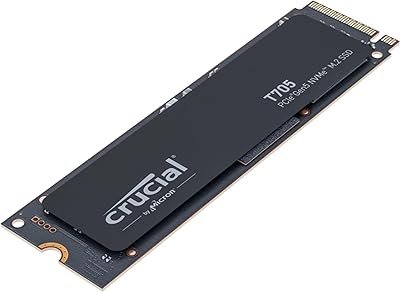
Crucial P3 Plus 2TB NVMe SSD

Overview
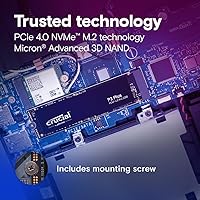
The Crucial P3 Plus 2TB NVMe SSD sits in an interesting spot in Crucial's lineup — it targets everyday upgraders rather than enthusiasts chasing peak performance at any cost. With 2TB of storage, it hits the sweet spot for most buyers who need room for a growing game library, a photo archive, or a primary system drive without overspending. It also drops into Gen3 systems if your board doesn't support Gen4 yet, which is a quietly useful real-world advantage. Just keep expectations calibrated: the sequential speeds are genuinely strong, but random performance trails the pricier Gen4 competition.
Features & Benefits
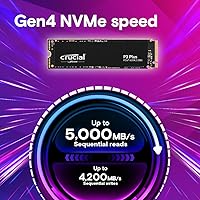
Running on a PCIe Gen4 x4 interface, this Gen4 NVMe drive hits sequential reads up to 5,000MB/s — fast enough to make large file transfers feel genuinely quick. The trade-off for that affordable price is QLC NAND flash, which handles everyday tasks well but slows noticeably on sustained writes once it burns through its SLC write cache. There is no DRAM cache either, which matters mostly under random access workloads. On the upside, built-in hardware encryption and an MTTF rating over 1.5 million hours point to solid everyday reliability. No heatsink is included, so monitoring temperatures under heavy sustained load is worth keeping in mind.
Best For
This 2TB SSD is a natural fit for PC and PS5 gamers who want noticeably faster load times compared to an older SATA drive, without paying a premium for a flagship model. If you're upgrading a laptop or desktop from a Gen3 SSD, you'll feel a genuine difference in responsiveness and boot times. PS5 owners will appreciate that it meets Sony's speed requirements for console storage expansion, with enough room for a large game library. Light content creators needing bulk storage for photos and video files will get plenty of headroom, as long as they're not routinely writing large batches of data in a single sitting.
User Feedback
Across more than 23,000 ratings, the Crucial P3 Plus holds a remarkably consistent reputation. Buyers frequently mention easy installation — even first-timers report no friction — and the jump in responsiveness over an older hard drive or SATA SSD is a recurring theme. On the critical side, technically minded reviewers point out that sustained write speeds drop once the drive's write cache is exhausted, a real but expected limitation of QLC storage at this price tier. A smaller group notes that peak speeds can vary slightly depending on motherboard slot and thermal environment. Encouragingly, reports of early failure or durability issues are notably rare across such a large sample.
Pros
- Reaches sequential read speeds up to 5,000MB/s, making large file transfers feel genuinely fast.
- 2TB capacity handles full game libraries, system files, and media collections without constant management.
- Works in both Gen4 and Gen3 M.2 slots, giving it strong compatibility across older and newer systems.
- Meets PS5 storage expansion requirements, making it a practical console upgrade option.
- Built-in AES 256-bit hardware encryption adds data security at no performance cost.
- MTTF rated above 1.5 million hours points to reliable long-term daily use.
- Standard M.2 2280 form factor fits virtually every modern desktop, laptop, and mini PC.
- Thousands of buyers report installation is straightforward, even for first-time upgraders.
- Priced well below flagship Gen4 drives while still delivering a meaningful real-world upgrade over SATA.
Cons
- QLC NAND means sustained write speeds drop significantly once the SLC cache is exhausted.
- No DRAM cache can result in slower random access performance under heavier multitasking workloads.
- No heatsink is included, and thermal throttling is a real risk in poorly ventilated cases under sustained load.
- Peak speeds vary depending on motherboard slot quality and system thermal conditions.
- Random read and write performance lags noticeably behind premium Gen4 competitors at similar price points.
- Not ideal for heavy video editing workflows that require consistent, high-speed sustained writes.
- Cache exhaustion behavior can catch buyers off guard if they routinely move very large data sets.
- No bundled software or cloning utility included, unlike some competing drives that ease the migration process.
Ratings
Our AI rating system analyzed thousands of verified global reviews for the Crucial P3 Plus 2TB NVMe SSD, applying filters to remove incentivized, bot-generated, and outlier feedback before scoring each category. The scores below reflect the honest consensus of real buyers across gaming rigs, home offices, laptops, and PS5 consoles. Both the genuine strengths and the frustrations that surface under demanding real-world conditions are represented transparently.
Sequential Read Speed
Sustained Write Performance
Random Access Performance
Value for Money
Gaming Load Times
PS5 Compatibility
Installation Experience
Thermal Management
Build & Reliability
Gen3 Backward Compatibility
Capacity Options
Software & Ecosystem
Hardware Encryption
Packaging & Presentation
Suitable for:
The Crucial P3 Plus 2TB NVMe SSD is a strong match for anyone looking to escape the bottleneck of an aging SATA drive or an older Gen3 SSD without spending flagship money. Gamers with growing libraries will appreciate the 2TB of breathing room alongside meaningfully faster load times in open-world titles — especially on a PS5, where this drive comfortably meets Sony's speed threshold for console expansion. Everyday power users who want a snappy system drive for booting, launching apps, and handling typical file work will notice a real difference compared to what most mid-range laptops and desktops ship with. It also works in Gen3 slots, so buyers upgrading an older system can install it without worrying about compatibility. Light photo and video workers who need bulk storage for organizing large media collections — but are not routinely writing hundreds of gigabytes in a single session — will find the capacity-to-cost ratio genuinely practical.
Not suitable for:
Buyers chasing the absolute best performance should look elsewhere; the Crucial P3 Plus 2TB NVMe SSD uses QLC NAND and skips a DRAM cache, which means sustained write speeds drop noticeably once the SLC write buffer fills up. For video editors working with large raw footage files, 4K multicam projects, or anyone who regularly transfers many gigabytes in a single sitting, this limitation is a real workflow concern rather than a theoretical one. Professionals running demanding workstation tasks — database operations, intensive virtualization, or continuous high-queue-depth workloads — will find that drives built around TLC NAND with a dedicated DRAM cache hold up far better under pressure. Competitive benchmark enthusiasts comparing against premium Gen4 rivals like the Samsung 990 Pro or WD Black SN850X will also be disappointed; the peak random read and write figures simply do not compete at that level. If your use case pushes the drive hard and consistently, spending more upfront on a higher-tier option is a smarter long-term decision.
Specifications
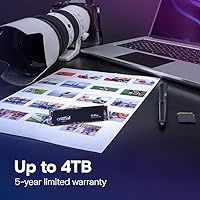
- Capacity: This drive offers 2TB of usable storage, suitable for operating systems, large game libraries, and media collections.
- Interface: It connects via PCIe Gen4 x4 NVMe, with backward compatibility for PCIe Gen3 x4 slots on older systems.
- Form Factor: The M.2 2280 form factor measures 3.15 x 0.09 x 0.87 inches and fits standard M.2 slots in desktops, laptops, and the PS5.
- Sequential Read: Peak sequential read speed reaches up to 5,000MB/s under optimal conditions on a Gen4-capable system.
- Sequential Write: Peak sequential write speed reaches up to 4,200MB/s, though sustained throughput drops once the SLC write cache is exhausted.
- Random Read: Random read performance is rated at up to 680,000 IOPS, covering typical application launch and OS responsiveness workloads.
- Random Write: Random write performance is rated at up to 850,000 IOPS for general multitasking and light mixed-workload scenarios.
- NAND Type: The drive uses 3D QLC (Quad-Level Cell) NAND flash, which enables high-capacity storage at a lower cost per gigabyte than TLC alternatives.
- DRAM Cache: No dedicated DRAM cache is included; the drive relies on the host system memory buffer (HMB) for mapping table operations.
- Encryption: AES 256-bit hardware encryption is supported natively, adding data security without measurable performance overhead.
- Reliability: Crucial rates the drive with an MTTF (Mean Time To Failure) of over 1.5 million hours under normal operating conditions.
- Voltage: The drive operates at 1.1V, consistent with standard NVMe M.2 power delivery on modern motherboards and laptops.
- Weight: At just 0.222 ounces, the drive adds negligible weight to any system, making it well suited for thin-and-light laptops.
- Heatsink: No heatsink is included in the box; users with thermally constrained cases may want to add an aftermarket M.2 heatsink separately.
- Compatibility: The drive is officially compatible with PC, Mac, and Linux systems, as well as the PlayStation 5 console storage expansion slot.
- Encryption Standard: Hardware-level AES 256-bit encryption operates at the controller level, meaning no software installation is required to enable basic drive security.
- Launch Date: The drive first became available in June 2022, placing it in Crucial's second-generation lineup of PCIe Gen4 consumer SSDs.
- Manufacturer: Crucial is the consumer storage brand of Micron Technology, one of the largest NAND flash manufacturers in the world.
Related Reviews
Crucial P3 Plus 4TB NVMe SSD
Crucial P3 Plus 1TB NVMe SSD
Crucial P3 Plus 500GB NVMe SSD
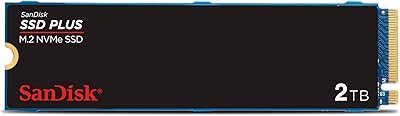
SanDisk 2TB SSD Plus M.2 NVMe SSD
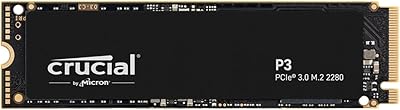
Crucial P3 1TB NVMe SSD
Crucial P3 500GB NVMe M.2 SSD
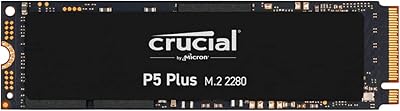
Crucial P5 Plus 2TB NVMe SSD
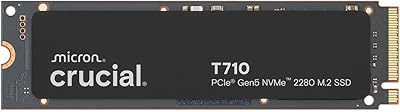
Crucial T710 2TB Gen5 NVMe SSD
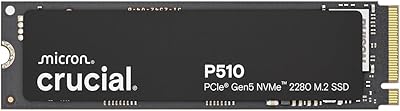
Crucial P510 2TB Gen5 NVMe SSD