Overview

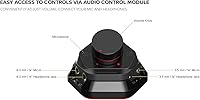
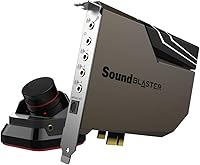
The Creative Sound Blaster AE-7 sits at the top of Creative's AE lineup, built for PC users who have outgrown the limitations of onboard audio and want something genuinely better. This isn't a casual upgrade — it's an enthusiast-grade internal sound card designed for audiophiles, serious gamers, and anyone who owns headphones that deserve a proper amplifier. The included Audio Control Module adds a physical volume knob and front-accessible jacks, a practical convenience most competitors skip. One important note upfront: this sound card requires a PCIe slot and runs exclusively on Windows, so Mac and Linux users should look elsewhere.
Features & Benefits

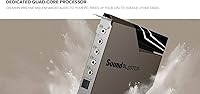
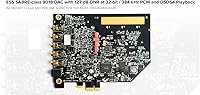
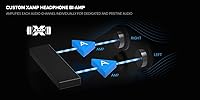
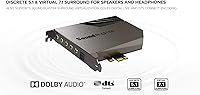
At the heart of the AE-7 is an ESS SABRE-class 9018 DAC delivering a 127dB dynamic range and 32-bit/384kHz playback — which in practice means audio that stays clean and detailed even at high volumes, without the hiss or distortion typical of cheaper hardware. The Xamp headphone amp powers each earcup independently, handles impedances up to 600 ohms, and holds its own with planar-magnetic headphones that most onboard solutions simply can't drive. A dedicated quad-core processor handles all audio processing on the card itself, keeping your CPU free. Discrete 5.1 speaker output with Dolby Digital Live and DTS Connect encoding rounds things out nicely.

Best For

This sound card makes the most sense for a fairly specific type of buyer. If you own high-impedance or planar-magnetic headphones and want a single internal solution rather than a separate DAC and amp stack cluttering your desk, the AE-7 is a strong fit. PC gamers chasing positional surround without external hardware will also find it compelling. It works well for home studio use or content creation where a clean, low-noise recording chain matters. If your motherboard audio picks up interference or just sounds flat and lifeless, this is a meaningful, tangible fix.

User Feedback

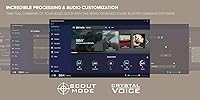
Owners with premium headphones tend to rate Creative's flagship PCIe card highly, with consistent praise directed at the clean noise floor and its ability to drive demanding headphones with real authority. Installation is generally straightforward, though a handful of users have reported driver hiccups on newer Windows builds — worth keeping in mind. The software suite draws mixed opinions: some appreciate the EQ and Scout Mode tools, but others find the interface dated and occasionally unstable. Value perception splits along similar lines — buyers who regularly use high-end audio gear see it as worthwhile, while those coming from basic setups sometimes feel the price premium is hard to justify.

Pros

  • Drives demanding headphones up to 600 ohms with clean, controlled output most motherboards cannot match.
  • The 127dB dynamic range DAC produces noticeably quieter backgrounds during critical listening and late-night sessions.
  • Discrete 5.1 speaker output with real Dolby Digital Live encoding works properly with AV receivers — not just emulated.
  • The Audio Control Module is included in the box, adding physical volume control and front-accessible jacks at no extra cost.
  • On-card audio processing frees up CPU resources, a meaningful benefit during streaming or heavy multitasking.
  • Scout Mode and the Acoustic Engine suite give gamers and music listeners meaningful, usable control over their sound profile.
  • High-resolution playback up to 32-bit/384kHz and DSD64 support covers virtually every serious audio format in practical use.
  • Users replacing noisy or interference-prone motherboard audio report a dramatic and immediate improvement in signal clarity.
  • The Xamp bi-amp design powering each earcup independently produces better stereo channel separation than single-amp designs.

Cons

  • Software stability is inconsistent — driver issues after Windows feature updates have tripped up a notable number of users.
  • Windows-only compatibility is a hard dealbreaker with no path forward for macOS or Linux users.
  • The companion software interface feels dated and can be crash-prone, undermining confidence in an otherwise premium product.
  • Buyers with low-impedance, high-sensitivity in-ear monitors may notice faint background hiss from the amp at low volumes.
  • DSD support tops out at DSD64, leaving dedicated DSD128 and DSD256 listeners without native playback capability.
  • Casual listeners without high-end headphones are effectively paying for amplifier headroom they will never actually use.
  • Installation on Windows 11 has caused enough friction among users that it warrants research before committing to a purchase.
  • The connecting cable for the Audio Control Module is shorter than some users would prefer given varied desktop setups.

Ratings

The Creative Sound Blaster AE-7 earns its reputation as one of the most capable internal sound cards available for Windows-based audiophiles and enthusiast PC builders — but it isn't without trade-offs. These scores were generated by AI after analyzing thousands of verified global user reviews, with spam, bot activity, and incentivized feedback actively filtered out. Both the genuine strengths and the recurring frustrations are reflected transparently below.
Audio Fidelity
93%
Users consistently describe a night-and-day difference compared to motherboard audio, with a noticeably cleaner, quieter background and more defined instrument separation during critical listening sessions. The 127dB dynamic range and ESS SABRE DAC deliver on their promise for music lovers using high-resolution files.
A small number of audiophiles with extremely resolving setups feel the AE-7 still falls short of dedicated external DACs in the same price bracket, particularly in terms of soundstage width and micro-detail retrieval.
Headphone Amplifier Performance
91%
The Xamp bi-amp design genuinely impresses users who previously struggled to drive demanding headphones. Owners of planar-magnetic models like the HiFiMAN Sundara or Audeze LCD-2 report full, controlled sound with no audible strain even at higher volumes.
At very low volumes, a few users with sensitive in-ear monitors notice a faint background hiss, suggesting the amp is optimized for high-impedance loads rather than low-impedance, high-sensitivity earphones.
Value for Money
71%
29%
For buyers who already own premium headphones, this sound card effectively replaces both a standalone DAC and a headphone amp, which makes the overall cost easier to justify. The included Audio Control Module adds tangible convenience that competing cards charge extra for.
Casual listeners upgrading from basic audio report feeling the price premium is hard to swallow when the perceptible gains feel incremental to untrained ears. Those without high-impedance headphones are paying for amplifier headroom they may never use.
Software Quality
58%
42%
Creative's Acoustic Engine suite covers a broad range of controls — parametric EQ, surround virtualization, Scout Mode for gaming — and when it behaves, it genuinely adds flexibility that hardware alone cannot provide. Scout Mode in particular gets positive mentions from competitive FPS players.
Software stability is the most consistent complaint in user reviews. Bugs, occasional crashes, and a UI that feels like it hasn't been substantially updated in years frustrate users who expect the software experience to match the hardware quality. Driver issues on newer Windows builds surface regularly enough to be a real concern.
Installation & Compatibility
67%
33%
Most users report a relatively painless physical installation, with the card fitting standard PCIe slots without clearance issues. For straightforward Windows 10 setups, the drivers install without incident and the card is recognized immediately.
Windows 11 compatibility has caused headaches for a meaningful share of buyers, with some reporting audio dropouts or failure to install drivers cleanly without manual intervention. The Windows-only limitation is a hard stop for anyone on Linux or macOS.
Gaming Surround Sound
82%
18%
Discrete 5.1 output with Dolby Digital Live and DTS Connect encoding gives users with physical speaker setups a real competitive advantage in positional audio games. Virtual 7.1 on headphones also performs better than most software-only surround solutions from competing brands.
Virtual surround on headphones is hit-or-miss depending on the game engine, and some users find the effect artificial-sounding enough to prefer stereo for certain titles. The surround virtualization feels more convincing for cinematic games than for tightly competitive multiplayer scenarios.
Build Quality
84%
The card feels solid and purposefully constructed. The Audio Control Module in particular has a premium tactile feel, with a smooth-turning volume knob that holds its position reliably and does not develop wobble over time according to long-term users.
A handful of buyers have noted that the card's connector panel feels slightly less robust than expected at this price point, and the PCIe bracket alignment required minor adjustment on some cases before the card seated flush.
Audio Control Module
88%
For users who place their PC tower under a desk or away from arm's reach, the Audio Control Module is genuinely useful — it keeps headphone swapping and volume adjustments quick and physical rather than requiring software interaction. The quarter-inch jack support for studio headphones is a practical bonus.
Some buyers were confused about whether the module was included or a separate purchase; it is included, but Creative's product listing makes this less clear than it should be. The cable connecting it to the card is functional but not particularly long.
Noise Floor & Signal Clarity
92%
Users transitioning from motherboards with poor EMI shielding report a dramatic reduction in background noise and electrical interference. Recording musicians appreciate the clean input chain when tracking vocals or instruments at lower gain settings.
In very electrically noisy PC environments with multiple GPUs or poorly shielded cases, a small number of users still detect faint interference, suggesting case quality and component layout still play a role in the final noise floor.
High-Resolution Audio Support
89%
32-bit/384kHz PCM playback and DSD64 support cover essentially every high-resolution audio format a serious listener would realistically use. Users who have invested in HD audio libraries from services like Qobuz or downloaded FLAC archives report the card handles them without conversion artifacts.
DSD support is limited to DSD64 and does not extend to DSD128 or DSD256, which matters to a subset of dedicated DSD enthusiasts. For most users this is irrelevant, but it is a gap worth noting for those specifically seeking native DSD playback.
CPU Offloading
83%
The on-card quad-core processor tangibly reduces audio-related CPU overhead during demanding sessions. Streamers and content creators running multiple applications simultaneously appreciate that audio processing does not compete for CPU resources the way software solutions do.
On modern high-core-count CPUs, the practical performance benefit of offloaded audio processing is less noticeable than it would have been on older quad-core systems where every freed cycle counted more meaningfully.
Speaker Output Quality
79%
21%
The discrete 5.1 analog output with real encoding support gives home theater PC users a meaningful upgrade path for speaker systems. Dolby Digital Live encoding in particular enables bitstream output to AV receivers that many competing cards still do not support properly.
Users with 2.0 stereo speaker setups report that the improvements over a decent onboard codec are real but less dramatic than the headphone experience, making the full value proposition harder to realize without a multi-channel speaker system.
Driver Stability Over Time
61%
39%
On stable, freshly installed Windows systems, the drivers perform reliably for extended periods. Users who set up the card and leave the software configuration largely untouched tend to report fewer issues than those who frequently update or reinstall.
Long-term driver stability after major Windows updates is a recurring weak point. Several users report that feature updates to Windows can break audio output or surround settings, requiring manual driver reinstallation — a frustrating experience for a premium product.
ASIO & Pro Audio Integration
76%
24%
ASIO 2.3 support gives home studio users low-latency recording capability that is genuinely useful for tracking and monitoring workflows in DAWs like Reaper or Ableton. Latency performance is competitive for an internal card at this tier.
Professional studio users who rely on ASIO for demanding multi-track sessions may find the AE-7's ASIO implementation adequate but not exceptional compared to dedicated prosumer audio interfaces. It works well for light production but has ceiling limitations in heavier workflows.

Suitable for:

The Creative Sound Blaster AE-7 was built for a specific kind of buyer, and it genuinely delivers for them. If you own high-impedance or planar-magnetic headphones — think anything from 150 to 600 ohms — and have been relying on your motherboard's audio output, this card will be a revelation. The on-board Xamp bi-amp has the headroom to drive those headphones properly, something most integrated audio solutions simply cannot do. It also makes strong sense for PC gamers who want real Dolby Digital Live or DTS Connect surround without routing audio through an external device, and for home studio users who need a clean, low-noise recording chain without investing in a full dedicated audio interface. Content creators who notice electrical interference or a thin, lifeless sound from their current setup will find the noise floor improvement alone worth the investment. The included Audio Control Module is a particularly useful addition for anyone with a tower PC tucked under a desk, putting volume control and headphone swapping within easy reach.
Not suitable for:

There are real scenarios where the Creative Sound Blaster AE-7 is the wrong tool for the job, and it is worth being direct about them. If you are on macOS or Linux, stop here — this card is Windows-only, and that is a hard limitation with no workaround. Casual listeners who use basic consumer headphones under 32 ohms will not extract meaningful value from the amp headroom they are paying for, and the improvement over a decent modern motherboard codec may feel subtle rather than transformative. Budget-conscious buyers should also consider whether their headphones and speakers are actually capable of revealing the difference a high-end DAC makes — pairing this card with entry-level audio gear is a mismatch. If you primarily use Bluetooth speakers or USB headsets, the AE-7's analog output chain is largely irrelevant to your setup. Finally, anyone who wants a set-it-and-forget-it solution with minimal software involvement may find Creative's companion software more trouble than it is worth, particularly after major Windows updates.
Specifications

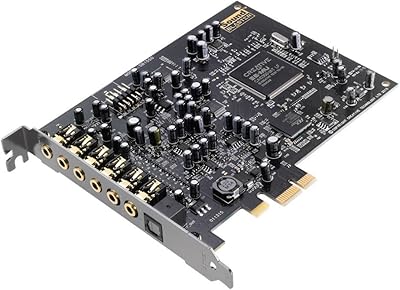
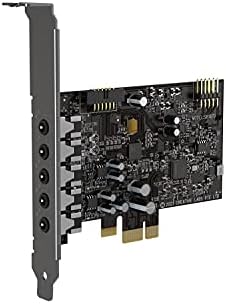
  • Interface: The card uses a PCIe x1 interface and is physically compatible with any PCIe x4, x8, or x16 slot on a standard desktop motherboard.
  • DAC: Audio conversion is handled by an ESS SABRE-class 9018 DAC, a chip widely regarded in audiophile circles for its low noise and high linearity.
  • Dynamic Range: The DAC achieves a 127dB dynamic range (DNR), meaning the gap between the quietest and loudest reproducible signal is exceptionally wide and clean.
  • Max Resolution: Playback supports PCM audio up to 32-bit depth at 384kHz sample rate, covering every high-resolution audio format in common use.
  • DSD Support: Native DSD playback is supported up to DSD64, suitable for most high-resolution DSD audio libraries available through download stores.
  • THD+N: Total harmonic distortion plus noise is rated at 0.0001% from the DAC output, indicating an extremely low level of audible coloration or signal degradation.
  • Headphone Amp: The Xamp discrete bi-amplifier powers the left and right channels independently, with a 1-ohm output impedance and support for headphones rated up to 600 ohms.
  • Processor: A dedicated quad-core Sound Core3D audio processor handles all signal processing on the card itself, offloading that work entirely from the host CPU.
  • Surround Output: The card supports discrete 5.1 analog surround for speaker setups and virtual 7.1 surround for headphones and stereo speaker configurations.
  • Encoding Support: Dolby Digital Live and DTS Connect encoding are supported, enabling real-time bitstream output to AV receivers via the optical TOSLINK connector.
  • ASIO Support: ASIO version 2.3 is supported for both playback and recording, providing low-latency audio routing compatible with major digital audio workstations.
  • Outputs: Physical outputs include one TOSLINK optical output, three 3.5mm jacks for discrete 5.1 line-out, and one dedicated 3.5mm headphone output.
  • Inputs: One combined 3.5mm mic and line input is provided, suitable for connecting a microphone or line-level source for recording.
  • Control Module: The Audio Control Module is included in the box and connects to the card to provide a desktop-accessible volume knob plus quarter-inch and eighth-inch headphone and mic jacks.
  • Platform: The card is officially supported on Windows only; macOS and Linux are not supported and no third-party driver solutions are endorsed by the manufacturer.
  • Dimensions: The card measures 5.71 inches long by 5.04 inches tall by 0.79 inches wide, fitting a standard single-slot PCIe form factor.
  • Weight: The card weighs 1.6 pounds including the bracket, which is typical for a full-featured internal sound card with a heat spreader.
  • Software Suite: Creative's Acoustic Engine software provides parametric EQ, Scout Mode for gaming, surround virtualization controls, and environmental audio presets via a Windows desktop application.

Related Reviews

Creative Sound Blaster Audigy PCIe RX 7.1 Sound Card
84%
88%
Sound Quality
83%
Setup and Installation
76%
Driver Compatibility
85%
Build Quality
92%
Value for Money
More
Creative Sound Blaster Audigy FX V2
74%
83%
Audio Quality Improvement
89%
Ease of Installation
57%
Software & Driver Experience
74%
Surround Sound Performance
78%
Build Quality & Hardware
More
Creative Sound Blaster X4
80%
88%
Audio Quality
91%
Headphone Amplifier Performance
74%
Surround Sound & Virtualization
86%
Build Quality & Physical Controls
92%
Connectivity & I/O Options
More
Creative Sound BlasterX G1
84%
88%
Overall Audio Improvement
79%
Virtual Surround Sound
84%
Competitive Gaming Performance (X-Plus Mode)
71%
Software & Customization
92%
Form Factor & Portability
More
Creative Sound Blaster X-Fi Titanium
72%
91%
Audio Quality Upgrade vs. Onboard
88%
Gaming Positional Audio
44%
Driver Installation & Setup
39%
Windows 10 / 11 Compatibility
82%
ASIO Recording Performance
More
Creative Sound Blaster Omni Surround 5.1
81%
89%
Audio Quality Improvement
76%
Ease of Installation
82%
Microphone Performance
91%
Physical Controls & Design
84%
Surround Sound Capability
More
Creative Sound BlasterX AE-5 Plus
79%
91%
DAC Audio Quality
88%
Headphone Amplifier Performance
58%
Software & Drivers
79%
Build & Installation
82%
Value for Money
More
Creative Sound BlasterX G5
83%
92%
Audio Clarity & Detail
88%
Gaming Spatial Awareness
91%
Amplification Power
86%
Console Compatibility
58%
Software User Experience
More
Creative Sound Blaster Play! 4
81%
88%
Audio Quality Upgrade
84%
Microphone Performance
91%
VoiceDetect Auto-Mute
79%
Noise Cancellation (Two-Way)
93%
Plug-and-Play Ease
More
Creative SBS E2900 + Sound Blaster Z SE
76%
88%
Audio Clarity & Fidelity
84%
Bass Performance
91%
Headphone Amplifier Quality
79%
Gaming Audio & Surround
58%
Software & Driver Experience
More

FAQ

It is included in the box — this trips up a lot of buyers because some of Creative's other cards sell it as an optional add-on. With this card, you get the desktop module with the volume knob and the quarter-inch headphone jack right out of the package.

Unfortunately, no. The Creative Sound Blaster AE-7 is a Windows-exclusive product, and Creative does not provide drivers for macOS or Linux. If you are not on Windows, this card is simply not an option regardless of how attractive the specs look.
Yes, and this is genuinely one of the strongest use cases for this card. The Xamp bi-amp is rated up to 600 ohms and handles 300-ohm headphones with headroom to spare. You should hear a clear improvement in control, dynamics, and volume range compared to most onboard audio solutions.

It does, and this is one area where the card earns its price. Planar-magnetic headphones tend to have lower impedance but high current demands, and the Xamp discrete amp is designed to handle exactly that. Users with popular planar models report clean, authoritative output without any sense of the amp straining.

It depends on your setup and tolerance for occasional friction. On a clean, stable Windows install the software works reliably, but Creative's companion application has a reputation for feeling dated and can behave unexpectedly after major Windows updates. If you prefer a set-it-and-forget-it experience, budget some time for troubleshooting, particularly if you are on Windows 11.

Yes, the card includes a 3.5mm mic and line input, and ASIO 2.3 support makes it usable as a basic recording interface in DAWs like Reaper or Ableton. It is not a full replacement for a dedicated audio interface if you need multiple inputs or phantom power, but for single-source recording it performs well.

Almost certainly, yes. The card uses a PCIe x1 connection but physically fits in any x4, x8, or x16 slot, which are present on virtually all modern desktop motherboards. The card takes up a single expansion slot in your case. The main thing to verify is that you have at least one free PCIe slot available.

The optical output supports Dolby Digital Live and DTS Connect encoding, which covers standard surround formats. It does not support Dolby Atmos over optical, as Atmos via TOSLINK is not a standard the card was designed around. For most home theater receiver setups, Dolby Digital Live over optical is perfectly adequate.

That depends a lot on what headphones or speakers you are using. If your current gear is capable of revealing detail — say, mid-range or better headphones — the improvement in noise floor and clarity is genuinely noticeable. If you are using basic consumer headphones, the difference will be subtler and may not justify the cost on its own.

Actually the opposite — the dedicated on-card processor handles all audio computation itself, so it reduces the CPU overhead that software audio processing would otherwise require. For most modern systems this is a modest benefit, but it is a real one, particularly in CPU-constrained scenarios like streaming while gaming.