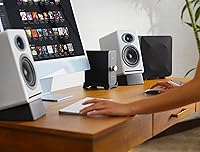
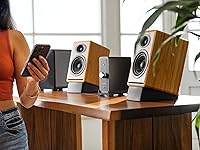
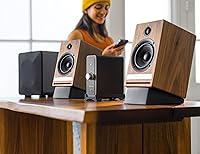
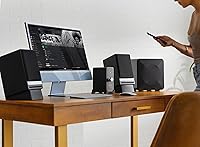
Overview

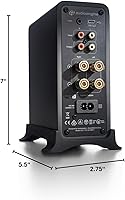
The Audioengine N22 Desktop Stereo Amplifier is the kind of compact amp that serious desktop listeners have been waiting for — one that does not ask you to choose between performance and a tidy workspace. Unlike the sea of plastic boxes in this category, the N22 ships in a real wood cabinet that actually looks good sitting next to a pair of bookshelf speakers. At this price tier, you are squarely in mid-to-premium territory, which means the competition includes both budget Class D upstarts and entry-level audiophile separates. The sound character leans neutral with solid detail retrieval — Class D done well, not warm and forgiving. Just keep in mind: this is a two-channel stereo amp, nothing more.

Features & Benefits

The N22's three input options — Bluetooth aptX, USB-C with an onboard DAC, and a 3.5mm analog jack — mean you can connect practically any source without hunting for adapters. The USB-C input doubles as a DAC feeding 16-bit CD-quality audio, which covers the vast majority of real-world listening situations. Power-wise, this desktop amp drives moderately sensitive bookshelf speakers with real confidence; pair it with speakers rated around 87 dB sensitivity or higher and there is ample headroom. The headphone amplifier, built around an OPA1602 op-amp, handles everything from budget earbuds to demanding high-impedance cans without issue. There is also a subwoofer output, and the internal power supply keeps your desk clean — no wall wart, no cable mess.

Best For

Audioengine's compact amplifier hits its sweet spot as a desktop hub for listeners who want one box handling speakers, headphones, and multiple source devices without compromise. It is a natural fit for remote workers or students making a genuine jump from built-in laptop audio to a proper stereo setup. Streaming enthusiasts will find the Bluetooth aptX connection reliable — a baseline expectation at this price, but implemented well here. Gamers who prioritize audio fidelity over surround sound gimmicks will also find it compelling, particularly those who switch frequently between headphones and speakers. If you are already in the Audioengine ecosystem or planning to add a powered subwoofer, the N22 slots in as a clean and logical centerpiece.

User Feedback

With a 4.2-star average across more than 200 ratings, the N22 earns generally warm marks — though not without reservations. Buyers consistently praise the sound clarity and build quality, noting the wood cabinet feels genuinely premium for the category. Setup earns favorable mentions too; most people are up and running within minutes. On the other side, some users in Wi-Fi-dense environments report inconsistent Bluetooth range, and a handful note the amp may struggle to fully control speakers with below-average sensitivity ratings. A few buyers also question whether the onboard DAC truly competes with a dedicated external unit at this price tier, and some price-conscious shoppers flag that budget alternatives from brands like Fosi Audio or SMSL deliver similar wattage for considerably less.

Pros

  • Real wood cabinet stands out immediately in a category flooded with generic plastic enclosures.
  • Three distinct inputs — Bluetooth aptX, USB-C, and analog — cover virtually every source without adapters.
  • The onboard headphone amp handles everything from sensitive in-ears to high-impedance studio headphones without a hitch.
  • Internal power supply eliminates the wall wart, keeping the desk noticeably cleaner.
  • Subwoofer output allows easy system expansion without adding a separate preamp down the line.
  • Setup is genuinely quick — most users are listening within minutes of unboxing.
  • The N22 runs cool and quiet; no audible hiss or hum at normal listening volumes.
  • Neutral, detailed sound character works well across genres rather than flattering only one type of music.
  • The integrated stand angles the unit slightly, making the front controls easier to reach on a desktop.

Cons

  • Bluetooth reliability can drop in Wi-Fi-dense environments like apartment buildings or open-plan offices.
  • Buyers on a tight budget will find cheaper alternatives that offer similar wattage for significantly less.
  • The onboard DAC, while capable, may disappoint listeners who already own a dedicated external DAC unit.
  • Not powerful enough to properly control low-sensitivity speakers below roughly 86 dB in larger rooms.
  • No remote control included, which becomes annoying if the unit sits at the back of a deep desk.
  • Only a single volume knob with no input-level trim, so mismatched source levels require manual adjustment.
  • Audioengine's ecosystem focus means some outputs and inputs are optimized for their own product pairings.
  • At this price tier, some competing amps offer higher-resolution DAC support beyond 16-bit CD quality.

Ratings

Our AI scoring system analyzed verified global buyer reviews for the Audioengine N22 Desktop Stereo Amplifier, actively filtering out incentivized, bot-generated, and low-quality submissions to surface what real owners actually experience day to day. The scores below reflect both the genuine strengths that keep buyers satisfied and the friction points that surface after weeks of daily use. Nothing is glossed over — the categories where this desktop amp earns its price and the ones where it asks you to compromise are both represented honestly.

Sound Quality
88%
Buyers consistently describe the N22 as clean and neutral — music sounds like music, not like it has been processed or colored. Desktop listeners upgrading from onboard PC audio or cheap powered speakers frequently cite the jump in clarity and instrument separation as immediately noticeable, even on the first listen.
A handful of more experienced audiophiles feel the Class D character can sound slightly lean on certain recordings, particularly acoustic and jazz material where warmth is expected. Those coming from higher-end integrated amplifiers occasionally note that fine dynamic nuance can feel compressed at the very top of the volume range.
Build Quality
91%
The real wood cabinet is the first thing buyers comment on — it feels and looks noticeably more considered than the brushed-aluminum or matte-plastic shells that dominate this price range. At 3.52 pounds, the unit has enough heft to feel solid on a desk without being inconvenient to reposition.
A small number of buyers noted minor fit-and-finish inconsistencies, particularly around the volume knob seating and input jack alignment, suggesting quality control is not perfectly uniform across every unit. The wood finish, while attractive, can show fingerprints and light scratches more readily than a matte metal surface would.
Headphone Amplifier
86%
The OPA1602-based headphone stage genuinely impresses across impedance ranges — buyers using everything from 32-ohm consumer headphones to 300-ohm studio models report clean, distortion-free output with no audible background hiss at idle. For a desktop amp that also drives speakers, having a headphone amp this capable built in is a real convenience.
A few buyers with extremely sensitive in-ear monitors noted a faint noise floor at very low volumes, which is not unusual for a shared speaker-and-headphone amplifier design. Those who already own a dedicated headphone DAC-amp at a similar price point may find the built-in stage redundant rather than additive.
Connectivity & Inputs
84%
Having Bluetooth aptX, USB-C with onboard DAC, and a 3.5mm analog jack in one compact unit covers almost every practical desktop source scenario without requiring adapters or external splitters. Buyers appreciate being able to switch between a laptop via USB-C and a phone over Bluetooth without touching a single cable.
There is no hardware input selector button — switching between inputs can feel fiddly depending on your setup and the order devices are detected. Buyers who use multiple wired sources simultaneously wished for at least one additional analog input to avoid unplugging and replugging cables.
Bluetooth Performance
71%
29%
In typical home environments with moderate wireless traffic, Bluetooth aptX delivers stable, clean audio up to a comfortable listening distance. Buyers in houses or small offices report reliable pairing and reconnection behavior, with aptX providing a noticeably cleaner signal than basic SBC Bluetooth.
Buyers in dense urban apartments or open-plan offices with heavy Wi-Fi congestion report frustrating dropouts and reduced effective range. At this price point, the absence of aptX HD or LDAC support is a legitimate criticism, since higher-resolution wireless codecs are available on competing units in the same category.
Onboard DAC Quality
74%
26%
For streaming, lossless files, and general computer audio, the USB-C DAC performs cleanly enough that most buyers will never feel the need to add an external unit. The 95 dB signal-to-noise ratio translates to a genuinely quiet background, which is appreciated during late-night listening sessions at low volumes.
Buyers who already own dedicated DACs in a similar or higher price range note the onboard DAC is clearly the weaker link in a high-resolution chain. At this tier, some competing amplifiers offer 24-bit DAC support, making the N22's 16-bit ceiling feel like a deliberate limitation rather than an oversight.
Value for Money
67%
33%
When the full package is considered — wood cabinet, onboard DAC, capable headphone amp, subwoofer output, and internal power supply — buyers who want a single polished unit find the pricing justifiable. Long-term owners especially appreciate not having to buy a separate headphone amp or DAC to complete their desk setup.
Budget-conscious buyers frequently compare the N22 against Class D amps from Fosi Audio or SMSL that deliver comparable speaker output power at a fraction of the cost. For buyers who only need to drive bookshelf speakers and have no interest in the headphone amp or onboard DAC, the value case is harder to defend.
Ease of Setup
93%
Setup is one of the most consistently praised aspects across buyer reviews — most users describe being fully operational within ten minutes of unboxing, with all necessary cables included in the box. The input configuration is intuitive enough that buyers with no prior amplifier experience rarely need to consult the manual.
A few buyers noted that the included speaker wire is quite short, which can force awkward desk arrangements if speakers are positioned further apart. First-time amp buyers occasionally expressed mild confusion about the speaker terminal wiring, which is a standard binding-post design but unfamiliar to those upgrading from plug-and-play powered speakers.
Desktop Footprint
89%
At 9 inches wide and 3 inches tall, the N22 sits comfortably between a keyboard and a monitor without dominating the workspace. The integrated stand's slight upward tilt makes the volume knob and front inputs ergonomically accessible without leaning forward.
A 7-inch depth is deeper than some buyers anticipated, which can be problematic on shallow desks or in setups where the unit needs to sit close to a wall. Users with very compact battlestation-style setups occasionally noted that the N22 takes up more real estate than expected for what is marketed as a mini amplifier.
Speaker Driving Ability
76%
24%
For sensitive bookshelf speakers — typically anything rated at 87 dB or above — the N22 delivers confident, dynamic sound with real headroom to spare at desktop listening distances. Buyers who pair it with Audioengine, Klipsch, or similarly efficient speakers describe the combination as punchy and well-controlled.
Buyers who attempted to drive lower-sensitivity or larger floorstanding speakers reported underwhelming results, with the amp running out of composure before reaching satisfying volume levels. Those in medium-to-large rooms also noted the output is less than ideal if the listening position is more than ten to twelve feet from the speakers.
Subwoofer Integration
81%
19%
The dedicated subwoofer output is a genuinely useful feature that buyers planning a 2.1 desk setup appreciate — it removes the need for a separate preamp or crossover and keeps cabling tidy. Users who paired the N22 with a powered subwoofer described the bass extension as transforming the overall listening experience.
There is no onboard crossover control, so buyers need to manage the low-pass filter settings on their subwoofer itself, which can be trial-and-error without prior experience. A few buyers also noted that the subwoofer output level is not independently adjustable from the main volume, requiring subwoofer gain adjustments to be made directly on the sub unit.
Heat & Noise Management
92%
The Class D design runs impressively cool even during extended listening sessions, and there are no fans or vents to generate mechanical noise — an important quality for quiet home office environments. Buyers who work in silence alongside their audio setup specifically praise the amp for contributing zero audible noise to the room.
A very small number of buyers reported a faint electrical hum from the unit itself — not through speakers or headphones, but from the chassis — which was distracting in dead-quiet listening rooms. This appears to be an isolated quality control issue rather than a systemic design flaw, but it is worth monitoring on initial setup.
Long-Term Reliability
83%
Buyers who have owned the N22 for a year or more report no significant degradation in performance, and Audioengine's reputation for long-term product support adds a degree of confidence to the purchase. The internal power supply, while adding to unit size, removes a common failure point associated with external wall adapters on competing products.
The product is relatively new — released in mid-2023 — so the long-term reliability data pool is smaller than for more established amplifiers in this class. A limited warranty without a clearly published duration leaves some buyers uncertain about what level of post-purchase support they can realistically expect.

Suitable for:

The Audioengine N22 Desktop Stereo Amplifier is built for the listener who has outgrown computer speakers and wants a proper stereo setup without dedicating a shelf — or a whole room — to audio gear. It fits naturally on a work-from-home desk alongside a pair of reasonably sensitive bookshelf speakers, serving as the single connection point for a laptop, a phone over Bluetooth, and a good pair of headphones. Students setting up their first real audio system will find the all-in-one input selection genuinely convenient, removing the need for a separate DAC, headphone amp, or preamp. Streamers and casual vinyl listeners who care about sound quality but not rack-mount complexity will also feel at home here. It is especially compelling for anyone already invested in the Audioengine product family, since the subwoofer output makes expanding the system later a straightforward decision rather than a rewiring project.

Not suitable for:

The Audioengine N22 Desktop Stereo Amplifier is not the right call for buyers chasing maximum output per dollar — budget-oriented Class D amps from SMSL or Fosi Audio can deliver comparable wattage at a fraction of the price, and if raw power is your only metric, the value math does not work in the N22's favor. Listeners planning to drive large floorstanding speakers or low-sensitivity passive speakers in a medium-to-large room should look elsewhere, as the N22's output is calibrated for compact speakers in modest spaces. Anyone who already owns a quality standalone DAC may find the onboard USB DAC redundant rather than additive. This desktop amp is also a poor fit for home theater setups that require multichannel decoding, Dolby processing, or HDMI connectivity. And if you live in a densely packed apartment building with heavy wireless interference, the Bluetooth connection may prove less reliable than you need for daily use.

Specifications

  • Power Output: Delivers 50 watts per channel into 6 ohms, providing ample headroom for most bookshelf speakers in desktop and small-room environments.
  • Amplifier Class: Uses a Class D topology based on the TDA7492 chip, offering efficient power delivery with low heat generation.
  • Headphone Amp: Integrates an OPA1602-based headphone amplifier that supports headphone impedances ranging from 10 to 600 ohms.
  • Inputs: Accepts audio via Bluetooth aptX, USB-C with onboard DAC, and a 3.5mm analog stereo jack.
  • Outputs: Provides binding-post speaker terminals, RCA stereo preouts, and a dedicated subwoofer output for system expansion.
  • DAC Resolution: The onboard USB DAC operates at 16-bit depth, delivering CD-quality audio from connected computers and tablets.
  • Signal-to-Noise: Rated at 95 dB signal-to-noise ratio, ensuring a clean, quiet background at normal and elevated listening volumes.
  • Bluetooth Range: Bluetooth connectivity is rated up to 100 feet in open conditions, though real-world range will vary in dense RF environments.
  • Bluetooth Codec: Supports aptX for CD-quality wireless streaming, a standard codec at this price tier that works with most modern Android and PC sources.
  • Cabinet Material: The enclosure is constructed from real wood, distinguishing it from the plastic-bodied amplifiers common in this category.
  • Dimensions: Measures 7″ deep by 9″ wide by 3″ tall, designed specifically for tabletop use without occupying excessive desk space.
  • Weight: Weighs 3.52 pounds, light enough to reposition easily but substantial enough to stay stable on a desk surface.
  • Power Supply: Features an internal power supply that accepts 110V AC, eliminating the need for an external power brick or wall adapter.
  • Mounting Type: Ships with an integrated stand that angles the unit slightly upward for easier front-panel access on a desktop surface.
  • Included Cables: Box includes an AC power cord, a 3.5mm mini-jack cable, RCA audio cables, a USB-C cable, and speaker wire.
  • Warranty: Covered by a limited manufacturer warranty; buyers should confirm specific duration and terms directly with Audioengine.
  • Availability Date: First made available in August 2023, placing it among Audioengine's more recent desktop amplifier offerings.
  • Compatible Devices: Designed for use with desktop computers, laptops, smartphones, and tablets across a wide range of operating systems.

Related Reviews
LOXJIE A30
LOXJIE A30
79%
86%
Sound Quality
82%
Build Quality
91%
Value for Money
89%
Input Versatility
63%
Bluetooth Performance
More
AK55 Stereo Amplifier
79%
88%
Value for Money
74%
Sound Quality
86%
Karaoke & Mic Performance
83%
Bluetooth Connectivity
91%
Input Variety
More
AK35 Stereo Mini Amplifier
71%
83%
Value for Money
67%
Sound Quality
71%
Bluetooth Performance
54%
Build Quality
89%
Setup & Ease of Use
More
Marantz PM6007 Integrated Stereo Amplifier
79%
93%
Sound Quality
91%
Build Quality
74%
Phono Stage
78%
Value for Money
57%
Connectivity & Inputs
More
Sunbuck AS-25BU Stereo Amplifier
73%
88%
Value for Money
74%
Sound Quality
91%
Connectivity & Input Range
63%
Bluetooth Performance
51%
Power Output Accuracy
More
Moukey MK0153 Karaoke Amplifier
73%
88%
Value for Money
91%
Ease of Setup
72%
Microphone Performance
78%
Bluetooth Connectivity
58%
Audio Output Power
More
Audioengine A1-MR Desktop Speakers
76%
88%
Sound Clarity
61%
Bass Performance
91%
Build Quality
63%
Wi-Fi Connectivity
58%
App Experience
More
Marantz PM7000N
Marantz PM7000N
79%
93%
Sound Quality
88%
Build Quality
74%
Streaming & Connectivity
61%
HEOS App Experience
86%
Phono Stage Performance
More
Pyle PDA69BU Stereo Amplifier Receiver
75%
83%
Bluetooth Connectivity
74%
Sound Quality
79%
Build Quality
86%
Value for Money
88%
Input Versatility
More
Audioengine A2+
Audioengine A2+
79%
91%
Sound Quality
93%
Build Quality
84%
Bluetooth Performance
76%
Value for Money
88%
Connectivity & Inputs
More

FAQ

The N22 works with any passive bookshelf speakers, not just Audioengine's own lineup. That said, you will get the best results pairing it with speakers rated at 87 dB sensitivity or higher — lower-sensitivity speakers may not reach satisfying volume levels in larger rooms.

For most listeners, yes. The USB-C input feeds a built-in DAC that handles 16-bit CD-quality audio, which covers streaming, lossless files, and everything most people actually listen to day-to-day. If you already own a dedicated external DAC that you consider a core part of your setup, you can still use it via the 3.5mm analog input.

Yes, the headphone amplifier section is rated to drive headphones up to 600 ohms, so demanding cans like Beyerdynamic 250-ohm or 300-ohm models are well within its capability. Sensitive in-ear monitors at the low-impedance end are also fine — the OPA1602 op-amp handles the full range cleanly.

In a typical home environment, Bluetooth performance is solid. However, a meaningful number of users in dense Wi-Fi environments — think apartment buildings with dozens of competing networks — have reported occasional dropouts. If your desk is near your router or you have significant interference, consider using the USB-C or analog input as your primary connection instead.

Yes, the N22 includes a dedicated subwoofer output, so you can connect a powered subwoofer directly without needing an additional preamp or crossover unit. Audioengine's own S6 and S8 subs are natural pairings, but any powered sub with an RCA input will work fine.

There is no remote control in the box, and Audioengine does not currently offer one as an accessory for the N22. If your desk is deep or the unit sits toward the back, this can become genuinely inconvenient for daily use — it is worth factoring into your placement decision.

Budget Class D amps from those brands can absolutely produce comparable wattage for considerably less money. Where the N22 differentiates itself is in the integrated headphone amplifier, the onboard USB DAC, the wood cabinet build quality, and the overall polish of the input/output layout. If you only need raw speaker power and nothing else, the value case for the N22 is harder to make — but if you want a single refined unit that handles speakers, headphones, and multiple sources cleanly, the premium starts to justify itself.

Not noticeably. Class D amplifiers are inherently efficient, and the N22 stays comfortably cool even after hours of continuous use at moderate listening levels. You will not need to worry about ventilation clearance the way you would with a Class A or Class A/B design.

Only if your turntable has a built-in phono preamp. The N22 does not include a phono stage, so a standard moving-magnet cartridge plugged straight in will produce very low output and no RIAA equalization. Most modern turntables aimed at beginners and mid-range users include a built-in preamp with a line-level output, which will connect to the 3.5mm or RCA inputs without issue.

Audioengine describes and markets it as a real wood cabinet, consistent with their approach on other products in their lineup where the wood finish is a genuine material choice rather than a printed plastic wrap. It contributes to the unit's slightly warmer, less industrial look compared to the brushed-aluminum or matte-plastic aesthetic of competing amps in this price range.

Where to Buy